600+ Types of Flowers A To Z (With Names and Pictures)
Types Of Flowers By Names (A-Z) Types Of Flowers By Color Types Of Flowers By Season Types Of Flowers By Blooming Time 600+ Types of Flowers No. Flower Name No.…

The Wisteria sinensis, also goes by other names such as Snow Wisteria and Silver Vine. It belongs to the Fabaceae family and is a deciduous vine. This variant of Wisteria blooms pure and flawless white flowers that emanate a strong fragrance.
Its main vine is more slender compared to other varieties but it tends to grow more of them. It’s often used to adorn the edges of lawns, beside rocks, by the pond or at the edge of woods, enhancing the landscape of gardens.
It can also be potted or used to create bonsai, making it a splendid addition to gardens or indoor living spaces.
The White Wisteria, a deciduous vine from the Fabaceae family, is a variant of the common Wisteria. Its scientific name is Wisteria sinensis (Sims) Sweet f. alba (Lindl.) Rehd.et Wils. This plant loves sunlight but can also tolerate a bit of shade.
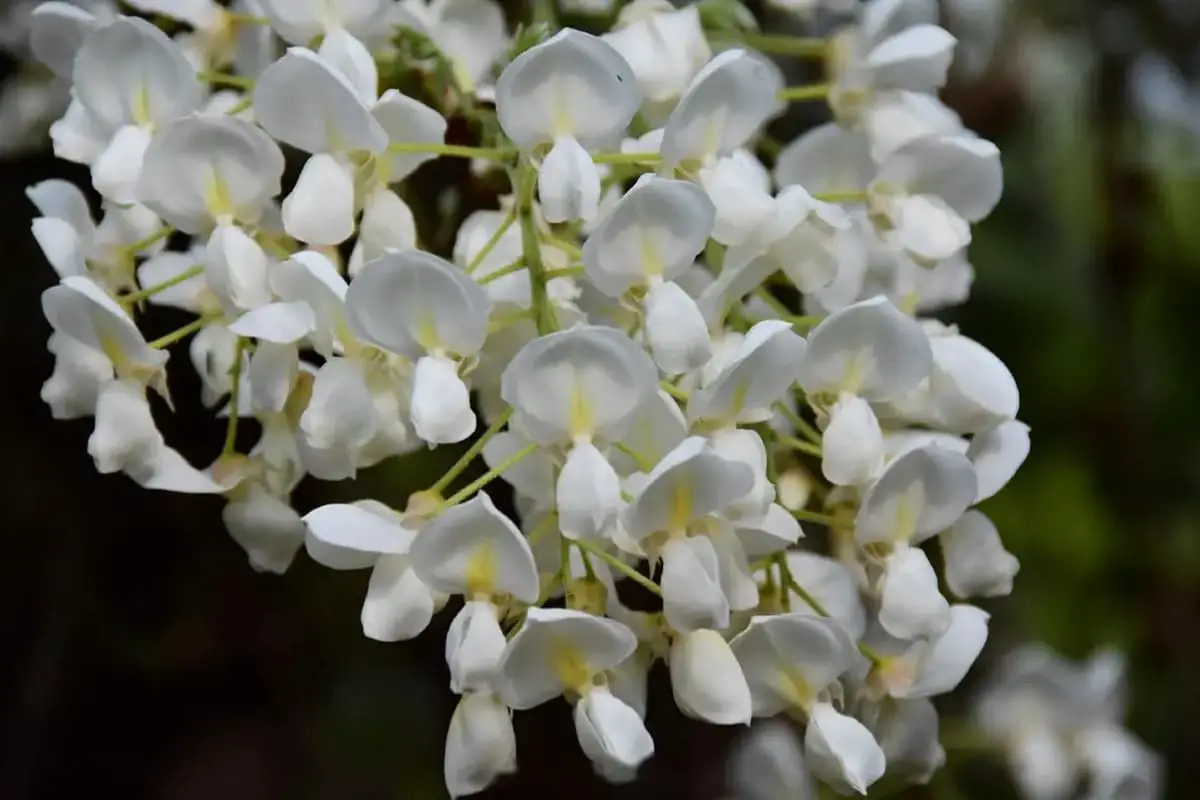
It is highly adaptable to external conditions such as climate and soil, boasting strong vitality. It’s cold-resistant, drought-resistant, waterlogged soil-tolerant, and has a certain resistance to pollution.
It’s often used to adorn the edges of lawns, beside rocks, by the pond, or at the edge of woods, enhancing the landscape of gardens.
It can also be potted or used to create bonsai, making it a splendid addition to gardens or indoor spaces. Wisteria has a strong ability to adapt to changes in climate and variations in soil conditions.
The Wisteria enjoys sunlight and can tolerate a bit of shade. It adapts well to external conditions such as climate and soil, showcasing strong vitality. It’s cold, drought, and humidity-resistant, and possesses a certain degree of pollution resistance. Wisteria adapts well to changes in climate and varying soil conditions.
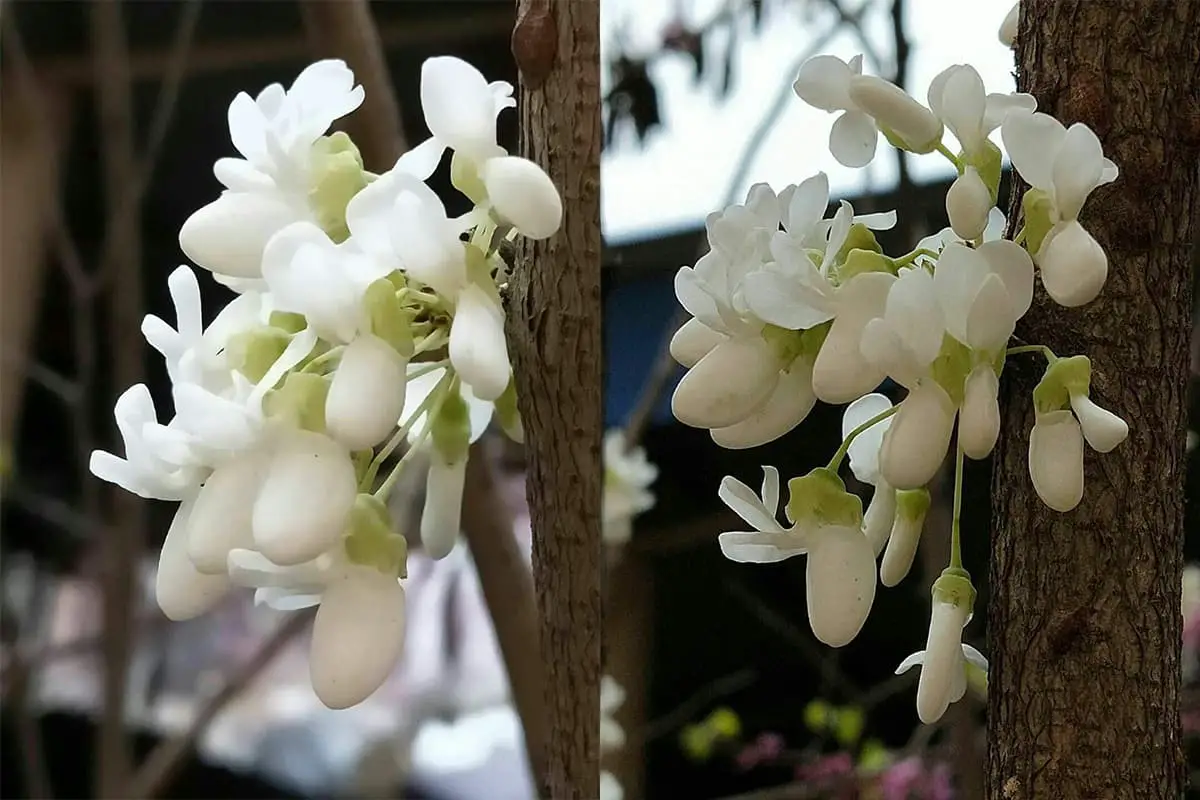
This deciduous vine has a left-handed stem and robust branches. The young branches are covered with white down, which later falls off. The winter buds are oval. The odd-pinnate compound leaves are 15-25 cm long, with linear stipules that fall off early.
The leaflets come in 3-6 pairs, are papery, ovate-elliptic to ovate-lanceolate. The upper leaflets are larger, with the base pair being the smallest, measuring 5-8 cm long and 2-4 cm wide.
The apex gradually tapers to a tail-tip, the base is bluntly rounded or wedge-shaped, or skewed. Young leaves on both sides are covered with flat hair, which later falls off. The petiole measures 3-4 mm and is covered with down.
The stipules are prickly, 4-5 mm long, and persistent. The raceme develops from the axillary or terminal buds of the previous year’s short branches, measures 15-30 cm long, and 8-10 cm in diameter, with the rachis covered with white down.
The bracts are lanceolate and fall off early. The flowers are 2-2.5 cm long and fragrant. The filaments are thin and 2-3 cm long. The calyx is cup-shaped, 5-6 mm long, 7-8 mm wide, densely covered with fine silk hair.
The corolla is purple and finely silky, with round standard petals that are slightly concave at the tip, and reflexed after flowering, with two calluses at the base. The wing petals are oblong, with a rounded base.
The keel petals are shorter than the wing petals and are broad sickle-shaped. The ovary is linear and densely covered with down. The style is hairless, curved upwards, with 6-8 ovules.
The pod is an inverted lanceolate, 10-15 cm long, 1.5-2 cm wide, densely covered with down, and does not fall off when suspended on a branch, containing 1-3 seeds.
The seeds are glossy brown, round, 1.5 cm wide, and flat. The flowering period is from mid-April to early May, and the fruiting period is from May to August.
This species has been cultivated as a garden trellis plant in our country since ancient times. It blooms before the leaves sprout, with purple panicles hanging down and sparse young leaves, making it very beautiful. Wild species have slight variations, and there is often one variant.
This variant has white flowers, which is different from the original variant.
Due to its long main root and fewer fibrous roots, the wisteria requires careful transplanting to avoid damaging the root system. The survival rate is higher when transplanted in spring and fall, and it can be transplanted without a soil ball.
Early spring planting is preferable, with organic fertilizer used in the planting hole. After planting, water thoroughly. Prior to planting, provide a trellis for the wisteria and tie the thicker branches to the trellis so they can climb.
Given the long growth period and lush foliage of the wisteria, a sturdy trellis should be built according to design requirements before planting or before the plant begins to climb.
Wisteria is generally pruned during its dormant period. The distribution of branches can be adjusted through thinning and manual training. To promote growth and development, prune the wisteria according to its growth habits.
Cut back the new growth of the current year by one-third to one-half, and remove weak, dead branches at the base. After flowering, prune vigorously, remove excessive buds to appropriately reduce the height, ensuring a good bush shape and enough robust branches for the current year’s growth.
Before the wisteria buds, apply a mix of nitrogen, phosphorus, and potassium fertilizer every half a month, and apply phosphorus and potassium fertilizer once more before flowering. Avoid using too much nitrogen fertilizer, as it will cause the plant to grow without flowering.
After flowering, prune timely, remove the flower stalks, and apply a nitrogen-based mixed fertilizer. In the fall, apply base fertilizer around the stem of the wisteria, preferably organic fertilizer, and water after application.
Seeding, cutting, and grafting can be used for propagation, but seeding is usually the primary method. Collect seeds after fall, dry and store them, and when the spring temperature stabilizes at 10-13°C, soak the seeds in 60°C warm water for 1-2 days.
Once the seeds expand, sow them in the soil. Seedlings emerge in about a month, with a germination rate of about 90%. As the plant does not tolerate transplanting, the spacing between the plants should be slightly larger when sowing, and transplanted directly to the planting site after 2-3 years.
For cutting propagation, collect branches in the fall, bundle and bury them until the next year, then cut and leave 2-3 sections for cutting. Root cutting can also be used.
To increase the survival rate, the base of the cutting can be soaked in 40-100mg/kg naphthalene acetic acid or rooting powder before planting.
Two-thirds of the cutting should be buried in the soil, watered thoroughly after planting, kept moist at all times, and appropriately shaded to prevent sunburn and promote survival.
For high-quality varieties, grafting can be used for propagation, using high-quality varieties as scions and grafting them onto common rootstocks. This is usually done before budding in the spring, and both branch grafting and root grafting can be used.
The main pests of wisteria are the wisteria leafminer, bean moth, yellow toxic moth, scale insects, and whitefly cattle, among which the wisteria leafminer is the primary threat. The main diseases are soft rot, gray spot disease, and vein flower leaf disease.
The larvae of the wisteria leafminer damage the leaves and overwinter in cocoons on the leaves. After the leaves fall in autumn, they should be cleaned up and burned.
Spray a 1000 times dilution of 40% Levo pesticide emulsion or a 3000 times dilution of 2.5% Bromocypermethrin emulsion in May and July when the adults emerge, and in late May and mid-late September when the larvae appear.
At least three to four applications of pesticide are needed during the adult wing stage and the initial stage of larvae to prevent the spread of pests.
Scale insects, which parasitize the edges or surfaces of wisteria leaves and cause wilting and even death of the plant by sucking sap, can be killed with a 1000 times dilution of 40% Levo pesticide emulsion, a 2000 times dilution of 50% Malathion emulsion, or a 1000 times dilution of 25% Imidacloprid wettable powder.
Whitefly, which parasitize the branches or leaves, can be killed with a 3000 times dilution of 2.5% Speed Kill emulsion or a 3000 times dilution of 2% Aphid Kill wettable powder.
When soft rot occurs in wisteria, it can kill the entire plant. Heavily infected plants should be discarded and buried to prevent them from becoming a source of infection.
Control can be achieved using a 1000 times dilution of 50% Carbendazim soluble wetting agent or a 800 times dilution of 50% Methyl Tobuzin soluble wetting agent. Gray spot disease mainly affects the leaves of wisteria.
Initial symptoms are light brown spots that gradually expand into brown circular or near-circular lesions, which later turn gray-brown. The fungus overwinters as mycelium or conidia on infected plants or in soil debris, with conidia spread by wind and rain.
Early in the infection, spray a 800 times dilution of 50% Metham-Sodium suspension or a 500 times dilution of 40% Carbendazim sulfur suspension every 10 days for 2-3 treatments.
Vein flower leaf disease in wisteria is caused by the Potato Virus Y group Vein Mottle Virus (WVMV). The initial infection source is diseased wisteria, and aphids act as non-persistent vectors.
Control aphids with a 1500 times dilution of 50% Aphid Pine emulsion or a 1000 times dilution of 80% Dimethoate emulsion.
Wisteria is an excellent material for decorating flower corridors, pergolas, fences, and rockeries. It can also be grown in pots for ornamental purposes.

Peggie was once a high school mathematics teacher, but she set aside her chalkboard and textbooks to follow her lifelong passion for flowers. After years of dedication and learning, she not only established a thriving flower shop but also founded this blog, “Flowers Library”. If you have any questions or wish to learn more about flowers, feel free to contact Peggie.
 English
  العربية
  Bahasa Indonesia
  Deutsch
  Français
  Italiano
  Nederlands
  Português
  Русский
  日本語
日本語