600+ Types of Flowers A To Z (With Names and Pictures)
Types Of Flowers By Names (A-Z) Types Of Flowers By Color Types Of Flowers By Season Types Of Flowers By Blooming Time 600+ Types of Flowers No. Flower Name No.…

Wisteria brevidentata, a member of the Fabaceae family, is a cultivated plant found throughout the country, commonly used as a pergola plant. It is suitable for planting by the lakeside, pondside, rockery, and stone archways, also it can be used for bonsai.
This variety is a deciduous vine, with twigs covered in prostrate long soft hair. Its two-year-old branches are grayish-yellow, bare, and old branches are gray; pinnate compound leaves unfold during the flowering period, measuring 13-17 centimeters in length.
Leaf stalks take up 3-4 centimeters, covered in prostrate soft hair; racemes are 10-18 centimeters long, flowers open in order from bottom to top, measuring 1.5 centimeters in length; flower stalks are short, 6-12 millimeters long, densely covered with short soft hair.
The corolla is purple, banner petals are nearly round, deeply indented at the tip, and slightly heart-shaped at the base.
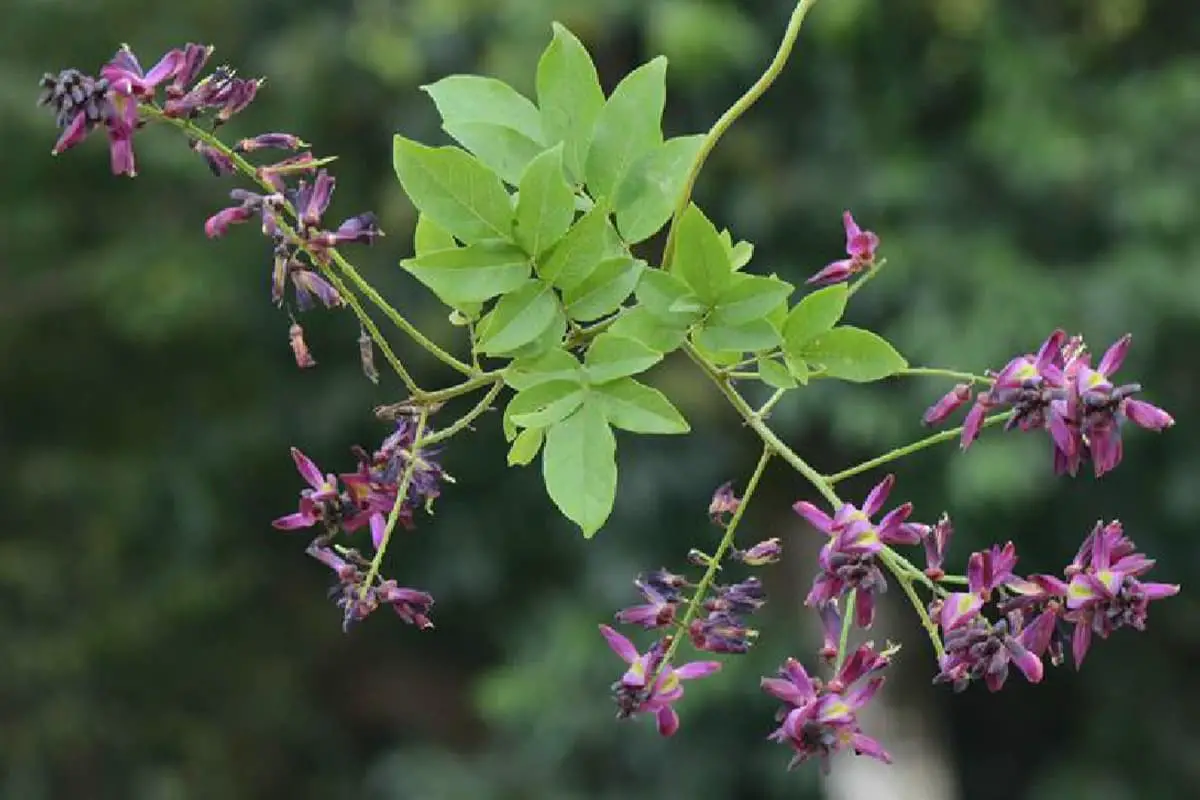
Wisteria brevidentata, a plant from the Fabaceae family, is a deciduous vine. Twigs are covered with prostrate long soft hair, two-year-old branches are grayish-yellow and bare, while old branches are gray; winter buds are approximately 6 millimeters long, externally covered with silky hair.
Pinnate compound leaves unfold during the flowering period, measuring 13-17 centimeters in length; leaf stalks take up 3-4 centimeters, covered in prostrate soft hair.
Racemes are 10-18 centimeters long, flowers open in order from bottom to top, measuring 1.5 centimeters in length. Fruits have not been observed.
It is not demanding in terms of soil, growing best in moist, fertile and well-drained soil.
It is cultivated for ornamental purposes throughout China, often used as a pergola plant. It is suitable for planting by the lakeside, pondside, rockery, and stone archways, also it can be used for bonsai.
It is not demanding in terms of soil, growing best in moist, fertile and well-drained soil.
Deciduous vine. Twigs are covered with prostrate long soft hair, two-year-old branches are grayish-yellow and bare, while old branches are gray; winter buds are approximately 6 millimeters long, externally covered with silky hair.
Pinnate compound leaves unfold during the flowering period, measuring 13-17 centimeters in length; leaf stalks take up 3-4 centimeters, covered in prostrate soft hair; Stipules fall early; small leaves 4-5 (-6) pairs, elliptic or ovate-oblong, 2.5-5 centimeters long, 1-1.8 centimeters wide, obtuse-rounded at the tip, with a fine point, the base is broadly wedge-shaped or obtuse-rounded, the top is sparsely covered with stiff hair, the underside is sparsely covered with stiff hair along the midrib; petiole is 2-3 millimeters long, densely covered with long stiff hair.
Racemes are 10-18 centimeters long, flowers open in order from bottom to top, measuring 1.5 centimeters in length; flower stalks are short, 6-12 millimeters long, densely covered with short soft hair; calyx is cup-shaped, 3-4 millimeters long, almost bilabiate, hairy, the upper 2 calyx teeth are almost fully fused, blunt-headed, the lower 3 teeth are triangular, almost equal in length, or the lowermost tooth is slightly longer, calyx teeth are 1.5-2 millimeters long, about one-third the length of the calyx tube; the corolla is purple, banner petals are nearly round, deeply indented at the tip, slightly heart-shaped at the base, the outside near the base is covered with long soft hair, with a petal stalk, wing petals and keel petals are broadly oblong, almost the same length as the banner petals, keel petals are deeply indented at the tip; the ovary is linear, velvety, the pistil is hairless, upwardly curved. Fruits have not been observed.
Short-stemmed wisteria is a plant with strong upright roots and few lateral roots. It isn’t picky about soil, but it prefers moist, fertile, and well-drained soil. During transplanting, as much lateral root as possible should be dug up, with a soil ball attached.
Transplanting is often done in early spring. Prior to transplanting, a frame should be built, and thick branches should be tied separately to the frame, allowing them to climb along it.
Since short-stemmed wisteria has a long lifespan, with thick branches and lush leaves, the frame material must be sturdy and durable. When using thin wooden posts or steel pipe frames, they should be painted to prevent corrosion. Alternatively, cement frames or stone pillars can be used as support.
The main root of short-stemmed wisteria is deep, so it has a strong drought resistance, but it’s prone to root rot if overly saturated. When cultivated in a yard, watering is only needed during dry seasons.
When a sapling is initially planted, the branches cannot form flower buds within the first year, and will only start to bud and flower thereafter.
If after several years it still does not flower, the reasons could be overly vigorous growth with too many branches and leaves, or weakened vitality, making it difficult to accumulate nutrients.
When the growth is too vigorous, partial root cutting and pruning of branches and leaves can be done. If the vitality is weak, additional fertilizer should be applied to supplement nutrients and promote flowering.
During cultivation, organic fertilizer is generally used as base fertilizer in planting pits, along with calcium superphosphate, wood ash, etc. Phosphorus and potassium fertilizers are usually applied 2-3 times during the growth period to promote flowering.
Short-stemmed wisteria is a vine plant, usually clinging to a pergola or other support and climbing up. Various styles of short-stemmed wisteria can be cultivated by employing cultivation measures such as binding pole support, vine twisting, and pruning shaping.
Pruning of short-stemmed wisteria is especially important. Pruning should be done during the dormant period, and uniform distribution of branches can be achieved through thinning and manual traction.
After flowering, the middle branches can be pruned short, leaving 5-6 buds, and weak branches should be cut off. Early cutting of thin, weak branches can promote the formation of flower buds in the following year.
Cuttings: This includes stem and root cuttings. Stem cuttings generally utilize hard stem cuttings. This is done in the fall or in March to April of the second year, before the branches sprout buds.
When operating, choose stout and tender branches that are 1-2 years old, cut them into 10-15 cm long cuttings, and insert them either directly or at an angle into a pre-prepared nursery bed. The depth of the cutting should be 2/3 of the length of the cutting.
After inserting, spray water to keep the nursery bed moist and reinforce maintenance. The survival rate is very high, and the plant height can reach 20-50 cm within the year. They can be removed from the nursery two years later.
Root cuttings use the indeterminate buds on the roots of short-stemmed wisteria. Generally, in mid to late March, dig up roots that are 0.5-2 cm thick, cut them into 10-12 cm long cuttings, and insert them into the nursery bed.
The cutting depth should keep the upper cut of the cutting level with the ground. After inserting, it is important to keep the nursery bed moist.
Seeding: Short-stemmed wisteria can naturally bear fruit when it blooms, but artificial pollination can promote pod formation. Seeds can be harvested and sown immediately when they mature in the fall, or they can often be dried and stored until spring sowing.
Before sowing, soak the seeds in 50-60℃ hot water for 1-2 days. When the water temperature drops to about 30℃, remove the seeds and rinse them briefly in cold water, then keep them moist and pile them up for 1 night before sowing.
The seeds can germinate at 10-13℃. However, seedlings produced by seed propagation need 3-5 years to bloom and are rarely used now.
Layering: This can be done after the leaves have fallen. During the operation, select two-year-old vigorous branches, peel off some of the skin at the layering site, wrap it with sphagnum moss or press it into the soil, and frequently water it to keep it moist, promoting rooting. After it has rooted, it can be separated from the parent plant and planted.
Division: This can be done after the leaves have fallen and before budding. During operation, cut off the young plants that have sprouted at the root and transplant them.
Grafting: This is generally used for the propagation of excellent varieties and can graft excellent varieties onto ordinary rootstocks. Grafting can be done before budding in the spring and can be done at the branch or root.
When grafting at the root, usually one or two-year-old branches are grafted onto the roots of another plant. Root grafting is most suitable for potted plants.
Diseases: The main diseases are soft rot and leaf spot. Soft rot can cause the entire plant to die, while leaf spot damages the leaves of the short-stemmed wisteria. Both diseases can be treated with a 1000-fold solution of 50% carbendazim, or an 800-fold solution of 50% methyloxime.
Pest Control: Common pests include snails, scale insects, and whiteflies. Snails are active in the rainy seasons of spring and summer, during which lime powder should be regularly spread around the plantation or the foot of the cultivation rack.
Poor ventilation in the cultivation environment of the short-stemmed wisteria often leads to scale insects, which parasitize the edges of the leaves or leaf surface, causing the plant to wilt. In severe cases, the entire plant may turn yellow and die.
A 1000-fold solution of 40% phoxim emulsion, or a 2000-fold solution of 50% malathion, or an 800-1000-fold solution of speed kill or imidacloprid can be sprayed to kill them. Whiteflies can be killed using a 3000-fold solution of speed kill aphid or aphid consumer spray.
It is cultivated for ornamental purposes throughout China and is often used as a pergola plant. It is suitable for planting by lakes, ponds, rockeries, stone archways, and can also be used for bonsai.
The flower language of wisteria is “intoxicating love, lingering memories”, “born for love, dying for love”, etc., implying the origin of a poignant love story.

Peggie was once a high school mathematics teacher, but she set aside her chalkboard and textbooks to follow her lifelong passion for flowers. After years of dedication and learning, she not only established a thriving flower shop but also founded this blog, “Flowers Library”. If you have any questions or wish to learn more about flowers, feel free to contact Peggie.
 English
  العربية
  Bahasa Indonesia
  Deutsch
  Français
  Italiano
  Nederlands
  Português
  Русский
  日本語
日本語