600+ Types of Flowers A To Z (With Names and Pictures)
Types Of Flowers By Names (A-Z) Types Of Flowers By Color Types Of Flowers By Season Types Of Flowers By Blooming Time 600+ Types of Flowers No. Flower Name No.…

Orchids are the second largest family of flowering plants and one of the most diverse and widely distributed plant families. The vibrant tropical orchids are commonly referred to as “yang lan” in Chinese. Yang lan doesn’t necessarily refer to introduced species; the Greater China region also possesses abundant wild orchid resources.
In the context of traditional Chinese flowers, “lan hua” specifically refers to several terrestrial orchid species within the Orchidaceae family, such as Chun Lan, Hui Lan, Jian Lan, Mo Lan, and Han Lan, collectively known as “Chinese orchids.”
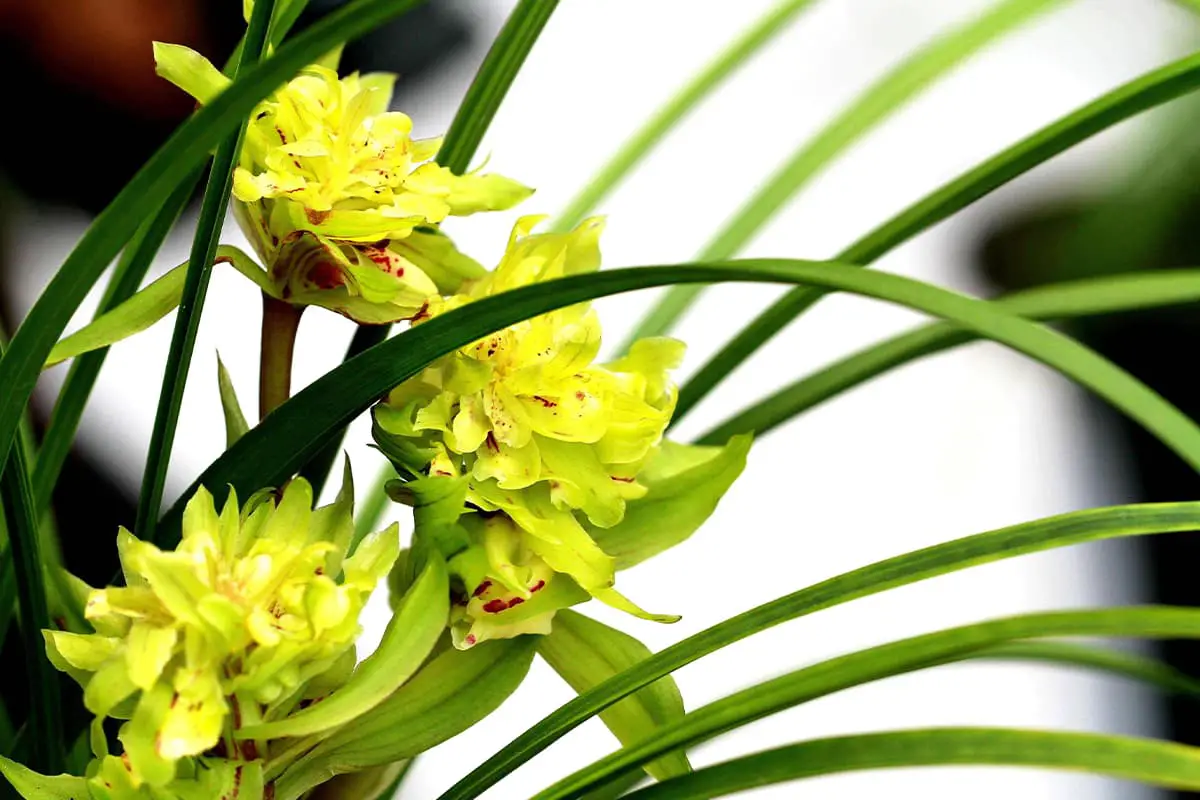
These orchids are distinct from the showy tropical orchids in terms of their size and coloration. They lack striking flamboyance and large flowers and leaves but exude a simple, elegant, and refined charm that aligns well with the aesthetic preferences of Eastern cultures. Orchid cultivation in China has a history of over a thousand years.
Chinese Orchid, Chun Lan, Lan Cao, Lan Hua, You Lan, Shan Lan, Guo Xiang, Kong Gu Xian Zi, Xiang Zu.
Orchids belong to the monocotyledonous plant order, Orchidales, and the Orchidaceae family. They are epiphytic or terrestrial herbs with one to several leaves. The leaves usually emerge from the base or lower nodes of pseudobulbs, arranged in two rows, strap-shaped, or rarely lanceolate to narrowly elliptic, often with broad sheaths and enclosing the pseudobulbs, exhibiting nodes.
The typical structure of an orchid flower consists of a pedicel, receptacle, sepals, petals, a group of pistils, and a group of stamens.
Orchids have a unique floral structure that sets them apart. The inflorescence is usually racemose, with several or numerous flowers, displaying colors such as white, pure white, white-green, yellow-green, light yellow, light yellow-brown, yellow, red, blue, and purple.
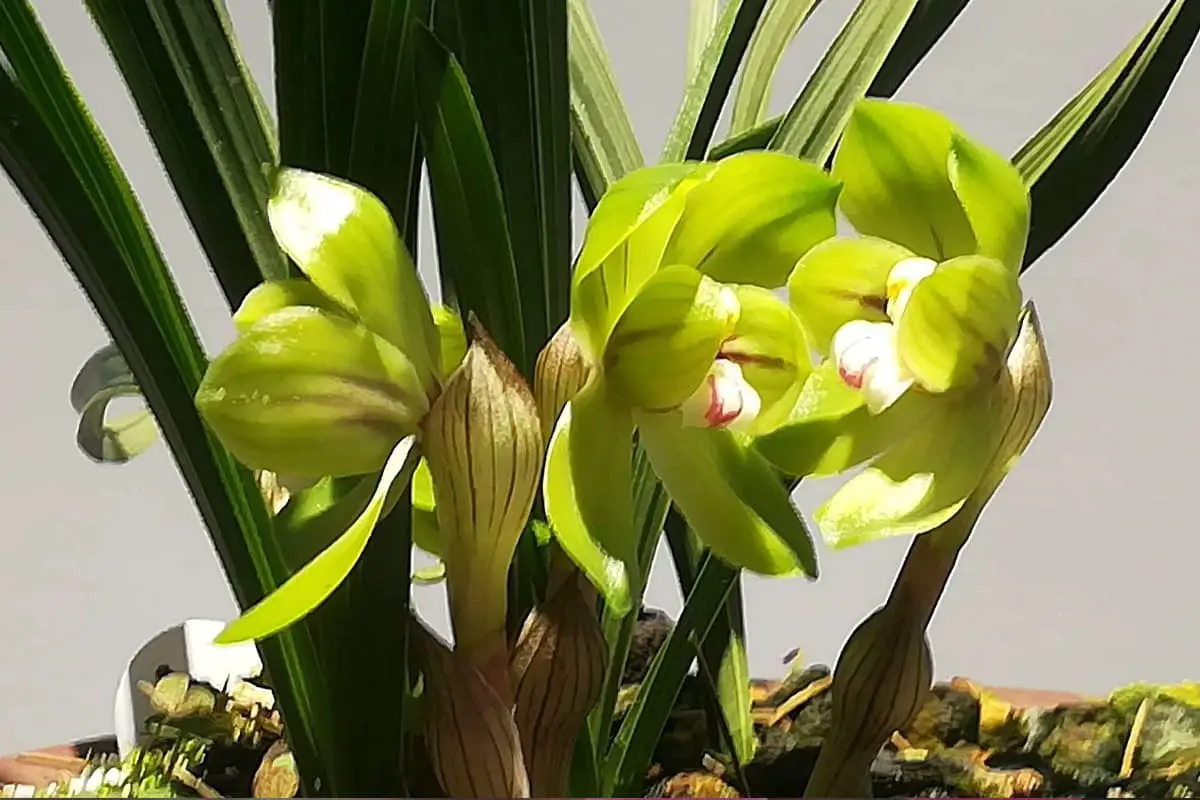
The peculiar structure of orchid flowers is adapted for insect pollination and includes a column, a rostellum, pollinia, and a labellum. Moreover, orchids possess bilateral symmetry, with the base of the labellum forming a nectar-filled spur and reduced numbers of stamens, inferior ovaries, diverse flower shapes, sizes, and colors. They are mostly herbaceous plants, either epiphytic or saprophytic.
Orchids prefer a shaded environment and are sensitive to direct sunlight. It is best to place them in semi-shaded areas with scattered light. They thrive in a moist environment and dislike dryness, so regular ventilation is necessary. Fertile soil enriched with organic matter promotes robust growth in orchids.
Ornamental Value: “Dew drops glisten, distorted by light; the wind carries its shadow askew. Compared to vulgar objects, it is the leaves that surpass the flowers.”
This poem describes the graceful and diverse beauty of orchid leaves. Placing a few pots of orchids in the home decorates the living space, instantly bringing vitality. When the flowers bloom, a fragrant aroma fills the air.
Culinary Use: Orchids have a delicate and fragrant aroma that can be used in tea or incorporated into soup dishes.
In general, orchids symbolize noble and refined individuals, often portraying women as “you lan” (ethereal orchids) in secluded valleys. The flower language of orchids includes attributes such as modesty, elegance, beauty, purity, and virtue. Chinese culture has always regarded orchids as a symbol of purity and elegance, alongside “plum blossoms, bamboo, and chrysanthemums,” collectively known as the “Four Gentlemen.
In China, “lan zhang” (orchid elegance) is often used to describe the beauty of poetry and literature, while “lan jiao” (orchid companionship) represents the genuineness of friendship.
Orchids are also used to express pure love, as seen in phrases like “The aura is like an orchid, enduring and unchanged; the heart is like an orchid, steadfast and unwavering” and “Finding an ethereal orchid to confide in, I offer a branch to the dreams of Xiao Xiang.”
Chinese culture has always regarded orchids as a symbol of purity and elegance, alongside “plum blossoms, bamboo, and chrysanthemums,” collectively known as the “Four Gentlemen.
Orchids are often associated with the beauty of poetry and literature (“lan zhang”) and the sincerity of friendship (“lan jiao”). They are also used to express pure love. In May 1985, orchids were selected as one of the top ten famous flowers in China.

Peggie was once a high school mathematics teacher, but she set aside her chalkboard and textbooks to follow her lifelong passion for flowers. After years of dedication and learning, she not only established a thriving flower shop but also founded this blog, “Flowers Library”. If you have any questions or wish to learn more about flowers, feel free to contact Peggie.
 English
  العربية
  Bahasa Indonesia
  Deutsch
  Français
  Italiano
  Nederlands
  Português
  Русский
  日本語
日本語