600+ Types of Flowers A To Z (With Names and Pictures)
Types Of Flowers By Names (A-Z) Types Of Flowers By Color Types Of Flowers By Season Types Of Flowers By Blooming Time 600+ Types of Flowers No. Flower Name No.…

The Weigela coraeensis, a deciduous shrub from the family Caprifoliaceae and Weigela genus, can grow up to 5 meters tall. Its branches are robust and either glabrous or nearly so.
The leaves are opposite, broad-oval to obovate in shape, featuring finely serrated margins. Flowers are borne in cymes at the axils of lateral branches or the apex; they have linear bracts.
The corolla is campanulate-funnelform, with flowers ranging in color from pale pink to yellowish-white, later deepening to dark red or purple. The fruit is a cylindrical capsule. Blooming occurs from May to June, with fruiting from September to October.

Weigela thrives in full sun, tolerates partial shade, is relatively cold-hardy, and prefers rich, moist, well-drained soil. It naturally grows in damp open spaces at altitudes of 2000 to 3000 meters. Weigela propagates through seeds, cuttings, and division.
In traditional medicine, Weigela is considered to have a bitter taste and cooling properties, offering heat-clearing and detoxifying effects. It’s traditionally used for symptoms such as lung heat with cough, dysentery, bloody stool, trachoma, and conjunctivitis.
With its variety of beautiful colors and attractive form, it is suitable for mass or solitary planting in gardens, parks, scenic areas, or for ornamental viewing along roadsides, against walls, or in corners. It can also be pruned into hedge shapes for additional aesthetic appeal.
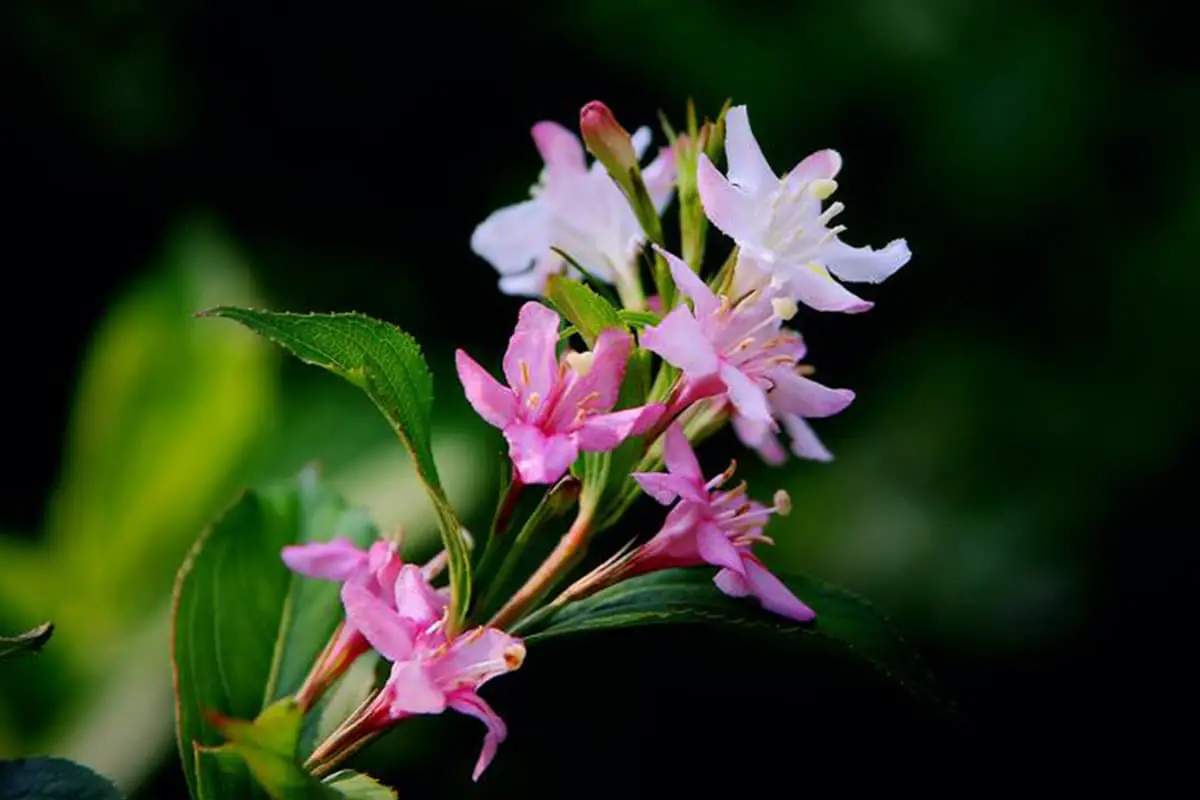
As a deciduous shrub, Weigela coraeensis can reach a height of 5 meters. Its robust branches can be yellow-brown or brown, either glabrous or nearly so.
The leaves are opposite, broad-oval or obovate, measuring 6-12 centimeters in length and 2.5-5 centimeters in width. The leaf apices are acuminate or cuspidate, with a broadly cuneate base and finely serrated margins.
The adaxial leaf surface is green with the midrib sparsely covered in appressed hairs, while the abaxial surface is a paler green with appressed hairs along the midrib and lateral veins, which are prominently raised on both sides.
The petioles are 5-10 millimeters long and have appressed hairs along the margins.
The inflorescence consists of several cymes borne on short branches at the leaf axils or apex. The calyx tube is tubular, up to 1.5 centimeters long, with five sepals and linear bracts about 8 millimeters long, completely separated at the base.
The corolla is campanulate-funnelform, pale pink to yellowish-white in color, later turning dark red or purple, measuring 2.5-4 centimeters in length, with the tube narrowing abruptly at the lower third.
The ovary is glabrous. The fruit is a cylindrical capsule, 1.5-1.7 centimeters long, topped with a short rostrum, glabrous, dehiscing between the two locules; seeds are numerous and small, wingless.
The flowering period is from May to June and the fruiting period from September to October.
Weigela coraeensis naturally grows in moist open spaces at altitudes ranging from 2000 to 3000 meters.
Weigela coraeensis is primarily propagated through cuttings, seeds, and division, with cuttings being the most common method in commercial production.
Cutting Propagation: From May to September, select semi-hardwood cuttings from current year’s growth and cut 15-20 centimeter lengths. After inserting the cuttings, water thoroughly and provide shade.
Space cuttings adequately (about 50 cm by 20 cm) to prevent weak growth. Cuttings can grow 40-50 centimeters within the year and have a higher success rate with mist systems. Hardwood cuttings are used for autumn propagation.
In winter, provide cold protection; using a polyethylene tunnel can achieve over 90% survival rate, with growth up to 50 centimeters within a year.
Seed Propagation: Collect seeds in October, air dry and store them. Before spring sowing, stratify the seeds by soaking in cold water for 2-3 hours, then place them in a cloth bag, rinse 2-3 times daily, and keep moist for 6-7 days before sowing.
Sow at a rate of 5-6 grams per square meter, cover with 1 centimeter of soil, and use a polyethylene tunnel. Gradually expose seedlings to light as they emerge, and provide adequate fertilization and watering.
Protect from frost in winter, transplant in the second year, and expect flowering in three years. For smaller quantities of seeds, containers can be used. Seed propagation is less common in commercial production due to genetic variability.
Division Propagation: In early spring before bud break, or after leaf fall in autumn, dig up clumps from the base of the plant. Remove soil, separate divisions with a sharp knife, and apply wood ash to the cuts. Divided plants generally establish well when replanted.
Transplanting Weigela coraeensis is most successful from post-leaf drop in fall to early spring before bud break.
Bare-root seedlings can be dipped in a mud slurry or transplanted with their original soil, while larger plants should be moved with a root ball.
Water and Fertilizer Management: At planting, apply 2-3 shovelfuls of well-decomposed compost per plant as a base fertilizer. Fertilize once before bud break in early spring and 2-3 times during the growing season to promote growth.
In colder regions, it’s crucial to water in spring to facilitate bud break and to water before winter to prevent frost damage. During dry summers, water as necessary and ensure proper drainage during wet periods.
In traditional medicine, Weigela coraeensis is considered bitter and cooling, with heat-clearing and detoxifying properties.
It has been traditionally used for various ailments, including dysentery, bloody stools, trachoma, conjunctivitis, cystitis, lung heat with cough, and sore throat. However, its medicinal use should be under professional guidance.
With its elegant form and rich array of flower colors, Weigela coraeensis is ideal for mass planting in flowerbeds, lawns, rock gardens, slopes, lakesides, courtyards, parks, and scenic areas.
It can also be planted as a specimen along roadsides, walls, or in corners for ornamental interest, or shaped into decorative hedges.
Weigela coraeensis prefers full sun and tolerates partial shade, with moderate cold hardiness. It adapts to various soil types but thrives in deep, fertile, and moist conditions with good drainage.
The plant grows quickly with strong regenerative ability, though its drought and cold tolerance are not as robust as some other shrubs. Regular pruning after flowering helps maintain its shape and promote vigorous growth.

Peggie was once a high school mathematics teacher, but she set aside her chalkboard and textbooks to follow her lifelong passion for flowers. After years of dedication and learning, she not only established a thriving flower shop but also founded this blog, “Flowers Library”. If you have any questions or wish to learn more about flowers, feel free to contact Peggie.
 English
  العربية
  Bahasa Indonesia
  Deutsch
  Français
  Italiano
  Nederlands
  Português
  Русский
  日本語
日本語