The Weeping Large-Leaved Early Cherry (scientific name: Cerasus subhirtella var. pendula) is a variant under the Rosaceae cherry genus. It is a tree that grows to 3-10 meters in height with gray-brown bark. Its twigs are gray, while its tender branches are green, densely covered with white short soft hairs.
The winter buds are oval, with sparse hairs at the tip of the scales. The leaves are oval to oblong, 3-6 cm long, 1.5-3 cm wide, tapering at the tip, with a broad wedge base, finely serrated and doubly serrated edges, dark green on top, hairless or with sparse soft hairs along the midrib, pale green underneath, with sparse white soft hairs that are especially dense along the veins and sparser between the veins as they fall off later.
The lateral veins are straight and almost parallel, with 10-14 pairs; the petiole is 5-8 mm long, covered with white short soft hairs; the stipules are brown, extremely narrow, linear, shorter than the petiole, with sparse glandular teeth on the edges.
Morphological Features
Also known as Silk Cherry, Weeping Higan Cherry or Weeping Large-Leaved Early Cherry, or Double Cherry. It is a large deciduous tree, 25 meters high, with large branches growing horizontally, and small branches standing upright or drooping.
The leaves are petiolate and alternate, elliptical, with a slender tip, wedge-shaped base, and sharp serrated edges, 4-9 cm long, 2-4 cm wide, with soft hairs on young and mature leaves. From late March to early April, the leaves emerge earlier than the flowers.
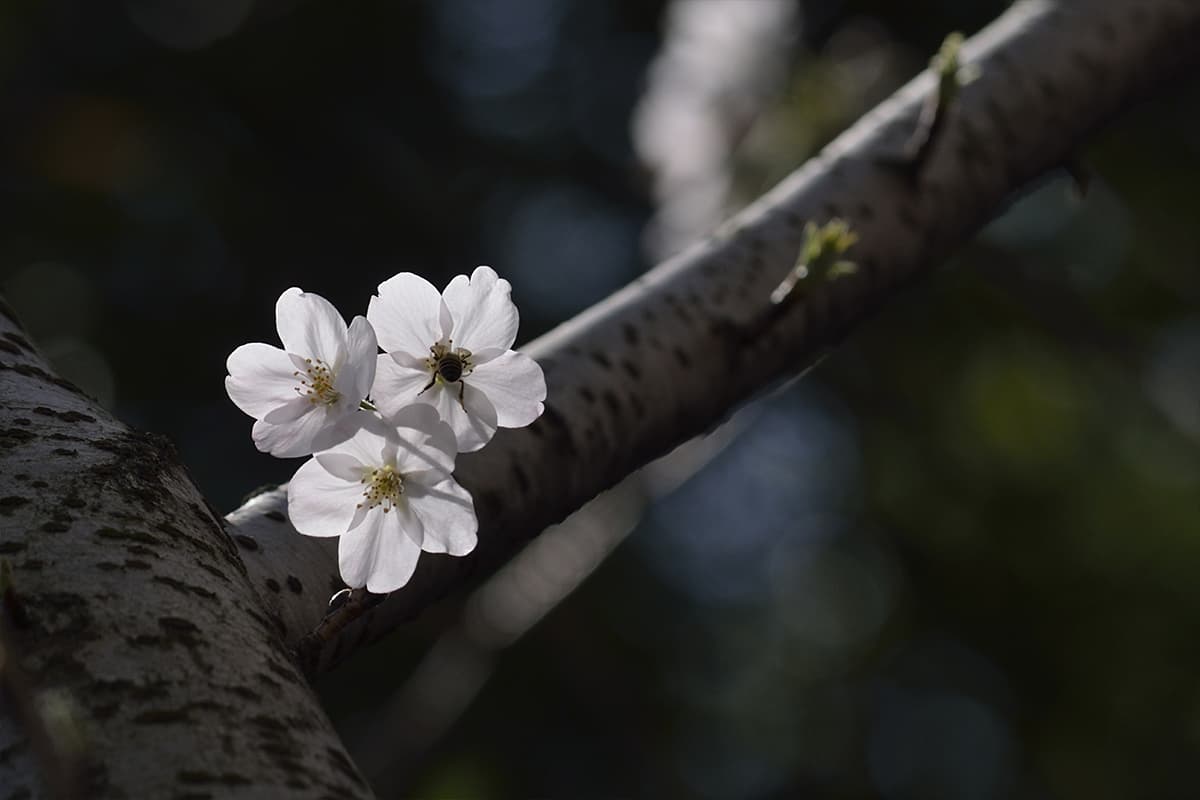
The flowers are pale pinkish-white, composed of several flowers forming an umbel, with long flower stems, and the calyx and pistil are hairy; the calyx is tubular, with five lobes on the upper part, five petals, concave, spreading horizontally, numerous stamens, and one pistil.
The inflorescence is umbel-shaped, with 2-3 flowers, the flowers and leaves bloom together; the total bracts are ovate, about 4 mm long, about 3 mm wide, sparsely covered with soft hairs on the outside, and fall off early; the flower stalk is 1-2 cm long, covered with sparse soft hairs.
The calyx tube is tubular, slightly pot-shaped, 4-5 mm long, 2-3 mm wide, slightly enlarged at the base, slightly contracted at the neck, covered with sparse white soft hairs on the outside, the calyx lobes are oblong-ovate, sharply pointed at the tip, with sparse teeth, nearly the same length as the calyx tube; the petals are light pink, ovate-oblong, concave at the tip; there are about 20 stamens.
The pistil has sparse hairs at the base, the drupes are ovate, black; the surface of the kernel has slight ridges; the fruit stalk is 1.5-2.5 cm long, covered with sparse soft hairs, slightly enlarged at the top. The flowering period is in April, and the fruiting period is in June.
Morphological characteristics: This variant differs from the previous variant in that the branches are spread out in an arc shape, and the small branches droop whip-like; the calyx tube is almost smooth and hairless.
Distribution Range
It is cultivated in Taiwan Province, China.


 English
  العربية
  Bahasa Indonesia
  Deutsch
  Français
  Italiano
  Nederlands
  Português
  Русский
  日本語
日本語