600+ Types of Flowers A To Z (With Names and Pictures)
Types Of Flowers By Names (A-Z) Types Of Flowers By Color Types Of Flowers By Season Types Of Flowers By Blooming Time 600+ Types of Flowers No. Flower Name No.…

Uraria crinita is a perennial subshrub in the legume family. It has erect stems that can grow up to 1.5 meters tall. It has few branches and its leaves are odd-pinnate compound, with triangular-shaped stipules that have long, slender, and pointed tips.
The edges of the stipules are covered in grayish-white hairs. The leaflets are leathery, with slightly smaller lateral leaflets.
The upper surface of the leaflets is hairless or sparsely covered in grayish short hairs along the midrib, while the lower surface is covered in short hairs along the veins.
The leaflets are raised on both surfaces and have prominent reticulate veins on the lower surface. The small triangular bracts are covered in short hairs, and the leaflet stalks are densely covered in hairs.
The inflorescence is terminal and in a raceme form, stout and robust, with oval or lanceolate bracts. The flower stalks elongate and bend after flowering.
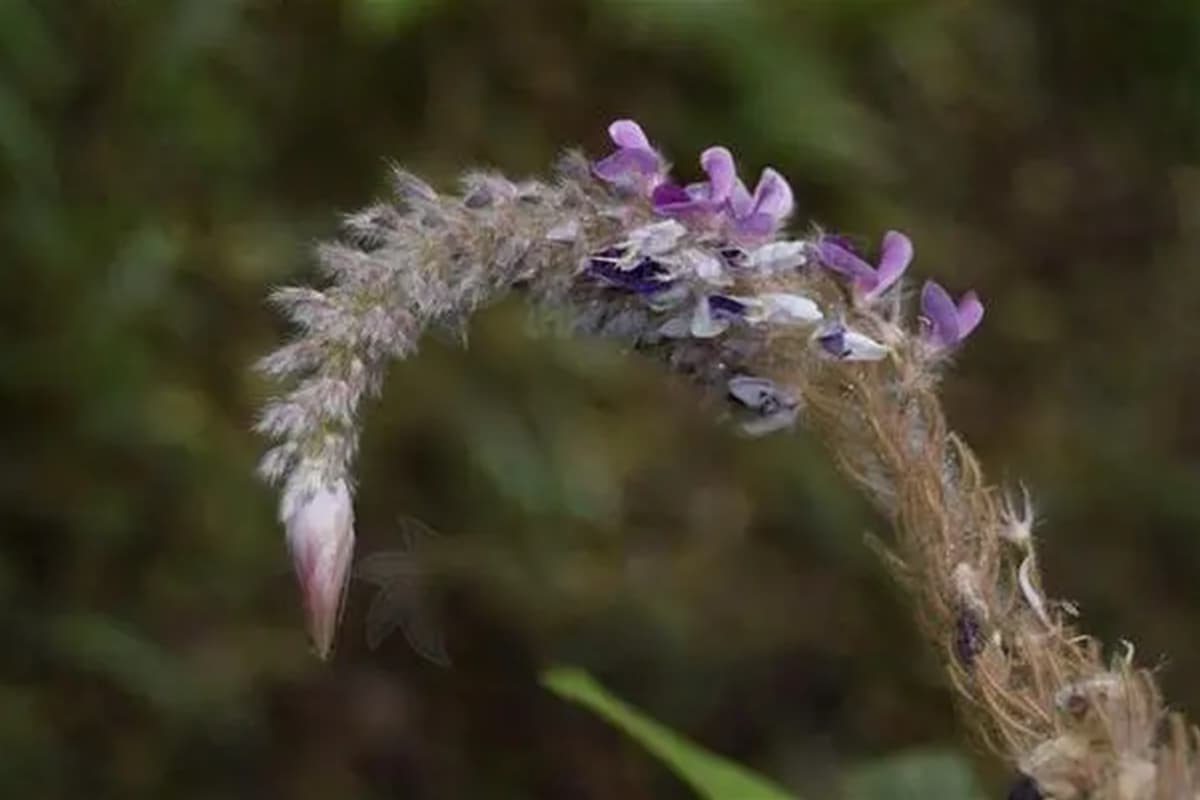
The calyx is shallowly cup-shaped and covered in long hairs, with 5 lobes, the upper 2 lobes being about 3mm long and the lower 3 lobes being about 3.5mm long.
The corolla is purple and about 6mm long. The fruit is slightly covered in short hairs, with 2-4 elliptical segments and reticulate veins. It flowers and fruits from April to September.
It is a subshrub with erect stems, reaching a height of 1-1.5 meters. It has few branches and is covered in grayish short hairs.
The leaves are odd-pinnate compound, with usually 3 leaflets in the lower part of the stem and 5 leaflets in the upper part, occasionally with 7 leaflets.
The stipules are triangular, measuring 6-10mm in length, with long, slender, and pointed tips, and a 2mm wide base. The edges of the stipules are covered in grayish-white hairs. The leaf stalk is 5.5-15cm long and covered in grayish-white short hairs.
The leaflets are leathery, elongated oval, lanceolate, or ovate in shape. The terminal leaflet measures 6-15cm in length and 3-8cm in width, while the lateral leaflets are slightly smaller.
The tips of the leaflets are slightly acute, obtuse, or rounded, and the bases are rounded to slightly cordate. The upper surface of the leaflets is hairless or sparsely covered in grayish short hairs along the midrib, while the lower surface is covered in short hairs along the veins.
There are 6-9 secondary veins on each side of the leaflets, which are raised on both surfaces. The lower surface has distinct reticulate veins.
The small triangular bracts are 5mm long and 1.5mm wide at the base, with sparse hairs along the edges. The leaflet stalks are 1-3mm long and densely covered in hairs.
The terminal raceme inflorescence is 15-30cm long or longer, stout, and densely covered in grayish-white long stiff hairs. The bracts are oval or lanceolate, up to 2cm long and 7mm wide, with stripes and white hairs along the edges.
The flower stalk is about 4mm long and elongates to 10-15mm after flowering, bending and covered in short hooked hairs and white long hairs. The calyx is shallowly cup-shaped, covered in white long stiff hairs, and has 5 lobes.
The upper lobes are about 3mm long and the lower lobes are about 3.5mm long. The corolla is purple and about 6mm long.
The fruit is slightly covered in short hairs, with 2-4 elliptical segments and reticulate veins. It flowers and fruits from April to September.
It is mostly found in dry slopes, roadsides, or shrubs at altitudes below 850 meters.
It is distributed in India, Sri Lanka, the Indochinese Peninsula, the Malay Peninsula, and south to northern Australia.
The seeds of Cat’s Tail Grass have a hard seed coat and need to be scarified before sowing to ensure uniform germination. For small-scale cultivation, farmers often use hard objects (such as bricks) to rub and break the seed coat.
For large-scale cultivation with a larger quantity of seeds, a small rice mill is used to crush the seeds. After scarification, the seeds are soaked in warm water at a temperature of 30-35°C for 12-18 days to promote germination before sowing.
There are two methods of sowing: direct sowing and seedling transplantation. Direct sowing is labor-saving but results in uneven emergence, poor control of planting density, and low yield.
Transplanting seedlings, on the other hand, ensures even growth, reasonable planting density, and high yield. It is recommended to use the seedling transplantation method for commercial production.

Peggie was once a high school mathematics teacher, but she set aside her chalkboard and textbooks to follow her lifelong passion for flowers. After years of dedication and learning, she not only established a thriving flower shop but also founded this blog, “Flowers Library”. If you have any questions or wish to learn more about flowers, feel free to contact Peggie.
 English
  العربية
  Bahasa Indonesia
  Deutsch
  Français
  Italiano
  Nederlands
  Português
  Русский
  日本語
日本語