600+ Types of Flowers A To Z (With Names and Pictures)
Types Of Flowers By Names (A-Z) Types Of Flowers By Color Types Of Flowers By Season Types Of Flowers By Blooming Time 600+ Types of Flowers No. Flower Name No.…

The Tephroseris kirilowii, also known as “Dog’s Tongue,” was selected as the flower to honor Pope Innocent during the invasion period of the Gordon people.
This flower belongs to the Asteraceae family and is most commonly found in the temperate regions of the Northern Hemisphere. Its small yellow blossoms closely resemble daisies, and it blooms from February to August. It is found in many provinces of China.
Tephroseris kirilowii is a perennial herb with an ascending rhizome often covered in brown, persistent leaf stalks, and has numerous fibrous roots.
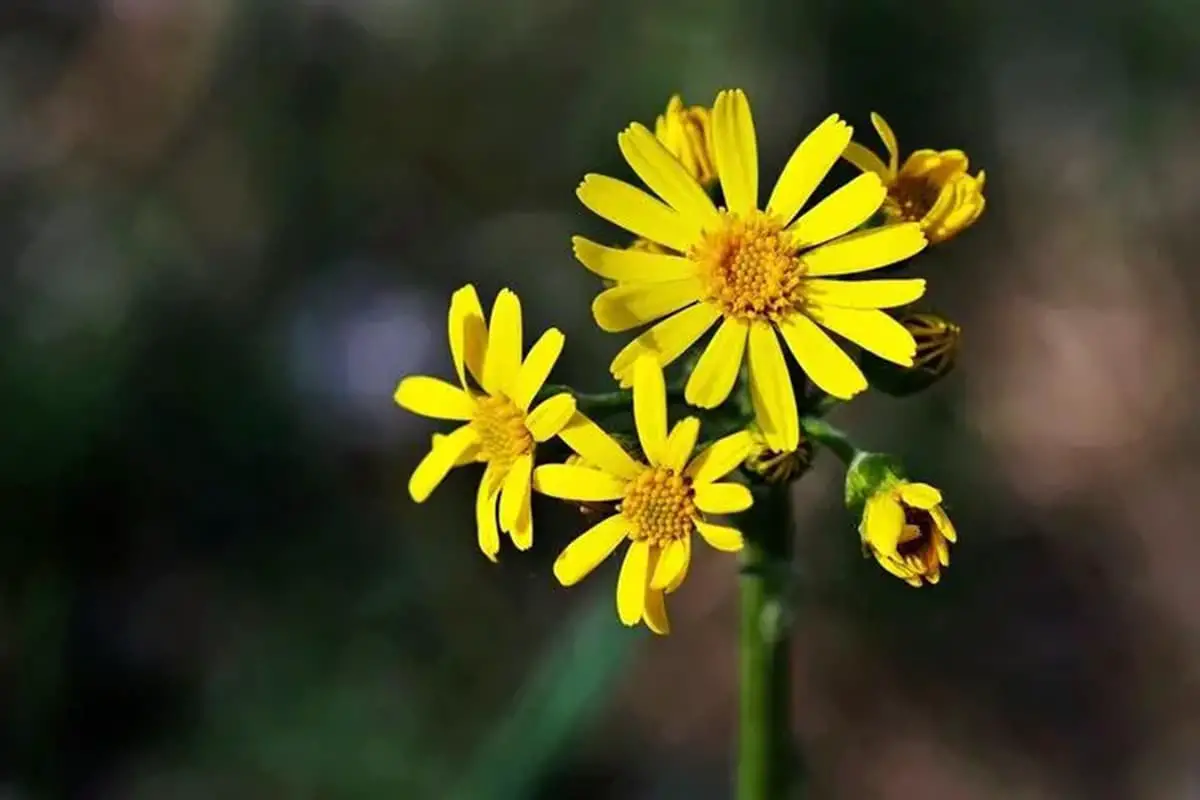
The stems are solitary, rarely 2-3, nearly racemose, erect, 20-60 cm tall, unbranched, covered in dense white cobweb-like hairs, and sometimes more or less glabrous.
In terms of leaf characteristics, this plant has several basal leaves, which are lotus-shaped and short-stalked, persisting during the flowering period.
They are oblong or ovate-oblong, 5-10 cm long, 1.5-2.5 cm wide, blunt at the tip, with small points at the base, wedge-shaped to gradually narrowing into narrow to wide-winged leaf stalks.
Both sides of the leaf are covered in dense or sparse white cobweb-like downy hairs. The stem leaves are fewer in number, gradually decreasing in size towards the stem’s upper part.
The lower leaves are inverted lanceolate or inverted lanceolate-oblong, 4-8 cm long, 0.5-1.5 cm wide, blunt to pointed, stalkless, semi-clasping at the base.
The upper leaves are smaller, lanceolate, bract-like, and pointed at the tip.
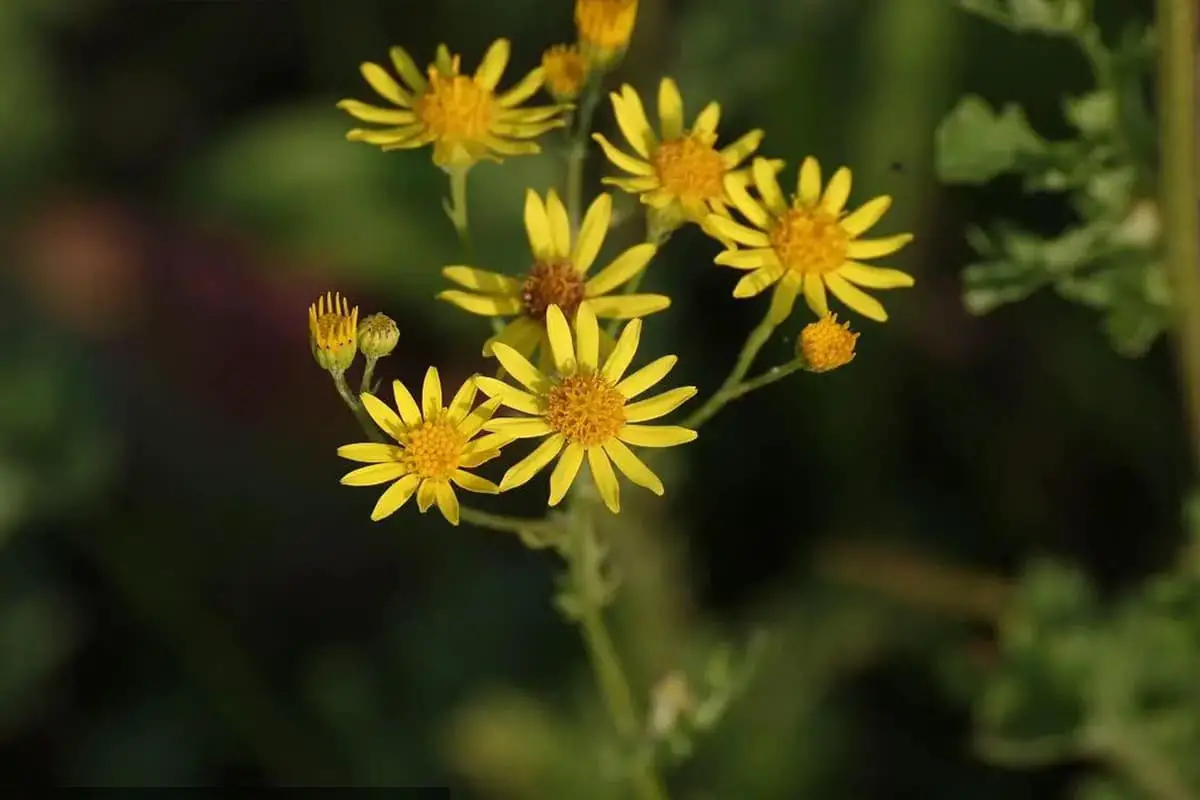
Flower characteristics include a head flower diameter of 1.5-2 cm, with 3-11 arranged in more or less umbellate-shaped terminal umbels. The inflorescence stalks are 1.5-5 cm long, covered in dense cobweb-like downy hairs, more or less covered in yellow-brown glandular hairs, with bracts at the base, and no small bracts at the top.
The general involucre is nearly cylindrical bell-shaped, 6-8 mm long, 6-9 mm wide, with no outer bracts.
The involucre bracts are 18-20, lanceolate or linear-lanceolate, 1-1.5 mm wide, gradually pointed or abruptly pointed at the tip, green or purple, herbaceous, with narrow membranous edges, the outside is covered in dense or sometimes sparse cobweb-like hairs, or more or less glabrous.
The ligulate flowers are 13-15, with a tube part 3-3.5 mm long. The ligule is yellow, oblong, 6.5-7 mm long, 2.5-3 mm wide, blunt at the tip, with 3 fine teeth, and 4 veins.
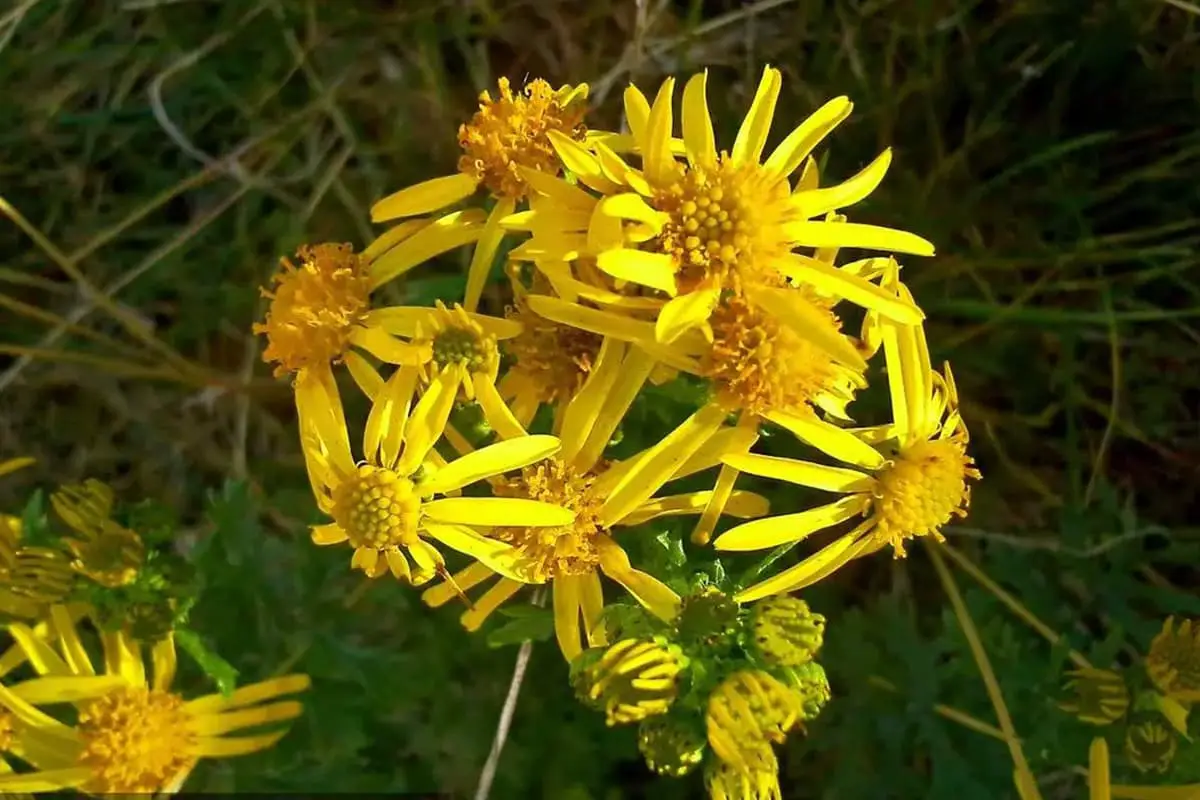
The tubular flowers are numerous, with a yellow corolla, about 8 mm long, the tube part is 4 mm long, and the limb part is funnel-shaped.
The lobes are ovate-lanceolate, 1.2 mm long, abruptly pointed, with papillate hairs at the tip. The anthers are 2.2 mm long, blunt at the base, and the attachment is ovate-lanceolate. The style branches are about 1 mm long.
The achenes are cylindrical, 2.5 mm long, and densely covered in stiff hairs. The pappus is white, about 6 mm long.
Bloom period is from February to August.
This plant is found in Heilongjiang, Liaoning, Jilin, Inner Mongolia, Hebei, Shanxi, Shandong, Henan, Shaanxi, Gansu, Hubei, Hunan, Sichuan, Guizhou, Jiangsu, Zhejiang, Anhui, Jiangxi, Fujian, Guangdong, and Taiwan.
It is also found in the Russian Far East, North Korea, and Japan. The type specimen was collected from Hebei.
This species is widely distributed in the Northeast, North China, Central China, East China, and Southwest provinces. The plant size, leaf shape, and hairiness vary greatly.
Generally, the plants and leaves in the Northeast and North China are densely covered in white cobweb-like downy hairs and sparse yellow-brown glandular hairs. The leaf stalk has wider wings.
However, the plants and leaves distributed in East China and the Southwest have sparse hairs or are more or less glabrous, and the leaf stalk has narrow wings. But the achenes are densely covered in stiff hairs, which is not difficult to distinguish from the previous species.
The plant commonly grows on grass slopes or sunlit mountaintops, at an altitude of 250-2000 meters.
Source: The whole plant of the Asteraceae, genus Senecio, species kirilowii Turcz. It is harvested in the summer and autumn, washed, and dried.
Taste and Meridian Attribution: Bitter, slightly sweet, cold. This species is a toxic plant recorded in the Chinese Plant Atlas Database. Its toxicity is that the whole plant is slightly poisonous, and excessive intake can cause liver and kidney damage.
Indications: It is used to clear heat, detoxify, and promote urination. It is used for lung abscesses, urinary tract infections, difficulty in urination, leukemia, stomatitis, and carbuncles.
Usage and Dosage: 3 to 5 grams.
In vitro tests show that 3 grams (raw drug) per milliliter of “Dog’s Tongue” inhibits leukemia cells (Methylene Blue Method).
Plants of this genus often contain pyrrolizidine alkaloids, which are toxic to the liver and have anti-tumor effects. There have also been reports or studies on their hepatocarcinogenic effects.
The alkaloid “Dog’s Tongue” extracted from the European “Dog’s Tongue” is non-toxic to the liver due to the saturation of Necine in its chemical structure, i.e., no double bond at positions 1 and 2. It has atropine-like effects, but its effectiveness is 20-30 times weaker than atropine.
It has a central inhibitory effect and can enhance the central inhibitory effect of small doses of magnesium sulfate. It can also lower blood pressure, and its mechanism of action may also be central.

Peggie was once a high school mathematics teacher, but she set aside her chalkboard and textbooks to follow her lifelong passion for flowers. After years of dedication and learning, she not only established a thriving flower shop but also founded this blog, “Flowers Library”. If you have any questions or wish to learn more about flowers, feel free to contact Peggie.
 English
  العربية
  Bahasa Indonesia
  Deutsch
  Français
  Italiano
  Nederlands
  Português
  Русский
  日本語
日本語