600+ Types of Flowers A To Z (With Names and Pictures)
Types Of Flowers By Names (A-Z) Types Of Flowers By Color Types Of Flowers By Season Types Of Flowers By Blooming Time 600+ Types of Flowers No. Flower Name No.…

The Tarenaya hassleriana, commonly known as the Drunken Butterfly Flower, is an annual herbaceous plant. The flower stems of the Drunken Butterfly Flower stand erect, with plant height ranging from 40 to 60 centimeters.
Its leaves are palmately compound, with 5 to 7 leaflets that are rectangular and lanceolate in shape. The inflorescence is apical, with flowers blooming sequentially from the base upward.
The flower buds are red, while the petals can either be rosy red or white, and they bloom from June to September. The Drunken Butterfly Flower is a highly adaptable plant that thrives in high temperatures and is heat resistant, but it does not tolerate cold conditions.
Originally from tropical America, it is cultivated globally in tropical to temperate climates for its ornamental value and is commonly seen in major cities across China.
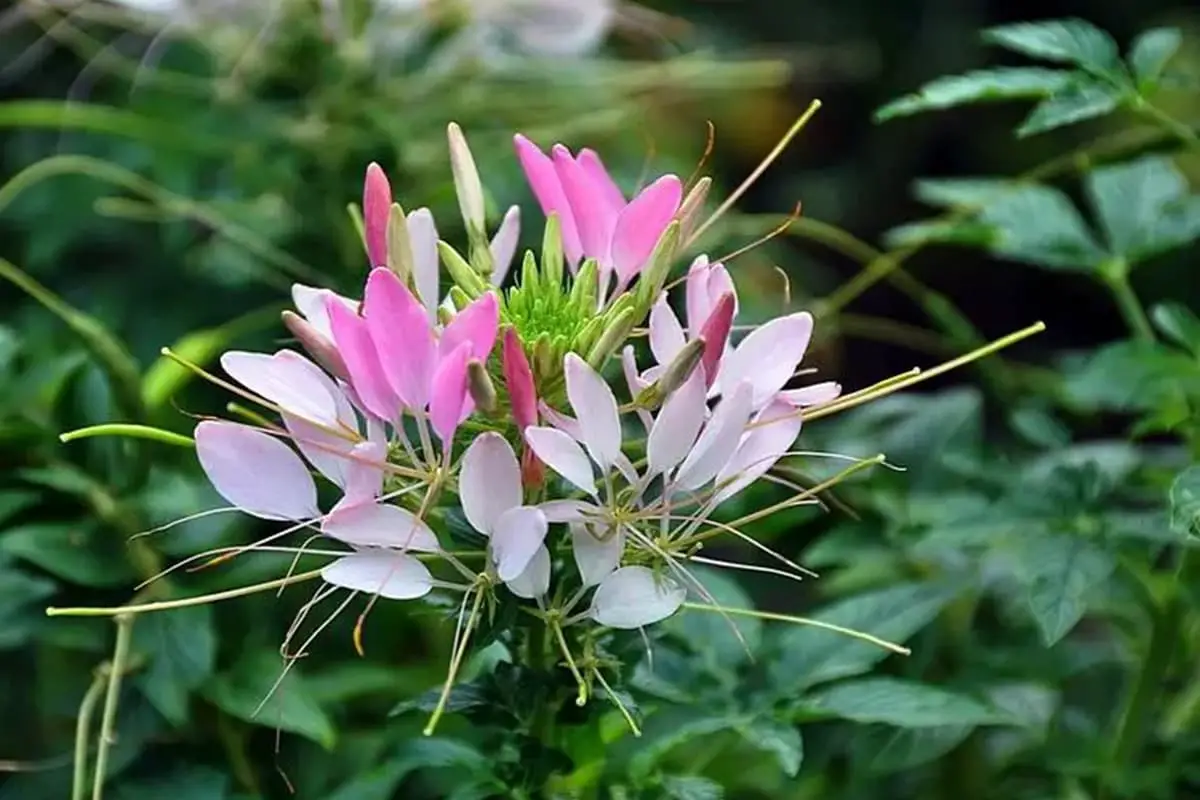
The Drunken Butterfly Flower is a robust annual herbaceous plant that grows to a height of 1 to 1.5 meters. The entire plant is covered in sticky glandular hairs and has a distinctive odor. It has stipular spines that can grow up to 4 millimeters long, are sharp, and curve outward.
The leaves are palmately compound with 5 to 7 leaflets, which are grass-like, elliptical lanceolate or inverted lanceolate in shape. The central leaflets are the largest, measuring 6 to 8 cm in length and 1.5 to 2.5 cm in width.
The smallest leaflets are on the outermost edge, approximately 2 cm long and 5 mm wide. The base is cuneate, narrowly extending into a petiolule, and its connection with the petiole is slightly webbed.
The leaf apex tapers sharply and has a short tip. Both surfaces are hairy, with the dorsal midrib and sometimes the lateral veins often having spines. It has 10 to 15 pairs of lateral veins. The petiole measures 2 to 8 cm long and often has pale yellow spines.
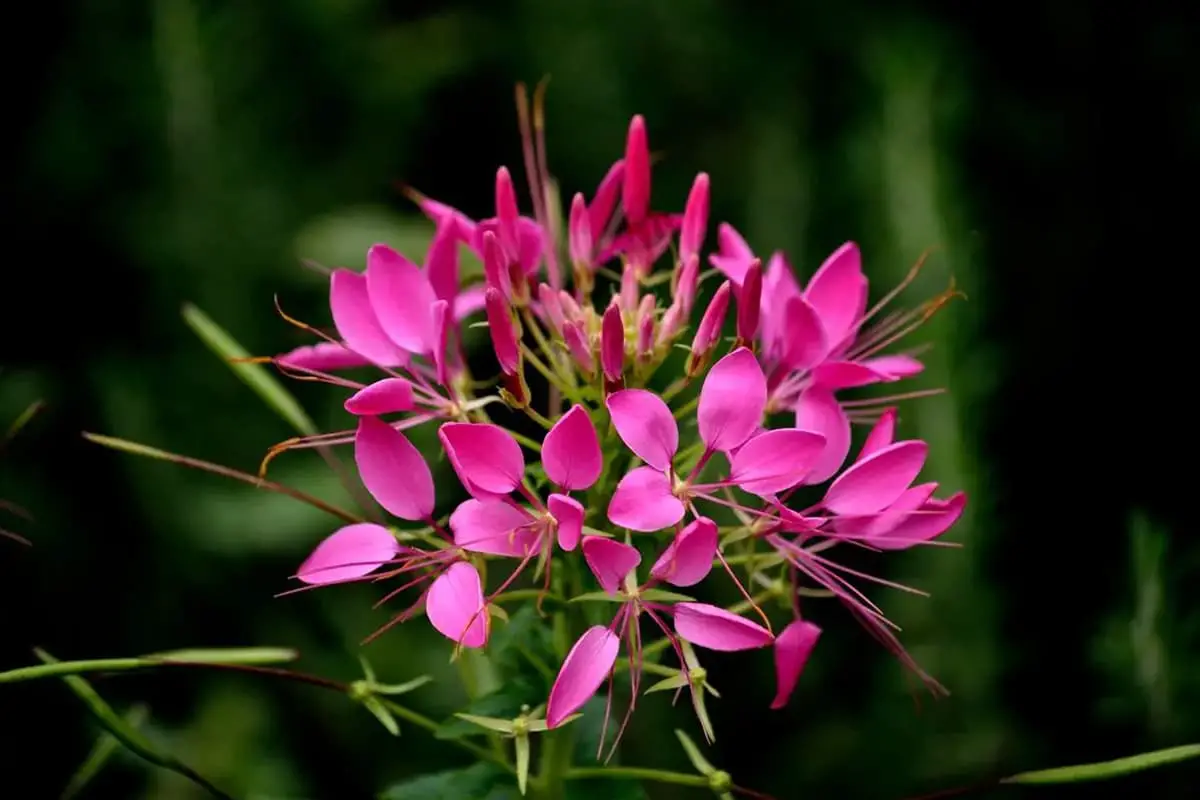
The inflorescence can extend up to 40 cm and is densely covered in sticky glandular hairs. Each has a single bract that’s leaf-like, ovate elliptical, 5 to 20 mm long, nearly stalkless or stalkless, with a somewhat heart-shaped base.
The flower buds are cylindrical, approximately 2.5 cm long, 4 mm in diameter, and hairless. The pedicels are 2 to 3 cm long, short glandular hairy, and are born singly in the axils of the bracts.
There are 4 sepals, each measuring 6 mm long, elliptical, tapering at the apex, and the outside is covered in glandular hair. The petals are pink, rarely white, imbricate in the bud, hairless, with claws 5 to 12 mm long.
The lamina is inverted spoon-shaped, 10 to 15 mm long, 4 to 6 mm wide, rounded at the apex, and narrows at the base. There are 6 stamens, with staminal filaments 3.5 to 4 cm long, and anthers linear, 7 to 8 mm long.
The gynophore measures 1 to 3 mm long; the gynophore stalk is 4 cm long and slightly elongates in fruit. The ovary is linearly columnar, 3 to 4 mm long, and hairless. The pistil is nearly absent, with a capitate stigma.
The fruit is cylindrical, 5.5 to 6.5 cm long, with a diameter of about 4 mm at the middle. Both ends are blunt, the surface is nearly flat or slightly beaded, with thin, dense, and not very clear veins.
The seeds have a diameter of about 2 mm, the surface is nearly smooth or has small wart-like protrusions, and lacks a false seed coat. Flowering and fruiting occur from late summer to early fall.
The Butterfly Pea is highly adaptable. It thrives in warm temperatures and has a good tolerance for heat, but it dislikes the cold. It prefers places with abundant sunlight, but it can also grow well in semi-shaded areas.
It is not overly demanding when it comes to soil conditions. In rich and well-fertilized soil, the plant can grow tall; it can also grow well in moderate-fertility soils.
However, it does not thrive in sandy or heavy clay soils or in alkaline conditions. The Butterfly Pea likes moist soil, and it can also withstand drought, but it does not do well with waterlogging.
Any type of soil can be used, but well-drained sandy soil rich in humus is preferred. Butterfly Bushes have a well-developed root system, so a deeper and larger pot is recommended, with a diameter of 20 to 30 centimeters.
Apart from alkaline soil where they don’t grow well, the plants can thrive in sandy soil and clay soil, with slightly acidic sandy loam being the most ideal.
A mixture of equal amounts of leaf mold and vegetable garden soil can be used as the cultivation soil. The soil should be loose and have good drainage.
When potting or transplanting seedlings, first place a 2-2 cm thick layer of coarse-grain substrate or ceramic granules at the bottom of the pot as a water filtration layer.
Sprinkle a layer of fully decomposed organic fertilizer as base fertilizer on top, about 1-2 cm thick, then cover with a layer of substrate of the same thickness. Then place the plant in the pot, separating the fertilizer from the roots to avoid root burn.
The substrate for potting can be one of the following: vegetable garden soil: slag = 3:1; or garden soil: medium-coarse river sand: sawdust = 4:1:2; or one kind of paddy soil, pond mud, or leaf mold soil.
Or, peat + perlite + ceramic granules = 2 parts + 2 parts + 1 part; vegetable garden soil + slag = 3 parts + 1 part; peat + slag + ceramic granules = 2 parts + 2 parts + 1 part; sawdust + vermiculite + medium-coarse river sand = 2 parts + 2 parts + 1 part.
After potting, water thoroughly once, and maintain in a slightly shaded environment for a week.
When transplanting seedlings, first dig a planting hole, sprinkle a layer of organic fertilizer at the bottom as base fertilizer, about 4-6 cm thick, then cover with a layer of soil and place the seedling in the hole, separating the fertilizer from the roots to avoid root burn.
After placing the seedling, backfill the soil, covering the root system, and compact the soil with your foot, then water thoroughly. Apply thin fertilizer once during the initial planting stage.
Control fertilizing during the growth period to maintain a moderate and attractive plant shape. Like other flowers, they require more fertilization, but follow the principle of “frequent application of light fertilizer, small amounts many times, complete nutrition”.
After fertilizing, keep the leaves and flowers dry at night. For potted plants, apply 2-3 times of diluted compound liquid fertilizer during the bud stage, and they can bloom during the Spring Festival.
Generally, prune twice before flowering to promote the growth of more flowering branches: one to two weeks after potting, or when the seedling is 6-10 cm tall and has more than six leaves, pinch off the top shoot, leaving 3-4 leaves below to encourage branching.
3-5 weeks after the first pruning, or when the side branches reach 6-8 cm in length, perform the second pruning, i.e., pinch off the top shoot of the side branches, leaving 4 leaves below on the side branches.
After two prunings, the plant shape will be more ideal and the number of flowers will also increase. When planting in flower beds, timely remove spent flowers to prevent seed formation and extend the flowering period.
They can endure drought, but they grow better with higher air humidity. Water every day during the hot summer, and water thoroughly. They prefer higher air humidity, and if the air humidity is too low, individual flowers will wither faster.
They also fear rain, and the leaves need to be kept dry at night. The optimal relative air humidity is 65-75%.
They love warm sunlight, can withstand heat, slightly tolerate semi-shade, and do not tolerate cold. Summer is the growing season, and the plants will die if they encounter frost. The suitable temperature for growth is 20-32°C.
Butterfly Bushes easily produce seeds. When the fruits start to change from green to yellow, they can be harvested. After the harvested seeds are air-dried, they can be stored in a cool place for use the following year.
Seed propagation is possible, with the elongated fruits maturing gradually from late summer to early autumn. Seeds can be harvested in stages, air-dried in the shade, and stored in a cool indoor place or in the refrigerator.
Early mature seeds can be sown immediately after harvesting, and flowers can be observed from late autumn to early winter. Generally, seeds are stored over winter and sown in early spring of the following year, with flowering in summer, or sown in late spring, with flowering in summer and autumn.
After sowing in an outdoor seedbed, keep the soil moist. The temperature for seed germination should be above 20°C. Early spring sowing requires temperature control in a plastic greenhouse for uniform germination.
If the temperature is appropriate, germination can occur about a week after sowing. The seeds have the ability to self-propagate.
For seed sowing, disinfect the substrate by heating it in a pan, effectively killing any pests or diseases. Soak the seeds in water at 25-30 degrees Celsius for 3-10 hours until the seeds have absorbed water and swelled.
For small seeds that are difficult to pick up with fingers or other tools, moisten one end of a toothpick and use it to place the seeds one by one on the surface of the substrate.
Cover with one centimeter of substrate, then place the seedling pot in water that is 1/2 to 2/3 the height of the pot, allowing the water to slowly soak up (this method is called “pot immersion”).
For larger seeds that can be picked up with hands or other tools, place the seeds directly into the substrate, spacing them 3×3 cm apart. After sowing, cover with a layer of substrate that is 2-3 times the size of the seed.
You can then wet the substrate using a sprayer or fine-hole watering can. When the soil in the pot is slightly dry, water it again, but be careful not to use too much force to avoid washing away the seeds.
After the seedlings emerge, remove the film in a timely manner and expose the seedlings to sunlight before 9:30 am or after 3:30 pm each day, otherwise the seedlings will grow weak.
Once most of the seeds have sprouted, thin out the seedlings: remove any sick or unhealthy seedlings to give the remaining ones some space. When most of the seedlings have grown 3 or more leaves, they can be transplanted to pots.
The cutting substrate is the nutrient soil or river sand, peat soil, etc., used for cuttings. For home cuttings, it is difficult to get the ideal cutting substrate due to limited conditions, so it is recommended to use pre-prepared and sterilized cutting substrate; medium-coarse river sand can also be used, but it should be rinsed several times before use.
Sea sand and river sand from saline-alkali areas should not be used as they are not suitable for the growth of flowers and plants. The branches used for cuttings are called cuttings. Usually, the robust, disease-free tops that are picked off during the pinching process are used as cuttings and inserted directly.
The optimal temperature for cuttings to take root is 18℃-25℃. Below 18℃, it is difficult and slow for cuttings to take root; above 25℃, the cut of the cutting is prone to bacterial infection and rot, and the higher the temperature, the greater the proportion of rot.
When encountering low temperatures after cutting, the main insulation measure is to wrap the pot or container used for cutting with a film; when the temperature is too high after cutting, the main cooling measure is to shade the cuttings, shading 50-80% of the sunlight, and spray the cuttings 3-5 times a day.
On sunny days when the temperature is higher, spray more; on cloudy and rainy days when the temperature is lower, spray less or not at all.
After cutting, the relative humidity of the air must be maintained at 75-85%. Humidity can be increased by spraying the cuttings 1-3 times a day. Spray more on sunny days when the temperature is higher, and less or not at all on cloudy and rainy days when the temperature is lower.
However, excessive spraying can cause the cutting to become infected and rot, as many types of bacteria exist in water.
Cutting propagation cannot be separated from sunlight, but the stronger the light, the higher the temperature inside the cutting, the more vigorous the transpiration, and the more water consumed, which is not conducive to the survival of the cuttings.
Therefore, after cutting, 50-80% of the sunlight must be blocked. After the root system has grown, gradually remove the shade net: remove the shade net at 4:00 pm on sunny days, and cover it before 9:00 am the next morning.
Common diseases include leaf spot and rust, which can be mitigated by spraying a solution of 50% Topsin M, a wettable powder, diluted 500 times for leaf spot, and a 50% mancozeb wettable powder solution diluted 3000 times for rust prevention.
Butterfly Pea is prone to Lepidopteran pests during the seedling stage, which can be controlled by spraying with abamectin, a pesticide, diluted 4000 times.
The lightweight and elegant petals of the Butterfly Pea bloom like a fluttering butterfly, adding an interesting touch. It can be planted in flower beds and borders in summer and autumn, or cultivated as a dwarf plant for pot viewing.
In garden applications, it can be planted under trees or on the shady side of buildings owing to its semi-shade tolerance.
The Butterfly Pea blossoms in the evening and withers during the day, thus it is also known as the flower of summer nights. Its fleeting life lends a sense of impermanence.
This flower, native to the tropical areas of South America, is an excellent pollution-resistant plant with strong resistance to sulfur dioxide and chlorine gas.
It beautifies the environment and can thrive even in heavily polluted factories and mines. It is also a superior source of nectar and can produce high-quality essential oil.
The Butterfly Pea has a long, sturdy stem and its inflorescences form a lush flower ball, with red and white colors complementing each other.
The long-clawed petals and elongated stamens protruding from the corolla, resembling a spider or dragon’s whiskers, are particularly interesting. When the Butterfly Pea blooms, the petals gradually open, and the long claw springs from the flower in a slow motion-like process.
It can be planted in the ground near courtyard walls or under trees, and when potted, it can be placed in front of windows or on desks, but the plant size should be controlled to prevent excessive height.
The entire plant is pungent and astringent, neutral, and slightly toxic. It is used to dispel wind, relieve cold, kill parasites, and alleviate itching. The fruit has been experimentally used in folk medicine to treat liver cancer.

Peggie was once a high school mathematics teacher, but she set aside her chalkboard and textbooks to follow her lifelong passion for flowers. After years of dedication and learning, she not only established a thriving flower shop but also founded this blog, “Flowers Library”. If you have any questions or wish to learn more about flowers, feel free to contact Peggie.
 English
  العربية
  Bahasa Indonesia
  Deutsch
  Français
  Italiano
  Nederlands
  Português
  Русский
  日本語
日本語