600+ Types of Flowers A To Z (With Names and Pictures)
Types Of Flowers By Names (A-Z) Types Of Flowers By Color Types Of Flowers By Season Types Of Flowers By Blooming Time 600+ Types of Flowers No. Flower Name No.…

Sterculia monosperma, also known as “Phoenix Eye Fruit,” has elongated oval leaves. The tree flowers in early summer with no corolla. The calyx is pink and the flowers are arranged in a conical inflorescence.
The fruit is divided into four or five sections, with a dark red exterior and a pitch-black interior. The seeds are oval or rectangular, dark brown, and about 1.5 cm in diameter.
The tree blooms from April to May but occasionally produces a second bloom in October or November.
Due to the low annual yield of Sterculia monosperma and the decline of traditional worship customs, large-scale planting is rare, with only sporadic cultivation.
The tree is also found in India, Vietnam, and Indonesia, where it is mostly artificially cultivated. The seeds are edible and taste like chestnuts when cooked.
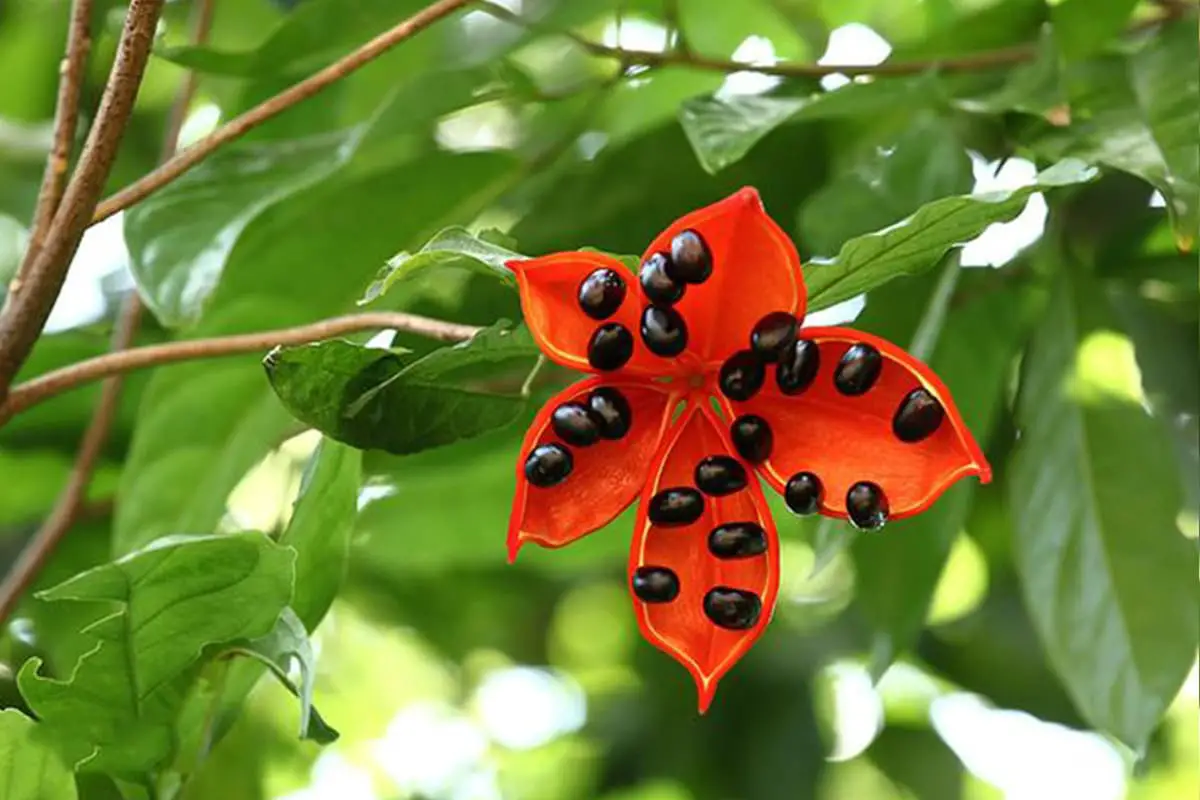
Sterculia monosperma is a deciduous tree with brown-black bark and young branches with a slight star-shaped fuzz. The leaves are thin and leathery, rectangular or oval, 8-25 cm long and 5-15 cm wide.
The leaf apex is sharply pointed or blunt, and the base is rounded or blunt, with no hair on both sides. The petiole is 2-3.5 cm long and the stipules fall off early.
The conical inflorescences are terminal or axillary, soft and spreading, up to 20 cm long, and have short soft hairs. The calyx is initially milky white, later turning pink, bell-shaped, and covered with short soft hairs.
It is about 10 mm long, with five lobes. The male flowers are numerous. The staminal column is curved and hairless, and the anthers are yellow.
The female flowers are fewer and slightly larger with a spherical ovary that has five grooves and is densely hairy. The pistil is curved, and the stigma is 5-lobed.
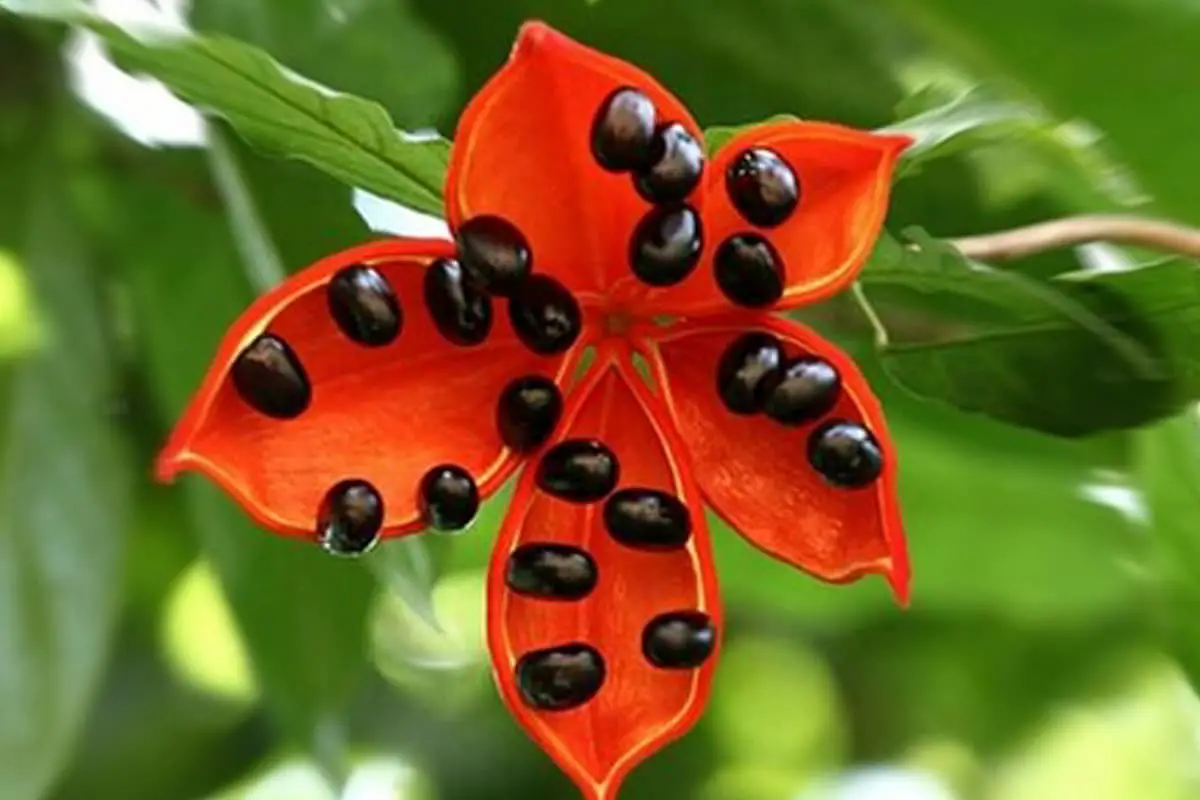
The drupe fruit is bright red, thick and leathery, rectangular or oval, about 5 cm long, and 2-3 cm wide. It has a beak at the top and contains 1-4 seeds.
The seeds are oval or rectangular, dark brown, and about 1.5 cm in diameter. The tree blooms from April to May but occasionally produces a second bloom in October or November.
It thrives in well-drained fertile soil and tolerates shade. It prefers a warm and humid climate.
The tree is also found in India, Vietnam, and Indonesia, where it is mostly artificially cultivated.
The propagation methods of Schefflera mainly include cutting propagation, high-pressure propagation, root tiller propagation, and seedling cultivation.
Schefflera’s branches are easy to root and are often propagated by cuttings. Semi-woody branches, woody branches, and even old branches can all be successfully propagated by cuttings.
Generally, 2-3 year old woody branches are selected, cut into approximately 15 cm lengths, and inserted into the nursery bed in spring and autumn.
To increase the survival rate, rooting hormone treatment can be performed. The cuttings are inserted into the soil about 3cm deep. As long as the humidity of the air and soil is maintained, roots can develop in about a month.
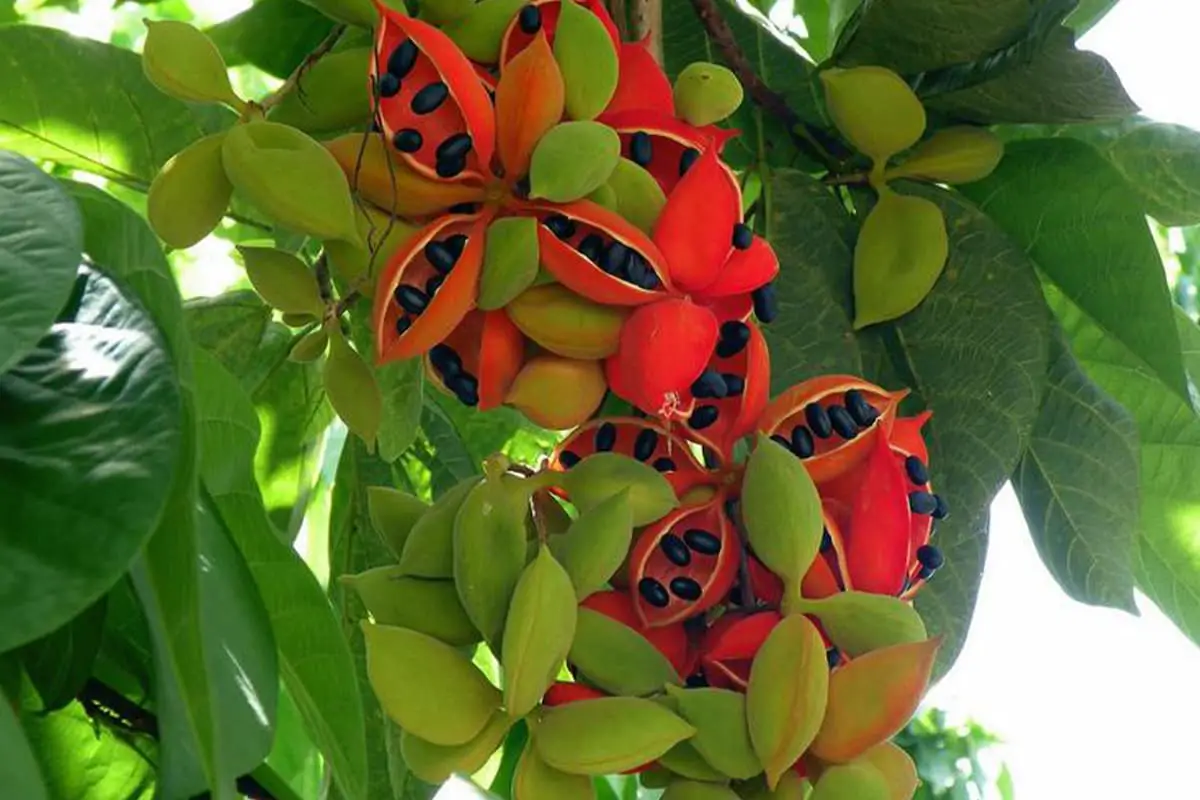
Seedling cultivation is also a common propagation method. When the pod fruits mature and split, the seeds are promptly harvested and sown immediately to avoid dehydration from exposure to the sun.
The sand bed should not be too damp, the ideal condition being when you can form a clump in your hand without any water droplets seeping through your fingers.

Before sowing, the sand bed and the seeds can be sterilized with methylobutazine or carbendazim, and the seeds are then sown using the spot sowing method. After sowing, it is important to shade and keep moisture.
The seeds can sprout after 7 days, and the plant can reach 20~40 cm in the second year of spring, and then can be transplanted in March or April.
The main pests and diseases of the Schefflera tree are anthracnose, root rot, and scale insects. By applying fertilizer in winter and maintaining cleanliness in the garden, collecting and burning fallen leaves, the sources of infection can be reduced.
In warm and rainy years, Schefflera often suffers from anthracnose, causing leaf withering and shedding. To prevent this, it is essential to maintain garden hygiene, collect and burn fallen leaves, and reduce the sources of infection.
For heavily infected gardens or plants, a comprehensive spray of 1% Bordeaux mixture or 30% oxychloride copper suspension 600 times liquid can be applied based on the cleanliness of the garden.
Secondly, from the start of the leaf expansion period or the start of the disease, alternate continuous sprays of 4% sulfur suspension 600 times liquid.
Schefflera scale insects harm the plant by sucking the juice from the leaves and branches, causing the leaves to turn yellow and curl, and the flower buds to develop poorly, affecting fruiting.
The insects can cause flowers to fall, affecting fruit set. They also secrete large amounts of white waxy powder and excrete sticky “honeydew”, which can induce sooty mold disease, further exacerbating the damage. To control this, first combine garden cleaning and burn fallen insect branches and leaves.
When the insects are at a young age, spray a 3000 times dilution of 20% speed kill butene emulsion, or a 1000 times dilution of 95% kill young urea water agent, or a 1500 times dilution of 2%~5% bromocyanate chrysanthemum ester emulsion, or a 1000~1500 times dilution of 25% kill mite wettable powder, alternate spraying 3~4 times every 7~15 days.
The harvest season for Sterculia lychnophora is from July to August each year. After the fresh seeds are picked and shelled, they are dried to become a product, without the need for special processing.
The edible part of Sterculia lychnophora is its seed, which can be prepared in a variety of ways such as steaming, boiling, roasting, and even using it in sweet syrup or braising.
After boiling the Sterculia lychnophora seeds, the black outer seed coat is peeled off, followed by the light brown semi-transparent inner seed coat, leaving the pale or milky white seed to be eaten.
The peeled seed is soft and white, resembling a small bird’s egg, delicate and beautiful. The flavor is similar to chestnuts, but slightly sweet and fragrant, with a refreshing and juicy texture that surpasses chestnuts.
The seeds of Sterculia lychnophora can be eaten and taste like chestnuts when cooked, but the fruiting rate is not high. If attention is paid to the selection and breeding of seeds to improve the fruiting rate, it is a woody grain plant worth promoting.
The bright red fruit of Trichosanthes tricuspidata is edible. The leaves can be used for wrapping dumplings. The seeds are edible and taste similar to pineapples or chestnuts.
In the Pearl River Delta, they are commonly used in braised meat dishes and taste extremely delicious. The pods and dates, when decocted with tangerine peel, can cure dysentery.
With a dense crown and evergreen leaves, the tree has a beautiful shape and is not prone to shedding leaves, making it an excellent choice for a street tree.
Taste and Temperature: Sweet, warm.
Main Function: Stop diarrhea. Mainly used to treat dysentery.
Seeds (Sterculia lychnophora): Sweet, warm. Warms the stomach and kills worms. Used for worm-induced abdominal pain, upset stomach, vomiting, and hernia pain.
Fruit Pods (Sterculia lychnophora shell): Neutral, bland. Used for middle ear infections, bloody dysentery, hernia; externally used for hemorrhoids.

Peggie was once a high school mathematics teacher, but she set aside her chalkboard and textbooks to follow her lifelong passion for flowers. After years of dedication and learning, she not only established a thriving flower shop but also founded this blog, “Flowers Library”. If you have any questions or wish to learn more about flowers, feel free to contact Peggie.
 English
  العربية
  Bahasa Indonesia
  Deutsch
  Français
  Italiano
  Nederlands
  Português
  Русский
  日本語
日本語