600+ Types of Flowers A To Z (With Names and Pictures)
Types Of Flowers By Names (A-Z) Types Of Flowers By Color Types Of Flowers By Season Types Of Flowers By Blooming Time 600+ Types of Flowers No. Flower Name No.…

The Spathodea campanulata is a tree species from the Bignoniaceae family. It has a smooth, grey-brown bark. Its odd-pinnate compound leaves, which are opposite each other, can reach up to 45 cm in length, including the petiole.
The tree has 13-17 leaflets, with elliptical to ovate leaves. Its inflorescence is umbellate, terminal, and dense, covered in brown, soft hairs and displaying noticeable lenticels. The flower’s corolla is enlarged on one side, with its base constricting into a slender tube.
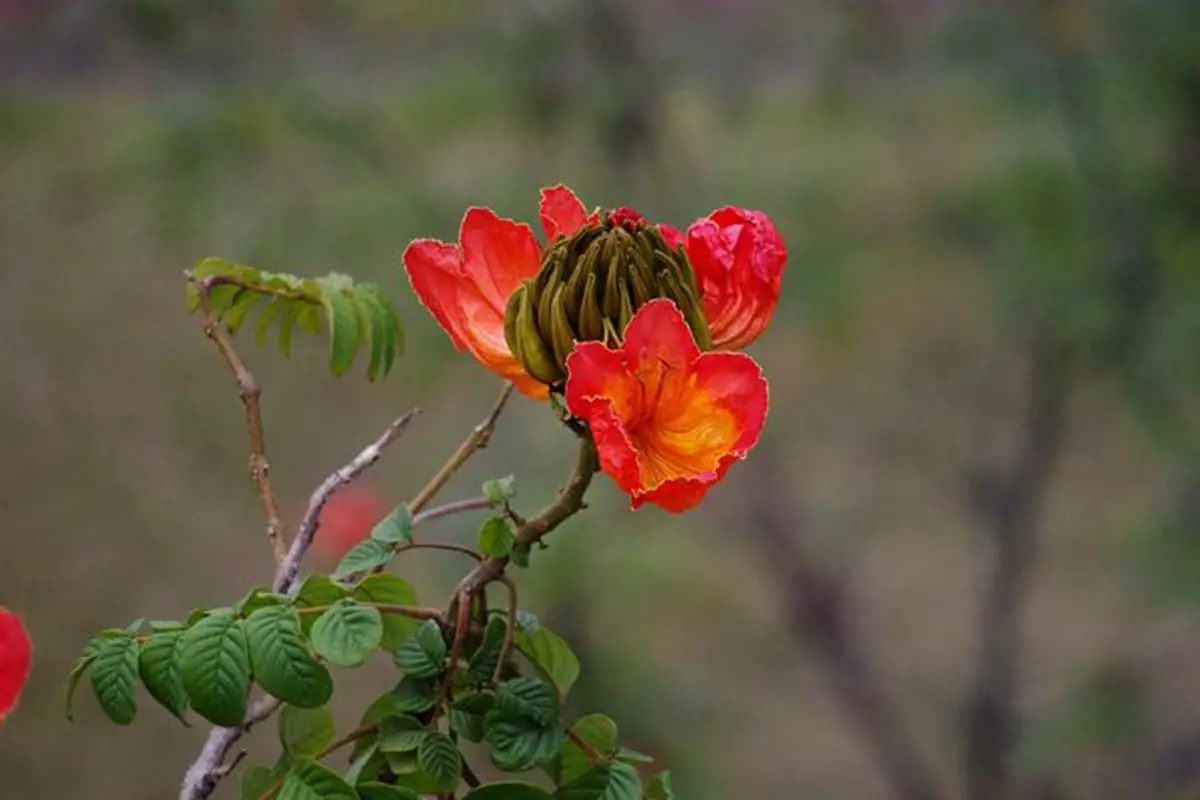
The limb is bell-shaped, orange-red with purple-red spots, and there are protruding stripes on the inside. It has five lobes that are broad ovate and unequal in size, with longitudinal pleats. The exterior of the lobes is orange-red, while the interior is orange-yellow.
The fruit is a dark brown capsule, and the seeds have wings and are nearly round, measuring 1.7-2.4 cm in both length and width. The tree flowers between April and May.
Originally from Africa, the Flame Tree is widely cultivated in India, Sri Lanka, and China. It is a robust species that thrives in high temperatures, ideally between 23-30℃, and can only grow normally at temperatures above 10℃.
The Flame Tree is a valuable tropical woody flower and an excellent landscape tree. Its seeds are edible.
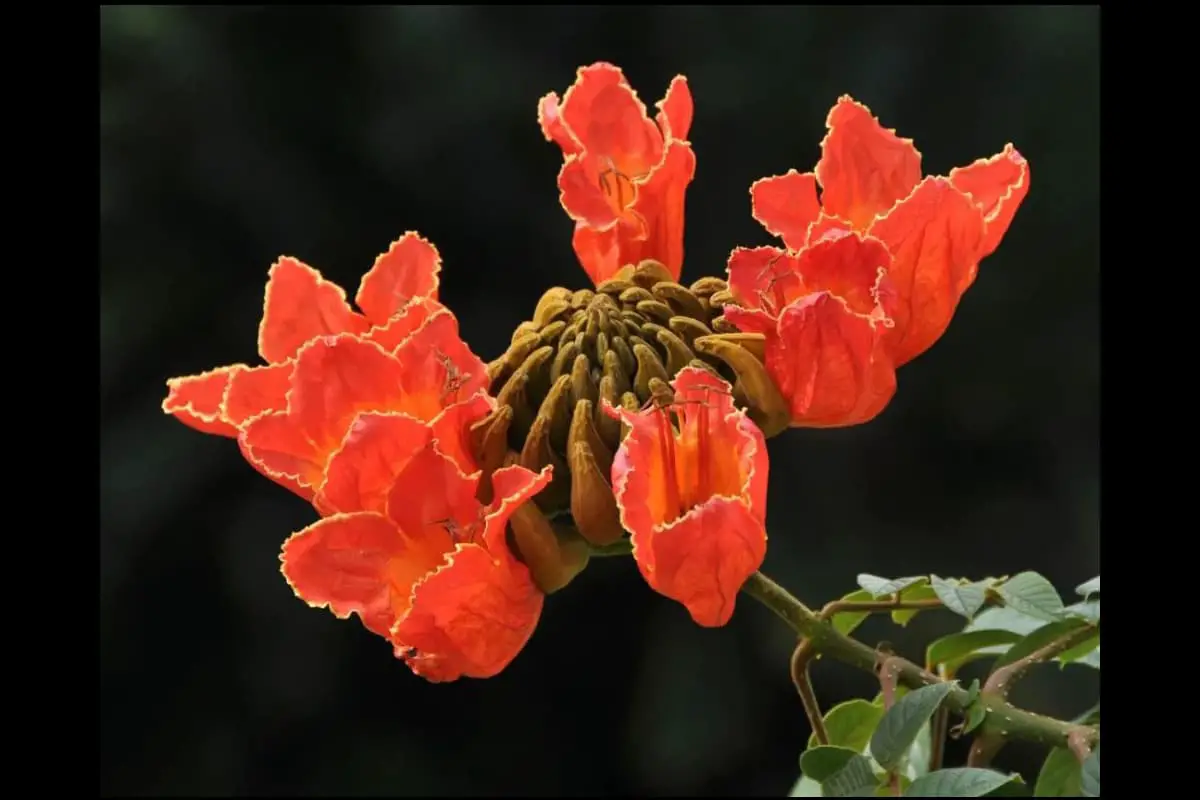
When the Flame Tree is in bloom, its flowers are numerous and densely packed, with a bright crimson color and a stunning appearance, resembling flames. This spectacle is especially spectacular when the entire tree is in bloom, hence its name.
Given the shape of its flowers, which resemble tulips, it is also known as the Tulip Tree in English. Furthermore, its flowers are bell-shaped and can store rain or dew for travelers or indigenous people to drink in its native tropical Africa, hence it is also known as the Fountain Tree.
This is a deciduous tree, standing 10 meters tall with smooth, brown-gray bark. It has odd-pinnate compound leaves that grow in pairs, each leaf, including the petiole, measures up to 45 cm long.
The tree has 13-17 leaflets, the leaves are oval to obovate, 5-9.5 cm in length, 3.5-5 cm wide, the apex is tapering, the base is round, the margin is entire, the back of the leaf is softly hairy along the veins, and the base has 2-3 veins. The petiole is short and softly hairy.
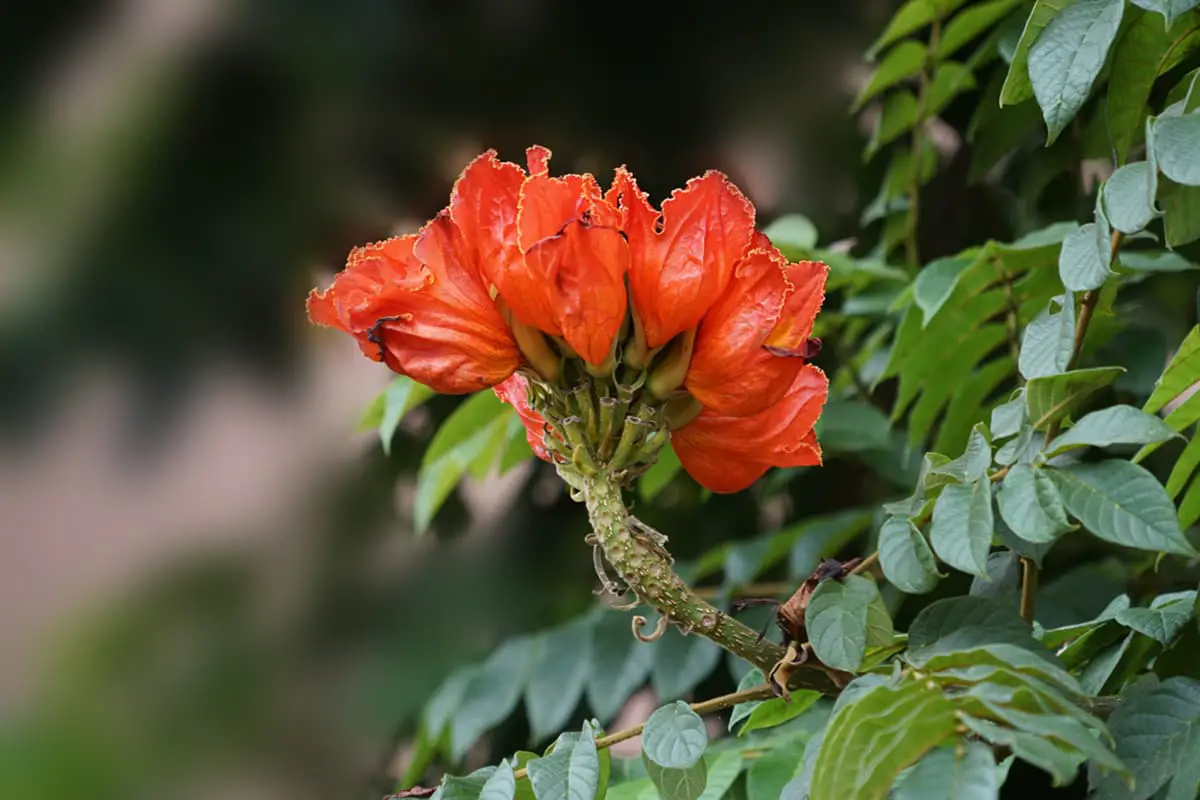
The inflorescence is an umbel, terminal, and dense. The inflorescence axis is about 12 cm long, covered with brown soft hairs, with noticeable lenticels. The pedicel is 2-4 cm long. The bracts are lanceolate, 2 cm long; the small bracts are 2, 2-10 mm long.
The calyx is flamboyant, externally covered with short velvet hair, the apex is outwardly curved and split, the base is entire, 5-6 cm long, 2-2.5 cm wide.
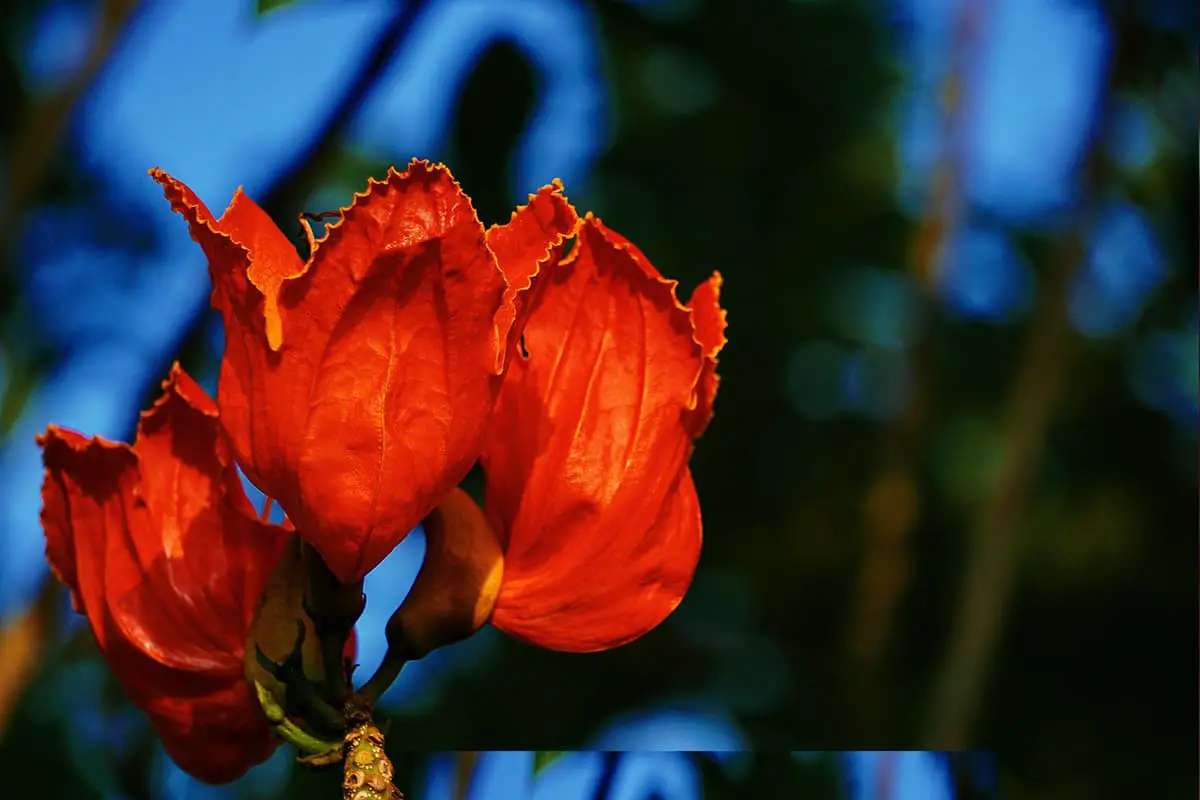
The corolla is inflated on one side, the base is constricted into a slender tube, the limb is bell-shaped, about 5-6 cm in diameter, 5-10 cm long, orange-red, with purple-red spots, the inner surface has raised stripes, the lobes are 5, broadly ovate, unequal in size, with longitudinal wrinkles, 3 cm long, 3-4 cm wide, the outside is orange-red, the inside is orange-yellow.
There are 4 stamens, the filaments are 5-7 cm long, the anthers are about 8 mm long, and they are cross-shaped. The pistil is 6 cm long, the stigma is ovulate-lanceolate, 2-lobed. The disk is annular, 4 mm high.
The capsule is dark brown, 15-25 cm long, 3.5 cm wide. The seeds have wings all around, are almost round, 1.7-2.4 cm long and wide. The flowering period is from April to May.
The flame tree is robust and loves high temperatures, growing best at 23-30°C. It generally grows in slightly shaded environments, but requires ample sunlight for quick growth.
It requires plenty of water and is not strict about soil quality, but well-drained loam or sandy loam is best. It is also not cold-tolerant.
The flame tree is native to Africa and is widely cultivated in countries such as India, Sri Lanka, and China.
The flame tree requires high temperatures to bloom. If the temperature is too low, it may not bloom or produce fewer flowers. Although it can bloom in Xiamen, China, the seeds do not mature, making it difficult to harvest them.
During winter, if a cold current occurs, the leaves may turn red or fall off. The tree can withstand drought after the leaves fall. If frost damage occurs, the branches may freeze, but the roots still have vitality and can grow and bloom normally.
The tree is not wind-resistant; strong winds can easily break the branches. If the soil fertility, moisture, density, and management meet the requirements, the annual height growth can reach 1-1.5 meters, and the diameter growth can reach 0.33-0.5 cm.
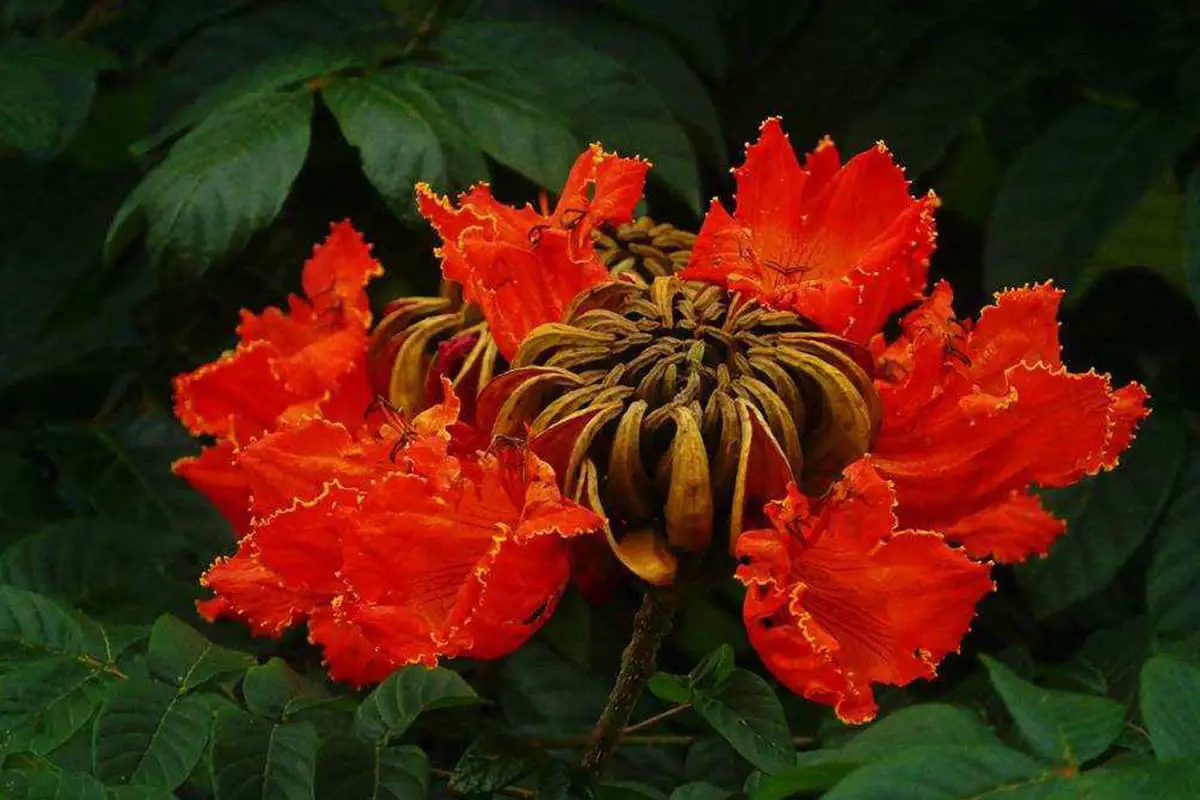
Generally, fruits form immediately after the flowers wilt. The fruit has a reddish-brown skin and contains seeds suitable for planting. The best time to plant seeds is in the spring.
When the seedlings reach a height of 30-40 cm, they can be transplanted. Once the seedlings reach a height of 1-1.5 meters, they can be permanently planted. Seedlings usually start to bloom after 5-6 years.
During the growing season, the flame tree can be propagated by cutting. Spring is the best time for this method. When cutting, choose branches that are healthy and nearly mature, with two to three nodes per cutting, each about 10 cm long, retaining the upper leaves.
The cut at the bottom of the cutting should be close to the bottom node. Perlite or river sand can both be used as mediums.
The cutting depth should be such that the stem does not fall over, and the density should be such that the leaves do not squeeze or touch each other, ensuring good ventilation for the roots and leaves and adequate light.
Generally, roots can form within about 30 days, with a rooting rate of over 85%. If treated with Series 3A rooting powder, roots can form 5-10 days earlier.
Once the cutting takes root and new leaves grow, a light application of fertilizer can be applied with watering to promote growth. Once the root system is fully developed, the plant can be transplanted.
Water and Fertilizer Management: During high temperatures and droughts, it’s vital to supplement young trees with water.
The Flame Tree does not require a high amount of fertilizer, but it does need to be supplemented appropriately during its growth and development, primarily with compound and organic fertilizers.
Depending on the fertility of the soil, fertilize 3-5 times a year, following the principle of frequent and light application.
Pruning: In winter, if defoliation occurs, take the opportunity to prune and maintain the tree’s aesthetics. If you want the plant to grow taller, trim the lower branches and leaves to promote the main branch’s extension.
The soil for planting should be deep, fertile, moist, loose, well-drained, and rich in humus. It’s best to have filled square soil. Dig a large hole (80cm x 60cm x 60cm) and apply base fertilizer to the topsoil.
Plant when leaves sprout in spring or during the rainy season. You can trim some branches and leaves to improve survival rates. Set up protective stanchions around young trees.
After planting, strengthen soil management, loosen the soil 1-2 times in the planting year, and apply appropriate topdressing. The Flame Tree is easy to cultivate and does not require meticulous management after planting.
As long as it is given enough water and a certain amount of light, it can grow and bloom normally.
The Flame Tree is highly adaptable and generally does not have pests or diseases. If pests or diseases occasionally occur, they can be prevented and treated according to the situation.
The Flame Tree has flowers that resemble flames and bloom for a long period. It is often used as a shade or roadside tree in warm areas and is also suitable for public places. It is cultivated in greenhouses in cold areas and is appreciated at a young age.
This species has elegant branches, a broad crown, and is evergreen all year round. If properly cultivated and the climate is suitable, it can bloom all year round, making it a precious tropical woody flower and an excellent landscape ornamental tree species. Its seeds are edible.
The Flame Tree is listed on the “IUCN Red List of Endangered Species” (IUCN) 2017 version 3.1—Least Concern (LC).

Peggie was once a high school mathematics teacher, but she set aside her chalkboard and textbooks to follow her lifelong passion for flowers. After years of dedication and learning, she not only established a thriving flower shop but also founded this blog, “Flowers Library”. If you have any questions or wish to learn more about flowers, feel free to contact Peggie.
 English
  العربية
  Bahasa Indonesia
  Deutsch
  Français
  Italiano
  Nederlands
  Português
  Русский
  日本語
日本語