600+ Types of Flowers A To Z (With Names and Pictures)
Types Of Flowers By Names (A-Z) Types Of Flowers By Color Types Of Flowers By Season Types Of Flowers By Blooming Time 600+ Types of Flowers No. Flower Name No.…

The Schlumbergera truncata, commonly known as the Christmas Cactus or Thanksgiving Cactus, is a popular epiphytic succulent from the cactus family (Cactaceae). While it’s often referred to as the “Crab Claw Cactus” due to its segmented stems resembling crab claws, it’s important to note that it’s not an orchid, despite some common names suggesting otherwise.
This Brazilian native plant is prized for its striking flowers and easy-care nature. The stems are flattened, leaf-like segments (cladodes) that are green to dark green, sometimes with a purple tinge, especially when exposed to bright light or cool temperatures. These segments are thornless and can grow up to 30-50 cm long.
The flowers of Schlumbergera truncata are zygomorphic (bilaterally symmetrical) and typically measure 6-8 cm in length. They bloom at the tips of the stems and come in a variety of colors, including shades of pink, red, white, and purple. The flowering period usually extends from late autumn to mid-winter, hence its association with Christmas in many Western countries.
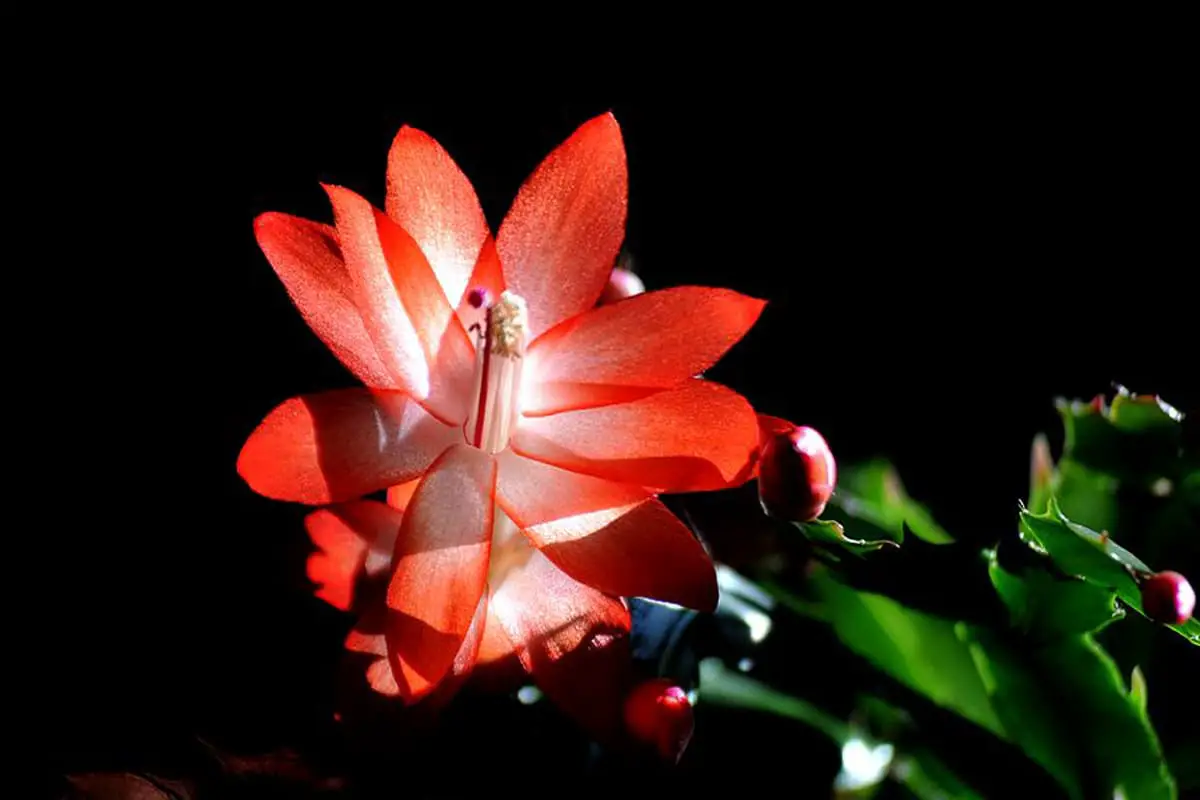
Schlumbergera truncata is a succulent epiphyte native to the coastal mountains of south-eastern Brazil. In its natural habitat, it grows on trees or rocks in shaded, humid environments. The plant has a shrub-like appearance with arching or pendulous stems composed of flattened segments.
The stem segments are 4-6 cm long and 2-3 cm wide, with 2-4 pointed teeth on each side. The areoles, located at the tips of these teeth, produce flowers and occasionally aerial roots. The stems become woody with age, providing structural support for the plant.
Flowers are produced from areoles at the ends of the stems. They are typically 6-8 cm long and 4-6 cm in diameter, with numerous tepals arranged in a way that gives the flower a somewhat irregular appearance. The numerous stamens are arranged in a ring, and the style extends beyond them.
The fruit is a small, fleshy berry, usually red or pink, containing numerous small seeds. In cultivation, the flowering period can be manipulated by controlling light exposure and temperature, allowing growers to produce blooming plants for specific seasons.

Through extensive breeding programs, hundreds of cultivars of Schlumbergera have been developed. These varieties showcase a wide range of flower colors, petal shapes, and growth habits. It’s worth noting that the term “Cymbidium” mentioned in the original text is incorrect, as Cymbidium refers to a genus of orchids, not Schlumbergera.
Some popular varieties of Schlumbergera include:
‘Gold Charm’: Features golden-yellow flowers, a rare color in Schlumbergera.
‘Bristol Queen’: Produces large, white flowers with a slight pink tinge.
‘Dark Eva’: Displays deep magenta-red flowers.
‘Kris Kringle’: Bears bright red flowers, perfect for the holiday season.
‘Caribbean Dancer’: Produces bi-colored flowers with red petals and white centers.
‘Thor Allie’: Features salmon-pink flowers with white centers.
‘Lavender Doll’: Displays light purple or lavender flowers.
These varieties offer a range of colors from pure white to deep reds, purples, and even yellow or orange hues. Some cultivars also exhibit bi-colored or multi-colored flowers, adding to the diversity of the genus.
Schlumbergera hybrids are often divided into two main groups: the Truncata Group (derived from S. truncata) and the Buckleyi Group (complex hybrids involving S. russelliana). The Truncata Group tends to flower earlier (around Thanksgiving in the Northern Hemisphere) and has pointed stem segments, while the Buckleyi Group flowers later (around Christmas) and has more rounded stem segments.
In cultivation, Schlumbergera plants prefer bright, indirect light, well-draining soil, and moderate humidity. They are popular as houseplants worldwide due to their attractive flowers, ease of care, and ability to bloom during winter months when many other plants are dormant.
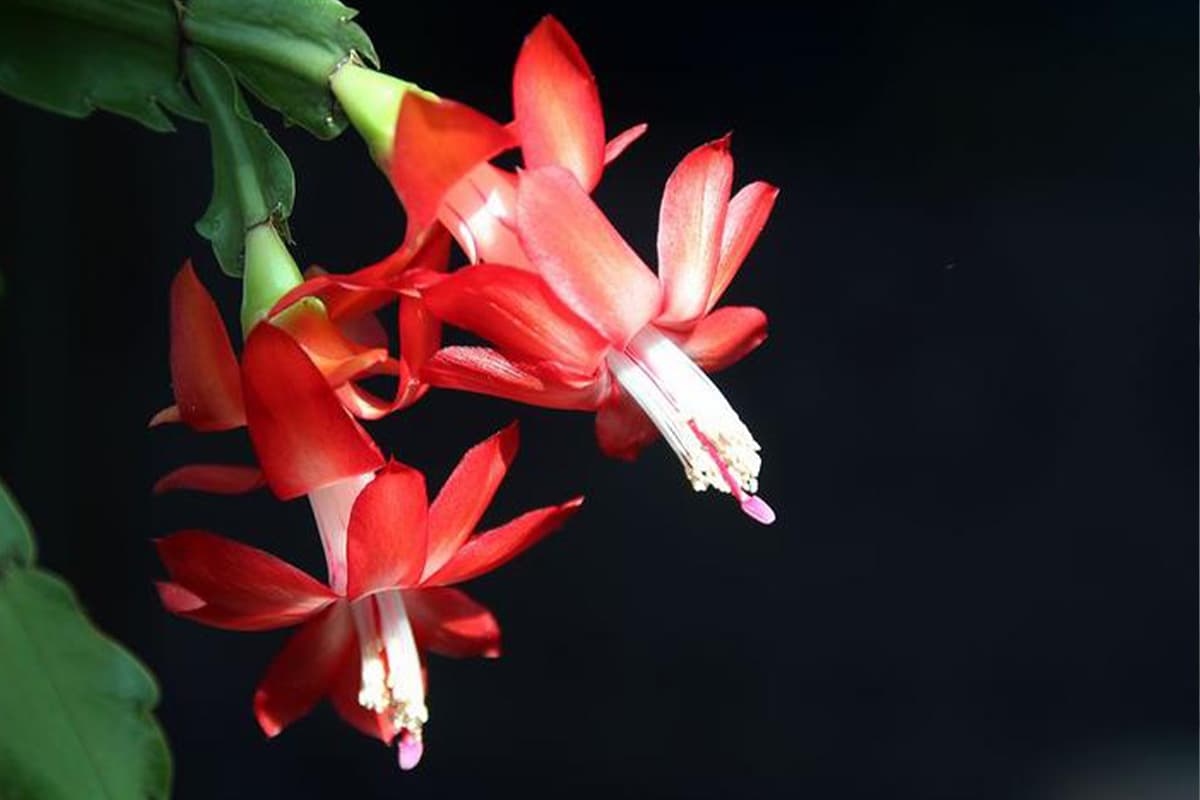
The Crab Claw Orchid (Schlumbergera truncata) thrives in warm, humid, semi-shaded environments. It is not frost-tolerant, requiring indoor protection during winter with minimum temperatures above 10°C (50°F). The optimal growth temperature range is 20-25°C (68-77°F).
This epiphyte prefers a well-draining, organically-rich substrate. As a short-day plant, it can bloom within 2-3 months under 8-10 hours of daily light exposure. Its flowering period can be manipulated by controlling light exposure.
Native to the coastal mountains of south-eastern Brazil, the Crab Claw Orchid has been widely cultivated in tropical and subtropical regions globally. It has been successfully introduced and cultivated in various parts of China.
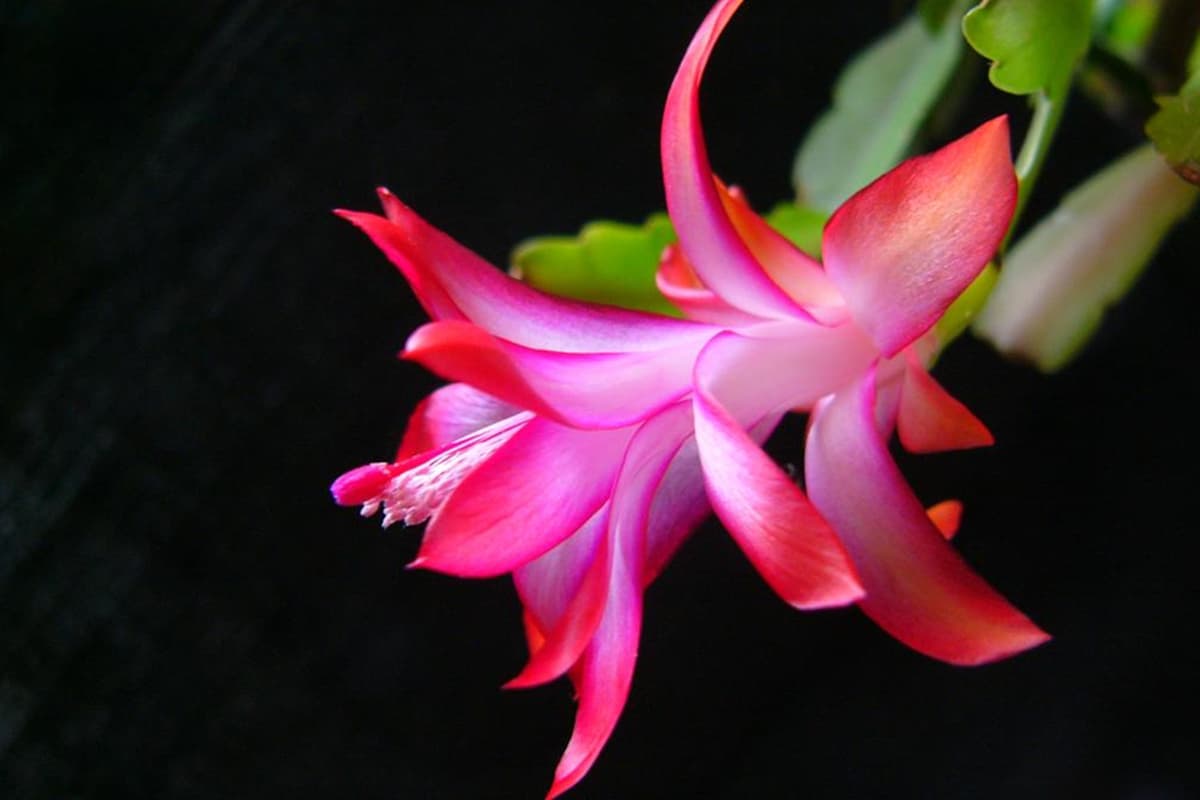
The Crab Claw Orchid is an epiphytic succulent with a shrub-like, leafless form. Its thornless stem is multi-branched and typically pendulous.
Mature stems are woody and slightly cylindrical, while young stems and branches are flattened. Internodes are rectangular to ovate, measuring 3-6 cm long and 1.5-2.5 cm wide, with a fresh green color occasionally tinged with purple.
The stem segments have truncated tops with 2-4 coarse serrations on each side and a prominent midrib on both surfaces. Areoles occasionally bear a few short spines.
Flowers are zygomorphic, rose-red, and 6-9 cm long, blooming individually at branch tips. The calyx has a short tubular base, separating at the top. The corolla consists of several whorls with a long tubular base, separating at the top, with the inner whorls having progressively longer tubes.
Numerous stamens are arranged in two whorls, protruding and curving upwards. The deep red pistil exceeds the stamens in length and features a seven-lobed stigma. Fruits are pear-shaped, red berries, approximately 1 cm in diameter.
The Christmas Cactus thrives in loose, organically rich, well-aerated, and well-draining soil with a slightly acidic pH. Annual repotting with fresh soil after flowering is recommended to maintain optimal growing conditions.
As a succulent, the Christmas Cactus requires moderate watering. Overwatering, especially during blooming, can cause bud and flower drop, and potentially root rot. Weekly watering is typically sufficient, ensuring thorough but slow application to avoid shallow watering.
Organic, well-decomposed fertilizers are preferred over chemical or concentrated ones. Fertilization should align with growth periods, pausing during dormancy and applying once or twice monthly during active growth.
Optimal growth occurs around 25°C (77°F), with semi-dormancy setting in above 30°C (86°F). Winter indoor temperatures should be maintained around 15°C (59°F). Temperatures below 10°C (50°F) or sudden fluctuations can cause bud and flower drop. During blooming, 10-15°C (50-59°F) is ideal, with diffused light to extend the display period.
The Christmas Cactus prefers indirect light, avoiding hot temperatures, direct sunlight, and rain. In summer, place it in a well-ventilated indoor location or shaded balcony. From autumn, gradually increase light exposure to 50%, promoting flower bud differentiation. Provide ample sunlight from late autumn through winter.
Biennial repotting in March or April is recommended. Use loose, fertile, well-draining, slightly acidic soil with a layer of fine sand at the pot’s base for drainage. During repotting, prune crowded or weak branches to encourage robust growth and abundant blooming.
Provide appropriate support based on plant size, especially for mature specimens over five years old. Replace supports timely to prevent toppling due to crown weight. For dense crowns, consider pruning to create a double-layered structure, improving ventilation, light penetration, and aesthetic appeal.
After spring flowering, prune branches 3-4 nodes below spent blooms and thin out old or crowded growth. Remove excess new growth at node ends, leaving 1-2 strong shoots. For 3-5 year old plants, use wire supports to create an umbrella shape, promoting photosynthesis and enhancing display.
Ensure adequate autumn and winter sunlight to prevent bud drop. Provide support for top-heavy plants. After flowering, remove spent blooms and control watering until new growth appears. Use a well-balanced potting mix for grafted specimens and repot every 1-2 years in spring after flowering.
Manage watering carefully during dormancy periods, maintaining slightly dry conditions in early spring and semi-moist soil during summer dormancy. Resume normal watering as vigor returns in autumn, misting buds frequently during formation. Proper watering management is crucial for prolonged blooming and overall plant health.
Timing: The optimal periods for propagating Christmas cacti are spring and fall. In spring, aim for March to June, ideally after the flowering period. In fall, September to October is most suitable.
Cuttings: Select 3-7 full, healthy stem segments as cuttings. Each segment should contain 2-3 leaf joints. Allow the cut ends to callus in a cool, well-ventilated area for 24-48 hours before planting.
Substrate: Prepare a well-draining, porous substrate. A mixture of 2 parts peat moss, 1 part perlite, and 1 part coarse sand works well.
Planting: Insert the callused end of the cutting about 1 inch deep into the substrate. Maintain slight moisture and provide bright, indirect light. Rooting typically occurs within 6-8 weeks.
Scion Preparation: Select 2-3 healthy stem segments as scions. Using a sterile, sharp knife, make a V-shaped cut at the base of each scion, approximately 1.5-2 cm long. Remove the epidermis from the cut area.
Rootstock Preparation: Choose a compatible rootstock, such as Pereskiopsis or Hylocereus. Make a corresponding vertical incision at the top of the rootstock, slightly longer than the scion cut.
Grafting Process: Insert the scion into the rootstock incision, ensuring cambium layers align. Secure the graft using split bamboo sections or grafting clips. Maintain the graft in a warm, humid environment out of direct sunlight.
Healing: The graft union should heal within 2-3 weeks. Gradually acclimate the grafted plant to normal growing conditions.
Sterilization: Disinfect all tools with 70% isopropyl alcohol before and between cuts to prevent infection.
Timing: Perform grafting on a sunny morning when both rootstock and scion are turgid, facilitating faster healing.
The Christmas cactus often suffers from anthracnose, root rot, and leaf blight, especially in hot and humid conditions. Severely affected plants should be uprooted and incinerated.
In the early stages of disease, spray with a 500 times diluted solution of 50% carbendazim wettable powder every 10-15 days, for a total of three sprays.
When infested with scale insects, the leaf stems are covered with white scales, causing the plant to weaken and turn yellow-white. If the damage is light, you can scrape it off with a bamboo slice.
In severe cases, spray with an 800 times diluted solution of 25% Imidacloprid emulsion. If red spider mites are present, spray with a 1000-1500 times diluted solution of Oxidized Le Fruit.
The stems of the Christmas cactus often hang down due to their length, so it’s often used as a hanging plant for decoration.
The Christmas cactus blooms around Christmas and New Year’s Day, making it suitable for window sills, entrances, and exhibition hall decorations. However, due to cultivation methods, some Christmas cacti are regulated to bloom in October.
In countries like Japan, Germany, and the United States, the Christmas cactus has been produced on a large scale and has become one of the main indoor potted plants in winter.
The Christmas cactus, named for its crab claw-like stem joints, is also known as the “Christmas cactus” in Western Christian countries because it blooms around Christmas.
The symbolism of the Crab Claw Orchid: Great fortune is upon you, and your luck can change the world.

Peggie was once a high school mathematics teacher, but she set aside her chalkboard and textbooks to follow her lifelong passion for flowers. After years of dedication and learning, she not only established a thriving flower shop but also founded this blog, “Flowers Library”. If you have any questions or wish to learn more about flowers, feel free to contact Peggie.
 English
  العربية
  Bahasa Indonesia
  Deutsch
  Français
  Italiano
  Nederlands
  Português
  Русский
  日本語
日本語