600+ Types of Flowers A To Z (With Names and Pictures)
Types Of Flowers By Names (A-Z) Types Of Flowers By Color Types Of Flowers By Season Types Of Flowers By Blooming Time 600+ Types of Flowers No. Flower Name No.…

Rudbeckia laciniata: Also known as Black-eyed Susan, Yellow Coneflower, False Sunflower, and other names, this species belongs to the order Asterales, family Asteraceae.
It is a perennial herb with stems that are either glabrous or slightly covered with short rough hair. The leaves are alternately arranged, glabrous or sparsely covered with short hair.
The inflorescences are solitary at the ends of branches, with long peduncles. The involucre is hemispherical; the receptacle is globular; the ray florets are golden yellow, and the laminae are inversely lanceolate; the disk florets are yellow or yellow-green.
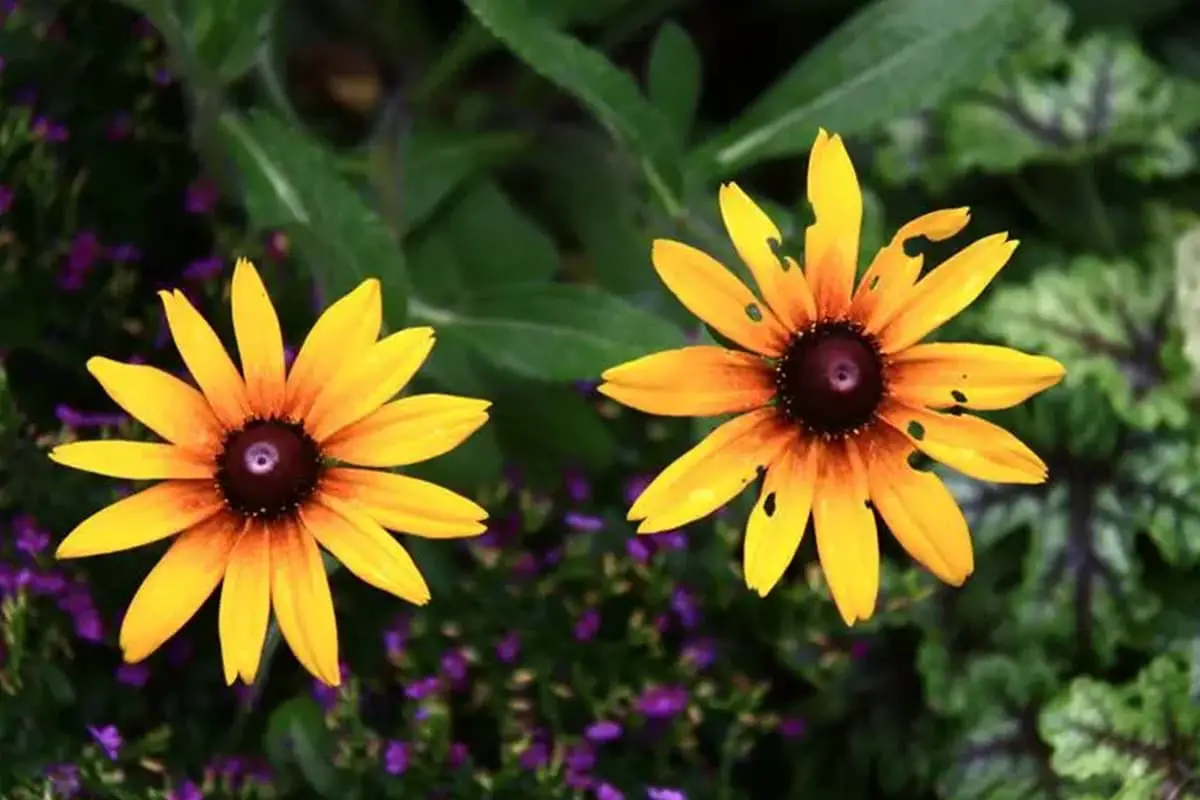
The achene is hairless and slightly four-angled. The blooming period is from July to October. Native to North America, this plant thrives in well-ventilated, sunny environments, is not demanding in terms of soil quality, but does not tolerate wet conditions.
This perennial herb ranges from 50 to 200 centimeters in height. The upper part of the stem branches and is either hairless or slightly covered with short rough hair. The leaves are alternately arranged, glabrous, or sparsely covered with short hair.
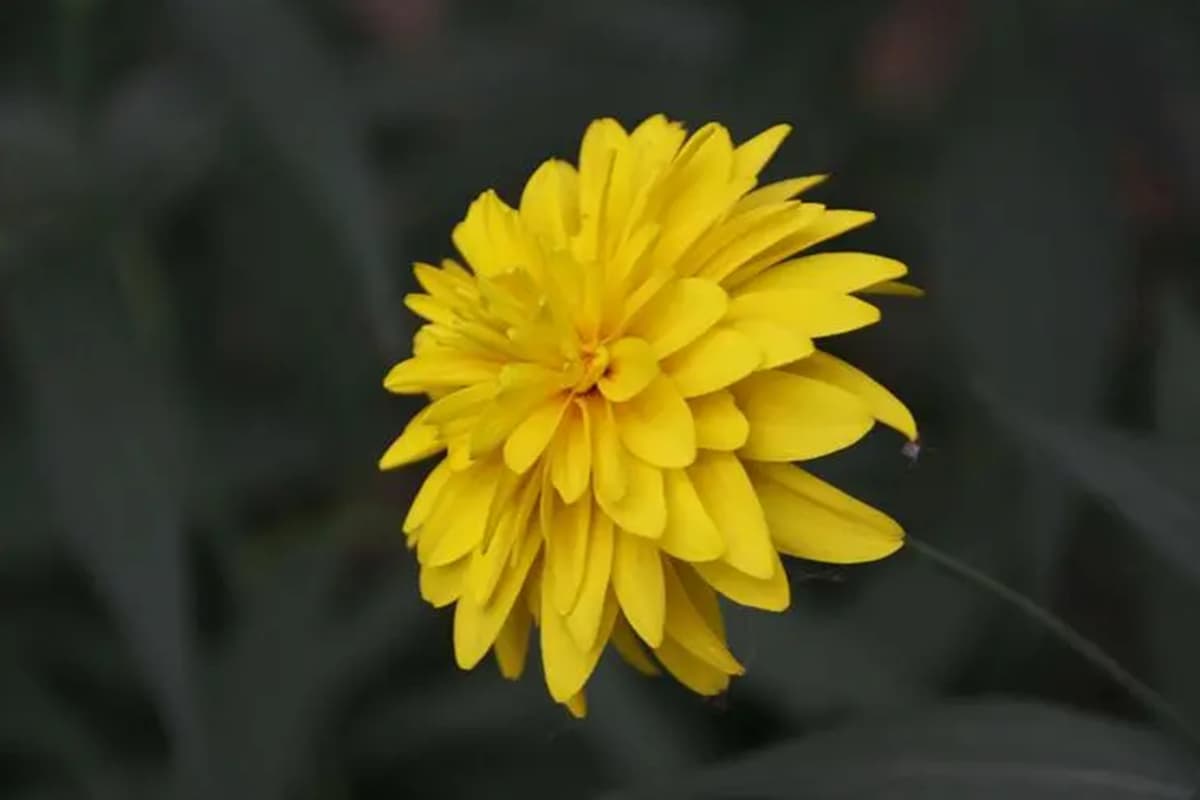
The lower leaves have petioles, are either unlobed or pinnately lobed with 5-7 deep segments, the segments are oblong-lanceolate with acute tips, and the margins are irregularly and sparsely serrated or slightly lobed; the middle leaves are 3-5 lobed, the upper leaves are unlobed, ovate, with acute tips, entire or with a few coarse teeth, and the back and edges are covered with short rough hair.
The flower heads are solitary at the ends of the branches, with long peduncles, and 7-12 centimeters in diameter.
The involucre is hemispherical; the bracts are in two rows, oblong, 7-10 millimeters long, with acute and slightly curved tips, covered with short hair. The receptacle is globular; the paleae are truncate at the top, hairy, and as long as the achenes.
The ray florets are golden yellow; the laminae are inversely lanceolate, about twice as long as the bracts, with two short teeth at the tip; the disk florets are yellow or yellow-green.
The achene is hairless, flattened, slightly four-angled, about 5-6 millimeters long, with a small crown at the top with four teeth. The blooming period is from July to October.
The plant favors well-ventilated environments with plenty of sunlight but is not very sensitive to light. It is highly adaptable, cold-resistant, and drought-tolerant.
It is not demanding in terms of soil quality but does not tolerate wet conditions. It grows well in well-drained, loose sandy soil.
Although it is a herbaceous plant, it has characteristics of a woody plant, with stems that are hard and not easily knocked down, and it also has disease and pest resistance.
Therefore, it is easy to cultivate, and its sensitivity to sunlight is not strong, so whether planted in areas with abundant sunlight or in environments with weaker light, the vibrancy of its flowers is not affected.
It is native to North America and is a beautiful ornamental plant commonly cultivated in gardens across China.
The plant is commonly propagated through division and sowing.
This can be done in both spring and fall. Early spring, when the buds are just sprouting, or after flowering in autumn, is the most suitable time for division.
The sprouting shoots are directly divided and transplanted from the parent plant, or the underground rhizomes are dug up and divided. When dividing, each sub-plant should have 3-4 terminal buds.
In the south, division is best done from October to November, while in cold northern regions, it is generally done from March to April.
Seeds can be sown in both spring and fall, and their germination capacity can be maintained for about two years. In the south, seeds can be sown directly in outdoor nursery beds; in the north, seeds are sown outdoors in the autumn or raised in greenhouses or tunnels in spring.
Fertile sandy soil is used for the seedbed. The soil is placed into a seedling tray, leveled, and watered thoroughly. Seeds are mixed with fine sand and scattered over the nursery bed at a rate of 5-6 grams per square meter.
After sowing, the seeds are covered with soil, and under suitable temperatures, seedlings emerge in 5-7 days. Once they have grown 2-3 pairs of true leaves, they can be transplanted for further cultivation. After the last frost, they can be planted outdoors.
The Cutleaf Coneflower has a large plant form, producing numerous flowers during its long blooming season with a short leaf-fall period, creating attractive displays for up to half a year.
This makes it suitable for arrangements in parks, institutions, schools, and home gardens. It can also be used in flower beds, borders, and as a premium choice for cut flowers and vase arrangements. Additionally, it can be planted along the edges of lawns in a naturalistic style.
The leaves of the Cutleaf Coneflower are known for their heat-clearing and detoxifying effects.
Chemical components include pubescent rudbeckolide and 15-acetyloxypubescent rudbeckolide, which have shown inhibitory activity against P-388 lymphocytic leukemia in mice in laboratory studies.
It is used for abdominal pain due to damp-heat accumulation in the gastrointestinal tract, diarrhea, and tenesmus. It has a bitter taste and a cold nature, affecting the stomach and large intestine meridians.
This species is listed in the Chinese Plant Atlas database as a toxic plant, with toxicity present throughout the entire plant; symptoms of livestock poisoning include reduced appetite, lethargy, increased excretion, and vision impairment. For internal use, it is taken as a decoction, 9-12 grams.

Peggie was once a high school mathematics teacher, but she set aside her chalkboard and textbooks to follow her lifelong passion for flowers. After years of dedication and learning, she not only established a thriving flower shop but also founded this blog, “Flowers Library”. If you have any questions or wish to learn more about flowers, feel free to contact Peggie.
 English
  العربية
  Bahasa Indonesia
  Deutsch
  Français
  Italiano
  Nederlands
  Português
  Русский
  日本語
日本語