600+ Types of Flowers A To Z (With Names and Pictures)
Types Of Flowers By Names (A-Z) Types Of Flowers By Color Types Of Flowers By Season Types Of Flowers By Blooming Time 600+ Types of Flowers No. Flower Name No.…

The single-petaled yellow thorn rose is an upright shrub and is the primitive species from which cultivated yellow thorn roses are derived. It is an upright shrub, growing 2-3 meters tall. The branches are thick, dense, and sprawling.
The twigs are hairless, with scattered thorns but no spines. The small leaves are broadly ovate or nearly round. The flowers are solitary, located at leaf axils, single-petaled, and lack bracts. The petals are yellow and broadly ovate.
The fruit is nearly spherical or ovate-round, and is purple-brown or black-brown. It blooms from April to June and bears fruit from July to August.
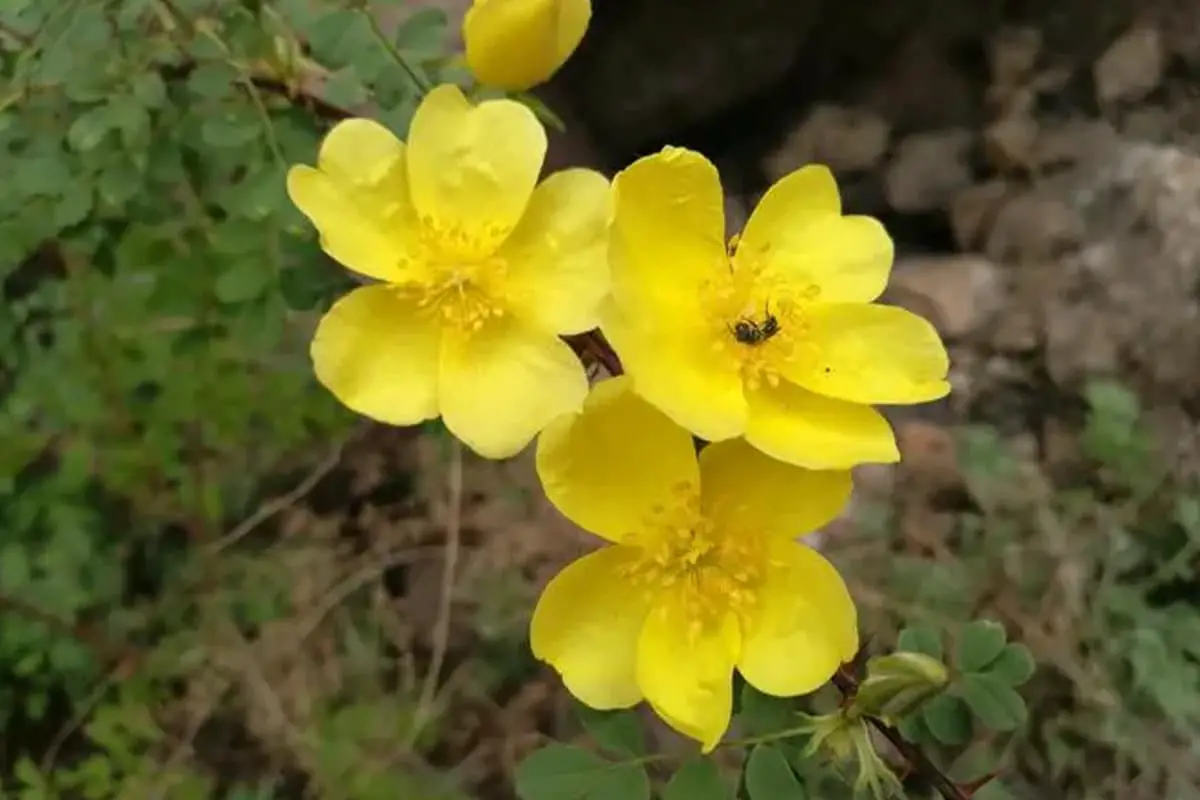
The plant is native to Chinese provinces and regions like Heilongjiang, Jilin, Liaoning, Inner Mongolia, Hebei, Shandong, Shanxi, Shaanxi, and Gansu.
The single-petaled yellow thorn rose is the ancestral species of the cultivated yellow thorn rose. It’s an upright shrub, standing 2-3 meters tall. The branches are thick, dense, and sprawling. The young branches are without hairs and have scattered skin thorns but lack spines.
There are 7-13 small leaves, with leaf stalks measuring 3-5 cm long. The small leaflets are broadly ovate or nearly round, occasionally elliptical, with a rounded tip and a broadly wedge-shaped or nearly round base. The edges have blunt serrations.
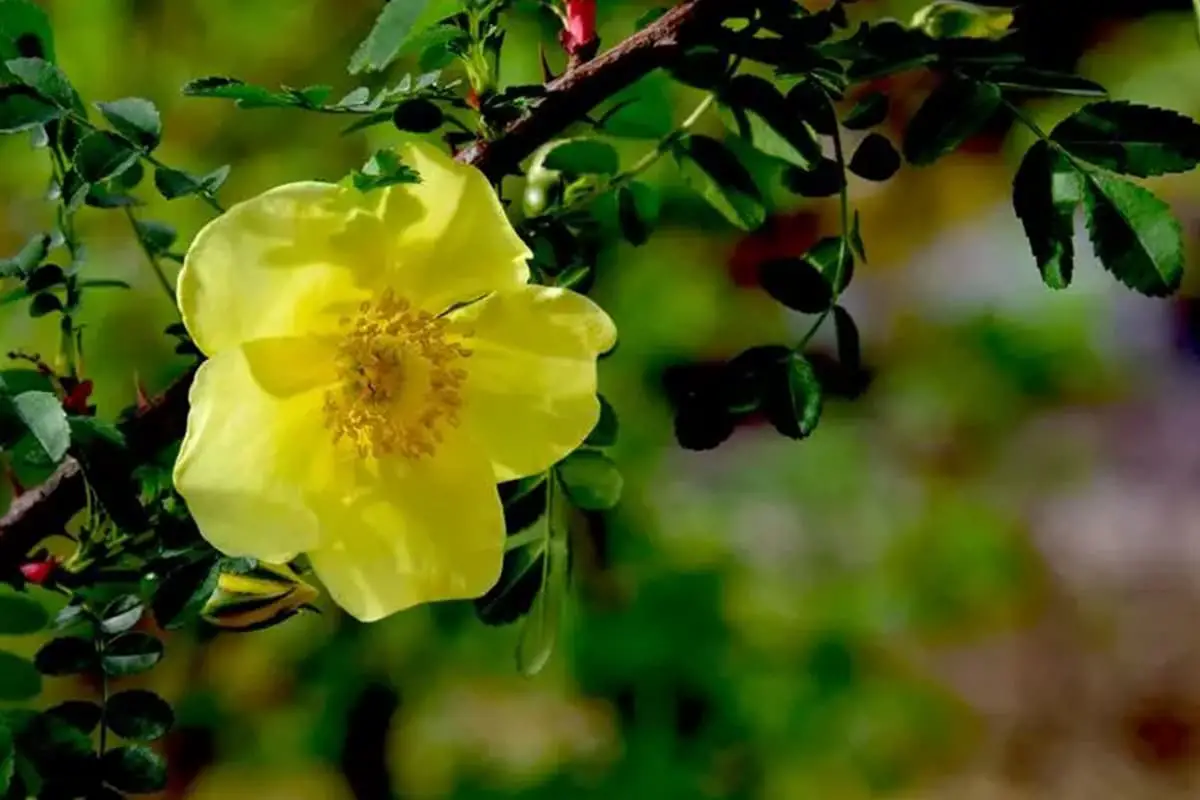
The tops are hairless, while the undersides are sparsely hairy when young, but this hairiness gradually sheds. The axis and petioles have sparse soft hairs and small thorns.
The stipules are band-like and lanceolate, mostly adhering to the petiole, with a separate portion shaped like an ear, having serrated and glandular edges.
The flowers are solitary, located in the leaf axils, single-petaled, yellow, and lack bracts. The flower stalk is 1-1.5 cm long, hairless, and gland-less. The flower’s diameter is 3-4(-5) cm. The sepals and sepal tubes are hairless on the outside.
The sepals are lanceolate, with entire edges, a gradually pointed tip, sparsely soft hair on the inside, and denser edges. The petals are yellow, broadly ovate with a slightly concave tip and a broadly wedge-shaped base.
The pistils are separate, covered in long soft hairs, protruding slightly from the sepal tube’s mouth, and much shorter than the stamens.
The fruit is nearly spherical or ovate-round, purple-brown or black-brown in color, measuring 8-10 mm in diameter, hairless, with sepals reflexed post-flowering. The flowering period spans April to June, while the fruiting period is from July to August.
The plant prefers sunny slopes or shrubs.
It is found in the Chinese provinces and regions of Heilongjiang, Jilin, Liaoning, Inner Mongolia, Hebei, Shandong, Shanxi, Shaanxi, and Gansu.
Medicinal Flower: It is used to regulate qi, relieve depression, harmonize blood, and disperse blood stasis.
I hope this provides a clear understanding of Rosa xanthina. Let me know if you need further translations or have any other questions!

Peggie was once a high school mathematics teacher, but she set aside her chalkboard and textbooks to follow her lifelong passion for flowers. After years of dedication and learning, she not only established a thriving flower shop but also founded this blog, “Flowers Library”. If you have any questions or wish to learn more about flowers, feel free to contact Peggie.
 English
  العربية
  Bahasa Indonesia
  Deutsch
  Français
  Italiano
  Nederlands
  Português
  Русский
  日本語
日本語