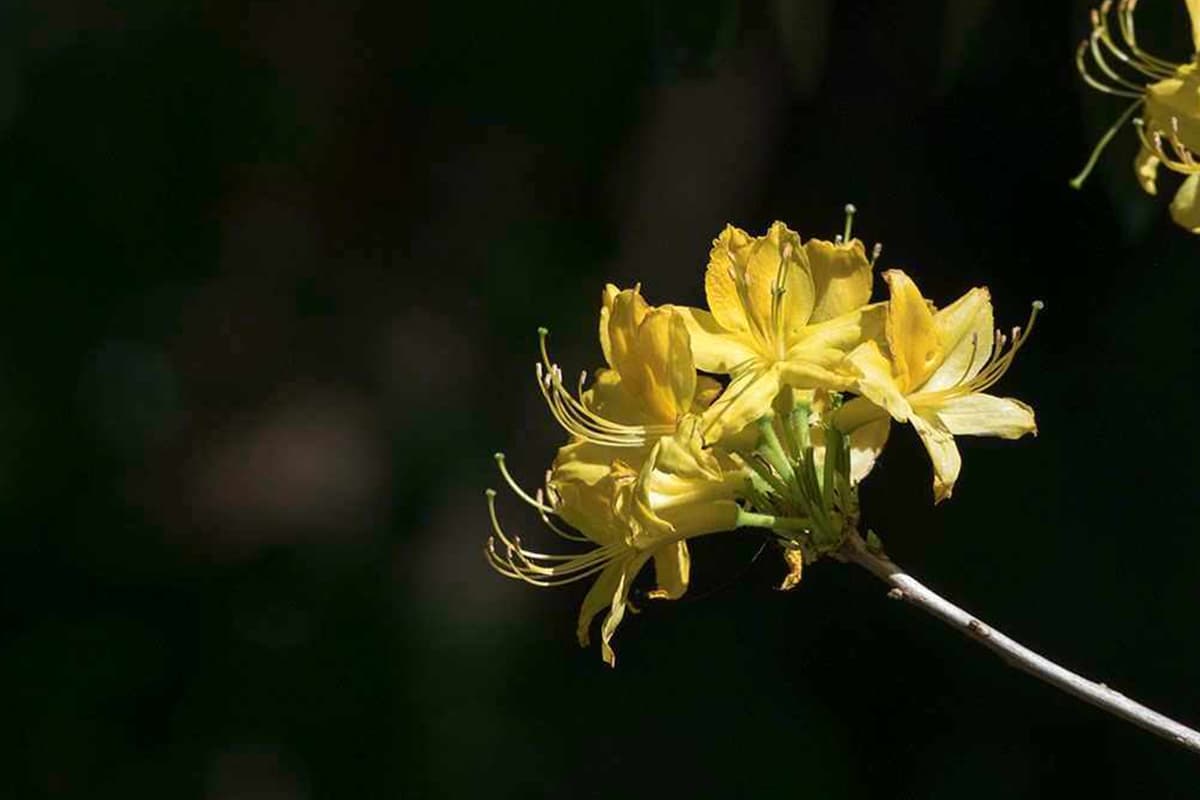
The Rhododendron molle, which belongs to the Rhododendron family, is easily identifiable due to its large leaves densely covered with soft, gray-white hairs and sparse stiff hairs; its large, yellow or golden yellow corolla.
This deciduous shrub grows to a height of 1 to 4 meters. The mature branches are smooth and brownish, while the younger branches have short soft hairs. It has single alternating leaves with short, hairy petioles.
The leaf blades are ovate to elliptical-lanceolate, blunt at the tip with a short point, wedge-shaped at the base, and entire. The edges have upwardly curved stiff hairs, and the underside is densely covered with gray-white short soft hairs when young.
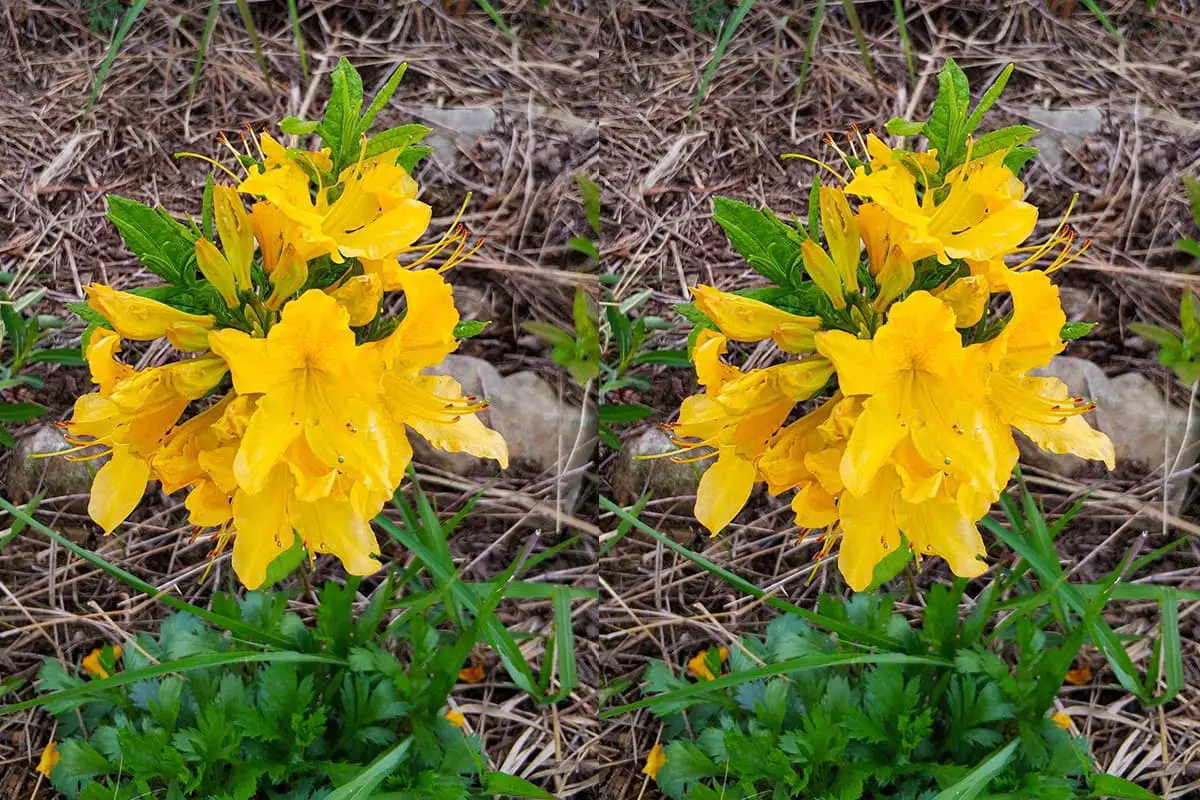
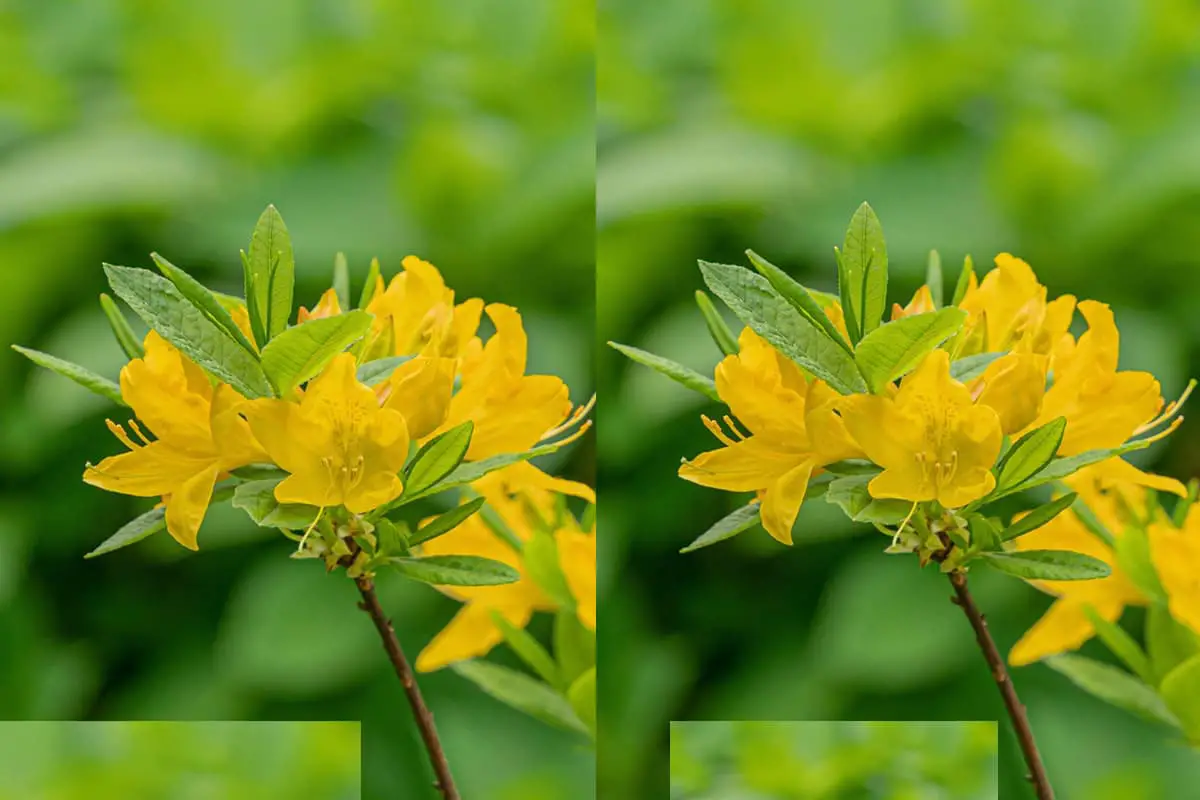
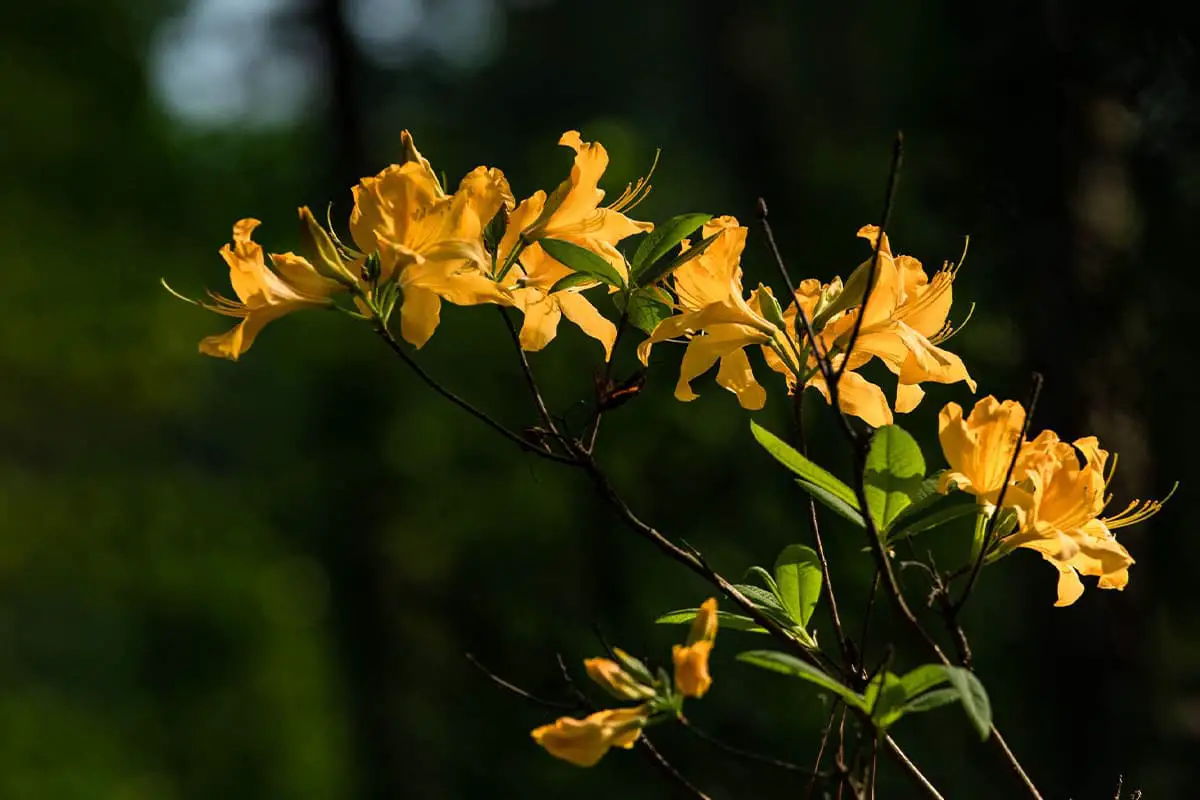
The numerous flowers form a short corymbose inflorescence at the top and bloom simultaneously with the leaves. It has a funnel-shaped, bright yellow corolla and a single, superior pistil with five chambers, externally covered with gray long hairs.
The style is slender and longer than the stamens. The mature fruit is a deep brown, elongated oval capsule that splits between the chambers. It has numerous, tiny seeds. The flowering period is from April to May, and the fruiting period is from June to July.
It is commonly found on slopes, in crevices, and in shrubs. The flowers or inflorescences are used for medicinal purposes and are harvested during the flowering period.
I. Morphological Features
Original Morphology
The plant is commonly known as Yellow Azalea, Jade Branch, Sheep Don’t Eat Grass, Yellow Rhododendron, Yellow Azalea, Sheep Won’t Graze, Southern Indian Grass, Yellow Rhododendron, Mountain Tiger, Shadow Mountain Yellow, Eight-Cent Hemp, Mountain Leopard, Mountain Loquat, Yellow Rice Festival Firewood, Yellow Stump Standard, and Large Leaf Stump Standard.
It is a deciduous shrub, measuring 1-2 meters in height. The old branches are smooth and brown, while the young branches are short and soft. The leaves are alternately arranged, with short petioles and hair.
The leaf blade is elliptical to ovate-lanceolate, with a blunt tip and short point, a wedge base, and upward bending stiff hairs along the edge. The back of the leaf is densely covered with grey-white short soft hair when young.
The flowers bloom in short terminal cymes with the leaves; the calyx is 5-lobed, persistent, and sparsely hairy. The flowers are golden yellow, and the corolla is funnel-shaped, externally hairy, with a 5-lobed tip and elliptical to ovate lobes.
The upper lobe is larger and has green spots; there are 5 stamens, as long as or slightly protruding from the corolla. The pistil is single, the ovary is superior with 5 chambers, externally covered with grey long hair, the style is slender, longer than the stamens.
The capsule is elongated, dark brown when ripe, with sparse stiff hair; it splits between the cells, and the seeds are numerous and small. The flowering period is from April to May, and the fruiting period is from June to July.
Characteristics
The product has several flowers clustered on a single stem, mostly falling off as singles, grey-yellow to yellow-brown, wrinkled.
The calyx is 5-lobed, the lobes are semi-circular to triangular, the edges have long fine hair; the corolla is bell-shaped, the tube part is longer, about 2.5cm, the top is curled, 5-lobed, the petals are wide ovate, the tip is blunt or slightly concave; there are 5 stamens, the filaments are curled, equal in length or slightly longer than the corolla, with villous hair below the middle, the anthers are red-brown, the top hole is split; there is 1 pistil, the stigma is head-shaped; the flower stalk is 1-2.8cm long, brownish, with short villous hair.
The odor is slight, the taste slightly numb.
The dried inflorescences are mostly wrinkled, composed of 6-12 flowers, clustered on a single stem, yellow-grey to yellow-brown; the corolla is bell-shaped, the top is curled, the surface sparsely covered with short soft hair; the stamens are longer, the filaments curved and protruding from the corolla, some have fallen off, the anthers are egg-yolk yellow.
Those that are dried, yellow-grey, and free from impurities are considered the best.
Toxicity
The plant contains toxic ingredients such as quinolizidine alkaloids, rhodotoxins, and phototoxins.
Symptoms of poisoning include nausea, vomiting, diarrhea, slow heartbeat, decreased blood pressure, coordination disturbances, respiratory difficulties, and in severe cases, death can occur due to respiratory failure.
Treatment includes considering inducing vomiting or gastric lavage and purgation; administering egg white, activated charcoal, and sugar water; intravenous dripping of 5% glucose saline, and administering stimulants and warming treatments; if blood pressure drops, administer noradrenaline; if there are breathing difficulties, administer oxygen and perform artificial respiration if necessary. Folk remedies use gardenia juice for detoxification.
Chemical Composition
The flowers contain toxic ingredients such as quinolizidine alkaloids and phototoxins. The leaves contain flavonoids, rhodotoxins, and methyl usnate.
Identification
The powder is yellow-brown. The pollen is tetrahedral, 58-97μm in diameter, with 3 apertures. The non-glandular hairs of the calyx consist of several cells, cross-arranged in several rows, 29-68μm in diameter.
The non-glandular hairs of the corolla are single-celled, 10-20μm in diameter, up to 400μm or more in length, with thin walls, some of which have wall warts visible.
The epidermal cells of the pollen sac are polygonal or nearly circular, 13-31μm in diameter, arranged neatly and closely, the walls are slightly thickened, some of the stomata are obvious, and the cells contain yellow-brown substances.
The epidermal cells of the corolla are rectangular, square, or irregular, 26-78μm in diameter, with thin walls, and are wavy.
II. Distribution Range
Commonly found on hillsides, in crevices, and within shrubbery.
III. Primary Values
Functions
Flowers: Dispel wind and dampness, disperse stasis and relieve pain. Used for rheumatism, physical injuries, stubborn skin ringworm. Externally applied for ringworm, decocted for gargling in the treatment of toothache.
Roots: Expel wind and suppress cough, disperse stasis and relieve pain. Used for rheumatism, physical injuries, neuralgia, chronic bronchitis; externally applied to treat anal fistulas, and to kill snails.
Fruits: Search wind and relieve pain, suppress cough and asthma. Used for physical injuries, rheumatoid arthritis pain.
Stems, Leaves: Kill fly maggots, mosquito larvae, and snails.
Precautions
Not suitable for long-term or excessive consumption. Not recommended for those with physical weakness or pregnant women.
Storage
Store in a dry place, avoid dampness.
Remarks
The toxic components of this plant are quinotoxine, rhodotoxin, and photinotoxin.
Symptoms of poisoning include initial nausea, vomiting, diarrhea, slow heartbeat, low blood pressure, uncoordinated movements, difficulty in breathing, and in severe cases, death due to respiratory failure.
Remedies include inducing vomiting or stomach lavage and catharsis; ingesting egg whites, activated charcoal, and sugar water; IV drip of 5% glucose saline solution, and administering stimulants, warmth; if blood pressure drops, administer adrenaline; if breathing is difficult, provide oxygen, and perform artificial respiration if necessary.
Folk remedy includes detoxification with gardenia juice.


 English
  العربية
  Bahasa Indonesia
  Deutsch
  Français
  Italiano
  Nederlands
  Português
  Русский
  日本語
日本語