600+ Types of Flowers A To Z (With Names and Pictures)
Types Of Flowers By Names (A-Z) Types Of Flowers By Color Types Of Flowers By Season Types Of Flowers By Blooming Time 600+ Types of Flowers No. Flower Name No.…

The Quinticolor Red Leadwort, also known as the Pink Camellia, is a variant of the “Red Leadwort” Camellia. This mid-sized plant branches easily and has lush, glossy green leaves.
Its flowers are a striking pink, streaked and mottled with red. Occasionally, the flowers may display half-pink, half-red or entirely pink or red hues.
These vibrant, large flowers can reach up to 15 centimeters in diameter and are highly valued for their aesthetic appeal. The Pink Camellia typically blooms from mid-February to late March, making it a very popular variety of Camellia.
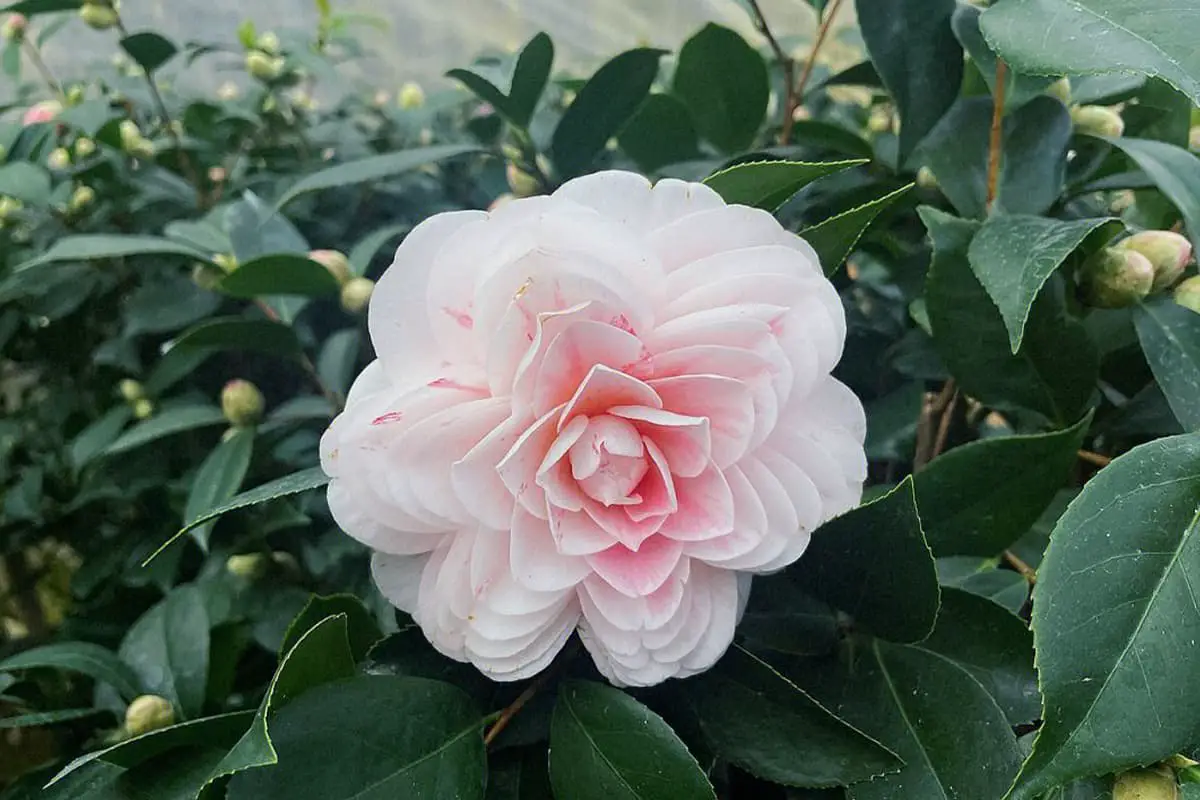
The Pink Camellia, also referred to as the Quinticolor Red Leadwort, is a variant of the “Red Leadwort” Camellia.
It shares the same characteristics as the Red Leadwort but it’s flowers, which are a lively pink adorned with red streaks and blotches, can sometimes appear half-pink, half-red or entirely pink or red.
This variant is considered more beautiful than the Red Leadwort. The two are very difficult to tell apart; however, the Red Leadwort generally grows more vigorously than the Pink Camellia.
The Red Leadwort has red or light red axillary buds, while the Pink Camellia has light yellow axillary buds and stronger leaf veins. These are distinguishing features. The blooming period is from mid-February to late March. It holds high ornamental value.
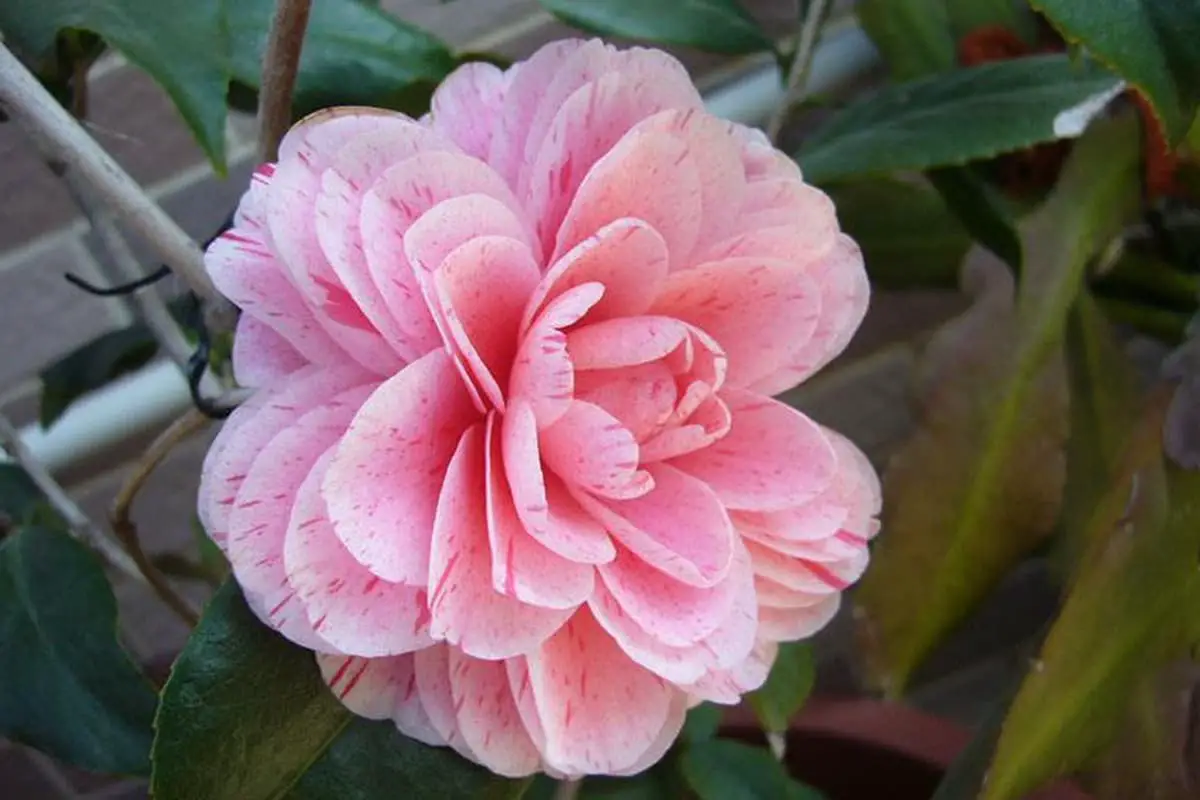
The Pink Camellia is a variety of Camellia. It is a shrub or small tree with purplish-red young branches and hairless tender branches. The leaves are leathery, dark green, and oval-shaped, gradually tapering to a point at the tip.
They are 5-10 cm long and 2.5-5 cm wide, with long tails at the leaf ends and flat leaf surfaces. The leaf stalks are dark red-brown.
The Pink Camellia flowers at the top, without a stalk. The flower form is completely double-petaled, rose-shaped, and sometimes radiating.
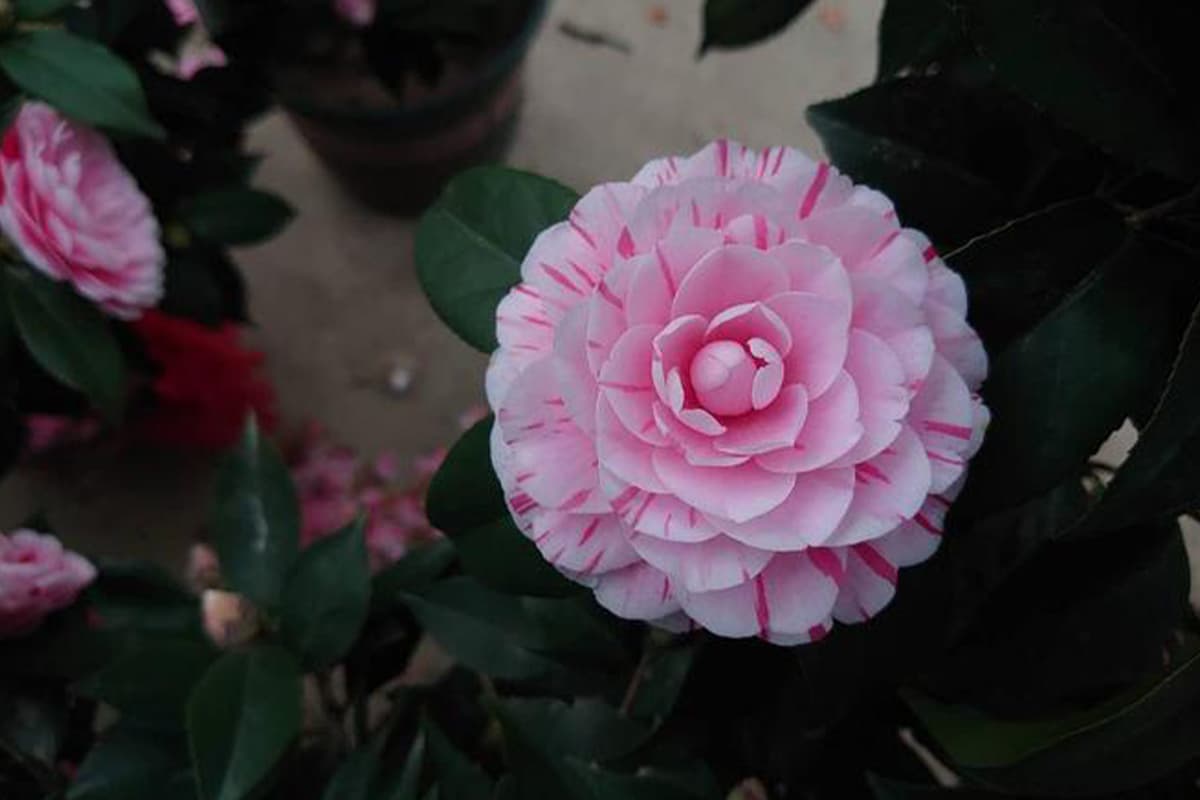
The flower colors vary, including solid red, solid pink with white edges, half-pink half-red, pink base with red patches, pink base with red lines.
The flowers are large, 10-12 cm in diameter, with 70-80 petals arranged in 7-9 rows, forming a rose shape or hexagonal, spiral arrangement. The corolla is slightly flat.
The petals are thick, round at the end, glossy, and the central petals are clasped like pearls. Sometimes, several small petals and stamens are tucked among the large petals.
The fruit is spherical, 2.5-3 cm in diameter, with 2-3 chambers, each containing 1-2 seeds. It splits into 3 sections. The fruit sections are thick and woody. The blooming period is from March to April.
This variety is wind-fearing, sun-loving, and should be planted in well-ventilated, warm, humid, well-drained, loose, and fertile sandy soil, loam, or peat soil. The optimal pH is 5.5-6.5.
The suitable temperature is between 20-32℃. Growth stops above 29℃, and leaves can get scorched at 35℃. A certain temperature difference is required. Environmental humidity should be above 70%.
It can withstand low temperatures down to -8℃ (natural overwintering, Yun Cha is slightly cold-resistant). In areas south of the Huai River, it can generally overwinter naturally. It prefers acidic soil and requires good aeration for root hair development.
Usually, peat, rotten sawdust, red soil, humus soil, or a mixture of the above can be used for cultivation. Camellias do not need shade in spring, autumn, and winter. In summer, they can be treated with 50% shading.
Soil is the foundation for the growth of potted camellias, as their roots rely on it for development. The water and nutrients necessary for the life activities of camellias are mainly absorbed from the soil.
Camellias prefer slightly acidic, humus-rich and loose, well-aerated mountain red (yellow) soil with a pH value between 5 and 6.5. Alkaline or heavy clay soils should not be used for potted camellias.
The soil mixture should consist of 50% mountain clay (mature red soil used for crops), 40% sawdust or edible mushroom residue, and 10% cake fertilizer powder or livestock manure and phosphate fertilizer powder.
Mix these components evenly, add a suitable amount of water, bag it, and let it mature. Let it sit for more than 20 days in summer and autumn, and over 30 days in spring and winter.
This soil is not only loose and well aerated, but also retains fertility and water, making it suitable for the growth and development of camellias.
Camellias need appropriate light, but they fear direct sunlight in high temperature. In spring and late autumn, move camellias to a sunny balcony or ground to receive all-day light, which promotes plant growth, bud differentiation, and robust flower buds.
When the summer sun is at its strongest, move the flower pots to a shaded, well-ventilated environment or to the upper or lower part of the north or south balcony.
You can also use a 75% shade net to cover the plants from 9 am to 5 pm to avoid direct sunlight, which can cause leaf injury or wilting of young plants. If possible, move the camellias under a sunshade for a safe summer.
Temperature is one of the important conditions for the growth of camellias. They prefer warmth, with the most suitable growth temperature being 18°C to 25°C, and a relative humidity of 60% to 65%.
The growth of camellias usually sprouts in mid to late March, begins to bud in April, forms terminal buds in mid to late May, stops growing, and gradually differentiates into leaf buds or flower buds, which take 180 to 240 days to bloom.
Summer shoots sprout in late July and stop growing in early September. Although camellias are cold-resistant, if a cold wave invades and the temperature suddenly drops below 0°C or is accompanied by a dry northwestern wind, it will cause frost damage to the tender branches.
The flower buds will wilt if they are frostbitten; hence, move the flower pot to a north-facing south area for safe wintering.
Camellias have many leaves with large surface areas, resulting in rapid transpiration. They prefer a humid climate and moist soil.
Therefore, you should provide enough water for potted camellias, watering them once a day during the spring and autumn growing seasons. In summer, especially during the “dog days”, water them once in the morning and once in the evening.
If the ground is dry, water or spray the surface of the flower pot and its surroundings once or twice to maintain a certain air humidity, and the plants will grow luxuriantly.
At the same time, note that due to frequent watering, and most households use tap water, the soil in the flower pot will alkalize over time.
Therefore, when watering, add 0.5% to 1% ferrous sulfate solution every month or use 5% to 8% edible vinegar solution to spray the leaves. Camellias like moist soil, but they fear water accumulation in the flower pot.
If water accumulates in the pot on rainy days, it must be drained in time to avoid the roots soaking in water and suffocating or rotting.
Camellias are plants that love fertilizer due to their robust growth, numerous leaves, and long flowering periods, requiring a significant amount of nutrients.
During the fertilization process, apply sufficient liquid fertilizer and long-lasting fertilizer when repotting. Depending on the size of the pot, apply 3 to 80 grams of matured cake fertilizer powder or sun-dried poultry manure to the bottom of the pot and mix with the soil.
Increase the application of organic fertilizer based on the growth stage of the plant. Except during the coldest and hottest periods of winter and summer, apply matured cake water once or twice a month.
The fertilizing method involves digging a small trench around the edge of the pot, applying the liquid fertilizer, and then covering with soil to avoid unpleasant smells.
Alternatively, you can mix matured cake fertilizer powder with the soil around the edge of the pot, allowing the plant to slowly absorb the nutrients. Urban gardeners can purchase specialized plant fertilizer from flower markets, which is both sanitary and safe.
To promote better growth of camellias, apply external root fertilizer once or twice a month during their vigorous growth period, spraying 0.2% to 0.3% dipotassium hydrogen phosphate and 1% to 2% plant growth regulator on the leaves.
The principle of fertilization is to apply lightly rather than heavily, dilute rather than concentrated, less rather than more, and always apply thin and frequent fertilization, especially avoiding raw fertilizer.
Camellias prefer to grow in environments with moderate air circulation and enjoy gentle breezes.
They appreciate the moisture brought by southeast winds but fear northwest winds and strong winds, which cause rapid evaporation of water, disrupting the balance between supply and demand of water in the plant and potentially damaging leaves, leading to dropped buds and flowers.
During winter, camellias should be kept in a sheltered, sunny environment with a certain temperature and humidity. In spring and autumn, move the flower pots to a balcony for proper ventilation and sunlight, allowing them to sway gently in the breeze.
This not only promotes good plant growth but also benefits bud differentiation, bud growth and development, and reduces the occurrence of diseases and pests. Years of practice have shown that moderate ventilation and suitable sunlight can help prevent diseases and pests.
During the rainy season in May and June, choose young parent plants, cut one-year-old tender branches from the top, about 10cm long, remove the lower leaves, use a blade to flatten the area below the node, and leave one apical bud and one lateral bud, with 2-3 leaves.
Insert into a medium of river sand or gravel, with a depth of 1/3 to 2/3. After insertion, cover with a grass curtain for shading, strengthen leaf spray to maintain air humidity in the insertion bed, and promote root growth.
To improve the survival rate of cuttings, soak them in a solution of 50-100ppm ABT rooting powder for 8-12 hours.
Choose robust seedlings or Camellia varieties that are easy to survive from cuttings as rootstocks, cut off about 4-5cm from the ground, split the pith about 1.5cm deep, use 1-2 year old branches as scions, keep 1-2 leaves on the upper part of the scion, shape the lower part into a wedge, insert into the split of the rootstock, ensuring close contact between the cambium layers of both.
Then tighten with a plastic strip. After grafting, cover the top of the scion with a plastic bag, tie the bottom with a band, but not too tight, so that water droplets form in the bag and continuously drip onto the rootstock.
Then add a paper bag outside the plastic bag to shield direct sunlight.
Each bud node is cut into a section, preserving a leaf and about 1.5cm in length. The lower part is cut diagonally and then inserted into a medium, deep enough to cover the branch. This method allows for optimal utilization of the branch, suitable for large-scale propagation.
Causes and Symptoms: The disease is caused by the fungus Colletotrichum gloeosporoides, which affects the leaves of the camellia. It is a major disease of camellias, with an infection rate of up to 33%.
Symptoms often appear on the leaf edges, leaf tips, and both sides of the leaf veins, initially as dark green spots that gradually enlarge into irregular patches, changing color from brown to black. In severe cases, it can spread to the entire leaf, causing extensive leaf fall.
Disease Occurrence: The occurrence of this disease is closely related to temperature and humidity. The general suitable temperature for disease occurrence is 25-28℃.
When the temperature is appropriate and humidity increases, especially during continuous rainfall, it can promote the spread and development of the disease. The disease generally begins in April, peaks in June-July, and tends to stop after September.
Control Methods:
① Thoroughly remove diseased leaves.
② Prune diseased and dead branches in winter.
③ Before the annual disease period, spray 1% Bordeaux mixture every half a month.
④ Spray a 600-fold dilution of Baizhangqing solution once a week, continue for 3-4 weeks.
⑤ Strengthen cultivation management, scientifically weed and fertilize. In spring, increase phosphorus and potassium fertilizers, and spray a 0.15% solution of monopotassium phosphate before leaf expansion.
Causes and Symptoms: This disease is caused by the parasitic algae Cephaleuros virescens. Lesions can appear on both sides of the leaf, but are mainly on the leaf surface.
In the initial stage, they appear as gray-green dots the size of needle tips, which gradually expand outward in a radial pattern, forming round or irregular lesions. The lesions are noticeably raised, with a surface of fine, felt-like stripes.
In the late stage of the disease, the color of the lesion changes from gray-green to dark brown. The cover of the pathogen affects the photosynthesis process of the leaf surface, thus weakening the growth of the camellia plant.
Disease Occurrence: The parasitic algae overwinter in the host tissue in the form of filamentous bodies. Under humid conditions, they produce motile spores that infect new plants.
This pathogen is a weak parasite. This disease is most severe in poorly grown camellia forests under high temperature and high humidity conditions, due to poor ventilation and light penetration.
Control Methods:
① Strengthen cultivation management, apply fertilizer reasonably, prune timely, and avoid excessive shade in the camellia forest. Ensure proper ventilation and sunlight to enhance the resistance of the camellia.
② A 0.2%-0.5% copper sulfate solution can be sprayed for prevention and control.
Cause and Symptoms: This disease is caused by the pathogenic fungus Glomerella cingulata, which infects the tender or old branches of the camellia, leading to branch necrosis.
Affected branches and leaves turn from green to pale yellow, gradually withering and falling from the top down, eventually resulting in the death of the entire branch.
Disease Pattern: The occurrence of this disease intensifies with the rise in spring temperatures, as the fungal spores that overwinter on diseased trees mature and spread to nearby camellia branches.
The fungus enters the tea tree through fresh buds, tender branch wounds, leaf scars, grafting or pruning wounds, and reproduces massively.
Control Methods:
① Remove and burn the diseased branches in winter.
② Remove unnecessary buds and weak branches to reduce the pathogen’s habitat.
③ Isolate diseased plants for care.
④ Before the camellia sprouts new shoots, spray fungicides such as methyl tobujin, fumeishuang, or baijinqing, especially on branch wounds.
⑤ Apply more phosphorus and potassium fertilizers, but less nitrogen fertilizer.
Cause and Symptoms: This disease is caused by several types of fungi, most commonly Phytophthora cinnamoni, Cylindrocladium crotalariae, and Armillaria, which primarily infect the roots of the camellia.
Infected plants have blackened, rotten roots, yellow leaves, dead shoot tips, falling flower buds, and the plants gradually wilt and die.
Disease Pattern: The pathogenic fungi overwinter in the soil or on diseased plants. In the spring, the fungi germinate and spread in the soil, infecting plant roots. The higher the temperature, the higher the incidence rate.
Control Methods:
① Diseased plants and nearby infected soil should be dug up promptly, and the surrounding soil should be disinfected with a 1% copper sulfate solution to prevent the spread of the fungus.
② Ensure good soil drainage and prevent waterlogging. ③ Cultivate camellia varieties with strong disease resistance.
Cause and Symptoms: This disease is caused by the fungus Phyllosticta sp., from the class Ascomycetes. Spots often occur on tender leaves, initially appearing as light brown circular stains.
The spots then spread, turning from light brown to dark brown, sometimes merging into larger patches or spreading across the entire leaf, causing massive leaf burn and shedding.
Disease Pattern: The pathogen survives on the host’s diseased remains, and spores are spread by wind, rain, and running water. The disease usually begins in May, peaking from July to September, resulting in significant leaf fall.
Control Methods:
① In the early stages of infection, a spray of 70% methyl tobujin at 1000-1500 times dilution, or 25% mancozeb at 400 times dilution can be used for prevention and treatment.
② During dry periods, increase leaf watering to suppress the occurrence of the disease.
Causes and Symptoms: This disease is caused by the fungus Giborinia camelliae Kohn, which infects the petals of camellias. The infected flowers first show small brown spots, which gradually enlarge until the entire flower turns brown and wilts.
Disease Pattern: The fungus can form sclerotia at the flower stalk, and its spores can be spread by the wind. The disease rate is usually lower in autumn. From December to March of the following year, as the temperature rises, the infection rate of flowers increases.
Control Methods:
①When camellia flowers infected with this disease are found, they should be removed and incinerated. Especially during the flowering period, it is necessary to promptly clean up the diseased flowers that have fallen on the ground.
②Before flowering, fungicides such as polyoxin can be sprayed on the flower buds 2-3 times.
③Choose to plant camellia varieties that bloom in autumn, or use gibberellin to treat mid-to-late flowering varieties to make them bloom in autumn and avoid the peak period of camellia blight.
④Use biological control methods. Inoculate the soil with the fungi Sporidesmium sclerotivorum and Coniotmyrium minitans to kill the fungal spores. ⑤Do not buy and cultivate camellia plants with flower blight.
Causes and Symptoms: This disease is induced by the damage of aphids and scale insects.
The surface of the leaves of the affected camellia is covered with a layer of fungal hyphae, forming a black “sooty” layer, which hinders the normal photosynthesis and gas exchange of the camellia plant, seriously hindering its growth and development.
Disease Pattern: The disease fungus likes low temperature and high humidity environmental conditions, among which the temperature conditions of 10-20°C are most suitable for the growth of the fungus.
Within this temperature range, the higher the temperature, the faster the fungus reproduces and spreads. Long-term overgrown with weeds, high humidity, and poorly lit camellia forests are conducive to the occurrence and spread of the disease.
Control Methods:
The pests that induce sooty mold are mainly aphids and scale insects, etc. Therefore, to prevent this disease, we must first prevent aphids and scale insects of camellia. Once the pests are eliminated, the disease will naturally disappear.
Flower language: humility, caution, virtue, true feelings, ideal love, elegance.
The radiant camellia, which can bloom in the freezing early spring and bring spring to people in the fragrant spring of peaches and plums, brings unlimited hope to life.
The camellia flower has experienced the vicissitudes of the years, and the flower shape is full and beautiful in spite of the wind, snow and frost.
In people’s hearts, she is a symbol of beauty. The camellia has coexisted with people, experiencing more than 2,500 years of long years, forming a wonderful culture about camellia.

Peggie was once a high school mathematics teacher, but she set aside her chalkboard and textbooks to follow her lifelong passion for flowers. After years of dedication and learning, she not only established a thriving flower shop but also founded this blog, “Flowers Library”. If you have any questions or wish to learn more about flowers, feel free to contact Peggie.
 English
  العربية
  Bahasa Indonesia
  Deutsch
  Français
  Italiano
  Nederlands
  Português
  Русский
  日本語
日本語