600+ Types of Flowers A To Z (With Names and Pictures)
Types Of Flowers By Names (A-Z) Types Of Flowers By Color Types Of Flowers By Season Types Of Flowers By Blooming Time 600+ Types of Flowers No. Flower Name No.…

Potentilla fruticosa, belonging to the Rose family and the Potentilla genus, is a shrub that can reach up to 2 meters in height, with bark that peels off longitudinally.
Its small branches are reddish-brown, featuring pinnate compound leaves with petioles covered in silky or sparse soft hairs; the leaflets are oblong, inverted-ovate, or ovate-lanceolate in shape, green on both sides, with a thin membranous stipule.
The flowers, borne singly or in clusters at the tips of branches, have densely soft-haired or silky-haired pedicels; the sepals are ovate, tapering to a sharp or gradually pointed tip.
Petals are yellow, broad, and inverted-egg-shaped with a blunt tip, longer than the sepals; styles arise near the base, with brownish-tan, nearly ovate achenes blooming and fruiting from June to September.
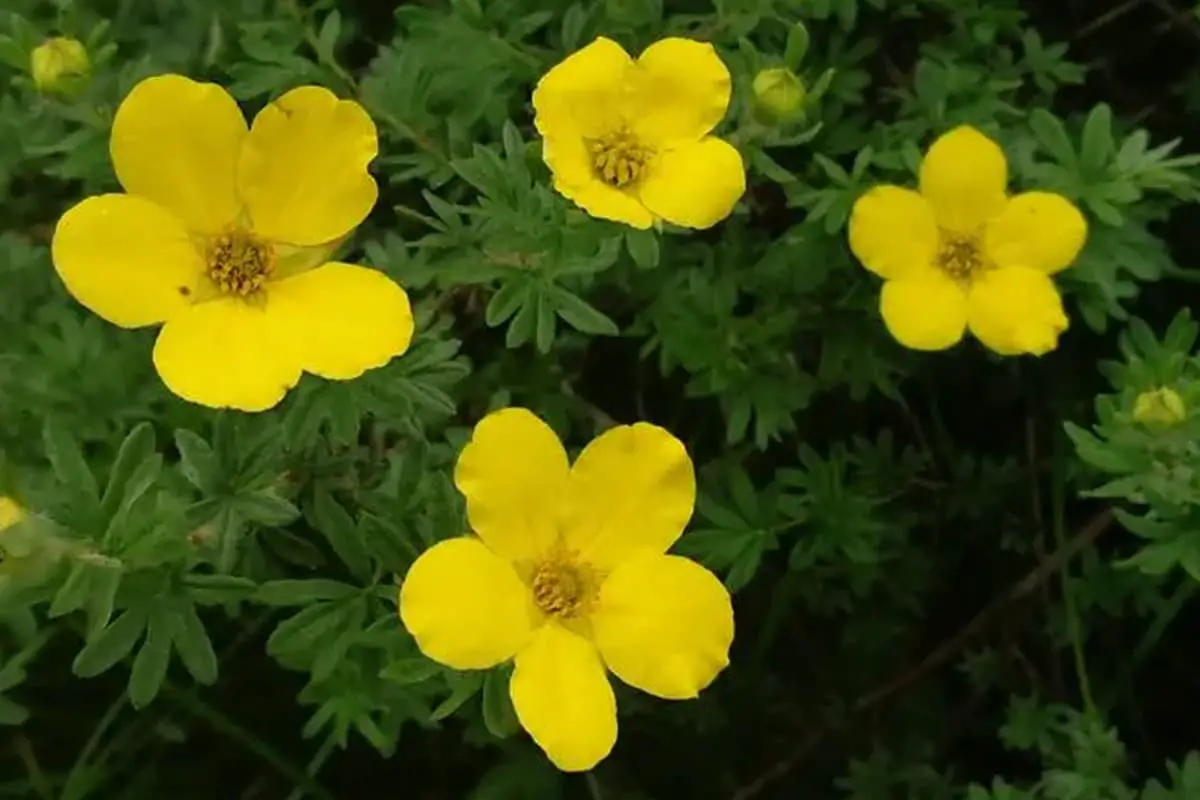
This shrub thrives on grassy slopes, gravelly slopes, thickets, and forest edges; with dense foliage and bright yellow flowers, it is ideal for ornamental gardening or as a low hedge. Its leaves and fruits contain tannins useful for producing tannin extract.
The tender leaves can be used as a tea substitute, while the flowers and leaves have medicinal properties, benefiting the spleen, alleviating dampness, clearing summer heat, and regulating menstruation.
The shrub, ranging from 0.5 to 2 meters tall, is multi-branched with bark peeling off longitudinally. The young branches are reddish-brown, covered with long, soft hairs when young.
The pinnate compound leaves have two, sometimes three, pairs of leaflets; the upper pair extends down to meet the rachis.
The leaf petioles are covered in silky or sparse soft hairs; leaflets are oblong to inverted-ovate or ovate-lanceolate, measuring 0.7-2 centimeters in length and 0.4-1 centimeter in width, with a flat margin, sharply pointed or rounded tip, wedge-shaped base, and green on both sides, sparsely covered with silky or soft hairs, or nearly hairless.
Stipules are thin, membranous, and wide, sometimes falling off.
Flowers, either solitary or in clusters, are borne at the branch tips with densely covered soft or silky-haired pedicels.
The flowers have a diameter of 2.2-3 centimeters; sepals are ovate with a sharp or gradually pointed tip, and petals are yellow, broad inverted-egg-shaped, and blunt at the tip, longer than the sepals.
The style is near the base, rod-shaped, slender at the bottom, constricted at the top with an enlarged stigma.
The achenes are nearly ovate, brownish-tan, and 1.5 millimeters long, with an outer covering of long, soft hairs. The flowering and fruiting period is from June to September.
Winter Jasmine is robust, cold-hardy, moisture-loving but intolerant of waterlogging, drought-resistant, and light-loving, performing poorly in shaded areas.
It is not demanding in terms of soil, thriving in sandy loam and plain sand, preferring fertile conditions yet tolerating poor ones.
This plant is found on grassy slopes, gravelly slopes, in thickets, and along forest edges, at altitudes of 1000-4000 meters.
For seed germination, begin by soaking the seeds in water at 50°C, using three times the volume of water to the volume of seeds, allowing the water to naturally cool to room temperature, and soaking for 24 hours.
Then transfer the seeds to a constant temperature germinator at 25°C until 20%-80% of the seeds show white sprouting.
Sow using the ditch method in mid-April. After fully watering the sowing trench, wait for the water to seep in, then place 1-2 centimeters of cultivating soil at the bottom.
Mix the seeds with damp sand at a 1:2 ratio and sow in the trench, covering them with a 0.2-centimeter layer of cultivating soil. Cover the seedbed with agricultural film to maintain moisture and a constant temperature.
During the seedling stage, control damping-off by spraying a 500-1000 times diluted solution of 50% carbendazim every 10 days, three times in a row, after the seeds have germinated.
During the rapid growth stage, spray the seedlings with an 800 times diluted solution of 50% phoxim emulsifiable concentrate to prevent leaf-eating insects.
To control subterranean pests, drench the roots with a 2000 times diluted solution of 50% phoxim emulsifiable concentrate every 7 days.
The species, with its dense foliage and bright yellow flowers, is suitable for ornamental shrubs in gardens or as a charming low hedge.
The leaves and fruits are rich in tannins, useful for producing tannin extract. Tender leaves may be used as a tea substitute. The flowers and leaves serve medicinal purposes, aiding the spleen, drying dampness, relieving summer heat, and regulating menstruation.
In Inner Mongolia, it is considered a medium-grade forage plant, favored by camels. Locals widely use it as a construction material, stuffing it under eaves or around doors and windows.

Peggie was once a high school mathematics teacher, but she set aside her chalkboard and textbooks to follow her lifelong passion for flowers. After years of dedication and learning, she not only established a thriving flower shop but also founded this blog, “Flowers Library”. If you have any questions or wish to learn more about flowers, feel free to contact Peggie.
 English
  العربية
  Bahasa Indonesia
  Deutsch
  Français
  Italiano
  Nederlands
  Português
  Русский
  日本語
日本語