600+ Types of Flowers A To Z (With Names and Pictures)
Types Of Flowers By Names (A-Z) Types Of Flowers By Color Types Of Flowers By Season Types Of Flowers By Blooming Time 600+ Types of Flowers No. Flower Name No.…

Photinia serratifolia, a member of the Rosaceae family, is a perennial evergreen shrub.
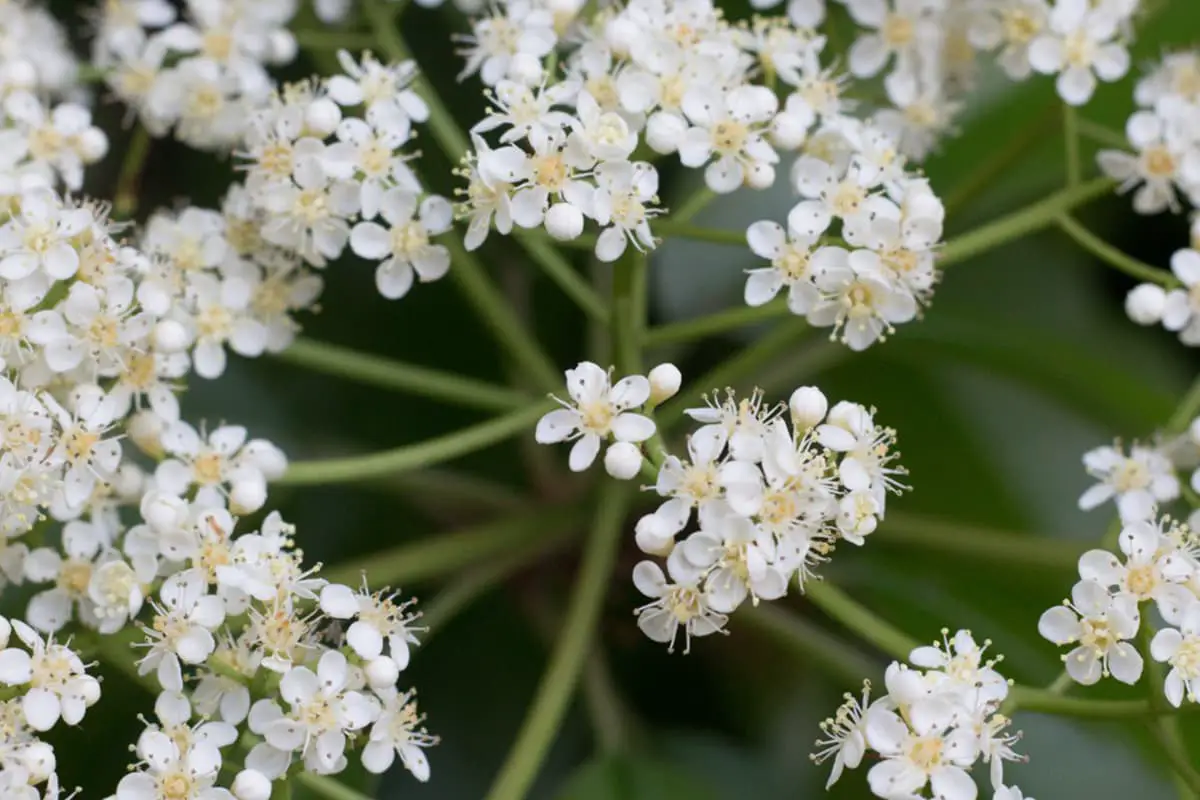
Its branches are brownish-grey; the scales are brown and hairless; the leaves are leathery and come in an elongated oval shape, elongated ovate shape, or oval elliptical shape; its petals are white and nearly round; the fruit is a red sphere that eventually turns brownish-purple; the seeds are smooth, brown and oval-shaped.
It flowers from April to May and fruits in October.
It thrives in warm, humid climates, can tolerate some shade, and can withstand short-term low temperatures down to -15°C.
It is not strict about soil conditions but prefers fertile, moist, deep, well-drained, slightly acidic sandy soil. Reproduction is achieved through both seed propagation and cutting propagation.
Photinia is often planted in courtyards, roadside, intersections, and its crown can be pruned into various shapes.
Its wood can be used to make wheels and tool handles, its seeds can be pressed for oil to make soap, its roots can be used to produce roasted glue, and its fruit can be used to make wine.
Its dried leaves can be used medicinally, offering diuretic, antipyretic, and analgesic effects.
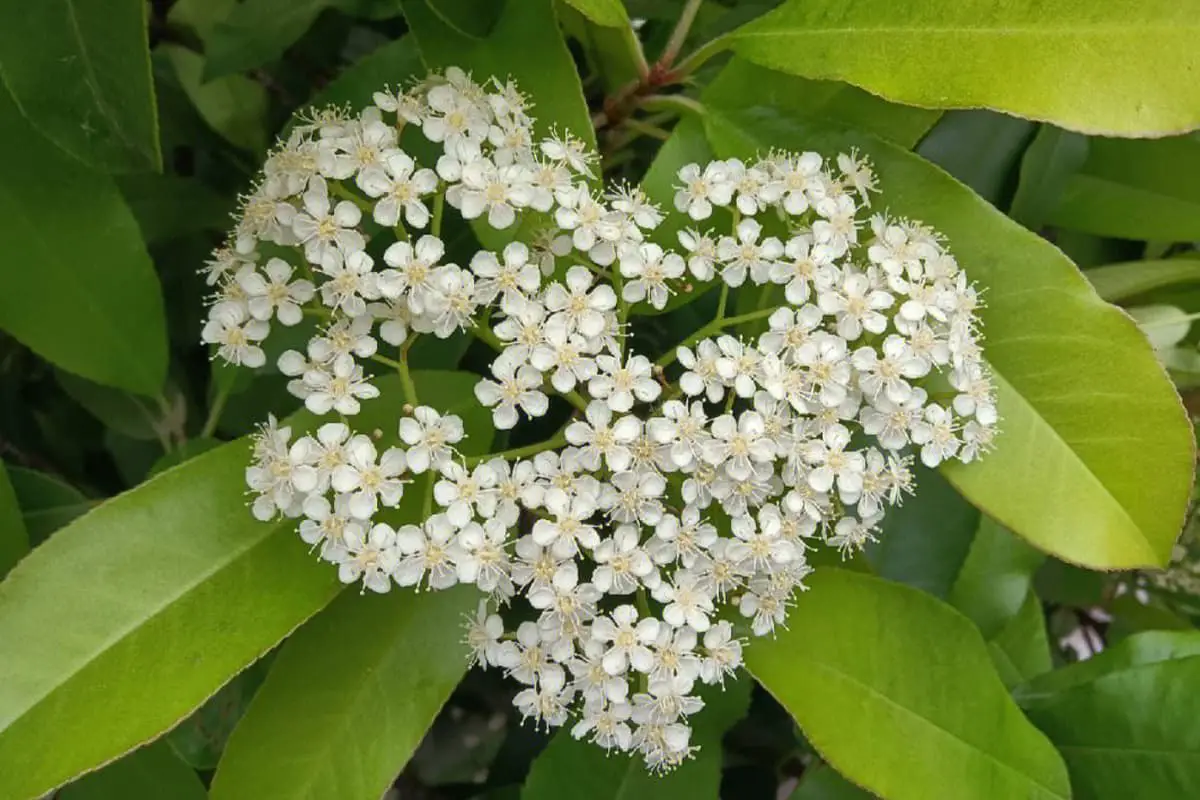
It is an evergreen shrub or medium-sized tree, 3-6 meters high, sometimes up to 12 meters; branches are brownish-grey, entirely hairless; winter buds are ovate, with brown, hairless scales.
The leaves are leathery, elongated oval shape, elongated ovate shape, or oval elliptical shape, 9-22 cm long and 3-6.5 cm wide, with an acutely pointed tip, round or wide wedge-shaped base, and sparsely glandular serrated edges near the base, shiny on top, with velvety midribs in their youth, hairless on both sides when mature, with prominent midribs and 25-30 pairs of side veins; the petioles are sturdy, 2-4 cm long, velvety in youth, later hairless.
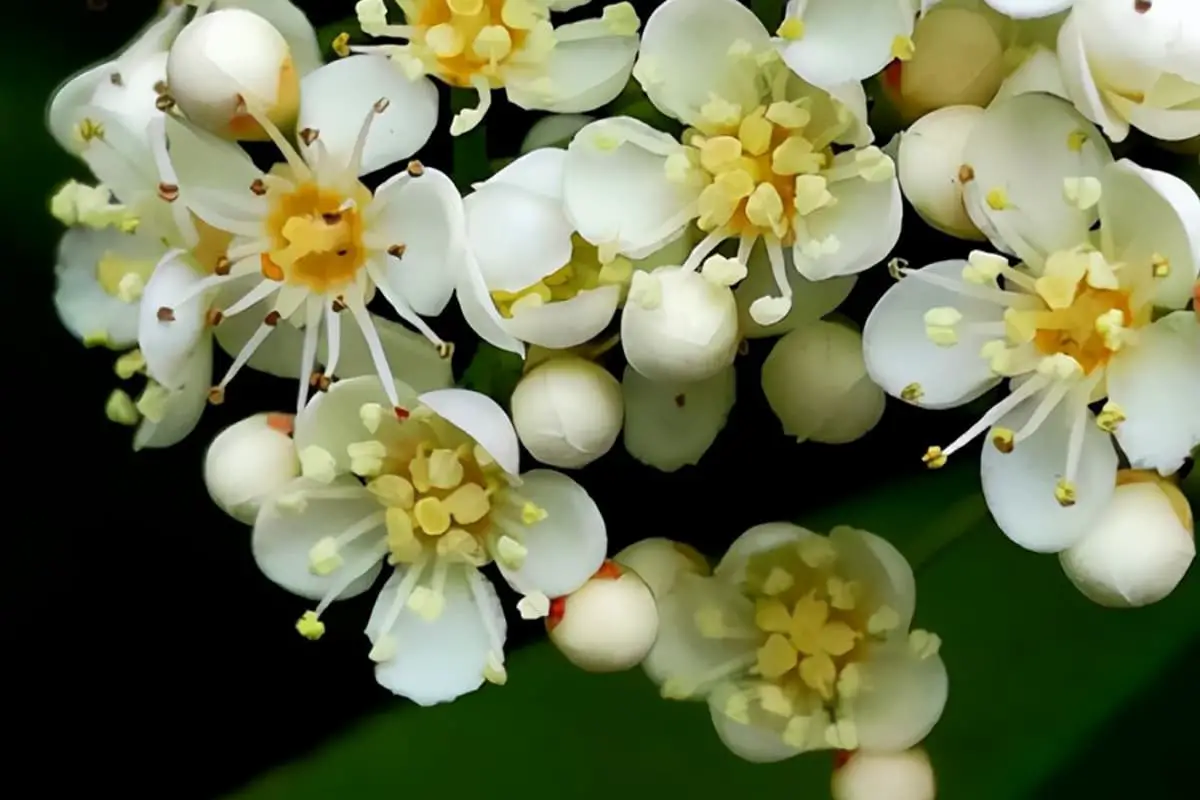
Flowering period is June-July, with compound umbel inflorescences, 10-16 cm in diameter; both the general and individual flower stalks are hairless, the latter 3-5 mm long; flowers are densely packed, 6-8 mm in diameter; the calyx is cup-shaped, about 1 mm long, hairless; the sepals are broad and triangular, about 1 mm long, with an acutely pointed tip, hairless; the petals are white, nearly round, 3-4 mm in diameter, hairless on both sides; there are 20 stamens, the outer ring longer than the petals, the inner ring shorter, the anthers are purple; there are 2, sometimes 3, pistils, fused at the base, with a capitate stigma, and the ovary has soft hairs at the top.
The fruit ripens in October-November; the fruit is spherical, 5-6 mm in diameter, red, later turning brownish-purple, containing one seed; the seed is ovate, 2 mm long, brown, and smooth.
There is considerable variation in leaf shape in this species, ranging from elongated oval, elongated ovate to oval elliptical, up to 22 cm long, with fine serrated edges and a thorny serrated edge in the seedling stage.
This plant is found worldwide, particularly in China, Japan, and Indonesia.
This plant prefers sunlight but can tolerate shade. It is deep-rooted and isn’t too demanding of the soil type, although it thrives best in fertile, moist, deep, well-drained, slightly acidic sandy soil.
It grows in mixed forests at altitudes between 1,000 and 2,500 meters. It can withstand short-term low temperatures of -15°C and enjoys a warm, humid climate.
This plant enjoys a warm, humid climate, tolerates light shade, and can withstand short-term low temperatures of -15°C. It isn’t too demanding of the soil type, but it prefers fertile, moist, deep, well-drained, slightly acidic sandy soil.
It has strong germination power, is resistant to pruning, and has a certain resistance to smoke and toxic gases.
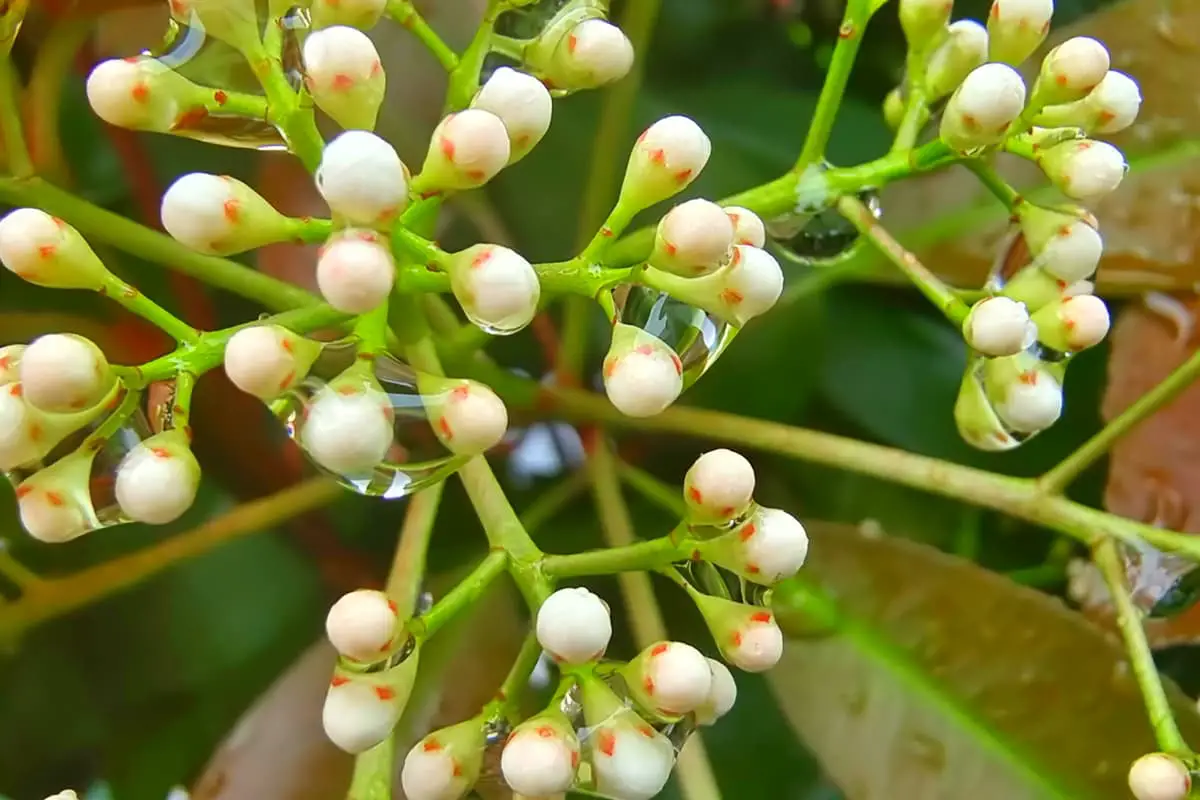
The Photinia Serratifolia var.lasiopetala (Hayata)H.Ohashi is one such variety. Its leaves are leathery, inverted ovate-elliptical, 8-15 cm long and 2.5-4.5 cm wide. The total flower stalks and pedicels are either hairless or softly hairy.
The calyx tube is cup-shaped, with soft hairs on the outside, and the sepals are triangular, with sharp tips and hairless insides.
The petals are white, inverted ovate, with long soft white hairs on the inside and a short claw at the base. It blooms in April and is found in Taiwan, China, growing at an altitude of 850 meters.
The Photinia Serratifolia var.daphniphylloides (Hayata)L.T.Lu is another variety. Its leaves are elliptical or long inverted ovate, 8-16 cm long and 3-7 cm wide, with sharp to rounded tips, blunt or truncated base, and almost entire to serrated edges. It blooms in April and is found on the east coast of Taiwan, China.
The Photinia Serratifolia var.ardisiifolia (Hayata) H.Ohashi is another variety.
Its leaves are inverted ovate-lanceolate or spoon-shaped inverted lanceolate, 6-10 cm long and 2-3 cm wide, with rounded tips with short pointed ends, wedge-shaped narrowed bases, and almost entire to serrated edges. It blooms in January and is found in Taiwan, China.
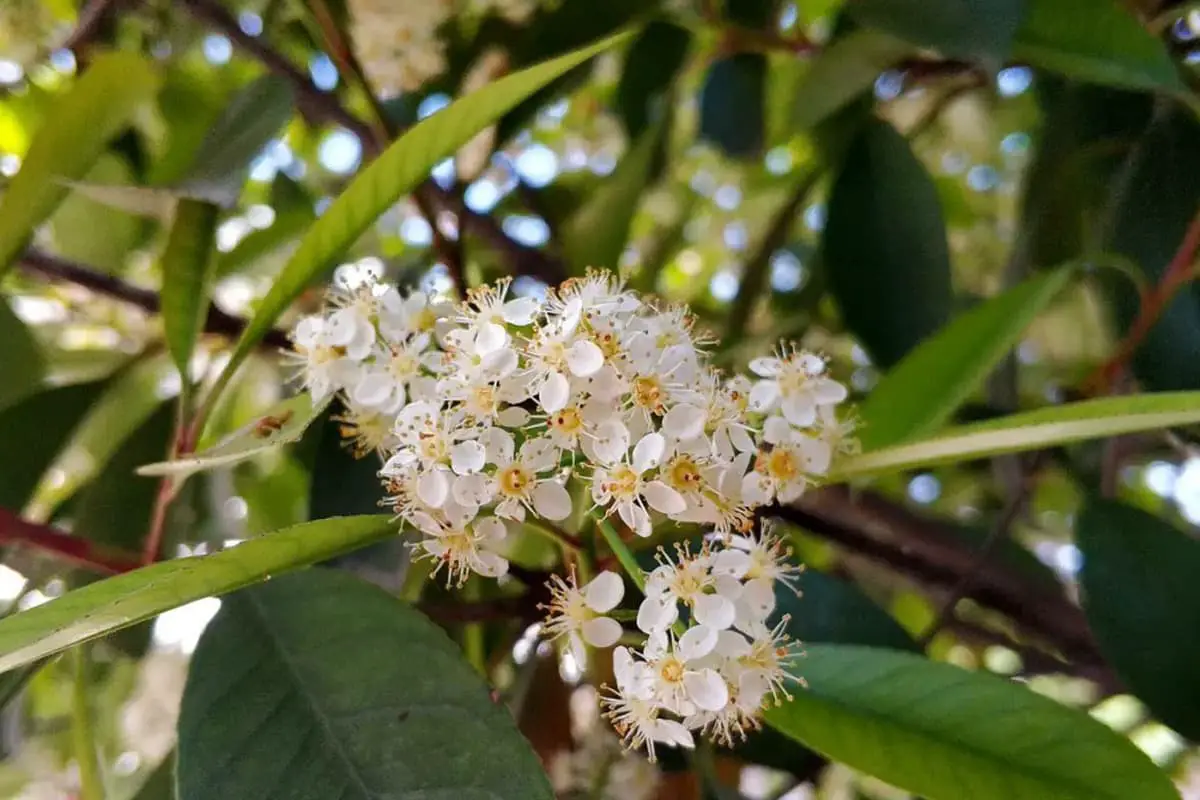
Seed Collection: Collect seeds when the fruit is ripe. Crush and wash the fruit to extract the seeds and then let them dry. Seeds are stored in layered sand until they are sown in the following spring. The ratio of seeds to sand should be 1:3.
Field Seeding: Choose a plot of soil that is fertile, deep, and soft (mix in 1/3 river sand) for outdoor seeding. In early February, sow the seeds in furrows, with a row spacing of 20 cm, and cover them with 2-3 cm of soil.
Slightly press down, water thoroughly, and cover with straw to keep the soil moist, which is beneficial for seed germination. The seeding rate is 15-18 kg per acre.
Preparation: Choose a nursery plot that has good drainage, a low groundwater level, convenient transportation, and ample water supply. The cutting bed should be 100 cm wide and 20-30 meters long, with a 12 cm tall barrier around it.
Spray the bed surface with a 200-fold potassium permanganate solution for disinfection, then lay the substrate, which consists of 70-80% loam and 20-30% fine sand, about 10 cm thick. After leveling the bed, it is ready for cutting after 24 hours.
Cutting: It can be done during the rainy season. Select semi-woody branches from the current year and cut them into 10-12 cm segments, each with one leaf and one bud, and trim 1/3 of the leaf.
The cut should be flat to prevent tearing of the bark and wood, creating new wounds. Mix 6 grams of rooting hormone, 30 ml of alcohol, 60 ml of 50% warm water, 1.4 kg of clean water, and 5 kg of loam into a paste.
Dip the cuttings into the rooting hormone paste. The spacing for cuttings is 4 cm x 6 cm, and the depth is 2/3 of the cutting.
After cutting, water thoroughly, spray a 1000-fold dilution of fungicide and zinc complex on the leaves, set up a small arch shed, cover with plastic film, seal all around, cover with a 50% light-transmitting net. In early spring, mature branches can also be used for cutting.
When the seedlings are basically all sprouted (about 30 days), carefully remove the straw cover to prevent pulling out the seedlings. If the seedling density is too high, thin them out in May.
If the density is too low, transplant or reseed as necessary. Plant the thinned seedlings at a spacing of 20 cm x 20 cm, water immediately after planting to ensure a high survival rate.
Fertilize with urea or a ternary compound fertilizer every half month, about 4 kg per acre. Water in dry weather and drain in case of flooding.
One week after cutting, keep the substrate moisture content at 60-70%, and the relative humidity in the air at 95%. After 15 days, most cuttings start to root, keep the substrate moisture content at around 40%, gradually remove the film and ventilate.
When over 50% of the cuttings have sprouted new leaves, remove the film. Spray a mixture of zinc complex and fungicide diluted 800 times every 20 days to prevent anthracnose and root rot, promptly remove and burn diseased plants.
After all the cuttings have rooted and leafed out, spray a water-soluble fertilizer (0.2% urea) to promote growth.
Before planting, apply a sufficient amount of base fertilizer, and water promptly after planting. During the growth period, pay attention to watering, especially during the high-temperature season of June to August, water once every half a month.
In spring and summer, apply a certain amount of compound fertilizer and organic fertilizer.
Newly transplanted Photinia must be protected from cold for 2-3 years. After winter, erect a sturdy wind barrier, leaving an opening on the south-facing side to accept sunlight. Also, cover the ground with a layer of straw or other covers to prevent the roots from freezing.
When pruning Photinia, plants with many thin branches should be pruned heavily, removing some branches; plants with fewer thick branches should be lightly pruned to promote the sprouting of more flower branches.
For trees with smaller crowns, cut back one-year-old branches to expand the crown; for trees with larger crowns, retract the main branches, substitute the side for the main, and ease the tree’s vigor.
If the Photinia grows vigorously, cut off the long branches after flowering to promote leaf bud growth. In winter, the purpose is to shape, remove some densely grown branches and useless branches, maintain growth space, and promote the development of new branches.
For tree species used for shaping, prune 1-2 times a year, if used for hedges, prune more frequently to maintain a good shape.
The main diseases are leaf spot disease and gray mold disease. Common diseases during the seedling bed period are sudden death disease and topple disease.
Leaf spot disease mainly occurs on Photinia leaves. In the early stages, the disease spots are brown, and after expansion, the disease spots are semicircular or irregular, slightly showing a gray-white ring pattern; in the later stages, the disease spots dry up, bear black granules, and can cause leaf fall in severe cases.
The pathogen usually invades from wounds and stomata, and diseased leaves can serve as a source of disease to cause reinfection. This disease occurs all year round, with more severe outbreaks during the rainy season.
Method to prevent and control leaf spot disease: one is to timely clean up diseased leaves; the other is to spray Bordeaux mixture 100-150 times liquid, or 60-75% Mancozeb 500-1000 times liquid for prevention and control at the beginning of the disease.
Method to prevent and control gray mold disease: use 50% Carbendazim 1000 times liquid spray for prevention, and during the disease period, use 1% Bordeaux mixture spray once every half a month, or use 50% Mancozeb 800 times liquid spray for prevention and control.
The main pests are scale insects, Photinia mealybugs, whiteflies, and borer pests. Common pests during the seedling bed period are grubs, mole crickets, etc., and also prevent damage to seedlings by birds and animals.
Control of scale insects: can be treated with 40% Omethoate emulsion 1000-2000 times liquid spray.
Control of Photinia mealybugs: manually remove leaves with bugs, eradicate their large-scale reproduction and spread; take advantage of the strong tendency of adults to yellow, set up yellow boards next to the plants for trapping two days before eclosion, and the killing effect is very good; use their main natural enemies such as parasitic wasps, ladybugs, lacewings, predatory mites, etc. for biological control.
Control of whiteflies: use 20% Cyfluthrin emulsion 2000 times liquid or 10% Imidacloprid wettable powder 2000 times liquid to spray the crown, can quickly kill the whitefly population; use 40% Omethoate emulsion 15 ml/plant root application, not only can protect natural enemies, but also has a good preventive effect.
Control of borer pests such as longhorn beetle larvae, weevils, etc.: can be sprayed with 40% Omethoate emulsion 200-400 times liquid or 50% Phoxim emulsion 100-200 times liquid, until the trunk drips liquid; when adults appear, spray with 80% DDVP 1000 times liquid; in late September, spray 80% DDVP or Phoxim 200 times liquid at the base of the trunk to kill adults.
The dense wood of Photinia can be made into wheels and tool handles. Its seeds are pressed for oil used in paint, soap, or as lubricants. It can also serve as a rootstock for the loquat tree, as loquats grafted onto Photinia have an extended lifespan, are more resistant to poor soil, and grow robustly.
Photinia is lush with branches and leaves, its branches naturally forming a round canopy, remaining evergreen throughout the year. The leaves are a lustrous, vibrant green. Early spring brings purple-red to the young branches and leaves.
After autumn, some older leaves turn a striking red. During the summer, the plant is speckled with white flowers, and after autumn, it bears bright red fruits. As an ornamental broadleaf evergreen tree, it makes a great shading tree or hedge.
Depending on the landscaping needs, it can be pruned into a spherical or conical shape among others.
It can be planted alone or as a foundational plant, and when planted in groups, it forms a low shrub. It can be combined with golden privet, red leaf barberry, clematis, and pretty yellow reed to create a beautiful pattern.
The leaves and roots can be used as a tonic and diuretic, providing calming and fever-reducing effects. It can also be used as a natural pesticide for aphids, and it has an inhibitory effect on the germination of potato disease spores.

Peggie was once a high school mathematics teacher, but she set aside her chalkboard and textbooks to follow her lifelong passion for flowers. After years of dedication and learning, she not only established a thriving flower shop but also founded this blog, “Flowers Library”. If you have any questions or wish to learn more about flowers, feel free to contact Peggie.
 English
  العربية
  Bahasa Indonesia
  Deutsch
  Français
  Italiano
  Nederlands
  Português
  Русский
  日本語
日本語