600+ Types of Flowers A To Z (With Names and Pictures)
Types Of Flowers By Names (A-Z) Types Of Flowers By Color Types Of Flowers By Season Types Of Flowers By Blooming Time 600+ Types of Flowers No. Flower Name No.…

The Peony, also known as the Luoyang Flower or Flower of Wealth, is a plant within the dicotyledon class, Paeoniaceae family, and Paeonia genus. It’s one of China’s most distinguished woody ornamental flowers, ranking among the top ten renowned flowers in the country.
Boasting thousands of years of natural growth and more than two millennia of cultivation history, it is endearingly referred to as the ‘flower of unparalleled beauty and fragrance’ and ‘king of flowers.’ Its prevalence in classical poetry, literature, and visual arts has solidified its beloved status.
With its vibrant colors and intoxicating aroma, the Peony is a symbol of grace and opulence. Its large size, captivating shape, and brilliant hues, paired with its intense fragrance, have earned it praises through the ages. It also holds significant ornamental and medicinal value.
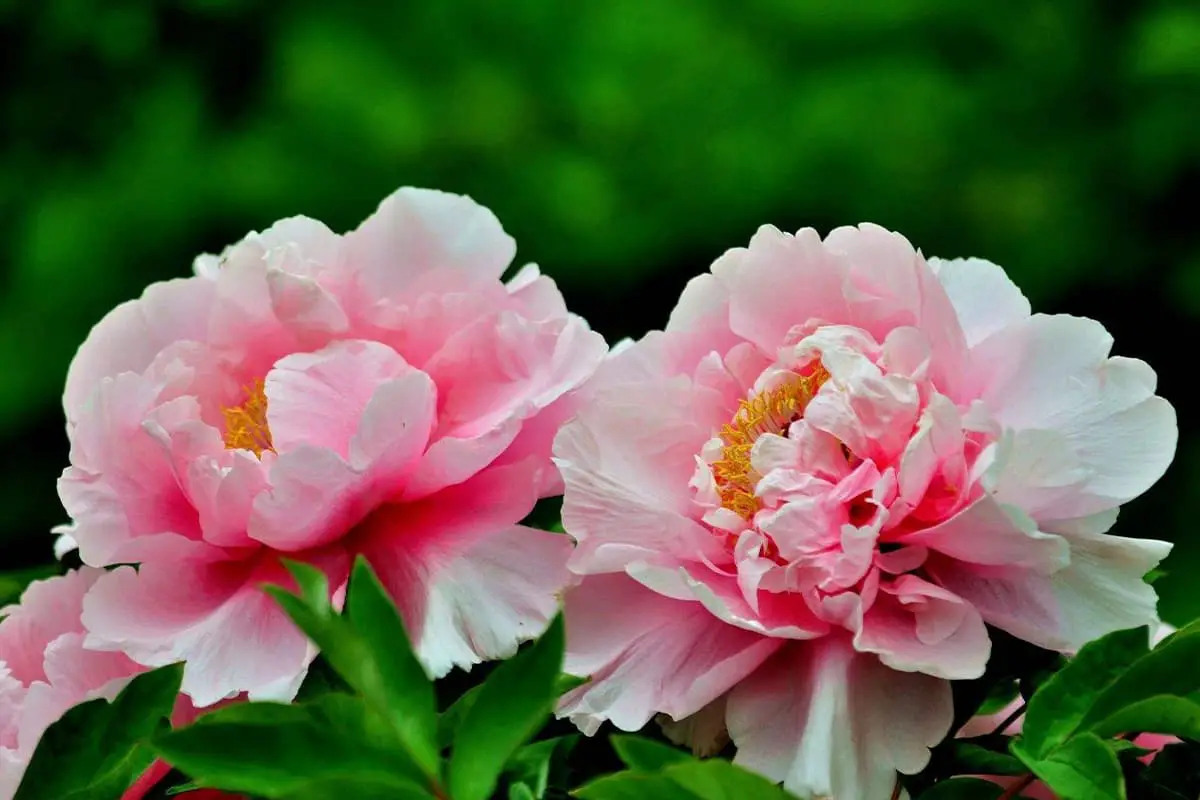
The Peony, a member of the dicotyledon class, Paeoniaceae family, and Paeonia genus, is a perennial deciduous shrub that can grow up to two meters in height with short, thick branches. Its leaves are usually bi-ternate compound, featuring a green top surface, hairless, with a paler underside that sometimes displays a white powder. The leaf stalk is between 5-11 cm long, and both it and the leaf axis are hairless. The flower is solitary at the branch tip, enclosed by five elliptical bracts.
The five sepals are green and broadly ovate, while the petals, either five or in multiple layers, range from rosy, purplish-red, pink to white, often showcasing great variations. They are inverted ovate, with irregular wavy edges at the top.
The anthers are oblong, measuring 4 mm in length; the floral disk is leathery and cup-shaped, purplish-red; and the carpels are densely covered with soft hair. The follicles are oblong and densely covered with yellow-brown stiff hair. Peonies bloom in May and fruit in June.
The flowers’ splendid hues, paired with their pleasant fragrance, lend an air of elegance and majesty to the plant, earning it the well-deserved title of ‘King of Flowers.’ Among the hundreds of cultivated varieties, classifications are primarily based on flower color.
The peony comes in a vast array of varieties and shades, with yellow, green, flesh-pink, dark red, and silver-red considered the most refined, especially yellow and green. The size and fragrance of peony flowers have also won it the title of ‘flower of unparalleled beauty and fragrance.’
In May 1985, the Peony was named as one of China’s top ten famous flowers. As a native prestigious woody flower of China, it has a history of thousands of years of natural growth and more than two thousand years of cultivation.
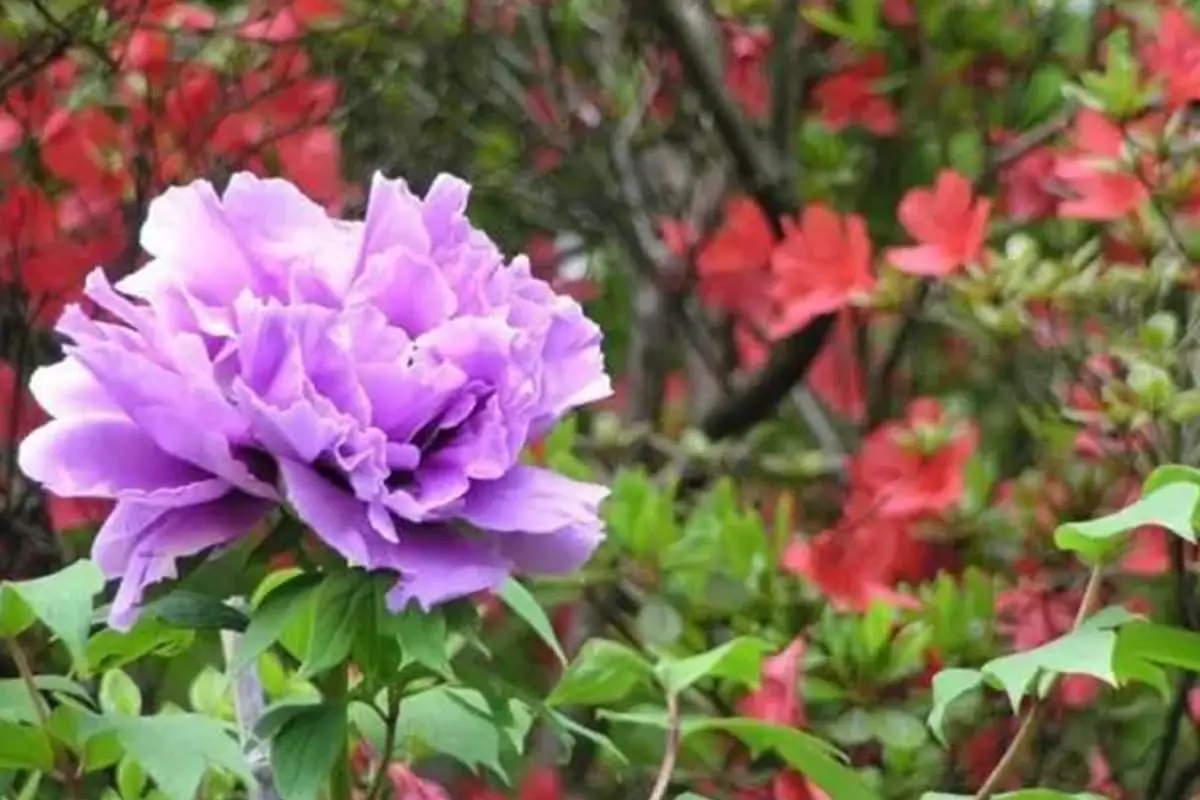
Peonies come in numerous varieties and colors, with yellow, green, flesh-pink, dark red, and silver-red regarded as superior, especially yellow and green. Among them, Yao Yellow, Wei Purple, Bean Green, and Zhao Pink are recognized as the four esteemed varieties.
Wei Purple exhibits the utmost beauty of double-layered petals. It is a valuable peony variety with purple-red flowers in the shape of a lotus or a crown. With a long blooming period and large yield, its full-bodied flowers have earned it the title of “Queen of Flowers. Its warm and passionate beauty adds a sense of success, festivity, wealth, and good fortune, making it a highly ornamental variety.
Yao Yellow mainly refers to the Thousand-Petaled Yellow Peony. The flower’s form resembles delicate carvings, and its texture is akin to soft jade, exhibiting an air of refined grace. Its gold-like petals unfold to release a unique fragrance. It stands tall in its beauty, sparking a city-wide frenzy when it blossoms, embodying the spirit of a chrysanthemum in the autumn breeze.
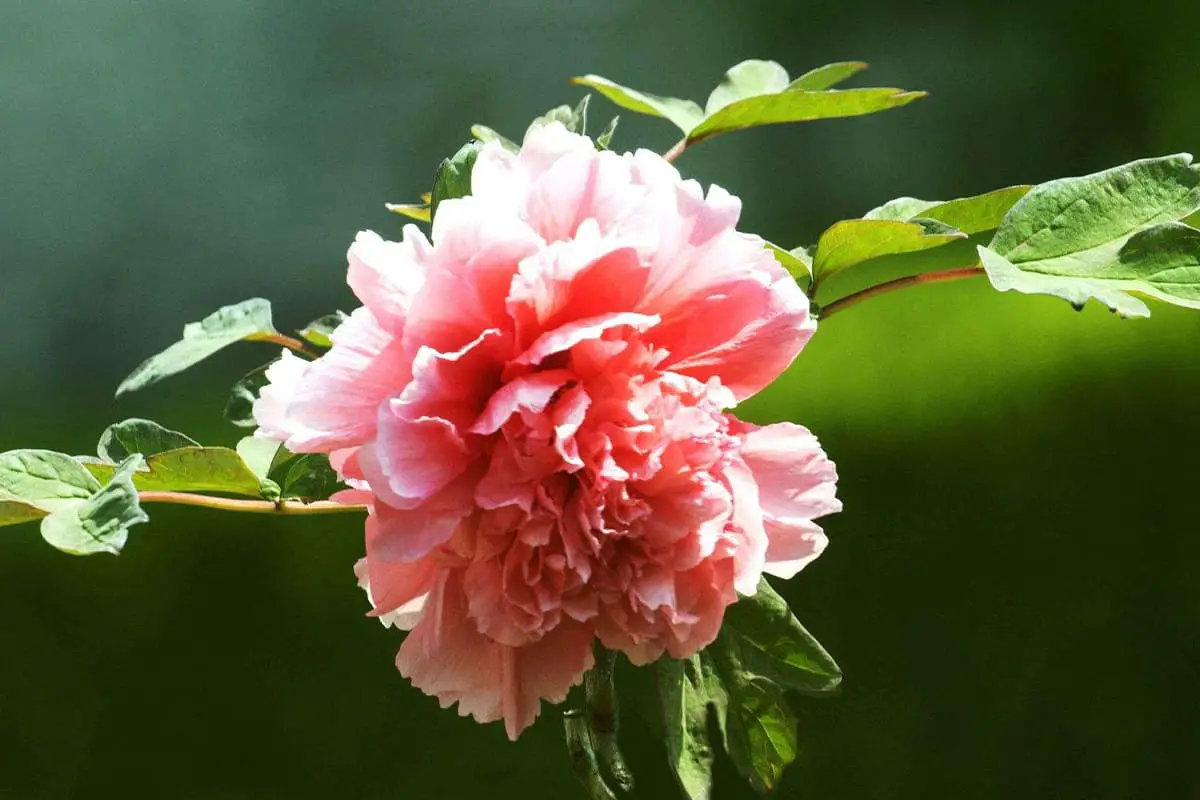
Zhao Pink is the youngest among the four great peony varieties. Its fragrance is rich and it features three types of flowers: single, semi-double, and double-layered, all of which can grow on the same tree. Its distinctive attributes quickly propelled it to fame, ranking it alongside Yao Yellow and Wei Purple as one of the four esteemed peony varieties.
Among peony varieties, Bean Green is the only one that showcases a pure green color. Its flowers resemble pom-poms, named for their color which resembles green beans. This late-blooming variety starts with a green color when it first blooms, which gradually fades to a paler shade. Under the sun, the flowers turn white, exuding a refreshing elegance and unique charm, standing apart with its unique beauty.
Originating from Luoyang, China, “White Snow Tower,” also known as “White Jade,” has white, crown-shaped flowers. The outer petals are large, while the inner petals are thin and creased, stacked high to form a ball shape. The base of the petals has a purple hue. When the flower first blooms, it appears greenish-white and turns to a lustrous white as it fully opens, resembling snow or jade.
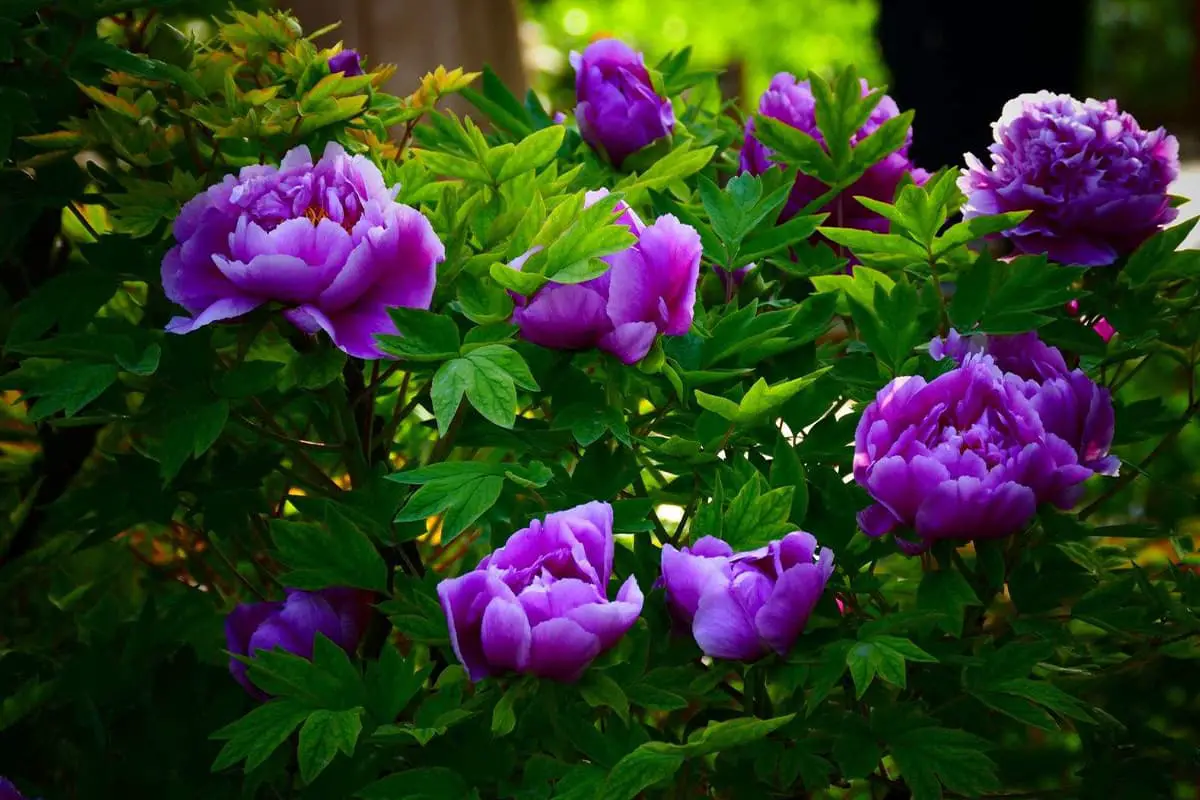
“Green Dragon in Ink Pond” has flowers of a tutu or sometimes crown shape. The bud is conical; the flower is a slightly light ink-purple color; its diameter is 19cm x 6cm. The outer petals are large and slightly curled, with an ink-purple hue at the base.
The inner petals are curled with normal stamens and pistils. Its short and soft stalk makes the flower bloom sideways. It is a medium flowering variety with an average height and broad spread. The leaf surface is yellow-green with a purple halo. The pistil appears green in the heart of the flower, surrounded by layers of ink-purple petals, resembling a green dragon lying in an ink pond, thus earning its name.
This flower, supported by green leaves, sways as if walking unsteadily, with its cloud-like hair bun hanging low. The bloom features multiple layers, with the petals being pinkish-purple with a touch of red when they first open. The inner petals are wrinkled and slender.
When in full bloom, the pinkish-purple petals exhibit a hint of blue, taking on the shape of a crown. As they begin to fade, the pinkish-purple petals seem to be stained white. The soft, bending flower stalk often causes the flower to hang down, appearing like a drunk beauty, hence the name “Drunken Concubine Yang.”
Imperial Robe Yellow” is an early blooming variety in the traditional yellow peony series, with its flower resembling a lotus or chrysanthemum. During the Qing Dynasty, it was considered the finest among flowers, with wealthy families offering thousands of taels of silver for a single plant. Yellow peonies are quite rare.
Apart from the “King of Flowers,” Yao Yellow, “Imperial Robe Yellow” can be considered a superior variety within this series. Its flower, when fully bloomed, generally measures around 15 cm in diameter, with broad, wavy petals; the flower color is pale yellow, and the stamens are golden-yellow.
This plant thrives in warm, cool, dry, and sunlit environments. It enjoys sunlight but also tolerates partial shade, cold, drought, and weak alkalinity. However, it detests waterlogging, heat, and direct exposure to strong sunlight. It grows best in loose, deep, fertile, well-drained, neutral sandy loam soil that is elevated and dry. Growth is stunted in acidic or heavy clay soils.
Adequate sunlight is beneficial to its growth, yet it doesn’t tolerate intense summer sun exposure. Temperatures above 25℃ put the plant in a dormant state. Ideal flowering temperature is between 17-20℃, but the plant requires a 2-3 month low-temperature treatment of 1-10℃ before it flowers. It can withstand temperatures as low as -30℃.
In northern cold regions, proper winter protection is necessary to prevent frost damage. The high heat and humidity in the south are extremely unfavorable for the growth of the peony, so specific environmental conditions are required for cultivating and enjoying the exquisite beauty of this flower in these regions.
Peonies are native to China, a country rich in peony resources. The cultivation of peonies in China is widespread, and the plant has spread globally for a long time. Known as the king of flowers, peonies possess an extraordinarily high aesthetic value.
The peony is a deciduous shrub. Its stems can reach up to 2 meters in height, with short and thick branches. Leaves are usually biternate, but occasionally the leaves near the branch apex are trifoliate. The terminal leaflet is broad-ovate, measuring 7-8 cm long and 5.5-7 cm wide, trifurcate to the middle, with leaflets undivided or shallowly 2-3 divided, green on the surface, hairless, pale green on the back, sometimes with white powder, and sparse short pubescence along veins or nearly hairless.
The leaf stalk is 1.2-3 cm long. Lateral leaflets are narrow ovate or oblong ovate, 4.5-6.5 cm long, 2.5-4 cm wide, unequally divided into 2 or 3 shallow lobes or undivided, nearly sessile; petioles 5-11 cm long, both petioles and rachises are hairless.
The flower is solitary at the branch apex, with a diameter of 10-17 cm; the peduncle is 4-6 cm long; the bracts number five and are long elliptical, varying in size; the sepals also number five and are green, broad ovate, and varying in size; the petals number five or can be double, ranging from rose-colored, purple-red, pink to white, often greatly varied, obovate, 5-8 cm long, 4.2-6 cm wide, with irregular wavy ends.
The stamens are 1-1.7 cm long, with the filaments being purplish-red, pink, and white at the top, about 1.3 cm long, and the anthers being oblong and 4 mm long.
The disc is leathery, cup-shaped, purplish-red, with several sharp teeth or lobes at the top, completely enclosing the pistils and splitting when the pistils mature. The pistils number five, sometimes more, densely pubescent. The follicles are oblong and densely covered with yellow-brown hard hairs. Flowering occurs in May; fruiting in June.
Peonies have straightforward soil requirements: they typically need sandy soil that is fertile, loose, and well-draining. A recommended soil mix consists of leaf mold, garden soil, and fine river sand.
Before planting, sterilize the soil using a solution of either carbendazim or methyl tobujin.
After planting, water the peony thoroughly. Peonies don’t tolerate waterlogged conditions, so be judicious with watering during the growing season. In arid northern regions, watering is usually done before flowering, after flowering, and before the ground freezes. For potted peonies, it’s convenient to prune off the spent flowers and bury the pot in the ground after flowering.
Peonies are heavy feeders. To ensure large, brightly colored flowers and to avoid biennial blooming, it’s crucial to fertilize at the right times. Newly planted peonies shouldn’t be fertilized within the first six months. After this period, start fertilizing.
Usually, peonies need three applications of fertilizer per year. The first application, the pre-bloom feed, should be done when the soil has thawed and the leaves have started to unfurl. The second application, the post-bloom feed, should be done within half a month after the flowers have faded.
It helps the plant recover and encourages the differentiation of flower buds. The third application, the pre-winter feed, should be done before winter sets in to promote growth in the spring.
Ample sunlight is highly beneficial for peonies, although they should be protected from prolonged direct sun exposure.
The ideal growth temperature is between 15~25℃. The plant will go dormant if the temperature exceeds 25℃. During the pre-bloom phase, ensure adequate ventilation to prevent excessively high temperatures, which can hinder growth.
Timely pruning is essential to encourage healthy growth and maintain the aesthetic appeal of the peony bush. Pruning is generally done in the winter and spring-summer periods.
In the spring, select the buds you wish to keep and remove the rest. Trim weak, pest-infested, or overly tall branches to maintain a pleasant plant shape and ensure good ventilation and light penetration.
After the flowers drop in the summer, prune off the spent blossoms. At the end of autumn, remove diseased, dead, and overly tall branches.
The propagation of peonies can be achieved through various methods including division, grafting, and sowing seeds. However, the most prevalent methods are division and grafting. Seed sowing is often used for breeding new varieties.
The method of propagating peonies by division was widely adopted during the Ming Dynasty. Here is the detailed procedure: A thriving peony plant is completely uprooted, and divisions are made at the junction of root systems. The number of divisions made depends on the size of the original plant, with larger plants producing more divisions, and smaller plants less. Typically, each division consists of 3-4 branches with a complete root system. A small amount of sulfur powder mixed with mud is applied and spread evenly over the root wounds before replanting. Division propagation should be carried out between the autumn equinox and the first frost of the year. During this time, the temperature is relatively high, and peonies are in a semi-dormant state, but still have a considerable period for nutrient growth. If the division propagation is done too late, root growth is weak in the same year, with no new roots developing. This can lead to weak plant development and a reduced drought resistance the following spring, making the plant prone to death. If the divisions are planted too early, the high temperature can lead to rapid growth, potentially causing an autumn burst.
For the mother plant of peony divisions, typically robust plant clusters are used. As much of the root system as possible should be retained on the mother plant used for division propagation, and all roots on the new shoots should be preserved, allowing for multiple new shoots to be produced after 5 years of growth. These divided plants are easy to establish and grow more vigorously. The more roots preserved, the more vigorous the growth.
Peony propagation through grafting can be done in two ways, depending on the type of rootstock used: wild peonies or paeonia lactiflora roots. The common methods of grafting peonies include inlay grafting, belly grafting, and bud grafting.
Inlay grafting: Paeonia lactiflora roots are used as rootstock due to their softness and lack of hard center, which makes grafting easier. The roots are thick and short, providing abundant nutrients, which ensure vigorous initial growth after grafting.
If peony roots are used for grafting, they are harder to graft due to their harder woody part, but they have a longer lifespan. The best time for grafting is from late September to early October each year. The rootstock should be robust paeonia lactiflora roots that are 2-3 cm in diameter and 10-15 cm in length, free from pests and diseases.
Belly grafting: This is a high-grafting method used to improve plant varieties. It uses the many branches of inferior peonies or 8-10-year-old medicinal peony plants, grafting them into different superior varieties with varying colors. The grafting period is from early July to mid-August. Start by selecting high-quality, robust peony plants free from pests and diseases. Cut short branches, 5-7 cm in length, with 2-3 strong buds growing from the ground or grown in the current year, to serve as scions.
Leave a petiole on the scion. After the scion is selected, cut the underside of the bud on the back of the scion into a horse-ear shape, and then cut the other side of the horse ear into a wedge shape. This allows both sides of the graft to connect to the cambium between the woody part and the phloem, increasing the likelihood of survival.
Other than during rainy seasons, appropriate moisture should be maintained for normal plant growth. Bud grafting is an effective method for propagating and cultivating peonies with various varieties and colors on one plant.
Bud grafting: This is carried out between May and July. The best grafting conditions occur on sunny days. There are two methods: bark grafting and bud replacement. Bark grafting involves cutting a rectangular or shield-shaped notch from the current year’s growth on the rootstock, along with the woody part, and then cutting a similarly sized and shaped bud piece from the scion.
Quickly attach the bud piece to the notch on the rootstock and secure it with plastic twine. Bud replacement involves removing the axillary bud at the grafting site on the rootstock along with the cambium, leaving the intact bud embryo on the woody part. Then, using the same method, remove the axillary bud from the scion.
Cutting propagation is a method that exploits the fact that peony stems readily produce adventitious roots to propagate new plants. It’s a form of asexual reproduction. The method involves first cutting the stem intended for propagation and detaching it from the parent plant. Then it is inserted into soil or another growing medium where it is allowed to root and form a new plant.
The stems for propagating peonies via cuttings should be chosen from the soil sprouts of the current year growing from the peony’s root, or from branches that are solid with full apex buds and free of pests and diseases, which can be found when pruning peonies.
The length should be around 10-18 centimeters. Peony roots are fleshy, prefer dry conditions, are intolerant to moisture, and are drought-resistant. Therefore, a nursery bed should be set up in a well-ventilated, sunny place and the seedlings should be grown on a raised bed. During the cutting process, water each ridge after planting, ensuring thorough watering at each instance.
Seed propagation, which involves the propagation of offspring or the selection of new varieties via seeds, is a form of sexual reproduction. Prior to sowing, the soil must be thoroughly prepared and disinfected, the land should be deep plowed and fine tilled, and sufficient base fertilizer should be applied.
Then, build small ridges that are 70-80 centimeters wide. Both hole sowing and row sowing can be employed. Seeds should not be sown too deep; a depth of 3-4 centimeters is appropriate. After sowing, cover the seeds with soil level with the surface. Lightly tamp the soil and then water thoroughly.
Peony propagation by layering uses the principle that branches can generate adventitious roots. By bending branches down or burying them in soil without detaching from the parent plant and maintaining the soil’s moisture, the buried sections of the stems produce roots.
After rooting, they are then cut and planted, becoming new plants. This also belongs to the category of asexual propagation for peonies. The main methods employed are pot soil layering and double flat method.
Medicinal Value
The medicinal varieties of peony are usually monotone and mainly white in color. The bark of the root, also known as peony bark, danpi, or shaved danpi, is commonly used as a blood-cooling and stasis-removing traditional Chinese medicine.
Li Shizhen, a famous medical scientist in ancient China, stated that the peony with the reddest color is the best, and despite the plant producing seeds, it sprouts from the root, hence it is named the peony. He also believed that wild single-petal varieties are better for medicinal purposes, while artificially cultivated multi-petal varieties have an impure smell and are unsuitable for medicinal use.
The peony bark is slightly cold in nature, and has a bitter and pungent taste. It belongs to the heart, liver, and kidney meridians in Traditional Chinese Medicine. It clears heat, cools the blood, invigorates blood circulation, and removes stasis. It is used to treat conditions such as warm-toxin rashes, hematemesis and epistaxis, night fever and morning coolness, fever with no sweating, menstrual blockage and painful menstruation, abscesses and sores, and traumatic injuries.
Modern research shows that peony bark has antibacterial, anti-inflammatory, anti-allergic, antitumor, hemostatic, blood stasis-removing, heat-clearing and detoxifying, sedative, analgesic, antispasmodic activities, and can also enhance the phagocytic function of monocytes, improve the body’s specific immune function, and increase the weight of immune organs.
It should be noted that those with blood deficiency and cold, pregnant women, and those with heavy menstruation should use it with caution. Peony flowers contain astragaloside, which can be used as a medicine in addition to its ornamental use, for regulating menstruation and invigorating blood circulation.
Ornamental Value
Peonies have exceptional color, shape, fragrance, and charm. Their large, vibrant flowers, graceful postures, and unmatched charm make them a standout among other flowers. Cultivated peonies have various series, such as the Peony series, the Purple-spotted Peony series, the Yellow Peony series, etc., usually divided into eight color series including ink purple, white, yellow, pink, red, purple, blue-green, and green.
According to the flowering period, they are divided into early, mid, and late blooming categories, and according to the flower structure, they are divided into single and double flower categories, with further distinctions of single-petal, double-petal, and thousand-petal varieties. In the spring, amidst a riot of flowers, the peonies in all their splendor stand out.
Edible Value
Peony flowers can be eaten. In many places in China, fresh peony petals are used to make peony soup, or they are added to dishes as garnishes. Peony petals can also be used to brew wine, resulting in a richly flavored peony dew wine.
Feng Shui Value
Peonies carry excellent symbolism, representing completeness and wealth. Placing them at home can imbue a good cultural atmosphere, enhance class, and improve home feng shui. If you feel that the atmosphere at home is a bit too mundane, try adding a pot of peony flowers to elevate the ambiance.
Home Decoration
Peonies have high ornamental value and can be viewed as single plants or grown as multiple plants in a pot. Displaying them at home can beautify the environment. Peonies always give people a sense of grandeur and elegance, and placing them in the living room can make the home seem more opulent and atmospheric, enhancing the home’s overall aesthetic.
The peony is hailed as the king of flowers, with a rich body of related cultural and artistic works. It is a unique native flower of China, with thousands of years of natural growth and more than two thousand years of artificial cultivation history. Its large, beautiful, brightly colored, and fragrant flowers possess high ornamental and medicinal value.
This has given rise to a multidisciplinary study of peony culture, including botany, horticulture, pharmacology, geography, literature, art, and folklore. Peony culture incorporates multiple fields of science, with an extremely wide-ranging composition.
It includes philosophy, religion, literature, art, education, customs, folk sentiment, and all other cultural fields. The cultural information provided by peony culture can reflect the basic profile of national culture, in accordance with the “holographic law” of the universe.
Flower Language of Peony

Peggie was once a high school mathematics teacher, but she set aside her chalkboard and textbooks to follow her lifelong passion for flowers. After years of dedication and learning, she not only established a thriving flower shop but also founded this blog, “Flowers Library”. If you have any questions or wish to learn more about flowers, feel free to contact Peggie.
 English
  العربية
  Bahasa Indonesia
  Deutsch
  Français
  Italiano
  Nederlands
  Português
  Русский
  日本語
日本語