600+ Types of Flowers A To Z (With Names and Pictures)
Types Of Flowers By Names (A-Z) Types Of Flowers By Color Types Of Flowers By Season Types Of Flowers By Blooming Time 600+ Types of Flowers No. Flower Name No.…

The Panax notoginseng, also known as the San Qi flower or Tian Qi flower, is a bud from the medicinal plant San Qi of the Araliaceae family.
The flower has a slightly sweet and bitter taste and is known for its liver-balancing, heat-clearing, fluid-generating, and thirst-quenching properties. Many people brew San Qi flowers as a tea, but it’s not suitable for everyone.
Its primary uses are for heat-clearing, detoxification, acne removal, and for treating boils caused by blood heat and damp poison, such as adolescent acne, peripheral oral blisters, pharyngitis, and periodontitis.
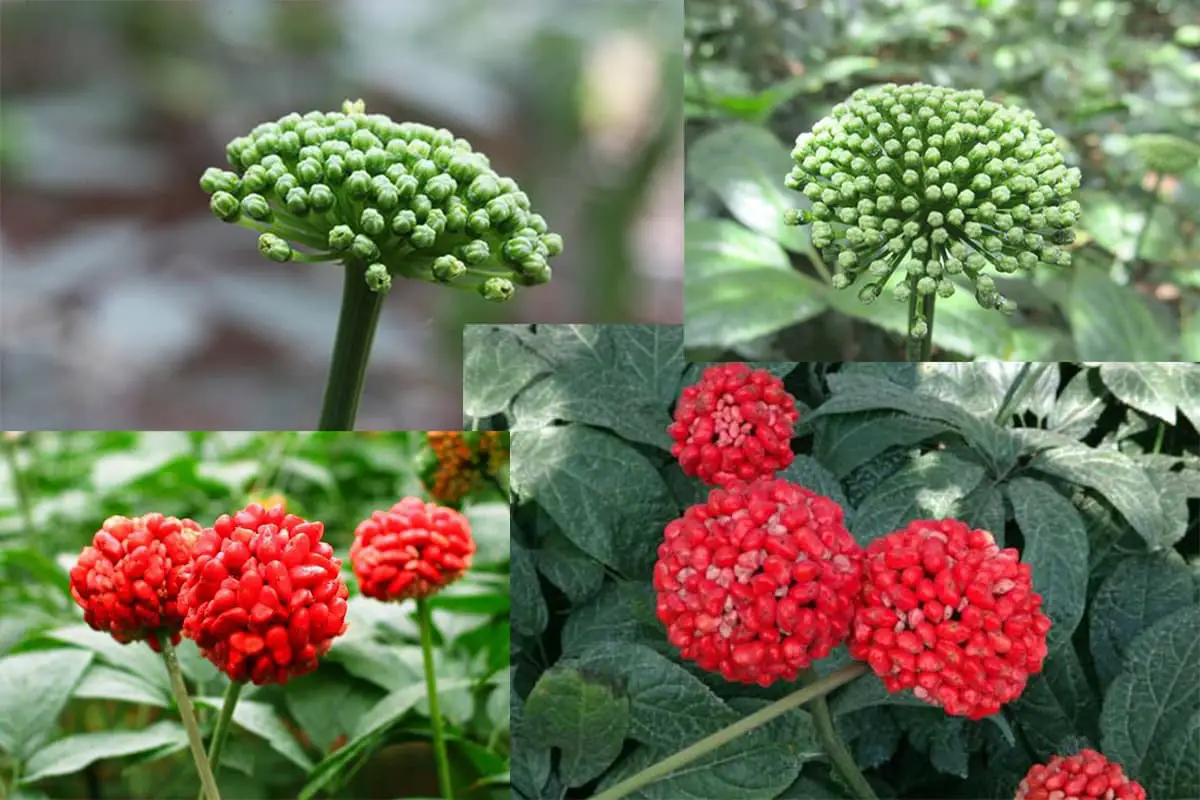
The Panax notoginseng is a dried product of the inflorescence of the Panax notoginseng plant of the Araliaceae family. The flower is typically semi-spherical, spherical, or umbrella-shaped, and it contains the highest amount of saponins among all parts of the San Qi plant.
The plant is native to the Wenshan Prefecture in Yunnan Province, China, and is harvested each year in August, September, and October. The roots are collected in the third year after planting, in late summer or early autumn.
They are then sun-dried until half-dry, hand-rubbed, and sun-dried again, repeating this process several times. The roots are then polished with wax in a hemp bag. On the market, the 3-year-old San Qi flowers are generally better than the 2-year-old ones.
As for Panax notoginseng that are 4 years or older, they are very rare and almost non-existent in the market.
Panax notoginseng is a perennial herb that prefers a warm winter and cool summer environment. It fears extreme cold and heat and likes humidity but not standing water.
The planting area should have loose soil and good drainage. Low-lying areas with poor drainage are not suitable for planting. It doesn’t tolerate continuous cropping or direct sunlight.
Wild Panax notoginseng are now rarely seen and are mostly cultivated. They grow wild under the forest on slopes and are now mostly cultivated on the gentle slopes at the foot of mountains at an altitude of 800-1000 meters, or under artificial shade.
This perennial herb can grow up to 60cm high. It has a short rhizome and an upright, smooth, and hairless stem. The palmate compound leaves have long petioles, with 3-4 leaves whorled at the top of the stem.
The leaflets are elliptical or oblong-ovate, with fine serrated edges. The umbrella-shaped inflorescence is terminal, with the inflorescence stem emerging from the center of the stem top, about 20-30cm long.
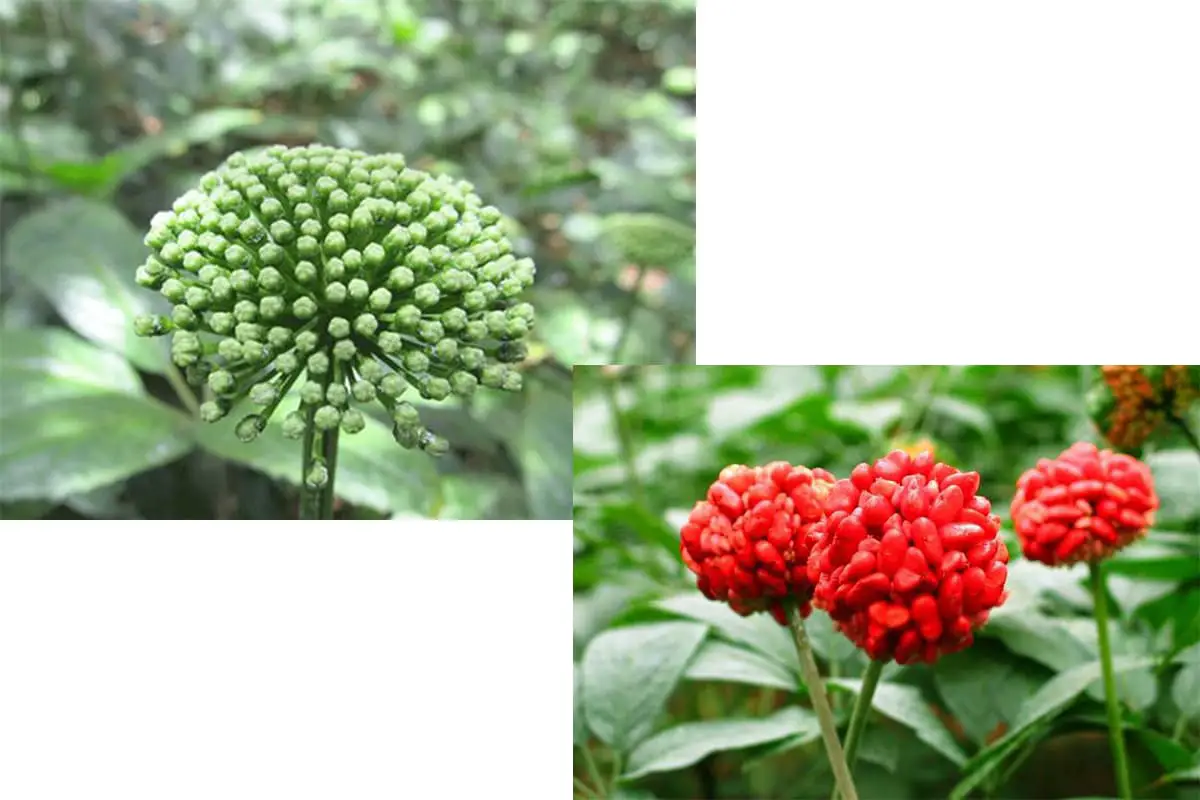
The flowers are small and yellow-green; the calyx is 5-lobed; there are 5 petals and stamens. The drupes are kidney-shaped, turning red when ripe. Each drupe contains 1-3 flat, spherical seeds.
The flowering period is from June to August, and the fruiting period is from August to October. The medicinal parts are the large, heavy, firm bodies with smooth skin and grey-green or grey-black cross-sections.
The plant grows under the forest on slopes, and is now mostly cultivated on gentle slopes at the foot of mountains at an altitude of 800-1000 meters.
The drupes are kidney-shaped, about 6-9mm long; they are green when young and turn red when ripe. Each drupe contains 1-3 spherical seeds with white seed coats. The flowering period is from June to August, and the fruiting period is from August to October.
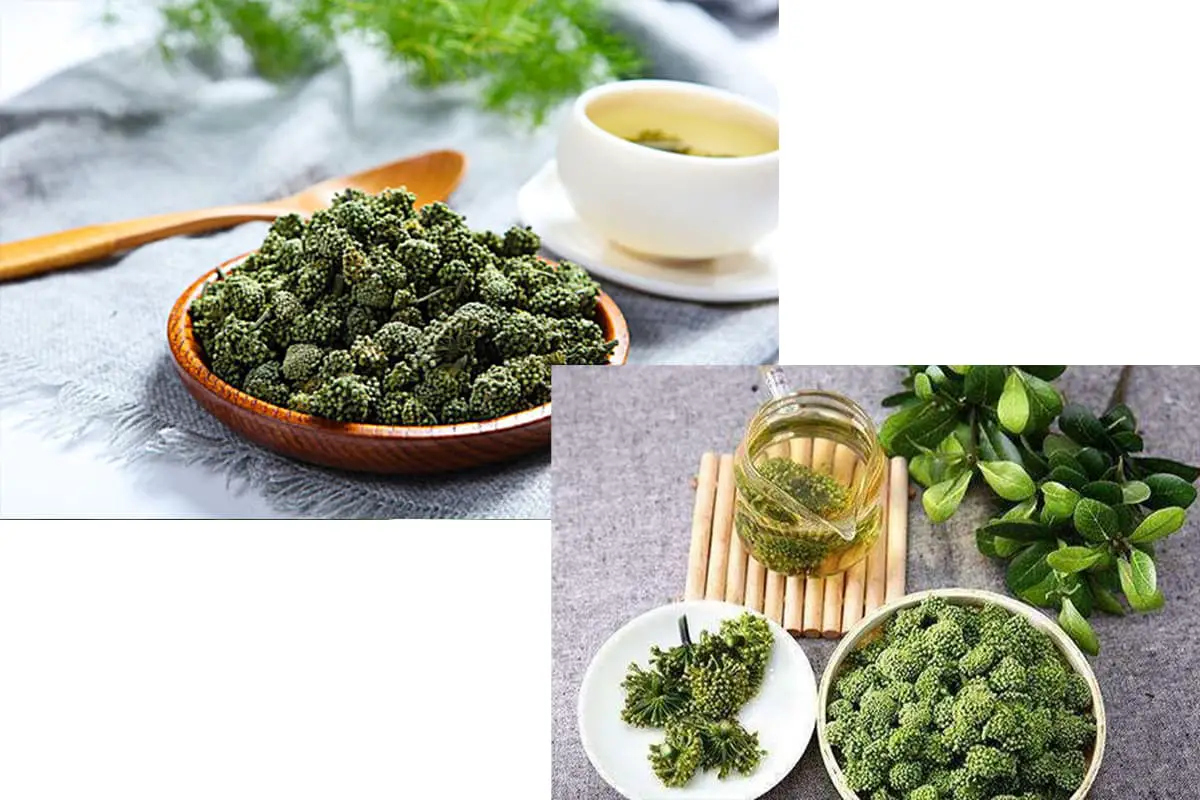
Panax Notoginsen flower, the part of Panax Notoginsen plant with the highest content of saponin, is sweet and cool in nature, and has the properties of clearing heat, calming the liver, and reducing blood pressure.
It is suitable for symptoms such as dizziness, vertigo, tinnitus, hypertension, and acute pharyngitis. It can be used in making tea, stir-frying meat, and making soup, and has certain effects in promoting sleep.
Relieving Inner Heat
Due to the fast pace of modern life, people often experience restlessness and inner heat. Regular consumption of Panax Notoginsen flower tea can reduce this inner heat.
Liver Detoxification
Panax Notoginsen flower tea has a significant effect on liver metabolism. It can alleviate the burden on the liver caused by long-term alcohol consumption.
Enhancing Immunity
Long-term consumption of Panax Notoginsen flower tea can enhance the body’s immunity and increase resistance to bacteria and viruses.
Fighting Fatigue
Panax Notoginsen flower tea is rich in saponin which can greatly resist fatigue, reduce free radicals, and is a tea with great beauty value for women.
The grade of Panax Notoginsen flower is determined by the color, size, presence or absence of a stem, and the length of the stem.
It can be divided into top grade three-year stemless Panax Notoginsen flower, first grade three-year stemless Panax Notoginsen flower, intermediate grade three-year stemless Panax Notoginsen flower, and three-year Panax Notoginsen flower with stem.
Panax Notoginsen flower is mainly produced in Wenshan, Yunnan, Guangxi, Tibet, etc. It is often used in traditional Chinese medicine to be processed into drugs, and has always been used as tea and food locally.
The inflorescence is harvested during the flowering period from June to August, and then fumigated and dried.Panax Notoginsen flower is harvested in the summer of the third year after planting (June, July, August each year). It is advisable to avoid harvesting immediately after spraying pesticides, and it is better to wait for more than a week.
After washing, soak it in clean water for 5-10 minutes to rinse it clean. When the water in the pot is boiling and the steamer is steaming, put the Panax Notoginsen flower into the steamer and steam for about 10 minutes.
The steamed Panax Notoginsen flower is then dried in the sun for 1-2 days, so that most of the water evaporates to the point where it will not mildew when stored in a cool place. Then place it in a ventilated place to dry, seal it in a food bag for storage, and it can be used all year round.

Peggie was once a high school mathematics teacher, but she set aside her chalkboard and textbooks to follow her lifelong passion for flowers. After years of dedication and learning, she not only established a thriving flower shop but also founded this blog, “Flowers Library”. If you have any questions or wish to learn more about flowers, feel free to contact Peggie.
 English
  العربية
  Bahasa Indonesia
  Deutsch
  Français
  Italiano
  Nederlands
  Português
  Русский
  日本語
日本語