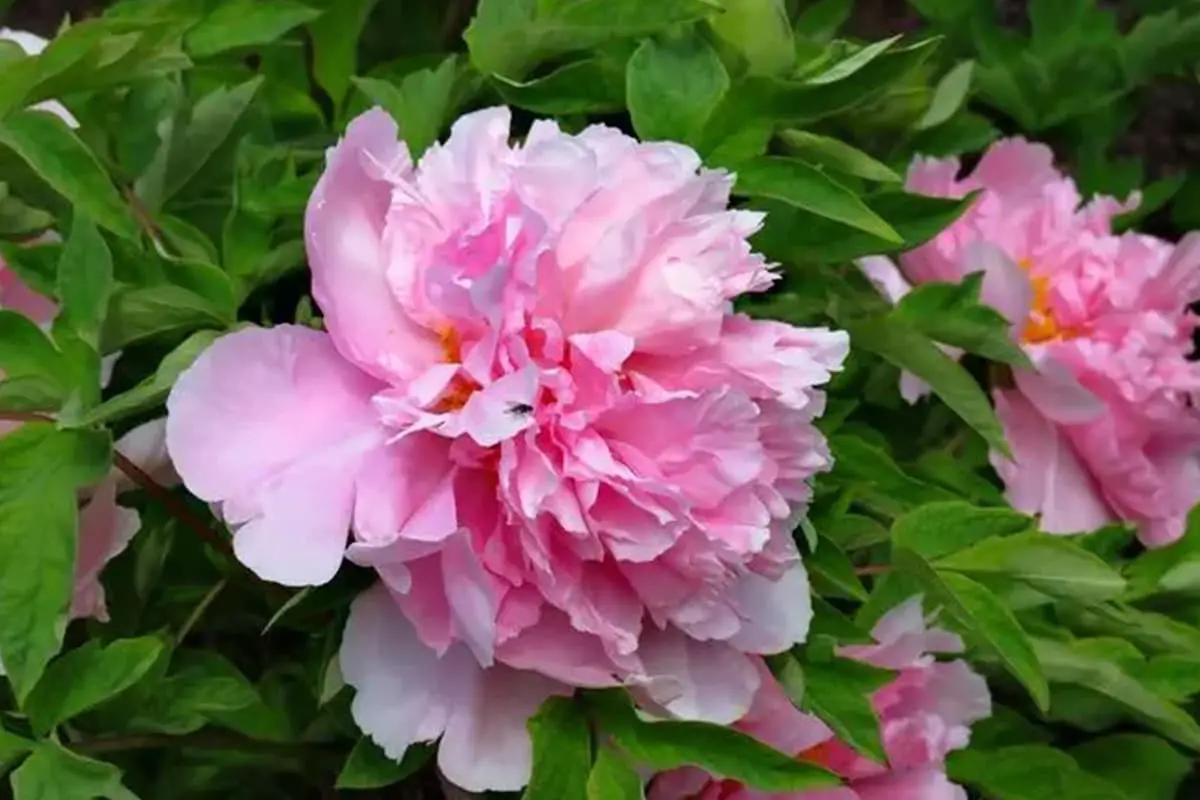
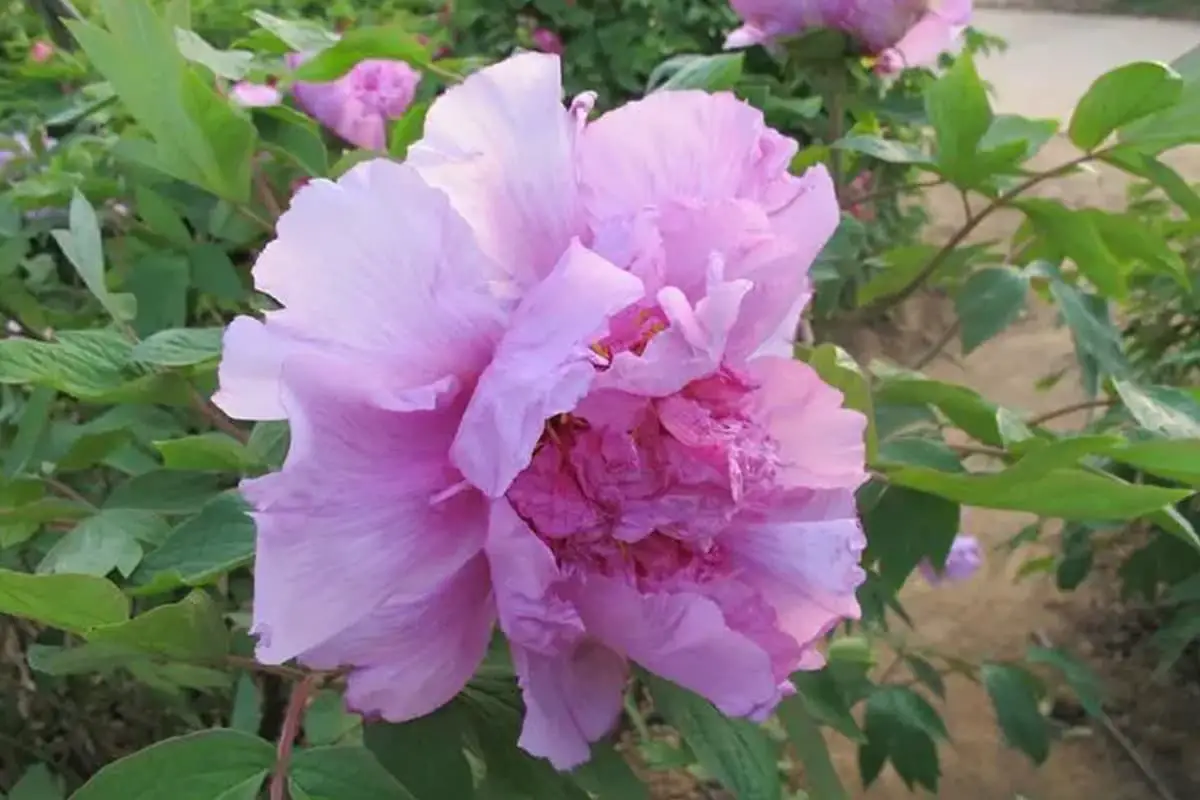
The Nelumbo nucifera ‘Guifeizuijiu’, also known as the ‘Drunken Concubine’, is a prized peony variety that produces delicate lavender flowers. When in full bloom, the flowers’ tops turn pink.
Named for its drooping flowers and soft branches that give it a tipsy appearance, the ‘Drunken Concubine’ boasts a large, spreading plant with thick branches and leaves. Its flowers, a tender lavender, have a hint of white within the red, resembling a blushing face.
They come in lotus or tray-clove shapes, and sometimes in a crown shape. Due to the soft stem, the flower blossoms sideways or droops, combined with the sparsely drooping branches and leaves, making it look like a drunken concubine, unable to stand on her own.
I. Basic Introduction
The ‘Drunken Concubine’ is a deciduous shrub with green new branches tinged with purple, and its branches are short and thick. Its buds are round and pointed, with few soil buds.
The leaves are usually bi-pinnate with a broad ovate apical leaflet, green and hairless on the surface, and pale green on the back, sometimes with white powdery substance, and sparsely hairy along the veins or nearly hairless.
The flowers are single at the branch top with 5 bracts of varying sizes; they come in lotus or tray-clove shapes, and sometimes in a crown shape. The flowers are lavender.
The upper part of the stamens is white, the anthers are oblong, and the disc is leathery, cup-shaped, and purplish-red; the pistils are densely hairy. The fruit is oblong and densely covered with yellow-brown hard hairs. It blooms in May and fruits in June.
The ‘Drunken Concubine’ is a prized peony variety that produces delicate lavender flowers. When in full bloom, the flowers’ tops turn pink. Because of the soft branches and drooping flower heads, it has the appearance of a delicate and drunken concubine. That’s why it’s named ‘Drunken Concubine’.
II. Morphology and Features
The ‘Drunken Concubine’ is a horticultural variety of peony. It is a deciduous shrub with a tall plant type, a semi-spreading plant with thick and sparse branches.
The leaves are large and thin, long and pointed, thick and soft, extremely sparse, appearing in long ovate to lanceolate shapes, green and glossy. The leaf surface and back are tinged with purple, and the leaf back is hairless.
The leaf stalk is flat, about 19 centimeters long, thick and soft, stretched flat; it is fat and purple-red. The leaflets are ovate or long ovate, with many notches, pointed at the end, hanging down, and the leaf surface is dark green.
The flowers come in lotus or tray-clove shapes, and sometimes in a crown shape. The flowers are lavender (73-B); the flower diameter is 25 centimeters x 8 centimeters.
When the flower first opens, it is lavender with a hint of red, in full bloom it is lavender-blue, and when it is about to wither it is pale lavender-white. The outer petals are 4-5 rounds, and the base has a purple-red halo; the inner petals are small and wrinkled, thin and soft, with clear purple veins on the petals.
There are many stamens, the stamens are long and lavender. The golden flower heart carries a noble glow. Some of the stamens are petalized; the pistils are basically normal, with petalization phenomena, and the ovary coat and stigma are lavender.
The petals are large, and the petal attachment is loose. The flower stem is long, soft and curved, 25-30 centimeters, so the flower head droops when it is in full bloom, as if it is shy and drunk, hence the name ‘Drunken Concubine’.
It has a large number of flowers, and is a medium-flower variety. The flower bud is round and pointed, the flower bud is yellow-green, which is different from other varieties. It has strong growth, high flowering rate, large flowers, but the flower shape is not neat, and there are fewer sprouts.
III. Living Habits
The Drunken Concubine Peony exhibits strong growth and prefers shade. It thrives in warm, cool, dry, and well-lit environments. While it enjoys sunlight, it can also tolerate semi-shade, cold, drought, and weak alkaline conditions.
However, it dislikes waterlogging, heat, and direct sunlight. It grows best in loose, deep, fertile, high and dry terrain with good drainage, in neutral sandy loam soil. It does not grow well in acidic or heavy clay soils, with a preferable pH range of 6.5-7.
Adequate sunlight benefits its growth, but it cannot tolerate intense summer sun. Temperatures above 25℃ will cause the plant to go dormant.
The optimal temperature for blooming is 17-20℃, but it must undergo a low-temperature treatment at 1-10℃ for 2-3 months before blooming. It can tolerate temperatures as low as -30℃.
IV. Cultivation Method
Planting: The soil should be loose, fertile, and neutral to slightly alkaline. Trim any broken or diseased roots from the Peony sapling, treat with insecticide and fungicide, then plant it in a pre-prepared pot or hole.
Ensure the root system is spread out. Fill the pot or hole halfway with soil, lightly lift and shake the sapling, then firmly compact the soil. The depth should be such that the rhizome is slightly below the surface.
Watering: After planting, water thoroughly once. Peonies dislike waterlogging, so water sparingly during the growing season. In northern arid regions, water just before and after flowering, and when the ground freezes. For potted plants, remove spent flowers after blooming and bury the pot in the ground for easier management.
Fertilizing: One year after planting, apply well-rotted organic fertilizer in the fall. This can be combined with loosening the soil, broadcast or hole fertilizing. In spring and summer, use more chemical fertilizer, combined with watering before and after flowering. Potted plants can be watered with liquid fertilizer.
Pruning: In the planting year, cut back hard. After spring sprouting, leave about 5 branches and remove the rest to concentrate nutrients and ensure larger, more colorful flowers the following year.
In autumn and winter, remove dried flower stems, weak branches, and non-flowering branches while tidying the garden. Potted plants can be pruned to your preferred shape as needed.
Weeding: During the growing season, weed regularly and watch for diseases and pests. In autumn and winter, turn the soil in biennial or older Peony plants.
Repotting: After three or four years of growth, potted Peonies should be repotted in larger pots with fresh fertile soil in the fall, or divided and planted separately.
Pest Control: Spray with lime sulfur before spring buds appear, and use a mixed insecticide and fungicide in summer. Depending on the disease, apply every 2 weeks. You can add chemical fertilizers and growth regulators when fertilizing.
Forcing Blooms: To have blooms for holidays or events, you can warm the Peony about 50 days in advance, maintaining a temperature of 10-25℃, with an average daily temperature of about 15℃. Initially, keep the plant moist, and after buds appear, ensure good ventilation and light.
Once the buds form, control the temperature according to the flowering period. Regularly apply foliar fertilizer and ensure adequate water supply. In this way, flowers can be seen in both winter and spring.
Viewing: A single Peony plant naturally blooms for about 10-15 days, shortening with rising temperatures. It can last for over a month at 3-8℃. For field planting, temporary shelters can be erected to block wind and light, extending the viewing period.
Potted plants should be moved to a place without direct sunlight, at a temperature of 5-10℃, and in a well-ventilated and well-lit environment. Water appropriately according to the appearance and moisture level of the potting soil, and avoid watering the flowers to prolong the blooming period.
When cutting for arrangements, cut or sear the wound under water. Preservative or a little sugar can be added to the water to prolong the blooming period of the cut flowers.
V. Propagation Methods
Division
The specific method of division propagation involves uprooting a thriving peony plant and separating it at the junction of the root system.
The number of offshoots separated from each plant depends on the size of the original plant; larger plants can be divided into more offshoots, smaller ones can be divided into fewer.
Generally, every 3-4 branches are considered one offshoot, with a complete root system. A little sulfur powder is mixed with mud and applied evenly to the wounds on the roots before the plant is ready for replanting.
Division is best done from the autumn equinox to frost, when the temperature is still high and the peony is in a semi-dormant state but still has a considerable period of nutrient growth. Early division allows the plant to produce some new roots and a few buds.
If division is done too late, the roots may not grow well or produce new roots, and the plant will be weak in the following spring. Early division, when the temperature is still high, can lead to rapid growth and possibly early budding.
The mother plant of the peony division is typically a robust clump. As much of the root system as possible should be retained on the mother plant used for division propagation, and all the roots on the new shoot should be preserved for growth, so that after 5 years, more new shoots can be produced. The more roots are retained, the more vigorous the growth.
Grafting
Peony grafting propagation relies on two types of rootstock: wild peony and peony root. The commonly used methods of peony grafting include inlay grafting, belly grafting, and bud grafting.
Inlay grafting: Peony root is used as rootstock. It’s soft and doesn’t have a hard core, making it easy to graft. The root is short and fat, providing ample nutrients for vigorous growth after grafting.
If the peony root is used for grafting, the wood is harder, making grafting difficult, but the lifespan is longer. The best time for grafting is usually from late September to early October. The rootstock is a strong, pest-free peony root, 2-3 cm in diameter and 10-15 cm long.
Bud Grafting Method: This is a method of improving the variety by grafting onto a sub-par peony or an 8-10-year-old medicinal peony plant with numerous branches, resulting in different color varieties.
The grafting period is from early July to mid-August. First, select peony plants that are of good variety, robust, and free from diseases and pests.
Cut the shoots that sprout from the ground, or short branches that have grown within the year that are 5-7 cm long, preferably with 2-3 robust buds to be used as grafts.
Leave a leaf stem on the graft. After selecting the graft, cut diagonally on the back of the lower bud of the graft, forming a horseshoe shape, then cut diagonally on the other side of the horseshoe shape to form a wedge shape, so that after grafting, both sides can reach the cambium between the wood and the bark, which is conducive to survival.
Before and after the peony graft, except during the rainy season when irrigation is not added, the appropriate humidity for normal plant growth should be maintained. Bud grafting is an effective method for propagating peonies and cultivating multiple varieties and colors on a single plant.
Bud Grafting Method: This is carried out between May and July. Grafting is best done on sunny days.
There are two methods: the bark grafting method and the bud changing method.
The bark grafting method involves cutting a rectangular or shield-shaped cut on the current year’s branch of the rootstock, along with the wood, then cutting a bud block of the same size and shape from the axillary bud of the graft, along with the wood.
Then quickly attach the bud block to the cut on the rootstock and tie it tightly with a plastic string. The bud changing method involves removing the axillary bud at the graft site on the rootstock, along with the cambium, while keeping the bud embryo intact on the wood.
Then, in the same way, strip off the axillary bud of the graft and quickly fit it onto the bud embryo of the rootstock, ensuring that the two align.
Finally, tie it tightly with a plastic string. After grafting, the plants should be watered, the soil loosened, and fertilizer applied promptly to promote healing.
Cutting
Cutting propagation is a method of using peony branches to produce new plants by growing adventitious roots, one of the asexual reproduction methods.
The method is to cut the branches used for cutting from the mother plant and then insert them into the soil or other substrates to grow roots and become new plants.
The branches used for peony cutting propagation should be the current year’s buds sprouting from the peony root or branches selected during the peony pruning, which are full and pest-free, and 10-18 cm long.
Peonies have fleshy roots that like to be dry, avoid dampness, and are drought-tolerant. Therefore, the seedbed should be in a well-ventilated and sunny place, and the seedlings should be raised on a high bed. After inserting, water each ridge once thoroughly.


 English
  العربية
  Bahasa Indonesia
  Deutsch
  Français
  Italiano
  Nederlands
  Português
  Русский
  日本語
日本語