600+ Types of Flowers A To Z (With Names and Pictures)
Types Of Flowers By Names (A-Z) Types Of Flowers By Color Types Of Flowers By Season Types Of Flowers By Blooming Time 600+ Types of Flowers No. Flower Name No.…

The Mimosa pudica, commonly known as the sensitive plant or touch-me-not, is a fascinating member of the pea family (Fabaceae) and the Mimosa genus. This unique herbaceous plant, native to tropical America, has captivated botanists and gardeners alike with its remarkable ability to respond to touch.

Mimosa pudica is a low-growing, sprawling perennial that typically reaches heights of 30-50 cm, though it can occasionally grow up to 1 meter. Its slender, cylindrical stems are adorned with branches and equipped with scattered, recurved prickles and retrorse bristles for protection.
The plant’s compound leaves are its most distinctive feature. Each leaf consists of 1-2 pairs of pinnae, arranged at the top of the petiole in a palmate fashion. These pinnae measure 3-8 cm in length and bear 10-20 pairs of leaflets. The leaflets are elongated-oval, measuring 8-13 mm in length and 1.5-2.5 mm in width, with an acute apex and ciliate margins.

What sets Mimosa pudica apart is its rapid seismonastic movement. When stimulated by touch, vibration, or even strong airflow, the pinnae fold together and the leaves droop, a response that occurs within seconds. This unique trait has earned it the nicknames “sensitive plant” and “shy plant.”
The inflorescences are globose heads, approximately 1 cm in diameter, borne on long peduncles either solitarily or in groups of 2-3 from the leaf axils. The flowers are small, pale pink to lavender, and densely packed. Each flower has a minute calyx, a bell-shaped corolla with four lobes covered in fine pubescence, four stamens that extend beyond the corolla, and a superior ovary with 3-4 ovules.
The fruit is a flat, slightly curved pod (loment) measuring 1-2 cm long and about 5 mm wide. It has bristly margins and breaks into 2-4 segments when mature, each containing a single ovoid seed about 3.5 mm long.
Mimosa pudica flowers from late spring through autumn (typically March to October in its native range) and fruits from early summer to late autumn (May to November).
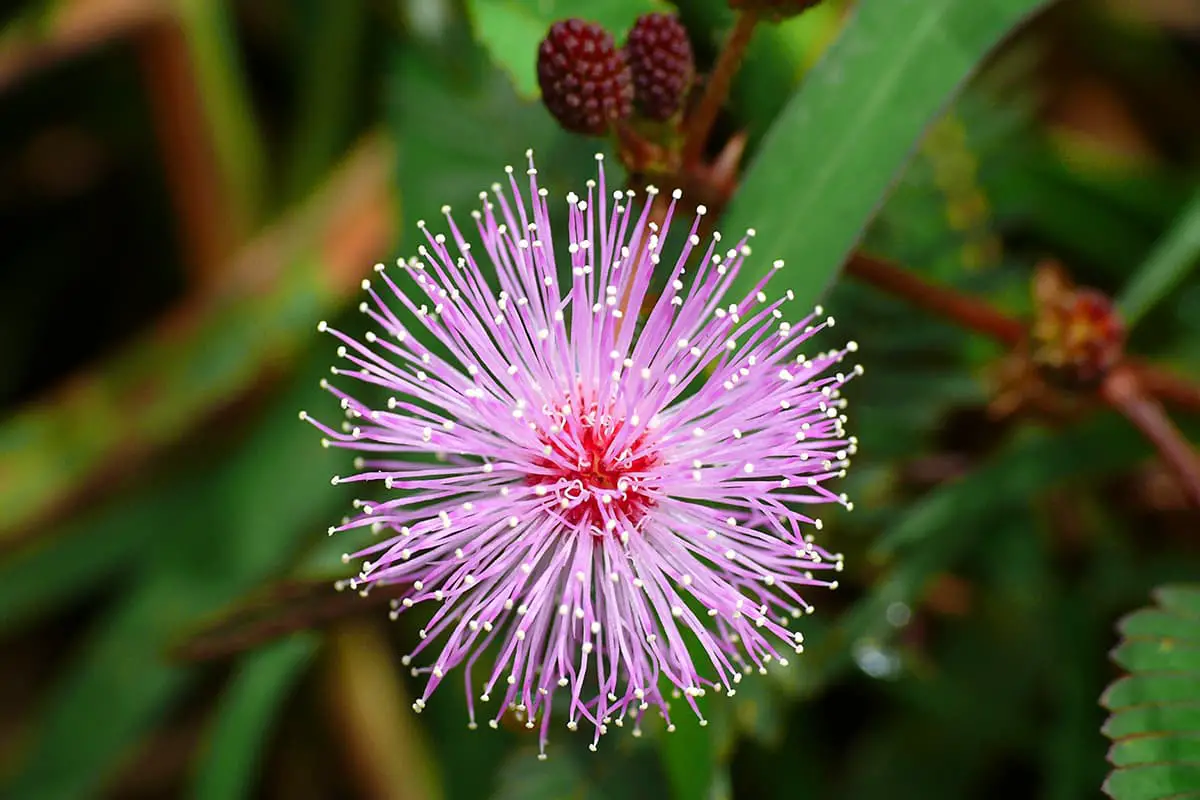
Originally from tropical America, Mimosa pudica has now naturalized in many tropical and subtropical regions worldwide. It thrives in open, disturbed areas such as fields, roadsides, and waste grounds, often at elevations between 20-200 meters above sea level.
The plant prefers warm, humid climates with ample sunlight. It grows best in well-drained, sandy loam soils rich in organic matter but can adapt to a variety of soil conditions. Mimosa pudica is known for its rapid growth and strong adaptability, which has contributed to its widespread distribution.
In temperate regions, such as the Yangtze River basin in China, it is often cultivated as an ornamental plant for its interesting leaf movements and delicate flowers.
Mimosa pudica, a taproot plant with minimal fibrous roots, is best propagated from seeds. Direct sowing is the preferred method to prevent root damage during transplantation.
If transplantation is necessary, it should be conducted during the early seedling stage to ensure survival. As an annual plant, Mimosa pudica is typically sown indoors in early spring.
Seeds can be sown directly in small individual pots or in shallow trays for later transplanting. The ideal sowing medium consists of 20% well-decomposed leaf mold, 30% garden soil, and 50% fine sand, thoroughly sifted and mixed.
To sow, first fill the container with the prepared soil mixture, level and lightly compact it, then water thoroughly. Once the water has fully absorbed, proceed with sowing. For direct sowing in small pots, plant 1-2 seeds per pot. In shallow trays, sow seeds at 2 cm x 2 cm intervals. Cover the seeds with 3-5 mm of soil.
Maintain humidity by covering the container with glass or plastic film. Place in diffused light at approximately 20°C (68°F). Water by bottom immersion when the soil surface dries. Germination typically occurs in 7-10 days.
After emergence, gradually expose seedlings to sunlight. When seedlings reach 3 cm in height, those in trays can be transplanted. It’s crucial to transplant with the soil intact to ensure survival. After transplanting, place in partial shade initially, then move to full sun once acclimated.
Seedlings sown directly in small pots can be placed in full sun immediately. In warmer regions, seedlings can be moved outdoors in mid-April, while in cooler areas, early May is more suitable. Maintain consistent soil moisture.
Begin applying diluted liquid fertilizer every 7-10 days when seedlings develop 4 true leaves. As plants grow, they may require repotting, but avoid overly large containers; a 15-20 cm pot is generally sufficient.
Mimosa pudica is a robust, fast-growing plant. During the active growing season, it thrives on balconies or in gardens, requiring deep, fertile, and consistently moist soil. In winter, move plants indoors to a sunny windowsill, where they can overwinter at temperatures around 10°C (50°F).
In full sun conditions, the root system develops rapidly, necessitating daily watering. During hot, dry summers, water twice daily – morning and evening. Insufficient water causes leaf drooping, yellowing, and loss of touch sensitivity.
Apply fertilizer every two weeks during the active growing period. To control plant size, reduce fertilizer application frequency or concentration.
Mimosa pudica’s compound leaves are arranged in a pinnate pattern. When stimulated by touch, the leaflets fold rapidly. Strong stimuli can cause the entire leaf to droop and may even trigger a response in adjacent leaves.
The plant’s unique leaf movement, known as seismonastic movement or thigmonasty, is a defensive mechanism against herbivores and environmental stresses. This rapid response is facilitated by specialized structures called pulvini at the base of each leaflet and leaf stalk.
For optimal growth, maintain temperatures between 20-30°C (68-86°F) during the day and not below 15°C (59°F) at night. Provide high humidity through regular misting or by placing the pot on a humidity tray filled with pebbles and water.
Prune regularly to maintain shape and encourage bushier growth. Pinch off the growing tips when the plant reaches about 15 cm (6 inches) tall to promote branching. Remove any dead or yellowing leaves promptly to prevent disease.
While generally pest-resistant, Mimosa pudica can occasionally suffer from spider mites or mealybugs, especially in dry conditions. Regularly inspect plants and treat any infestations promptly with insecticidal soap or neem oil.
The Mimosa pudica plant, in its entirety, exhibits sweet and astringent properties with a cooling nature. It possesses the ability to calm the mind, clear heat, and detoxify. Traditional applications include treating vomiting, diarrhea, insomnia, pediatric malnutrition, inflamed eyes, deep abscesses, and herpes zoster.
The root of Mimosa pudica is astringent and slightly bitter, with some toxicity. It is known to suppress cough, dissolve phlegm, benefit dampness, open meridians, harmonize the stomach, and reduce accumulation. It is commonly used for coughs with phlegm, rheumatic joint pain, and digestive issues in children.
The O-β-D-glucoside of Mimosa pudica alkaloid is mildly toxic. Prolonged exposure or ingestion can lead to decay of hair follicles in skin cells, resulting in yellowing and potential loss of hair and eyebrows. Due to its slight toxicity, Mimosa pudica should never be administered alone but always in combination with other herbs. The alkaloid can also potentially cause cataracts and inhibit growth.
Given its potential to cause hair loss in humans, Mimosa pudica is not recommended for indoor cultivation.
Mimosa pudica boasts a scattered growth habit with delicate, beautiful feathery leaves that respond to touch by closing immediately. Its numerous, elegant flowers create a refined and delicate impression. This plant is ideal for planting in courtyard corners or as a potted specimen on windowsills and desks.
For gifting, the pot can be gently covered with pink gauze and tied with a pink ribbon bow. Adding a pink marabou pompom can enhance its charm. Mimosa pudica has gained popularity as an indoor ornamental plant due to these attractive qualities.
Mimosa pudica, often called the “shy plant,” demonstrates remarkable weather-indicating properties. When touched, its leaves typically close quickly and reopen slowly in clear weather. However, if the leaves retract slowly, hang limply, or close and reopen, it may indicate an impending change from sunny to cloudy conditions or potential rainfall.
This weather forecasting ability is primarily due to the pulvinus, a small, drum-like, thin-walled cellular structure at the base of the leaves. The pulvinus is filled with water, and when stimulated, the water in the lower pulvinus cells flows upwards and sideways, causing the lower part to deflate and the upper part to inflate. This results in the drooping of the leaf stalk and closure of the leaves.
The rate of leaf closure and opening is influenced by the turgor pressure in the pulvinus, which correlates closely with air humidity. In dry air, the turgor pressure is higher, leading to rapid leaf movements. Conversely, humid air results in slower leaf movements. Thus, the speed of Mimosa pudica’s leaf movements indirectly reflects air humidity levels, serving as a reference for weather forecasting.
Interestingly, Mimosa pudica has also been associated with earthquake prediction. Turkish seismologist Elci observed that the plant’s leaves suddenly wilt and wither a few hours before major earthquakes. Japanese scientists have noted that under normal circumstances, the leaves open during the day and close at night. A reversal of this pattern may precede an earthquake.
Moreover, Mimosa pudica can potentially predict other disastrous weather changes. It exhibits unusual growth activity in response to sudden unseasonal temperature differences and changes in geomagnetic and geoelectric fields. As a precautionary measure against natural disasters, some people keep potted Mimosa pudica plants indoors for monitoring and forecasting such changes.
Mimosa pudica is associated with three primary meanings in flower language: Shyness, Sensitivity, and Politeness.
The plant’s responsive nature, curling up when touched, watered, or exposed to strong winds, evokes the image of bowing, hence its association with politeness. People born under the influence of this flower are often well-behaved and favored by elders but may inspire awe in their peers. They are advised to occasionally relax, as excessive seriousness can be intimidating, even to potential romantic interests.
The plant’s rapid leaf closure in response to touch or even a gentle breeze has led to its association with shyness, likening it to a shy maiden. Individuals born under this flower’s influence tend to be extremely shy, timid, and often introverted. They possess a sharp sense of perception and strong self-esteem. While they may be reserved in general, they are more relaxed around those who understand them. These individuals typically prefer quality over quantity in friendships and value long-term, steady relationships.

Peggie was once a high school mathematics teacher, but she set aside her chalkboard and textbooks to follow her lifelong passion for flowers. After years of dedication and learning, she not only established a thriving flower shop but also founded this blog, “Flowers Library”. If you have any questions or wish to learn more about flowers, feel free to contact Peggie.
 English
  العربية
  Bahasa Indonesia
  Deutsch
  Français
  Italiano
  Nederlands
  Português
  Русский
  日本語
日本語