Kerria japonica, also known as Japanese kerria, is a deciduous shrub that typically grows to heights of 1-2 meters, but can occasionally reach up to 3 meters.
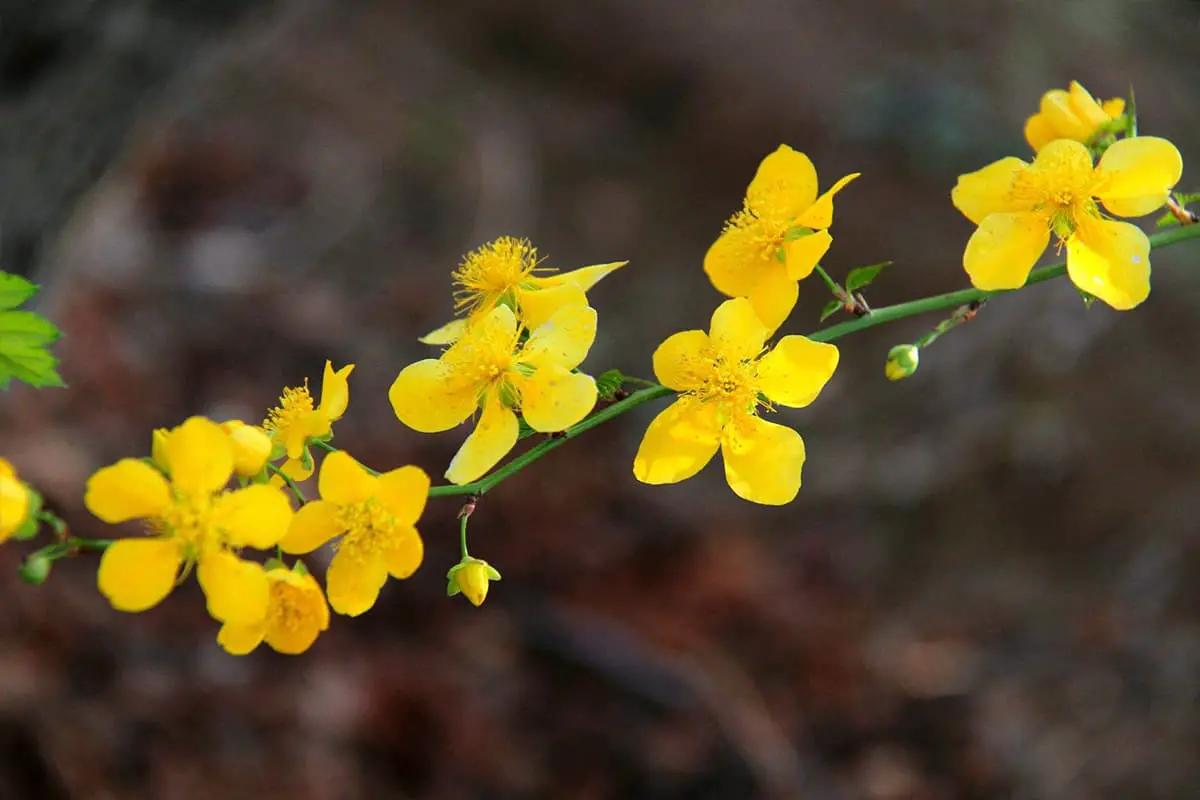
The slender branches are green, cylindrical, hairless, and often arching, with young branches displaying angular features. It produces solitary flowers that bloom at the ends of the current year’s side branches. The flower stems are hairless.
The plant flowers from May to June, with the fruiting period from July to August. The Japanese kerria prefers warm, humid, and semi-shaded environments but has a relatively low cold tolerance.
Its vibrant green branches and leaves, along with its golden flowers that densely cover the tree, give it a unique elegance, making it a popular ornamental plant. Moreover, it is also used medicinally for its anti-inflammatory, analgesic, antitussive, and digestive properties.
I. Morphological characteristics
The Japanese kerria is a shrub with alternate leaves. The leaves are ovate to ovate-elliptic in shape. The branches remain green throughout the year, while the flowers are a brilliant golden yellow. The thin fruits are a dark brown color.
The flowering period is from April to May. This deciduous shrub grows in clusters and reaches heights of 1-2 meters. The small branches are green, hairless, with a white pith, and are soft in texture.
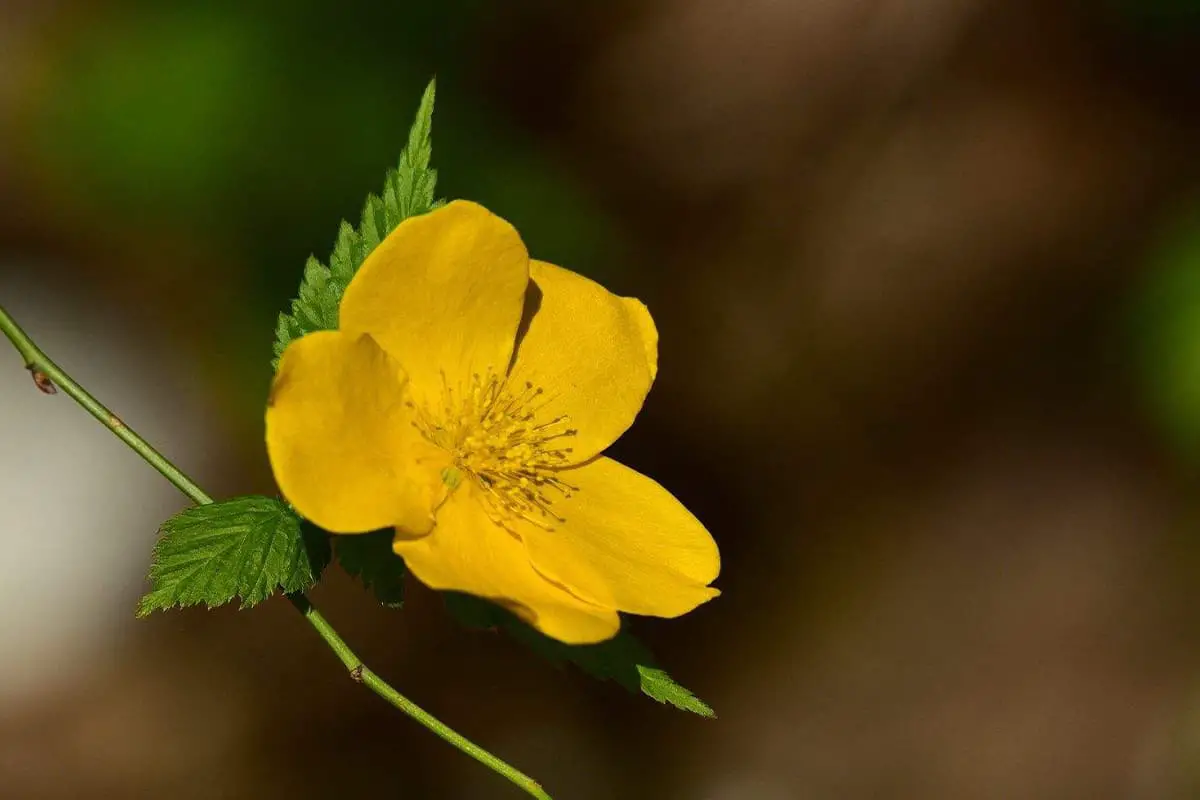
The leaves are ovate or triangular-ovate, 2-8cm long, 1.2-3cm wide, gradually tapering to a pointed tip, with a truncated or nearly round base. The leaf margins have sharp, double serrate teeth, and the leaf undersides sparsely grow short, soft hairs.
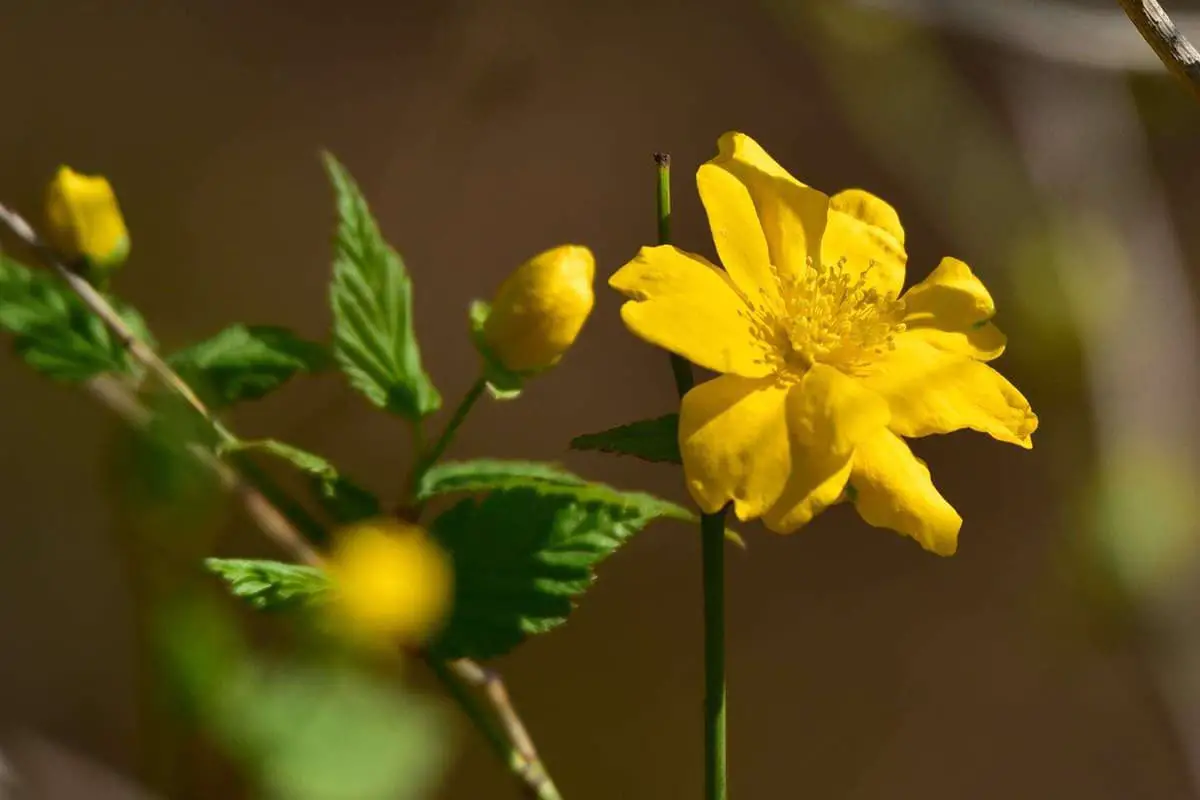
The leaf stalks are 0.5-1.5cm long and hairless. The stipules are lanceolate, membranous, and have white-haired edges. The flowers bloom singly at the ends of the current year’s side branches.
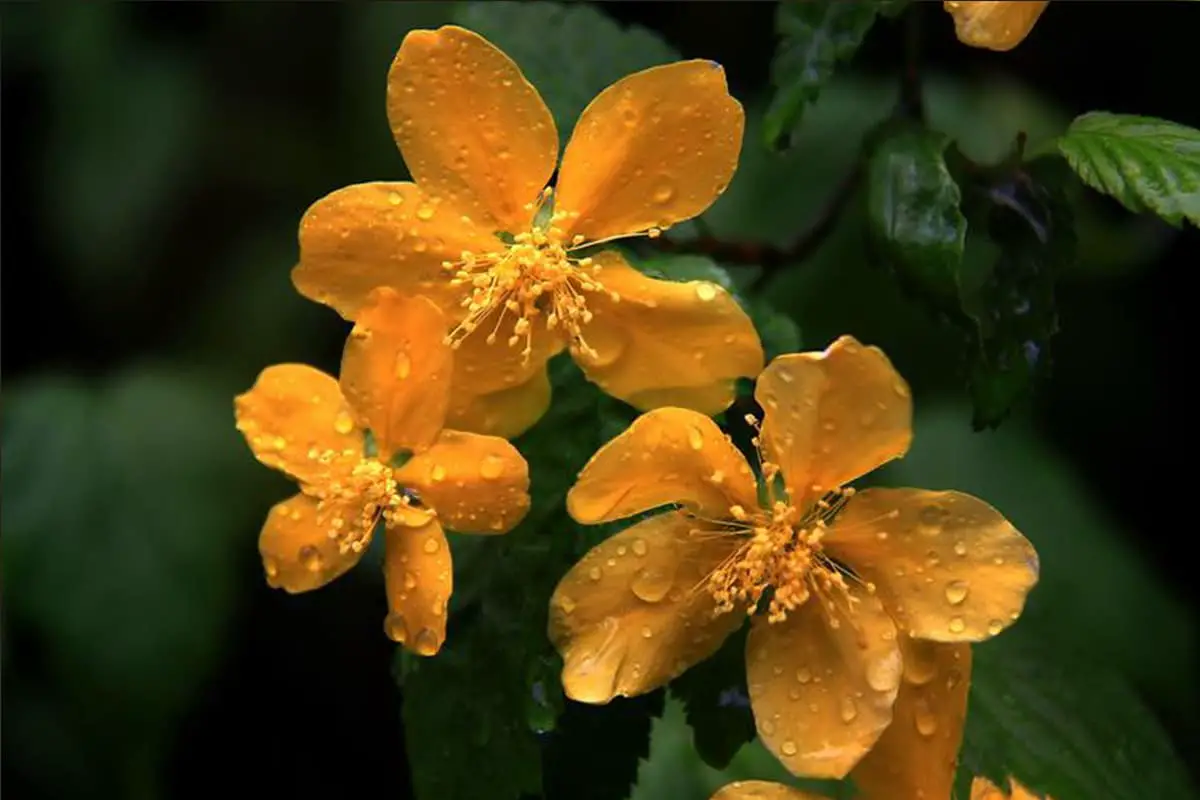
The flower stems are 1-1.2cm long and hairless. The flowers are golden yellow, with a diameter of 3-4.5cm. The calyx tube is hairless, with ovate-triangular or elliptic calyx lobes that are approximately 0.5em long, have entire margins, and are hairless on both sides.
The flower petals are long and round or nearly round, 1.8-2.5cm long, with slightly indented tips. The stamens are less than half the length of the petals. The pistils are terminal and nearly the same length as the stamens.
The thin fruits are brownish-black and flattened spherical. The plant flowers from May to June, with the fruiting period from July to August, producing a single fruit per plant.
II. Growth Environment
The flowering quince thrives in a warm climate, and is not highly resistant to cold. It should be planted in a spot that is sheltered from the wind and bathed in sunlight. It prefers a warm, moist climate, can tolerate some shade, but is not adept at surviving cold. It has moderate soil requirements, but does not fare well in drought conditions.
III. Range of Distribution
This plant commonly grows on the slopes and in the valleys of shrublands and mixed forests at altitudes of 400-1000 meters.
IV. Propagation
Propagation is often done through division. In production, seeds, division, and cuttings are the three most common propagation methods, with cuttings and division being the most widely used.
V. Main Value
The flowering quince can be planted in clusters at the base of trees, along walls, beside water, on slopes, at the edge of forests and lawns, or laid out as flower paths, hedges, or combined with rockeries for an excellent landscape effect.
The flowers of the flowering quince have medicinal properties, including reducing swelling, relieving coughs, alleviating pain, and aiding digestion.
Garden Use
In gardens, it can be used as a greenery material for shade, such as at the edge of the forests, beside lakes, and on the north side of buildings and rockeries. It is often planted in rows to form flower clusters or hedges, contrasting with dark backgrounds, making the bright yellow floral branches stand out. The flowers can be used for medicinal purposes.
VI. Pest and Disease Control
Common issues include brown spot and dieback diseases, which can be treated by spraying with a 1000-fold liquid of 50% carbendazim wettable powder. Other pests include the red spider mite, which can be exterminated by spraying with a 1500-fold liquid of 40% dicofol emulsion oil. It is recommended to use more farmyard manure.


 English
  العربية
  Bahasa Indonesia
  Deutsch
  Français
  Italiano
  Nederlands
  Português
  Русский
  日本語
日本語