600+ Types of Flowers A To Z (With Names and Pictures)
Types Of Flowers By Names (A-Z) Types Of Flowers By Color Types Of Flowers By Season Types Of Flowers By Blooming Time 600+ Types of Flowers No. Flower Name No.…

Jacaranda mimosifolia is a deciduous tree that can reach up to 15 meters in height. Its tubular flower crowns are slender, blue, slightly curved at the bottom, and swollen at the top, with a length of about 18 centimeters.
The flower crown lobes are round, and the filaments are attached to the middle part of the flower crown tube. The ovary is cylindrical and hairless.
The fruit is woody, flat ovate, approximately 5 centimeters in length and width, thicker in the middle, gradually thinning towards the edges, and not flat. It blooms in May and June.
Originally native to Brazil in South America, it has been introduced to China in recent years for ornamental purposes. Jacaranda mimosifolia is a tree species admired for its leaves, flowers, and appearance.
It is widely planted as a roadside tree in tropical and warm subtropical regions. Its timber is yellowish-white to gray, soft and light, with straight grain and easy to work with. It can be used for papermaking.
The initial whiteness of the wood powder is relatively low, the lignin content is relatively high, and the solvent extract content is comparable to that of poplar and other broad-leaved woods. It can be used as furniture material. This species has both ornamental and economic value.
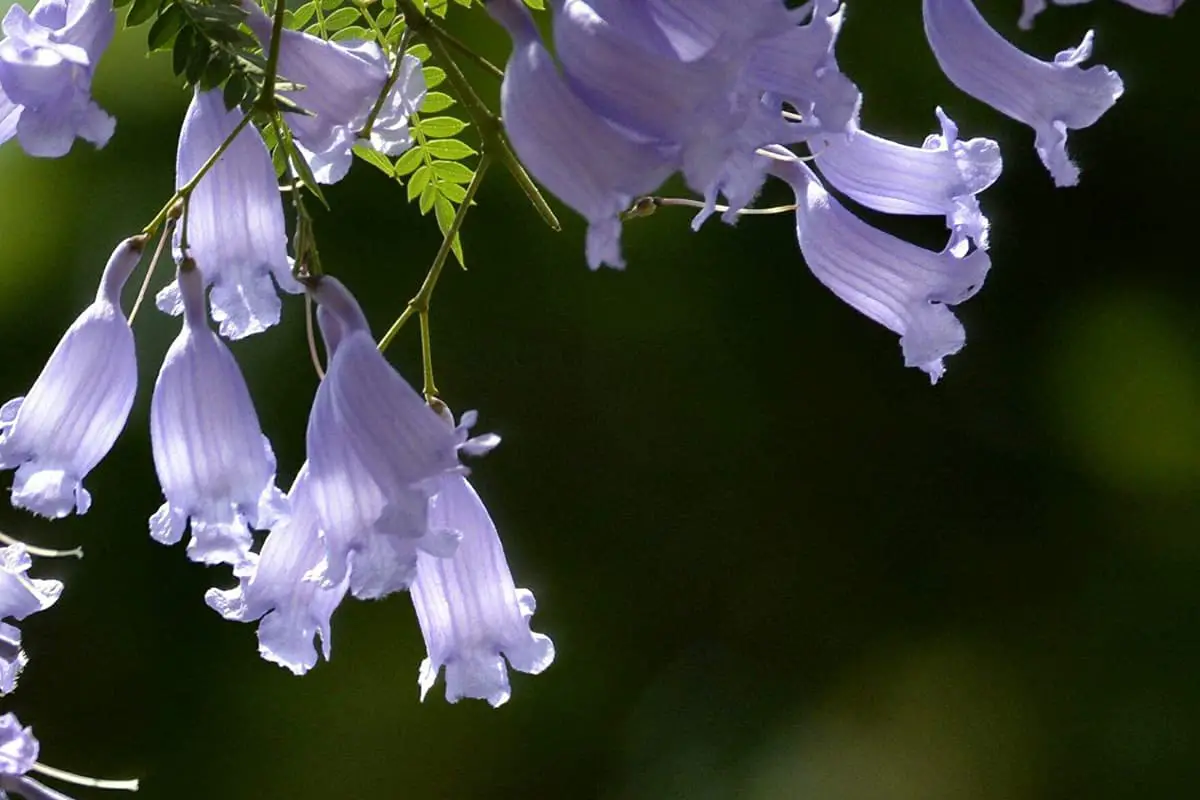
Jacaranda mimosifolia is a deciduous tree that can reach up to 15 meters in height. Leaves are opposite and are bipinnate, with usually more than 16 pairs of leaflets, each with 16-24 pairs of small leaves.
The small leaves are ovate-lanceolate to rhombic-elliptic, 6-12 millimeters long, 2-7 millimeters wide, with an acute apex, cuneate base, and entire margin.
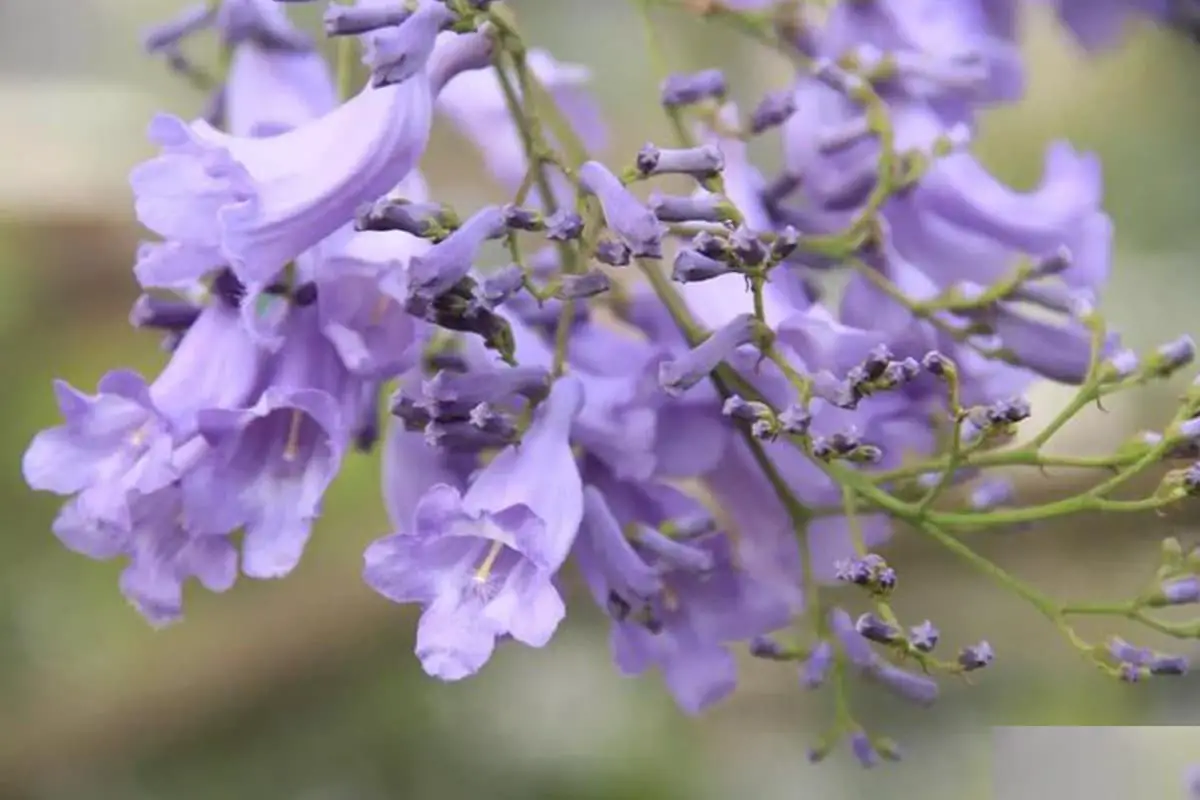
The flowers are blue, in panicles up to 30 centimeters long, approximately 18 centimeters in diameter. The calyx is tubular, about 5 millimeters in length and width, with 5 calyx teeth.
The flower crown tube is slender and blue, slightly curved at the bottom, swollen at the top, about 18 centimeters long, and the flower crown lobes are round.
There are four stamens, two of which are stronger, and the filaments are attached to the middle part of the flower crown tube. The ovary is cylindrical and hairless.
The fruit is woody, flat ovate, approximately 5 centimeters in length and width, thicker in the middle, gradually thinning towards the edges, and not flat. It blooms in May and June.
Jacaranda mimosifolia thrives in warm, moist environments with plenty of sunlight. It is not frost-resistant. It is not demanding in terms of soil conditions and grows well in neutral and slightly acidic soils.
Jacaranda mimosifolia is native to Brazil, Bolivia, and Argentina in South America.
The propagation methods of Jacaranda mimosifolia include seed propagation, cutting propagation, and tissue culture propagation.
The fruit ripening period of Jacaranda mimosifolia is in November. After picking, they should be sun-dried in a windless place or stacked.
After drying, they can be stored and sown in March of the following year. Since Jacaranda mimosifolia is native to tropical areas, the sowing should be done when the temperature is around 20 degrees.
Cutting propagation can be done in spring and autumn. When cutting, choose semi-mature branches as cuttings for a higher rooting rate.
Tissue culture is also relatively easy. Some research units in our country have used the stem tips and stem segments of seedlings as explants to propagate a large number of test-tube seedlings.

The Jacaranda tree has few diseases, but it can be infested by beetles. If reddish-brown droppings are found at the base of the trunk, you can use a small knife to peel back the bark and catch the larvae.
Alternatively, before the adult beetles emerge, you can apply a mixture of 10 parts lime, 1 part sulfur, and some salt to the lower 80 cm of the trunk to prevent the beetles from laying eggs.
The Jacaranda is a tree species appreciated for its beauty, its leaves, and its flowers. It is extensively planted as a street tree, shade tree, and landscape tree in tropical and warm subtropical regions.
The tree blooms twice a year, in summer and autumn, and during the blooming season, it is covered with elegant and delicate purple-blue flowers. Especially in the tropics, blue-flowering trees are rare, making the Jacaranda a precious and unique woody plant.
Jacaranda is used in the paper industry. The wood pulp has a relatively low initial whiteness and a high lignin content, with extractable substances comparable to those of poplar and other broad-leaved trees. The fibers are short, and the basic density is low.
The wood is yellowish-white to gray, soft and light, with a straight grain. It is easy to work with and can be used to make furniture.
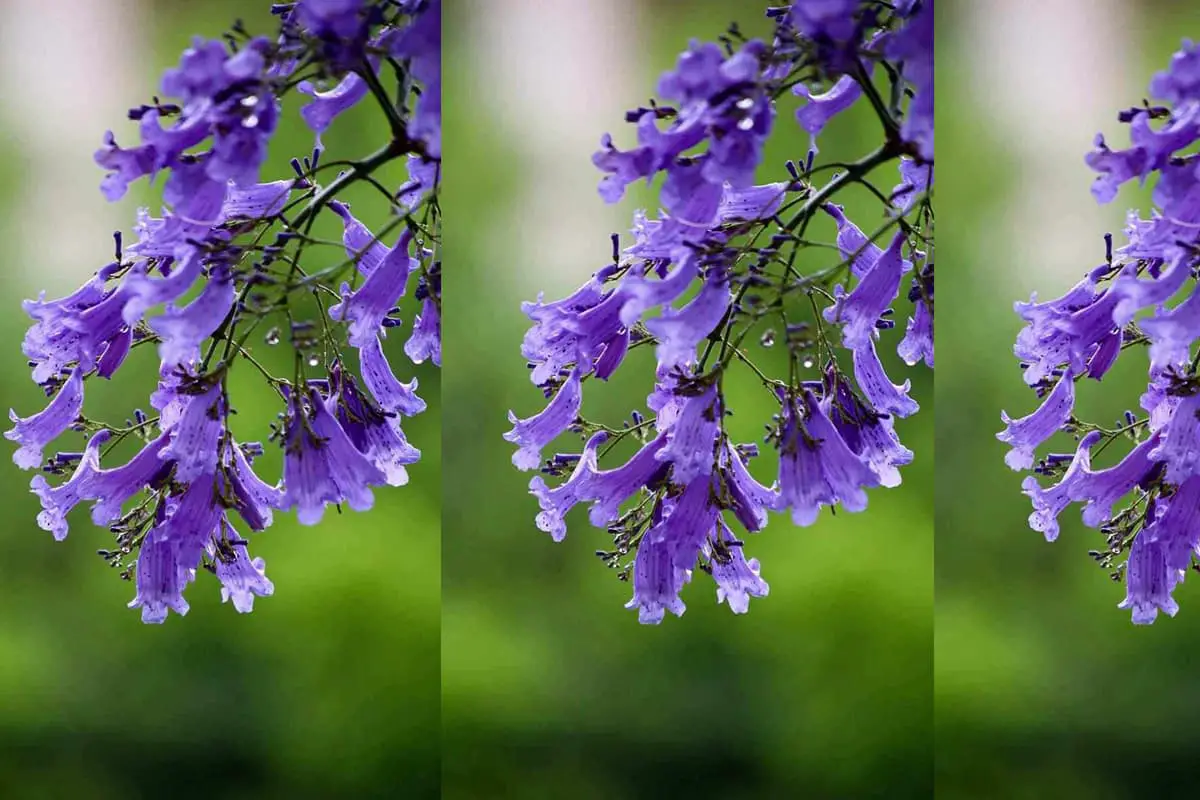
Flower Language: Tranquility, depth, melancholy, waiting for love in despair.

Peggie was once a high school mathematics teacher, but she set aside her chalkboard and textbooks to follow her lifelong passion for flowers. After years of dedication and learning, she not only established a thriving flower shop but also founded this blog, “Flowers Library”. If you have any questions or wish to learn more about flowers, feel free to contact Peggie.
 English
  العربية
  Bahasa Indonesia
  Deutsch
  Français
  Italiano
  Nederlands
  Português
  Русский
  日本語
日本語