The Hemerocallis hybrid, also known as the large-bracted daylily, is a perennial herb of the lily family and daylily genus. It has a rather short, fleshy rhizome with leaves growing from the base in two rows.
The leaves are linear, about 30-45 cm long and 2-2.5 cm wide. The flower stalk rises above the leaves, with branches at the top, bearing 2-4 small, fragrant flowers. The flowers are large with short stalks and large, triangular bracts.
The roots of the large-bracted daylily are divided into fleshy roots and fibrous roots. The fleshy roots are spindle-shaped, and the fibrous roots often grow on the fleshy roots.
It has short stem-like roots, with bright green, narrow leaves growing from the base in a belt-like manner. The flower corolla is funnel-shaped or bell-shaped to campanulate, with the segments bending outwards.
It blooms from July to August and is distributed in Korea, Japan, and the Soviet Union. This type of flower has a special tolerance for alkaline soil, making it a rare greening material for oil fields and mudflats.
It can be used to decorate various flower beds, road dividers, sparse forest grass slopes, etc., and can also take advantage of its dwarf nature as a ground cover plant. Several varieties are “evergreen” types, planted in the south, they can stay green all year round and are excellent garden green flowers.
I. Physical features
he roots of the large-bracted daylily are divided into fleshy roots and fibrous roots. The fleshy roots are spindle-shaped, and the fibrous roots often grow on the fleshy roots. It has short stem-like roots.
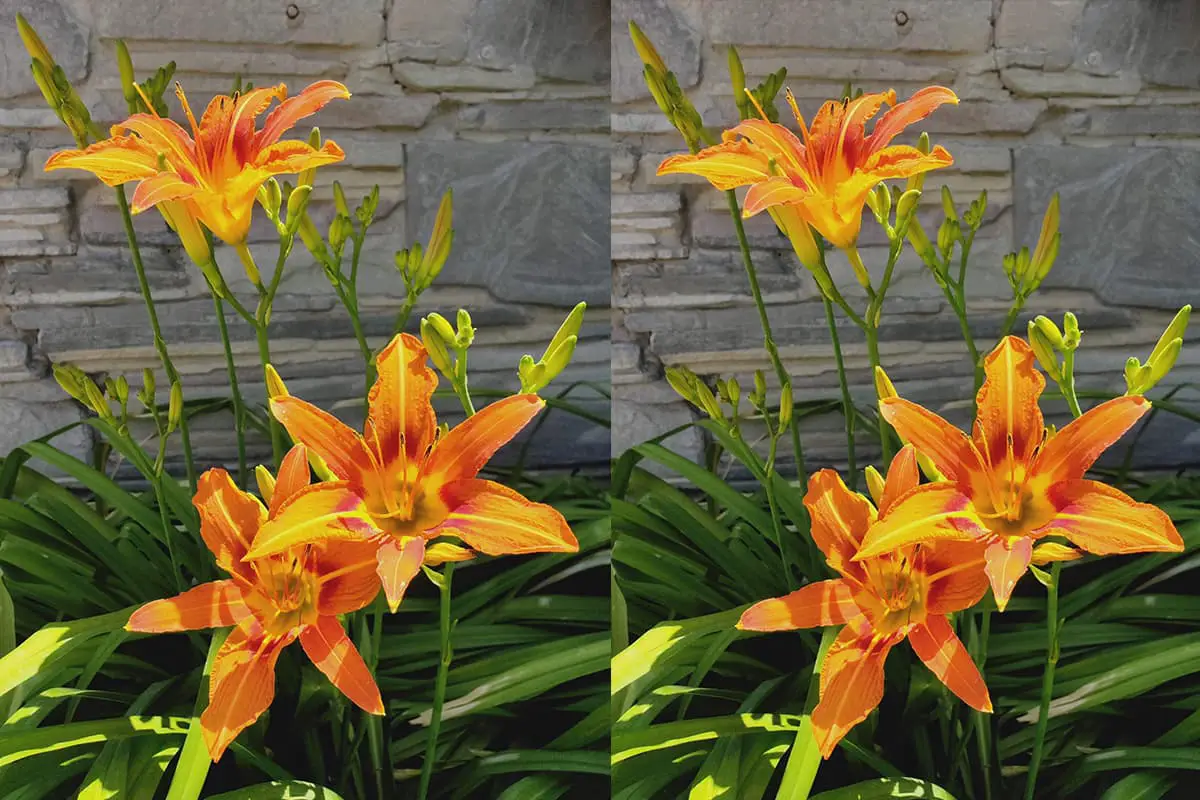
The leaves are bright green and narrow, growing from the base in two rows in a belt-like manner. The flower stalk emerges from the middle, spiraling into an umbel inflorescence, each inflorescence bearing dozens of flowers.
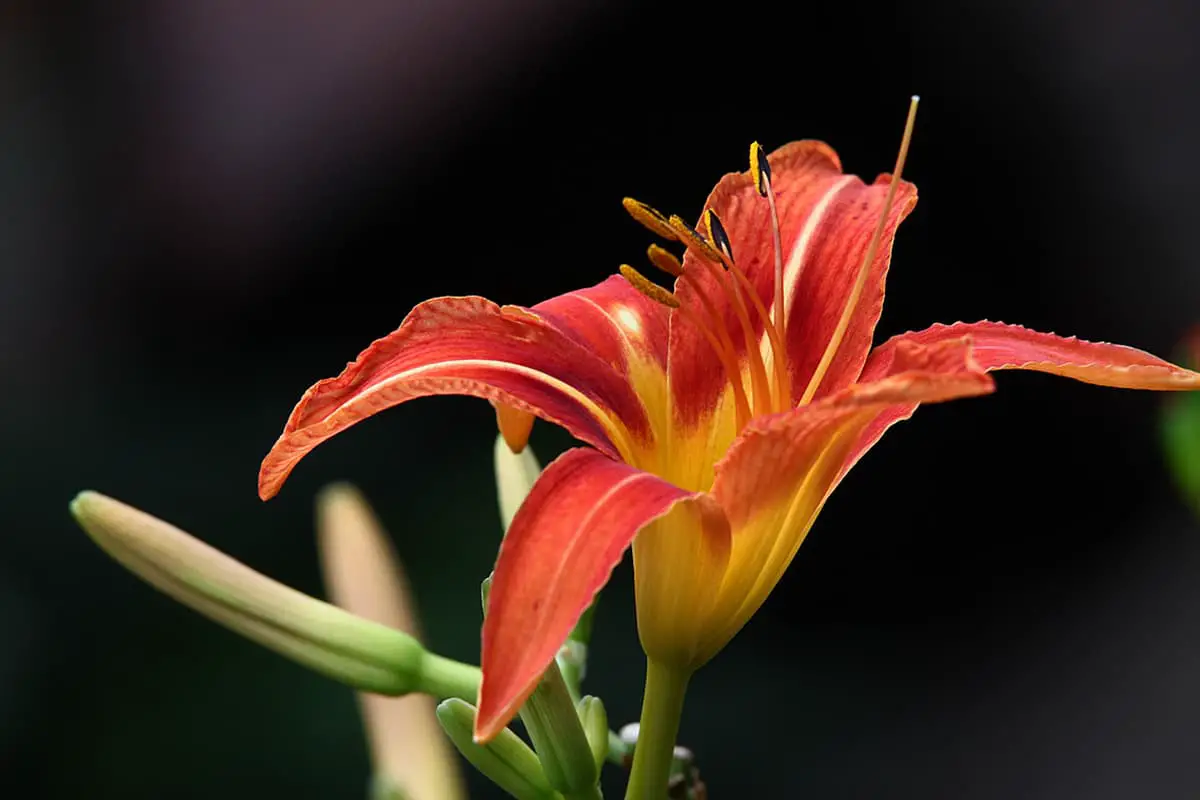
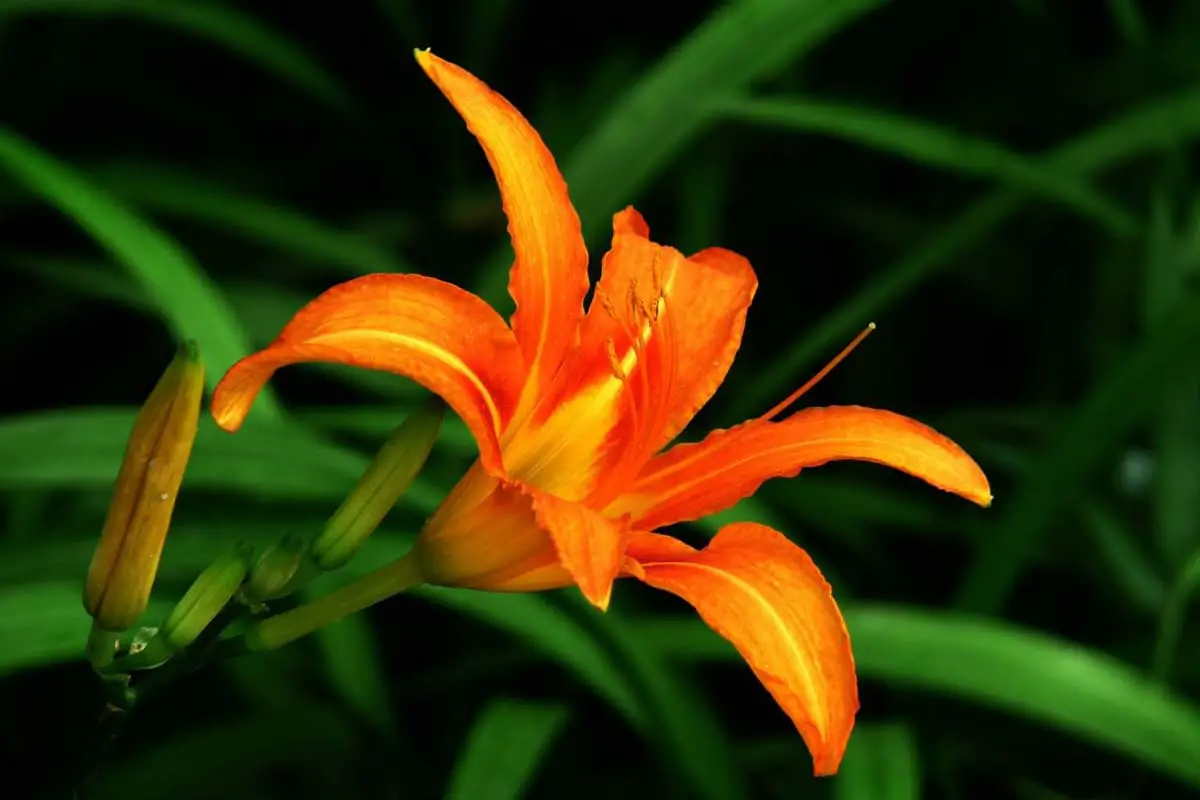
The buds resemble hairpins, opening like funnels, with the segments curling, forming a lily-shaped corolla, and the petals split at the tip.
The base of the flower is fused into a tube, with 6 stamens, 3 long and 3 short, with the anthers in a T-shape, attached to the top of the filament. Apart from blue and pure white, all other flower colors have cultivated varieties.
The diameter of the flowers varies greatly, as does the shape, and the flowering period extends from late spring to autumn.
Most varieties only bloom for one day, but the peak flowering period can last several weeks or even months, and some varieties have a single flower life span of more than 24 hours.
The fruit is a loculicidal capsule, black-brown, multi-angled, shiny, with a low natural fruit set rate, but most varieties do not set fruit.
The roots are more or less rope-like, 1.5-3 mm thick. The leaves are 50-80 cm long, usually 1-2 cm wide, soft, and bending down at the top.
The flower stalk is almost equal in length to the leaves, unbranched, with 2-6 flowers clustered at the top; the bracts are broad ovate, 1-2.5 cm wide, tapering to a tail-like tip, 1.8-4 cm long; the flowers are clustered, with very short stalks; the perianth is golden or orange; the perianth tube is 1-1.7 cm long, about 1/3-2/3 covered by the bracts (except for the topmost flowers), the perianth segments are 6-7.5 cm long, the inner three are 1.5-2.5 cm wide.
The fruit is an elliptical capsule, slightly tri-angled, about 2 cm long. The flowering and fruiting period is from June to October.
II. Distribution Range
It is found in North Korea, Japan, and the Soviet Union.
III. Growth Environment
It thrives in lower altitude forests, wetlands, meadows, or grasslands. It has strong cold resistance, needs abundant sunlight, but can also tolerate partial shade. It is not demanding about the soil, but prefers high humus content, well-drained, and permeable soil.
It is regularly fertilized during the growing season. In the North, the underground tubers need to be dug up before the frost and stored in an environment around 5℃.
Its large, bright, and varied colors, good plant shape, and easy cultivation make it attractive. The most suitable temperature for outdoor cultivation is 13-17℃.
The triploid daylily blooms new flowers every day from May to September. It adapts to various soil environments, whether it is saline-alkali soil, sandy soil, or barren wasteland, it can grow well. It is resistant to disease and pest infestation and has a strong tolerance for noise and dust.
IV. Growth and Propagation
Dividing and separating clumps of Daylily is the most common method of propagation. This method is straightforward, the plants are easy to keep alive, and their growth is relatively consistent.
The division can involve digging out the entire mother clump and replanting it, or taking a portion from the side of the mother clump to serve as seedlings, leaving the rest to continue growing.
Division is often carried out in early spring before budding or in autumn after leaf fall. Spring division allows the plant to flower in the same year, whereas autumn division results in flowering the following year. During transplantation, choose robust plants with many buds of good quality and free of pests.
When dividing, take a portion of the clump as a seedling, ensuring to include roots. Cut away from the shortened stem, remove old, decayed, and diseased roots, preserving as many fleshy roots as possible.
After appropriately trimming (leaving about 10 centimeters), the plant is ready to be planted. Planting should be done on a sunny day, minimizing root injury. Generally, plants should be divided every 2 to 3 years to ensure vigorous growth.
Seeding is a method for rapidly mass-producing seedlings. However, due to the low germination rate of seeds, they must be soaked to germinate before planting. Plants should be healthy, with full fruits and free from pests. Seeds are sown in the spring of the following year.
The seedbed should be adequately fertilized. Seeds are sown in shallow furrows, about 3 centimeters deep and 20 centimeters apart, covered with a layer of fine soil, and then a layer of fine sand.
Water and weed before seedlings emerge, maintaining proper soil moisture. Each acre of seedbed requires 2.5 kilograms of seed, which can grow 50,000 to 60,000 seedlings.
Alternatively, seeds can be sown in the open after soaking to germinate, with a sowing rate of 5 to 7 kilograms per acre. After the plants have grown 2 to 3 leaves, apply a thin layer of human urine and feces once.
After winter, use a small arch shed for cold protection, and strengthen field management in the spring. Seeds collected from evergreen Daylilies can be sown directly, or stored at room temperature before sowing.
Budding refers to the small plants on the stems of large Daylilies. Buds can be cut from the stem and further divided before planting if they are large enough. They can take root within a week after transplanting, which can increase the number of plants and ultimately increase economic benefits.
Tissue culture involves culturing plants from young leaves, filaments, and anthers. The method involves first inducing young organs to produce callus tissue, then culturing the young plant with an appropriate medium under suitable temperature, humidity, light, and air conditions.
The seedlings are then planted in a nutrient bowl, grown into plant seedlings after a period of time, and finally planted. However, this method has not been widely accepted.
Apart from the four methods mentioned above, there are other ways to propagate large Daylilies. Individual asexual plants can be divided into thin slices with growth points and root systems, which can be divided again after about six months of planting.
These plants should not be smaller than a quarter of the original plant. Another method is to cut off the top of the corolla, use plant growth regulators to enhance the vitality of the cut plant, promote its rooting by in vitro culture, and then plant it.
Most of the Daylilies are planted in early spring, before budding in March. Although Daylilies are not strict about soil requirements, because they can grow for many years after planting, the choice of planting site should be considered.
The best sites are flatlands with low groundwater levels or slopes with good water sources and irrigation conditions, with good drainage, loose soil, and deep soil layers.
The land must be leveled, and the plant row spacing should be maintained at 40 to 50 centimeters due to the strong tillering ability of the Daylilies. When planting, it should not be too deep or too shallow. Too deep will slow tillering, while too shallow will lead to weak growth despite fast tillering.
Generally, the planting hole should be more than 30 centimeters deep, apply base fertilizer to about 15 to 20 centimeters from the ground surface, and then cover the soil and compact it. Each acre requires 500 to 600 kilograms of human urine and feces mixed with water to ensure survival.
V. Main Value
This type of flower has a special tolerance for alkaline soil and is a valuable greening material for oil fields and intertidal zones. It can be used to decorate various flower beds, road dividers, sparse forest grass slopes, etc.
It can also take advantage of its dwarf characteristics to be used as a ground cover plant. Several varieties are “evergreen” types. When planted in the south, they can stay green all year round, making them excellent landscaping flowers.



 English
  العربية
  Bahasa Indonesia
  Deutsch
  Français
  Italiano
  Nederlands
  Português
  Русский
  日本語
日本語