The Hamamelis mollis, also known as Chinese Witch Hazel, Woodland Fragrance, or Ox-Hoof Fruit, is a deciduous shrub or small tree that can grow up to 8 meters high. Its young branches are covered with star-shaped downy hairs, while the old branches are bare.
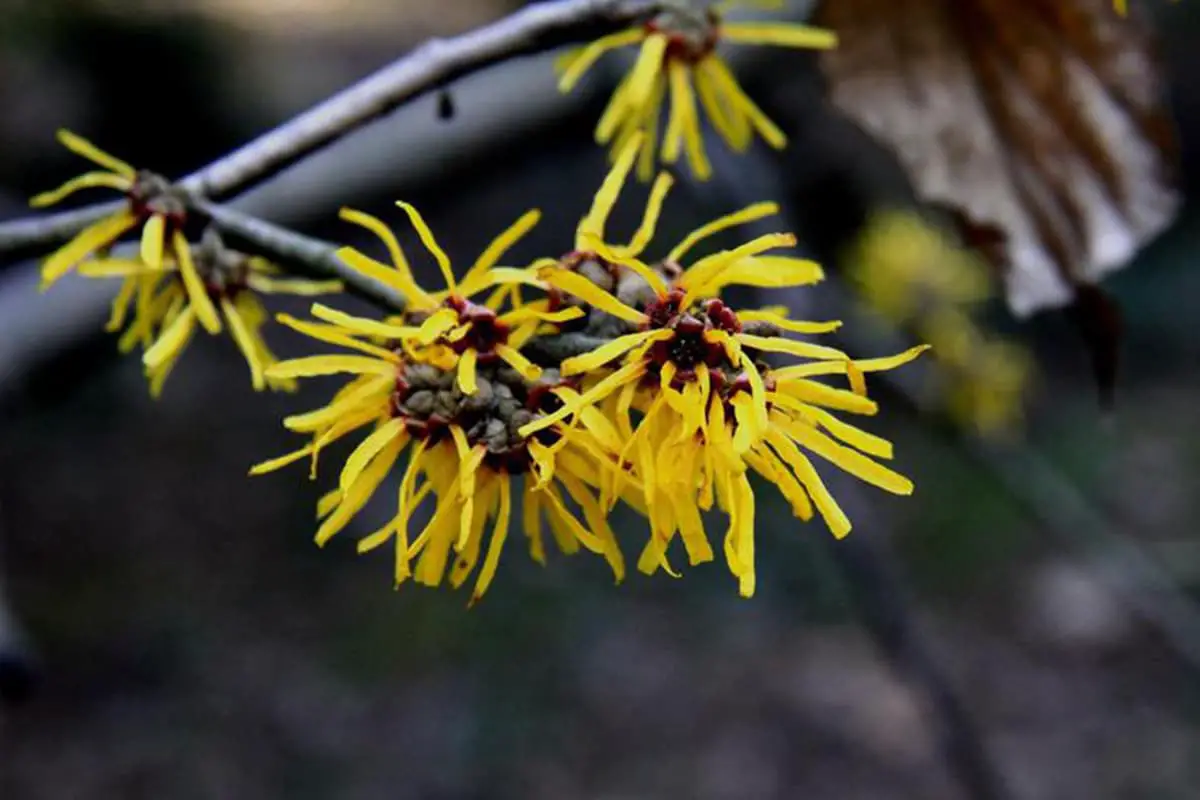
The plant has long ovate buds and broad ovate circular leaves, which make it attractive. It blooms before its leaves appear in February, with clusters of golden yellow flowers that dance in the wind.
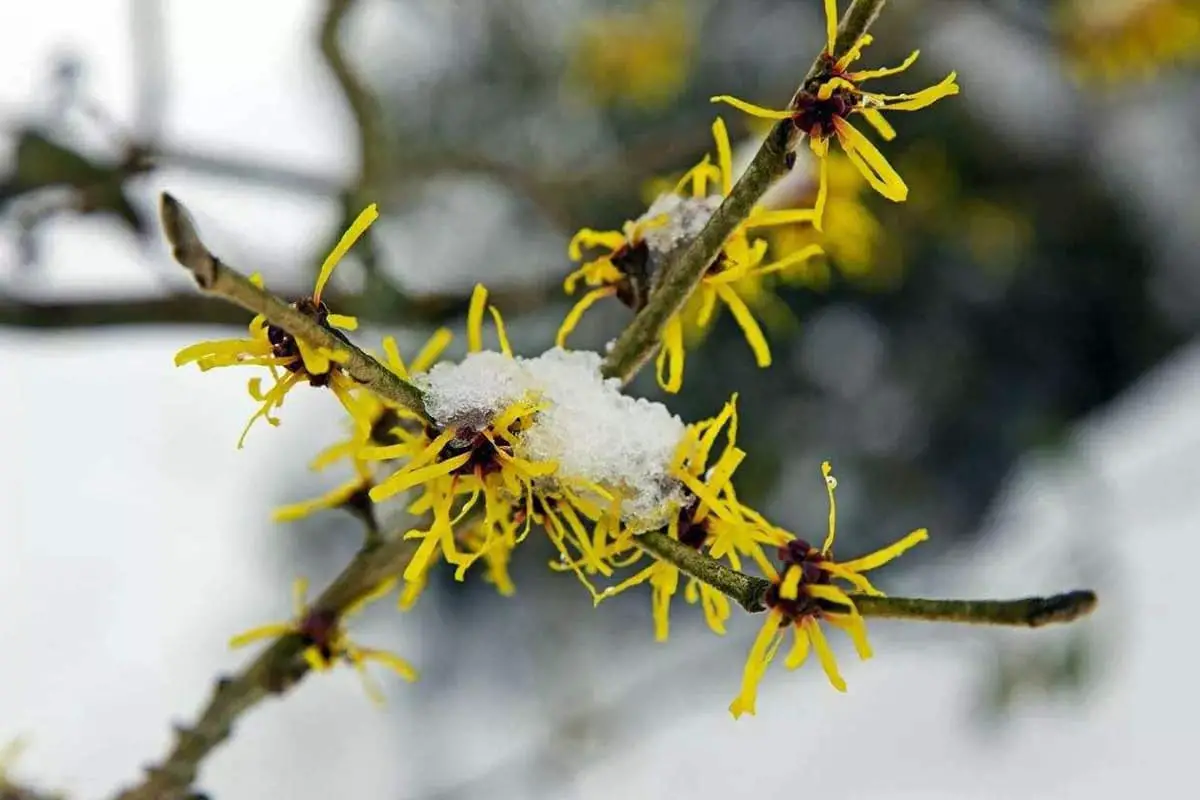
The flower petals resemble golden threads, hence its name. Blooming in early spring, even in snow, it resembles the wax flower, hence its name. Because of its cold tolerance, it’s also known as the “Winter Flower”.
It is distributed throughout the provinces along the Yangtze River. Hamamelis mollis is a valuable ornamental plant, with an elegant shape and a crown that is round or broad spherical. It blooms early, from winter to early spring, a period when few other plants flower.
I. Morphological Features
This deciduous shrub or small tree can grow up to 8 meters high. Its young branches are covered with star-shaped downy hairs, while the old branches are bare. The buds are long ovate, covered with gray-yellow downy hairs.
The leaves are papery or thin leathery, broad ovate circular, 8-15 cm long, 6-10 cm wide, with a short sharp tip, and an unequal heart-shaped base. The upper surface is slightly rough, with sparse star-shaped hairs, and does not shine.
The underside is densely covered with gray star-shaped downy hairs. The leaf margin has wavy blunt teeth, and the petiole is 6-10 mm long, covered with downy hairs. The stipules fall off early.
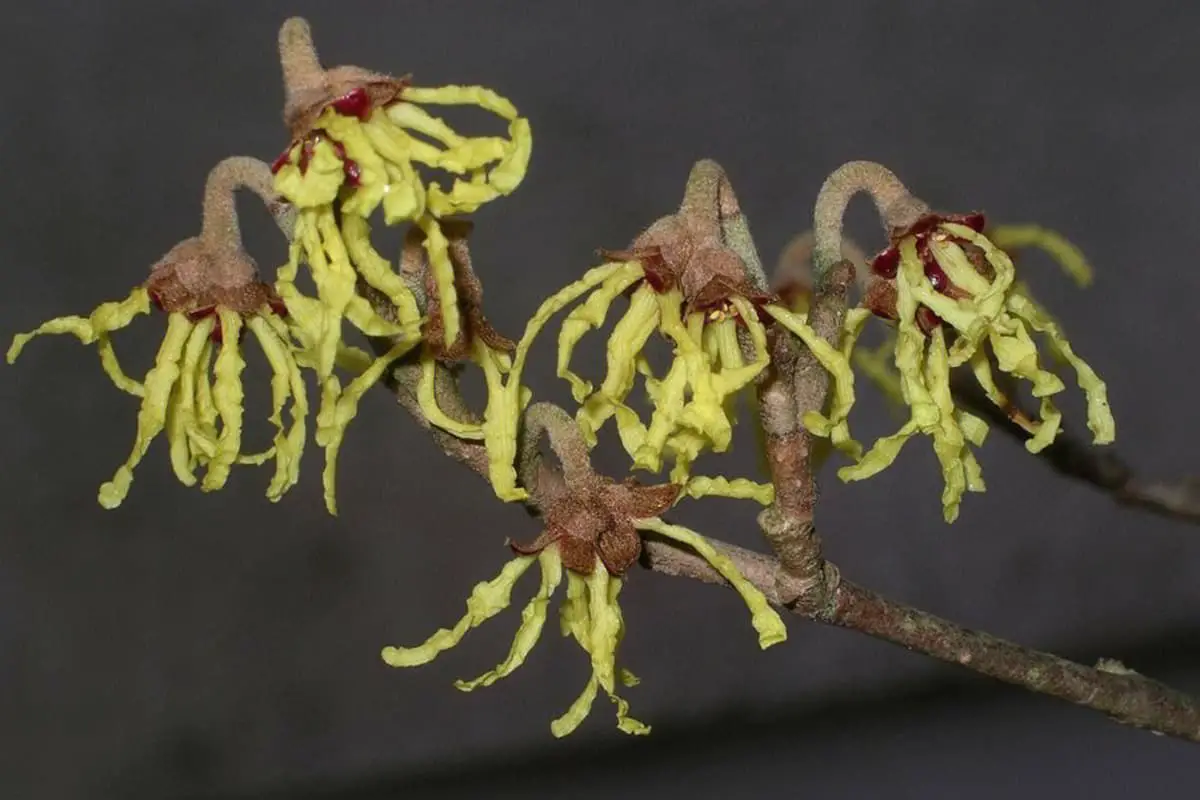
The flowers are grouped in a head or short spike, without a flower stalk. The bracts are ovate, and the inflorescence stalk is short, less than 5 mm long. The calyx tube is short, fused with the ovary, and the sepals are ovate, 3 mm long, and persist, all covered with star-shaped downy hairs.
The petals are strap-shaped, about 1.5 cm long, and yellow-white. There are four stamens, the filaments 2 mm long, and the anthers are almost as long as the filaments. The ovary is covered with downy hairs, and the style is 1-1.5 mm long.
The capsule is ovate, 1.2 cm long, 1 cm wide, densely covered with yellow-brown star-shaped downy hairs. The calyx tube is about one-third the length of the capsule. The seeds are elliptical, about 8 mm long, black, and shiny. It blooms in May.
II. Growing environment
It often grows on slopes, in valleys, at the edge of broad-leaved forests, and in shrubs. It is a high-altitude tree species, commonly found at elevations of 600-1600 meters above sea level.
Hamamelis mollis is a warm-weather species with strong cold tolerance. It can grow in open ground at temperatures of -15℃. It likes light but can tolerate shade during its juvenile stage, growing under semi-shaded conditions.
It has no strict soil requirements and can grow in acidic and neutral soils, but it grows best in rich, moist, loose, well-drained sandy soil.
III. Growth and Propagation
The propagation of witch hazel primarily involves seed sowing. After the fruit matures in the fall, it is harvested and dried in the sun for 2-3 days until the fruit shell cracks. The seeds are then removed and immediately sown in the ground.
About half a month to 20 days later, when a third to a half of the seeds have sprouted, the seedlings are gently uncovered either on a cloudy day or in the evening.
Subsequent tasks include timely soil loosening, weeding, fertilizing, and drought prevention to nurture the seedlings. Transplantation or relocation of the seedlings begins after their leaves fall and before they sprout new leaves the following spring, which guarantees a high survival rate.
Other asexual propagation methods such as layering, grafting, and cutting can also be used to increase the population.
IV. Pest and Disease Control
Diseases
Leaf spot disease and anthracnose can be controlled by spraying a 600-fold diluted solution of 65% zinc dimethyldithiocarbamate. The invasive caterpillars and leafrollers can be exterminated by spraying a 2000-fold diluted solution of 10% deltamethrin.
Pests
The tree is often infested by large bagworm moths and caterpillars. Adult pests can be killed using light traps, while the larvae can be exterminated by spraying insecticides.
V. Main Value
Ornamental Value
Witch hazel is a highly ornamental plant with an elegant shape and a crown that can be spherical, ovoid, or broadly spherical. Its flowering season extends from winter to early spring, a time when few other plants are in bloom.
The delicate, vibrant flowers range from pale yellow to orange-red, adding charm to the tree. The pleasing fragrance and attractive appearance of the blooming witch hazel make it a standout feature in winter gardens.
It can be planted alone or in clusters, and when combined with other flowers and plants, it can create an impressive scene. Witch hazel is an important early spring flowering plant in landscape areas and urban greening projects.
When combined with other flowering plants, it contributes to the beautification, floral, and fragrance aspects of the ecological environment.
Medicinal Value
Properties and Meridians
Sweet; Neutral. Spleen Meridian.
Functions
Boosts energy. Effective for fatigue and weakness.
Usage and Dosage
Oral: Decoction, 15-30g; fresh product, 60-90g.
Precautions
Avoid sour, spicy foods, mustard, and radish while taking this medicine.
Chemical Composition
Contains kaempferol, quercetin, astragalin, etc.
Cosmetic Value
Witch hazel contains tannins, such as ellagitannin and hamamelitannin, which can regulate sebum secretion and have moisturizing and whitening effects. It promotes lymphatic and blood circulation and can specifically overcome morning puffiness and dark circles.
It has soothing, calming effects and can improve cracked skin, sunburn, and acne. It can effectively help with skin regeneration at night, remove eye bags, relax and soothe oily or allergic skin.
It has astringent, antibacterial, and anti-aging effects, and is an excellent choice for teenagers or those with severe oily skin.


 English
  العربية
  Bahasa Indonesia
  Deutsch
  Français
  Italiano
  Nederlands
  Português
  Русский
  日本語
日本語