600+ Types of Flowers A To Z (With Names and Pictures)
Types Of Flowers By Names (A-Z) Types Of Flowers By Color Types Of Flowers By Season Types Of Flowers By Blooming Time 600+ Types of Flowers No. Flower Name No.…

The Grevillea banksii, also known as the Red Silky Oak or Banks’ Grevillea, belongs to the Proteaceae family. It is native to the coastal regions and nearby islands of Queensland, Australia.
This dense shrub varies in form, reaching up to 3 meters in height, and boasts large, brush-like flowers that come in red or white, with occasional pink and apricot hues.
The flowering period is extensive, and the plant responds well to light pruning of its annual branches. However, its leaves can cause dermatitis in some individuals.
Originally from eastern Australia, it is now widely cultivated in the tropical and warm subtropical regions of the world.
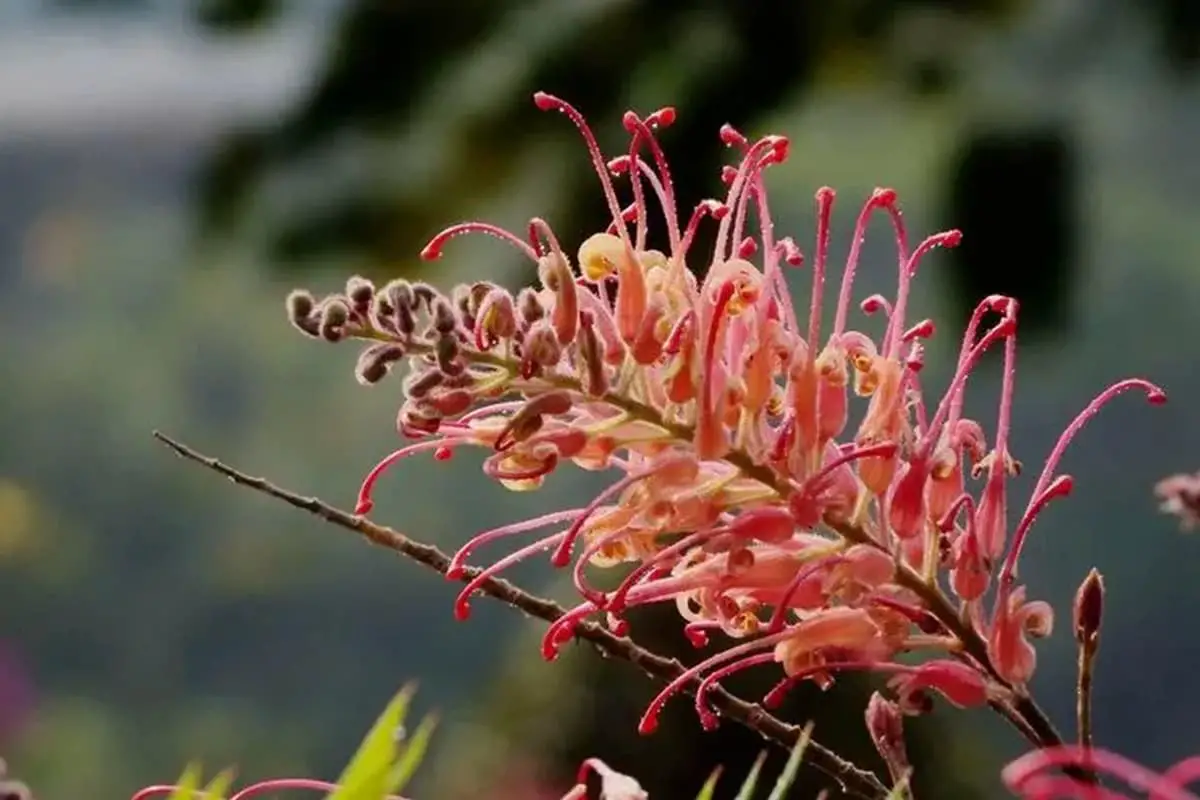
The Red Silky Oak is primarily used for flower beds, courtyards, road green belts, and for the transformation of pine forests. It can be planted singly or in groups as an ornamental tree.
When grown indoors as a small potted plant, seeds should be sown in a nursery pot until germination, after which seedlings of similar growth rates can be transferred to 3 to 5-inch pots for a more uniform growth.
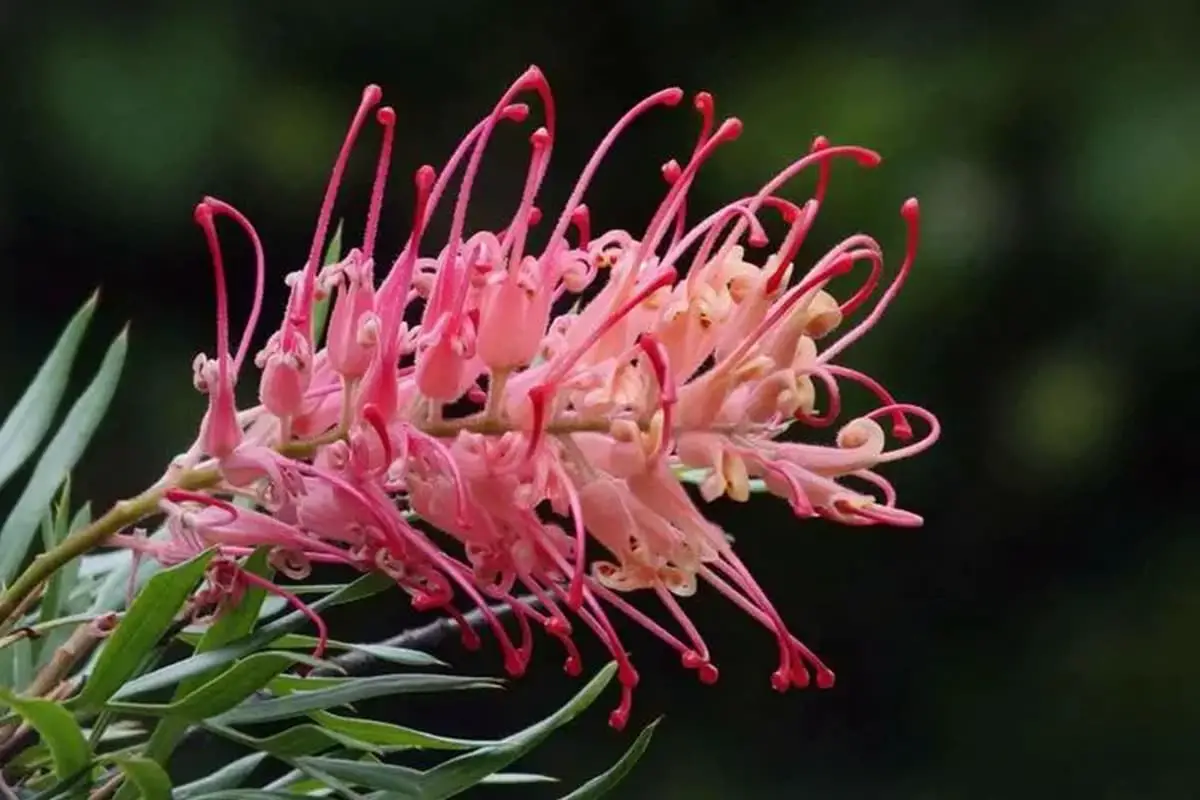
The Red Silky Oak is an evergreen small tree that can reach up to 5 meters tall with young branches that are hairy.
Its leaves are alternate and pinnately divided, with linear leaflets covered in dense white down on the underside. Flowering occurs from spring to summer with terminal racemes, and the bloom colors range from orange-red to bright red.
The fruit is a flattened, oblique ovoid, turning brown upon ripening. Both flowers and leaves are aesthetically pleasing.
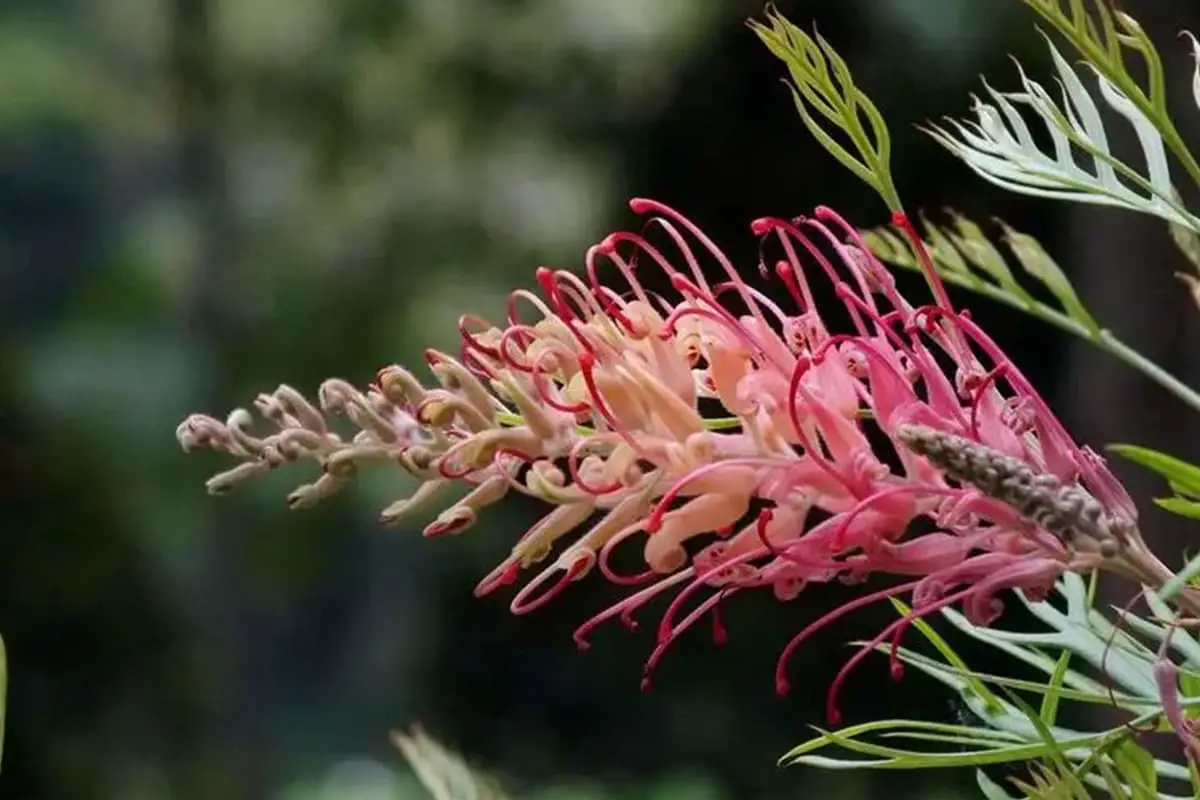
A crucial reason for the Red Silky Oak’s rapid popularity in South China is its outstanding landscape effect. It is an evergreen small tree or shrub that offers an attractive display of flowers, foliage, and form.
Its flowers form large brush-like terminal clusters with tubular corollas, from which the red styles extend outward and curve at the tips, creating a distinctive and vivid appearance.
With a very long blooming period, the Red Silky Oak can flower throughout the year in its native habitat, with a bloom duration of over 250 days.
In South China, mature plants can flower all year round, with a peak blooming period from November to May. During full bloom, the tree is covered in a spectacular display of red, which is particularly striking.
Its leaves are pinnate with a silvery-white down on the underside, which gives the tree its common name.
The Red Silky Oak has delicate branching, an elegant crown, and a dense, conical or ovate shape.
In addition to its landscape appeal, the Red Silky Oak is also known for its strong pollution resistance.
Highly adaptable, it can tolerate dry and poor soils. In South China, it is being demonstrated and applied mainly in flower beds, road green belts, and pine forest transformations.
In flower beds, the Red Silky Oak can be planted as a background tree in the upper layer, with mass plantings along forest edges, accompanied by shrubs and ground cover species to separate roadways.
It can also be incorporated into medians to form multi-layered plant communities.
In parks, green spaces, and residential gardens, the Red Silky Oak can be planted as a single ornamental tree or in groups.
The Red Silky Oak’s long flowering period, attractive shape, and strong pollution resistance have made it a sought-after tree upon its introduction to the horticultural market.
Initially, the limited availability of domestically produced seeds and the high cost of imported seeds restricted its propagation.
However, research institutions have since achieved rapid propagation through tissue culture, overcoming the difficulties of reproduction and reducing the cost of seedlings, leading to widespread cultivation by farmers.
With strong regrowth ability, in favorable conditions of the Pearl River Delta, ground-planted saplings can grow to 4.5 to 5 meters in one year.
The South China region has now amassed a large reserve of Red Silky Oak nursery stock, as evidenced by the bustling activity at this exhibition.
The Red Silky Oak is a heliophilous species, thriving in well-drained, slightly acidic soils. Transplanting should be done in the spring, with root pruning and ball reduction carried out six months prior to improve the survival rate.
To enhance flowering, it is advisable to prune annually to prevent woodification and to encourage the growth of new flowering branches.
Originally from eastern Australia, the Red-flowering Gum is now extensively cultivated in tropical and warm subtropical regions worldwide.
The Red-flowering Gum is primarily used in floral borders, courtyards, roadside green belts, and pine forest renovations. To enhance its flowering, it should be pruned annually.
In floral landscapes, this tree serves as a background species for the upper layer or can be integrated with other shrubs and ground covers along roads as a divider.
In parks and gardens, it can be planted as a solitary specimen or in groups for ornamental purposes. The Red-flowering Gum’s prolonged blooming period, attractive form, and strong pollution resistance quickly made it a favorite in the landscaping market.
As an indoor bonsai, seeds should be first sown in a nursery pot. Once germinated, seedlings of similar growth rates are transplanted into 3 to 5-inch pots for a more uniform growth.
Care must be taken not to damage the roots during transplantation. Planting more than five seedlings in a three-inch pot encourages lush growth.
Pots can range from simple terracotta to ornate blue and white porcelain, both of which complement the delicate foliage of the Red-flowering Gum.
Positioned by a window or in a well-lit indoor area, the seedlings will not grow too large due to the pot’s constraints, maintaining their petite size for a long period. However, insufficient light can cause the seedlings to become leggy and lose their aesthetic appeal.
When planted in the ground and provided with the right environment, the Red-flowering Gum can grow into a large tree over 30 meters tall.
The mature trunk is straight with silvery-grey bark and beautiful fissures, and the young branches are covered with brown fine hairs.
The underside of the leaves and the new buds are adorned with beautiful silvery-white silky hairs, which is how the tree got its name.
Belonging to the Sapindaceae family, it blossoms in early summer with orange-yellow brush-like flowers, creating a spectacular display of color throughout the tree. However, it takes approximately 30 years from seed to bloom.

Peggie was once a high school mathematics teacher, but she set aside her chalkboard and textbooks to follow her lifelong passion for flowers. After years of dedication and learning, she not only established a thriving flower shop but also founded this blog, “Flowers Library”. If you have any questions or wish to learn more about flowers, feel free to contact Peggie.
 English
  العربية
  Bahasa Indonesia
  Deutsch
  Français
  Italiano
  Nederlands
  Português
  Русский
  日本語
日本語