600+ Types of Flowers A To Z (With Names and Pictures)
Types Of Flowers By Names (A-Z) Types Of Flowers By Color Types Of Flowers By Season Types Of Flowers By Blooming Time 600+ Types of Flowers No. Flower Name No.…

The Giant Taro, also known as the “Corpse Flower”, “Corpse Stink Amorphophallus”, or “Titan Arum”, is a plant of the Araceae and Amorphophallus genus. When it blooms, it emits a smell similar to that of a rotting corpse, hence it is often referred to as “the stinkiest flower in the world”.
The tuber of the Giant Taro can reach a diameter of 65 centimeters and weigh over 100 kilograms. Its petiole is usually 3-4 meters high, and the diameter of the leaf blade exceeds 5 meters, covering an area of more than 20 square meters. Wild Giant Taro only grows in the tropical rainforests of Sumatra, Indonesia. It only blooms two or three times in its lifetime, and the blooming period is very short, at most a few days. After the fruit grows, it will quickly wither.
In 1878, the Italian botanist Beccari first discovered this plant. He sent some seeds to the Royal Botanic Gardens in the UK, and after cultivation, the Giant Taro bloomed for the first time in 1889. This was the first record of the Giant Taro blooming in cultivation, and since then there have been about 60 more blooming records.

The Giant Taro is on the verge of extinction, and the recorded 134 plants are all cultivated. The artificially cultivated Giant Taro greedily absorbs liquid fertilizer and potassium fertilizer, and its growth rate is astonishing.
The Giant Taro has a unique underground tuber, and its growth process is different from most flowers. It blooms first, and only after the flower withers does it grow leaves. The giant inflorescence grows directly from the tuber.
On the short and thick flower stalk, there is a wide bract that is green on the outside and purple on the inside, resembling a flower petal. This is also called the spadix, which is trumpet-shaped and very colorful. The flower can reach a height of more than 1 meter, and the diameter at the top can generally reach 1.5 meters.
In the middle of the huge spadix stands a hollow fleshy inflorescence axis, like a huge candle stuck in the middle of the petals. The growth rate of the inflorescence is extremely fast, it can grow about 10 centimeters in a day, so it makes a “clicking” sound during the growth process. The height of the inflorescence can reach about 3 meters.
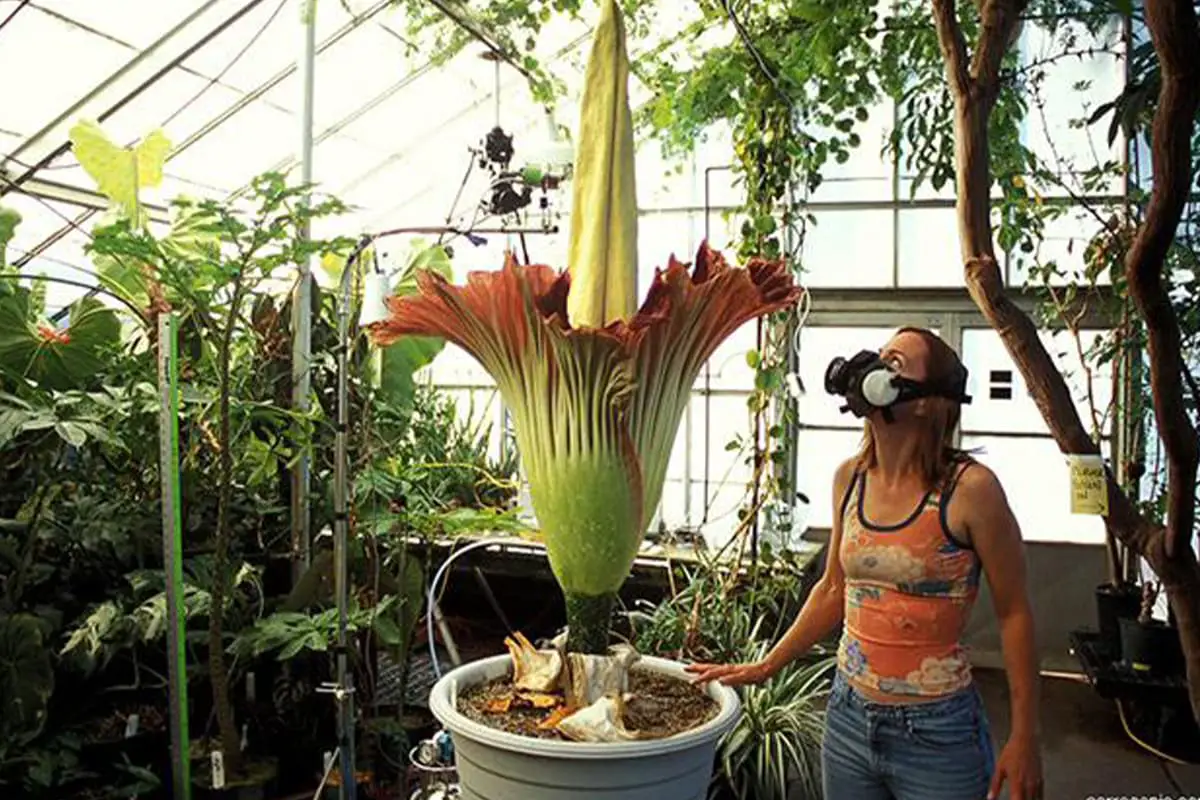
The Giant Taro is distributed in the tropical rainforests of the Barisan mountain range in the western part of Sumatra Island in Indonesia. It prefers loose and fertile loam. The growing environment requires sufficient light to maintain normal plant growth, but excessive light will burn the leaves. The growing environment should not be dry, but overly wet soil can cause the bulb to rot. The optimal temperature for growth is 25-38°C during the day and 20-25°C at night.
The inflorescence of the Giant Taro can be over three meters high, which is taller than a person. Like other species in the same family, such as the Spotted-Leaf Arisaema and the Sacred Lotus, the inflorescence is a spadix. The flowers are unisexual and grow on a fleshy inflorescence axis, surrounded by a petal-like spathe.
Male and female flowers grow on the same inflorescence. The female flowers bloom first, and after a day or two, the male flowers bloom. The female and male flowers of the same plant do not bloom at the same time to prevent self-pollination. The inflorescence emits a smell similar to rotten meat, which attracts beetles and flies that feed on rotting meat to pollinate it.
The Giant Taro blooms first and then grows leaves. After the flower withers, a leaf grows from the bulb underground. This leaf is very large and can grow to six meters high and five meters wide, roughly the size of a small tree. The leaf stalk is green and resembles a tree trunk.
At the top of the leaf stalk, it branches into three branches, each of which bears many small leaves. When the growing season ends and the underground bulb has stored enough energy, the old leaves will wilt and fall off, and the bulb enters a dormant period, which lasts about four months.
① Temperature: The highest temperature is 34°C, and the lowest is 24°C. The ideal temperature is 26°C.
② Humidity: The humidity is controlled at 85-75%, and spraying is required in summer.
③ Water: Adequate water is needed during the growing and flowering period, but water should not be allowed to accumulate to prevent rot. Watering is stopped during the dormant period.
④ Light: It needs a light intensity of 200,000 lux. It should be placed in a place with light, but it must be shaded from 10 to 14 o’clock in the summer, and additional light is needed from 9 to 21 o’clock in the winter.
Fertilize once a week from March to October, using water-soluble fertilizer each time (the ratio of nitrogen, phosphorus, and potassium is 8:8:6). From November to February of the following year, the cycle is once every 3 weeks. If the leaves show abnormalities, stop fertilizing immediately.
The growth period of the Giant Taro lasts for 12-20 months. When the leaves show signs of wilting, the dormant period has begun (2-4 months). The end of the dormant period is marked by the appearance of new buds.
In areas where rot is severe, clean the rotten parts (the cleaning surface should be larger than the rotten surface), then apply lime powder to the wound, place it in a cool place, wait for the rotten part to no longer spread and the wound to heal, and then it can be replanted.
Preparation before planting: First, the bulbs that are about to enter the dormant period are poured out of the pot. Then, an umbrella-shaped spray head is used to wash the soil on the bulb.
Afterwards, a soft toothbrush is used to clean the fine lines on the bulb. This step is to thoroughly clean the bulbs and remove possible pests and diseases. Finally, select a clean planting pot that is 2-3 times larger than the bulb, put it in the pot, and place it in a shady place to air dry.
Cultivation medium: At the bottom of the pot, use ceramic granules with a diameter of 2-3 cm to make a drainage layer, and then add a planting soil mixed with 80% organic fertilizer peat soil + 10% washed fine sand + 10% perlite. Put in the bulb, fill in the planting soil until the soil layer covers the top of the bud by 5 cm. Finally, insert the variety card and water thoroughly.
Sowing method: Seeds need to be sowed immediately after maturity. Before sowing, the seeds must be washed clean, and the outer flesh and skin should be peeled off. When sowing, plant the seeds in a 9 cm pot, fill in the planting soil of the giant taro, and the seeds need to be placed under a 5 mm layer of soil. Control the temperature at 26°C, keep the planting soil moist, but not too wet.
During the dormant period, fungi can cause bulb rot. It’s best to wash and dry the bulbs before the dormant period to prevent fungal infection.
The main pests that affect the Giant Taro are nematodes and mealybugs. Generally, nematodes do not need to be prevented in a sterile environment, so you should choose sterile planting soil. For mealybugs, the basic method is to release predatory mites for biological control, because chemical control can affect the growth of plants.
Listed in the International Union for Conservation of Nature Red List of Endangered Species (IUCN) 2018 ver 3.1 as Endangered (EN).
The giant taro’s flowers are large and attractive, extremely flamboyant, yet emit a scent completely different from other flowers, providing high ornamental value.
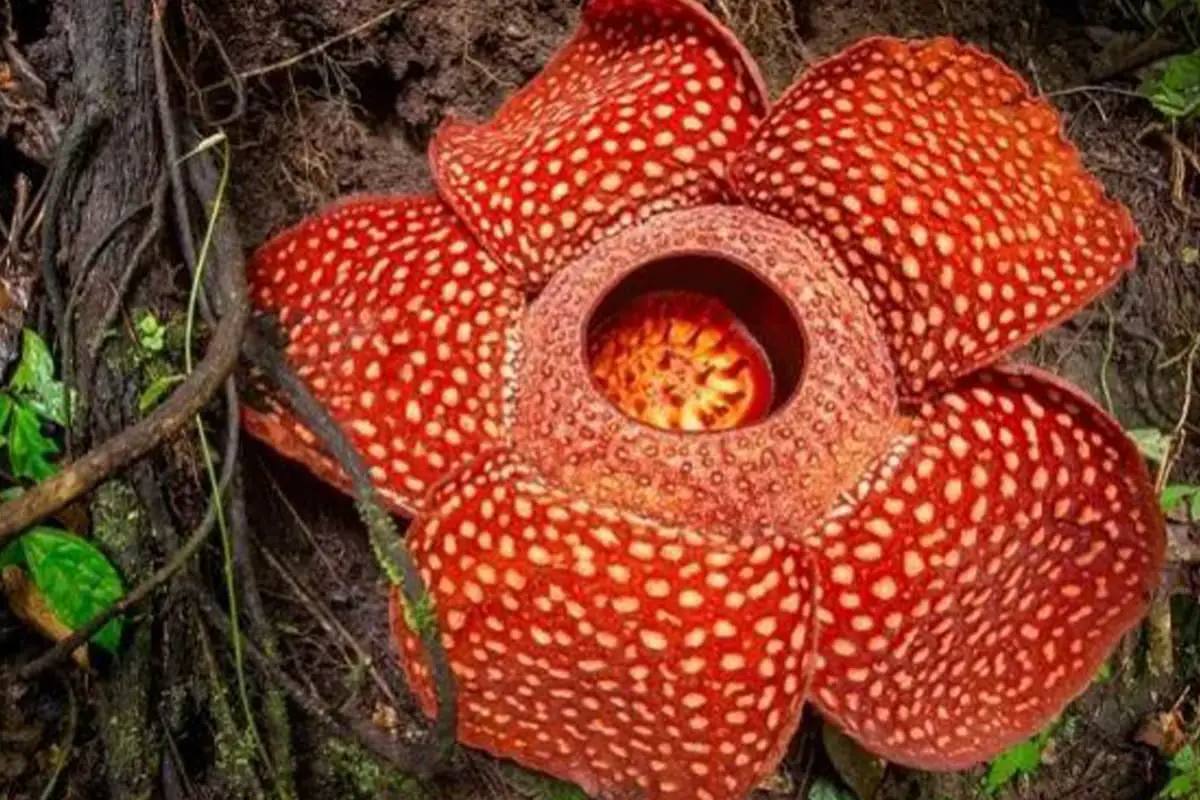
Largest Single Flower Plant: In January 2020, a large flower with a diameter of 111 cm was found in the rainforest on the island of West Sumatra, Indonesia. This species, which has no leaves, stems or roots, is parasitic in jungle vines and is known as the “corpse flower” due to its unpleasant smell. (Guinness World Records)
Plant with the Strongest Heat Generation Ability: In terms of the maximum heat production rate for the entire flower, the Titan Arum can generate 34.53W of energy.

Peggie was once a high school mathematics teacher, but she set aside her chalkboard and textbooks to follow her lifelong passion for flowers. After years of dedication and learning, she not only established a thriving flower shop but also founded this blog, “Flowers Library”. If you have any questions or wish to learn more about flowers, feel free to contact Peggie.
 English
  العربية
  Bahasa Indonesia
  Deutsch
  Français
  Italiano
  Nederlands
  Português
  Русский
  日本語
日本語