600+ Types of Flowers A To Z (With Names and Pictures)
Types Of Flowers By Names (A-Z) Types Of Flowers By Color Types Of Flowers By Season Types Of Flowers By Blooming Time 600+ Types of Flowers No. Flower Name No.…

Gentiana dahurica, commonly known as Dahurian gentian, belongs to the Gentianaceae family and is a perennial herbaceous plant. The plant can grow up to 25 cm in height, with clustered stems.
The rosette leaves are lanceolate or linear-elliptical, tapering at the tip and narrowing at the base, with flat leaf stalks. The stem leaves are linear-lanceolate or linear. The inflorescences are terminal or axillary umbels.
The calyx is membranous, yellow-green or purplish-red, undivided, irregular, and linear. The corolla is a deep blue color, sometimes with yellow spots near the throat. The corolla lobes are ovate or ovate-elliptical, blunt at the tip, and entire at the margins.
The fruit is an enclosed capsule, elliptical-lanceolate, and stalkless. The seeds bear fine reticulated patterns. The flowering period is in July, and the fruiting period is from August to September.
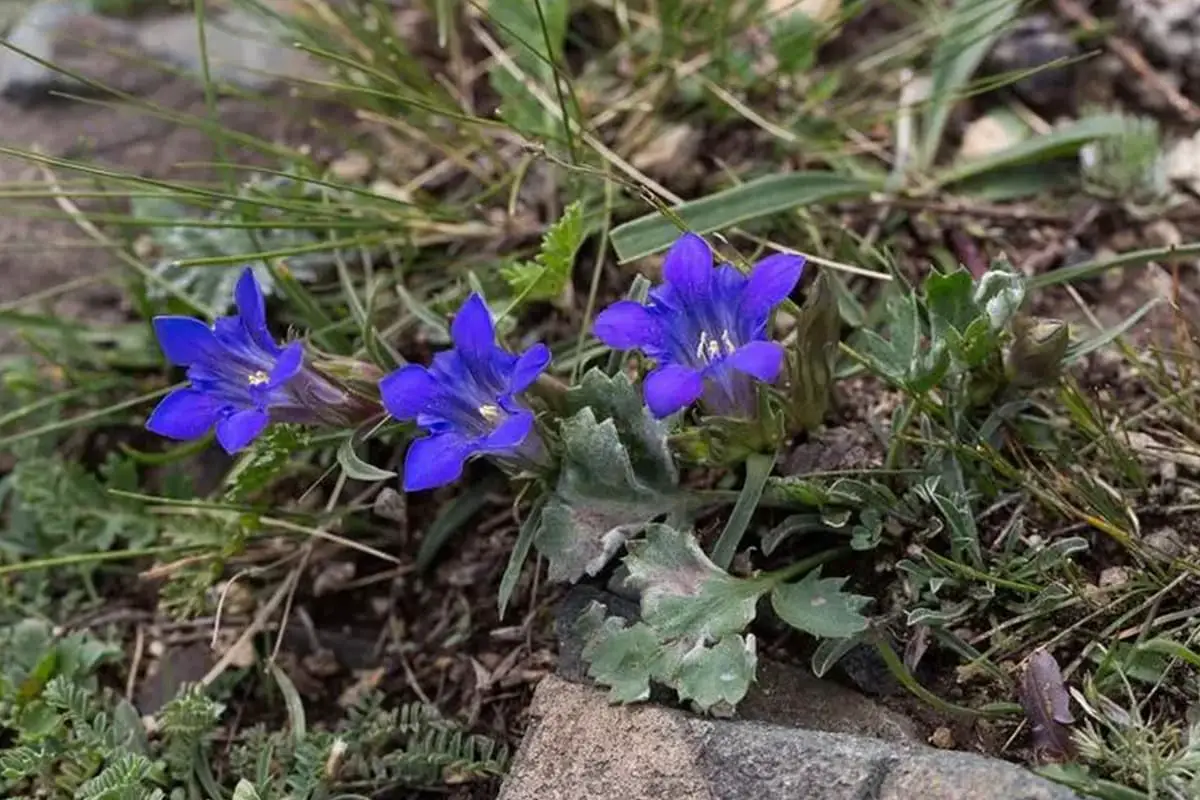
Gentiana dahurica is native to Sichuan, China. It can be found growing at altitudes ranging from 870 to 4500 meters in fields, along roadsides, riverbanks, sandy shores of lakes, water ditch sides, sunny mountain slopes, and dry grasslands.
Gentiana dahurica prefers damp and cool climatic conditions. It is cold-resistant, tolerant to intense light, but not stagnant water. It isn’t very demanding regarding soil conditions but thrives best in moist soil with high organic matter.
Optimal growth occurs at elevations between 1500 and 2000 meters, with a frost-free period of more than 124 days annually, an average yearly temperature of 3°C, an average January temperature of 15°C, and an average July temperature of 19°C.
It benefits from 2500-3000 hours of sunlight per year, with a 65-75% sunshine percentage and an average annual rainfall of 250-400 mm. Suitable soil types include loamy sand, gravelly sand, and alluvial soils.
The plant is distributed across China, Russia, and Mongolia. Scattered plantings can be found in Wuchuan County and Siziwang Banner in Inner Mongolia.
Select sandy loam with irrigation facilities for the nursery. Apply base fertilizer and plow after fertilizing to a depth of 30-35 cm. Construct raised beds 6-10 meters long, 3 meters wide, and 10-15 cm high, then level and refine with a rake.
From mid-June to early July, mix seeds with 10-20 times their volume of fine sand. Manually broadcast the seeds uniformly, cover the surface with 2-3 mm of fine sand, and water thoroughly. Keep the seedbed moist until seedlings emerge.
Cover the seedbed with grass curtains or shading nets. Remove these after seedlings appear. The sowing rate is 22.5-30 kg/hectare. After sowing, keep the seedbed moist.
The primary component of Gentiana dahurica is gentiopicrin, which has effects like dispelling wind and dampness, alleviating pain, relaxing tendons, clearing deficiency heat, and promoting diuresis. It can be used to treat tonsillitis, urticaria, anthrax, and rheumatoid arthritis.

Peggie was once a high school mathematics teacher, but she set aside her chalkboard and textbooks to follow her lifelong passion for flowers. After years of dedication and learning, she not only established a thriving flower shop but also founded this blog, “Flowers Library”. If you have any questions or wish to learn more about flowers, feel free to contact Peggie.
 English
  العربية
  Bahasa Indonesia
  Deutsch
  Français
  Italiano
  Nederlands
  Português
  Русский
  日本語
日本語