600+ Types of Flowers A To Z (With Names and Pictures)
Types Of Flowers By Names (A-Z) Types Of Flowers By Color Types Of Flowers By Season Types Of Flowers By Blooming Time 600+ Types of Flowers No. Flower Name No.…

The poinsettia, also known as Euphorbia pulcherrima Willd, is a shrub that belongs to the Euphorbiaceae family and Euphorbia genus. It has a cylindrical root system with numerous branches.
The stem is upright, 1-3 meters high and 1-4 centimeters in diameter, and is hairless. Its leaves are alternate, ovate-elliptical, oblong-elliptical or lanceolate, green, with entire, shallowly lobed or wavy shallowly lobed edges.
The leaf surface has short pubescence or no hair, and the leaf back has pubescence. The bracts are 5-7, narrow elliptical, 3-7 cm long and 1-2 cm wide, usually with entire margins and rarely with shallow wavy margins, and are scarlet.
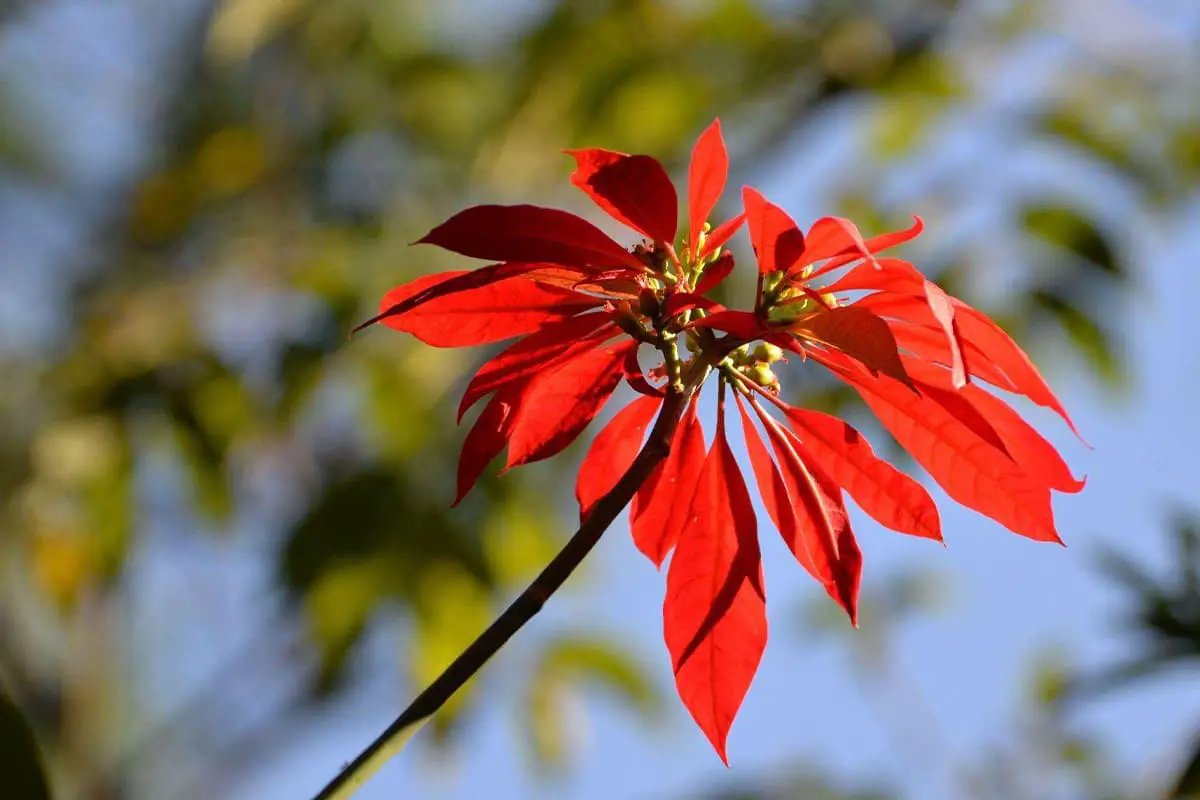
The inflorescences are several umbels arranged at the top of the branches; the general inflorescence is urn-shaped, light green, with 5 toothed edges, and the lobes are triangular and hairless. The fruit is a schizocarp, trihedral-round, smooth and hairless.
The seeds are ovate, gray or light gray, nearly smooth; without seed hilum. The flowering and fruiting period is from October to April of the following year.
The poinsettia is native to Central America and is widely cultivated in tropical and subtropical regions. It is cultivated in most provinces, regions and cities in China and is common in parks, botanical gardens and greenhouses for ornamental purposes.
The plant has mild toxicity. The stem and leaves can be used as medicine with the effect of reducing swelling, and can be used to treat injuries from falls.
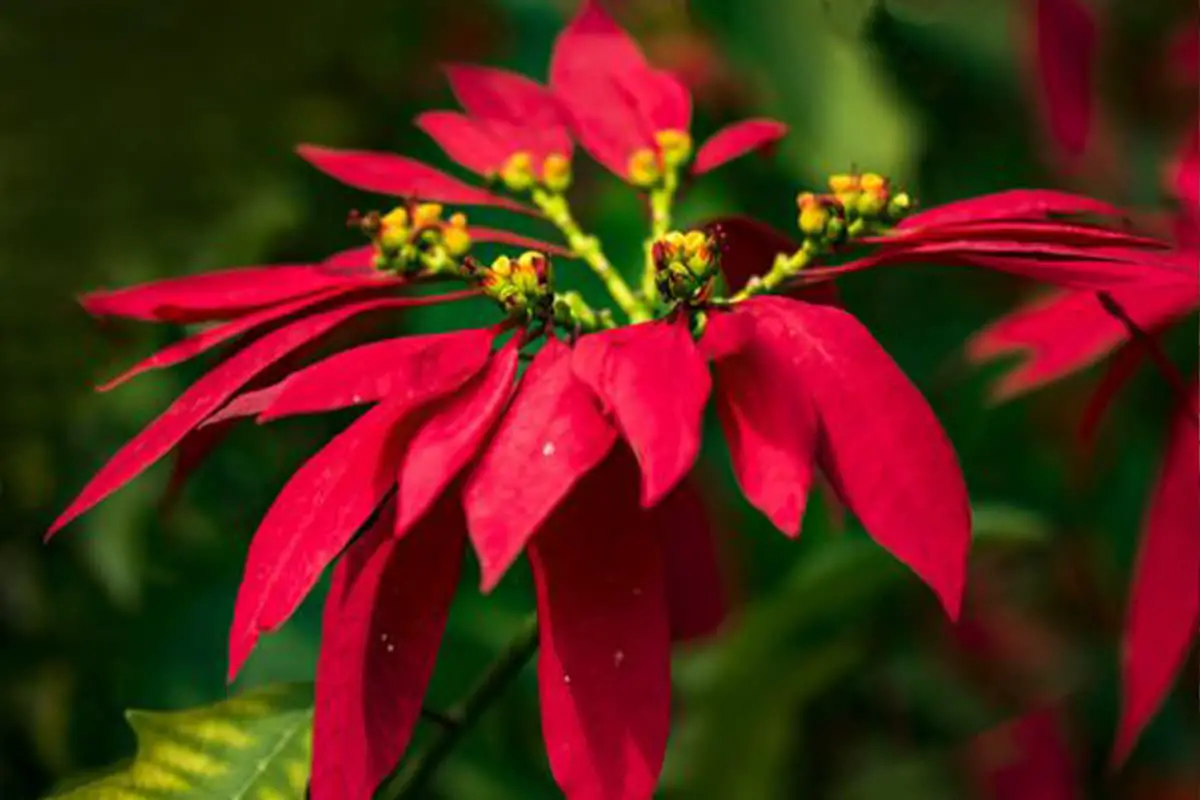
There are many types of poinsettias, mainly over twenty varieties, the common ones are white poinsettia, pink poinsettia, yellow poinsettia, orange Lilo, flame ball poinsettia, ice cave, cream strawberry, pearl, new wave, double poinsettia, variegated poinsettia, marble poinsettia, triploid poinsettia, sweet blush, sweet rose, lemon drop, festive red, orange Lilo, ice cave, Cortes Burgundy and so on.
White Poinsettia: The white poinsettia was first discovered in 1945. For a long time, to preserve the color of its leaves and bracts, it could only be placed in a greenhouse. The bracts are milky white. After 1960, the gene was stabilized, and it was gradually widely planted.
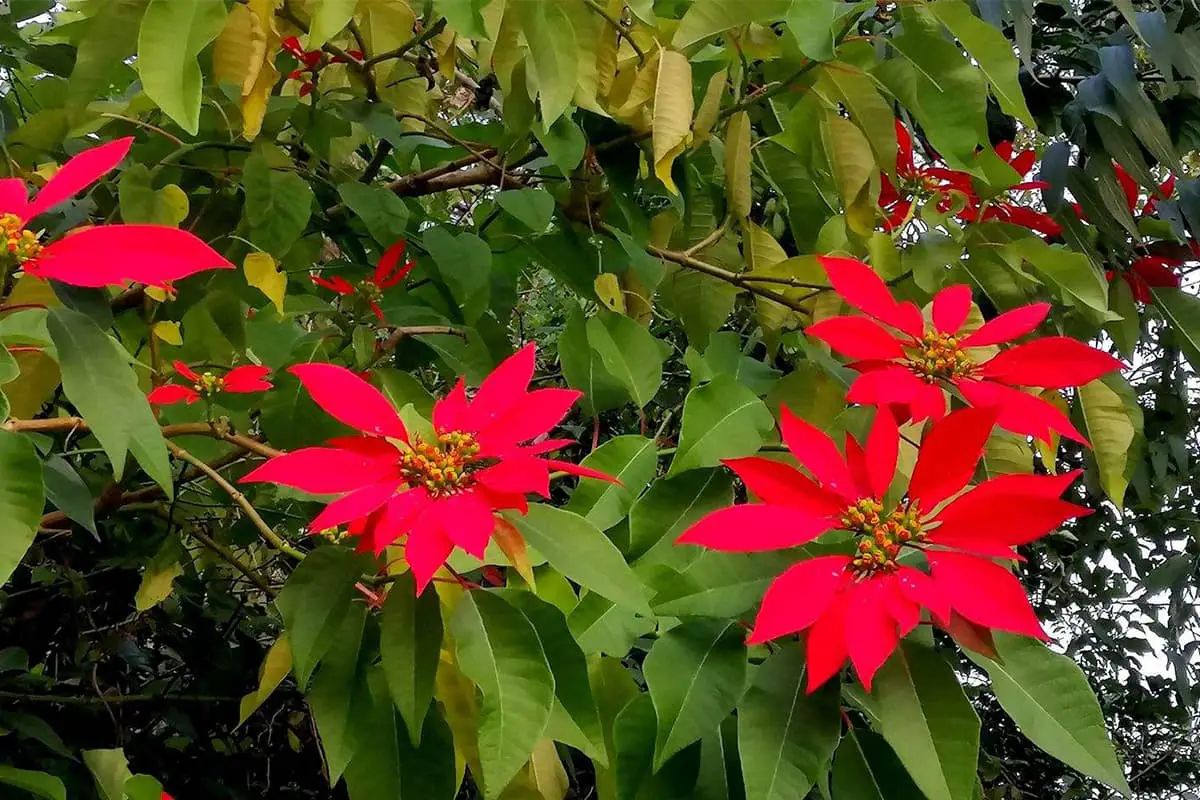
Pink Poinsettia: The appearance does not differ much from other varieties, and the bracts are pink.
Yellow Poinsettia: The bracts are yellow.
Orange Lilo Poinsettia: The bracts are large and orange-red.
Cream Strawberry Poinsettia: It has strawberry-like red color, interspersed with cream-like purity.
Pink Poinsettia: The bracts are pink.
Henrietta Ecke Poinsettia: The bracts are bright red, double-layered, with outer bracts spreading and inner bracts upright, which is very beautiful.
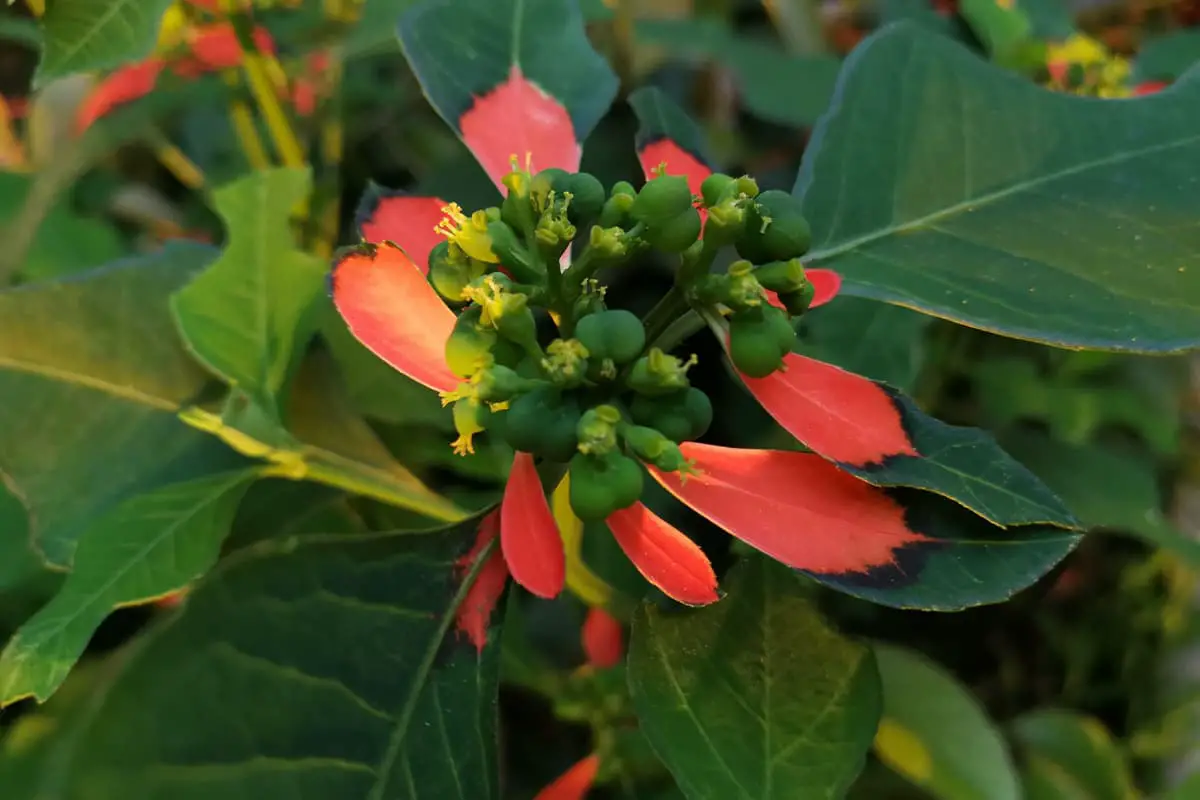
Deep Red Poinsettia: The bracts are deep red.
Double Poinsettia: The leaves are gray-green, and the bracts are red and double-layered.
Flame Ball Poinsettia: The bracts are blood red, double-layered, and the bracts curl up and down into a ball shape, growing slowly. It is an old variety that was successfully cultivated in 1950.
Marble Poinsettia: The colors are white and pink, with a faint green on the edge of the bracts.
Variegated Poinsettia: The leaves are light gray-green with white stripes, and the bracts are bright red.
Sweet Blush Poinsettia: The bracts are very thin, and the pink color gives a cute impression. It is said to be a hybrid of poinsettia species, but the exact origin is unknown.
Ice Cave Poinsettia: This variety grows weakly in hot summer. The bracts are red and very beautiful. What is impressive are the white spots contained on the bracts, like an “ice cave”.
Poinsettia is a short-day plant that likes warmth, with a suitable growing temperature of 18-25℃, 18-24℃ from April to September, and 13-16℃ from September to April of the following year, with winter temperature not lower than 10℃. It likes humidity, and poinsettia is quite sensitive to water.
As long as the water supply is sufficient during the growth period, it can thrive. It also likes sunlight. During the stem and leaf growth period, sufficient sunlight is needed to promote rapid and lush growth of stems and leaves.
Poinsettia is originally from the Taxco region of Mexico in Central America. It was introduced to the United States in 1825 by Joel Roberts Poinsett, the first US ambassador to Mexico.
Native to Central America, it is widely cultivated in tropical and subtropical regions. Most provinces, cities, and regions in China have cultivated it, and it is commonly seen in parks, botanical gardens, and greenhouses for ornamental purposes.
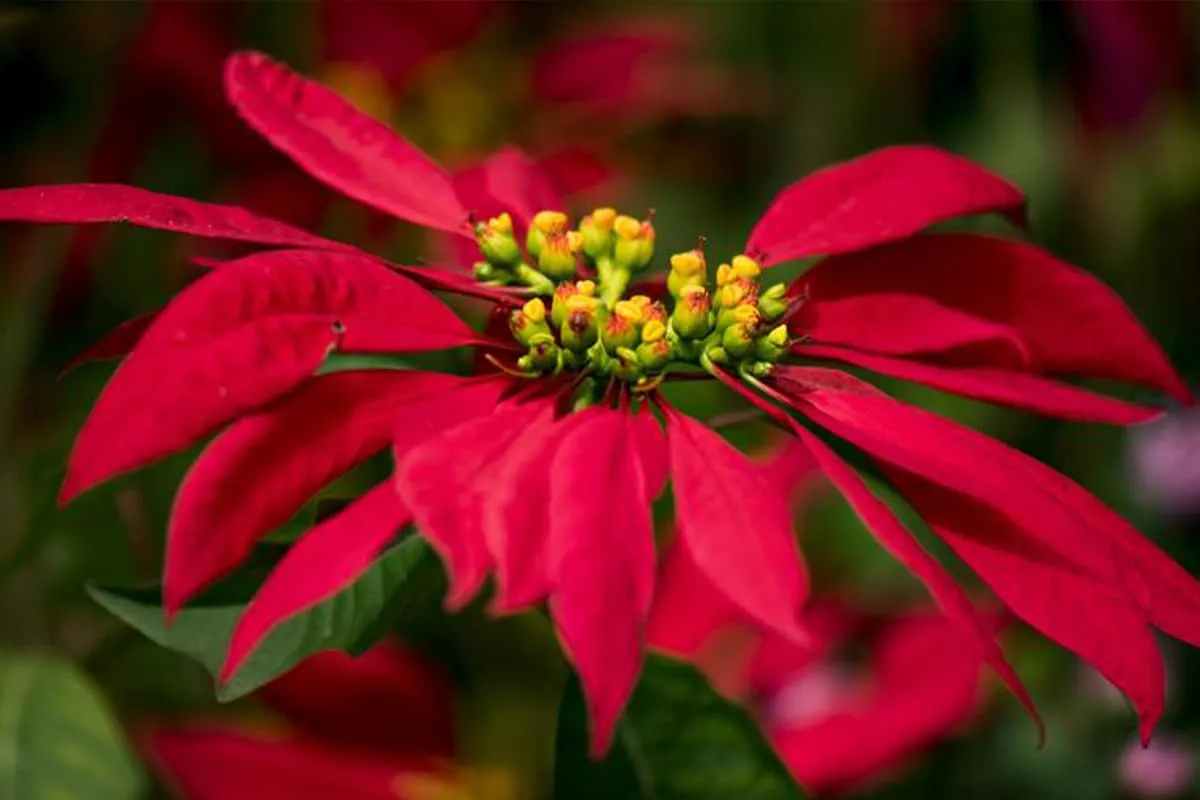
Poinsettia is a shrub. The root is cylindrical and highly branched. The stem is upright, 1-3 (4) meters tall, 1-4 (5) cm in diameter, and hairless.
Leaves are alternate, ovate-elliptic, long elliptic, or lanceolate, 6-25 cm long, 4-10 cm wide, tip gradually or sharply pointed, base cuneate or gradually narrow, green, margin entire or slightly split or wavy split, leaf surface short pilose or hairless, leaf back pilose; leaf stalk 2-5 cm long, hairless; no stipule; bracts 5-7, narrowly elliptic, 3-7 cm long, 1-2 cm wide, usually entire, very rarely margin shallowly wavy split, vermilion; leaf stalk 2-6 cm long.
The inflorescence is arranged in umbels at the top of the branch; the inflorescence stalk is 3-4 mm long; the general bract is urn-shaped, pale green, 7-9 mm high, 6-8 mm in diameter, margin 5-toothed, lobes triangular, hairless; glands usually 1, very rarely 2, yellow, often flat, two-lipped, 4-5 mm long, about 3 mm wide.
There are many male flowers, often protruding from the general bract; the female flower is 1, the ovary stalk obviously protrudes from the general bract, hairless; the ovary is smooth; the style is 3, fused below the middle; the stigma is 2 deep split.
The fruit is a capsule, triangular-round, 1.5-2.0 cm long, about 1.5 cm in diameter, smooth and hairless. The seed is ovate, about 1 cm long, 8-9 mm in diameter, gray or pale gray, nearly smooth; no seed mound. The flowering and fruiting period is from October to April of the following year.
Soil
Poinsettia likes loose and well-drained soil. Generally, 3 parts of vegetable garden soil, 3 parts of humus soil, 3 parts of leafy soil, 1 part of rotten cake fertilizer, and a small amount of slag are mixed for use.
Pinching
Three weeks after planting, the roots have grown out. At this time, you can pinch, leave 4-6 leaf nodes when pinching.
The temperature rises to 28-30℃ during the day and 23℃ at night, spray frequently to increase humidity, continue for about two weeks, see the buds grow out, and then slowly lower the temperature, 25-28℃ during the day, and also lower the humidity.
During this period, you can pinch again according to the neatness and plumpness of the plant, supplement nutrients, and combine with dwarfing agent treatment.
Temperature
The Euphorbia pulcherrima, or Poinsettia, thrives in warmth and shuns cold. From mid to late September, it should be moved indoors with improved ventilation, so the plant gradually adapts to the indoor environment.
During winter, room temperature should be maintained between 15℃ and 20℃. This period coincides with the transformation of the bracts and the bud differentiation phase; if the temperature drops below 15℃, the development of the flowers and leaves may be impaired. From mid-December, as it enters its flowering stage, ventilation should be gradually increased.
Light Exposure
Poinsettias love ample light, exhibit strong phototropism, and are short-day plants. Sufficient light exposure is crucial all year round, but especially so during the bract color change, bud differentiation, and flowering periods.
Inadequate light can result in overly elongated branches, disease susceptibility, dim flower colors, and if kept in dim conditions for a long period, the plant will not bloom and may shed leaves in winter.
To encourage or delay blooming, light control can be applied by providing 8 to 9 hours of daily light exposure for 40 days, which should stimulate flowering.
Fertilization
Poinsettias prefer fertile sandy soil. In addition to adding organic fertilizers and hoof chips as base fertilizers during repotting, diluted (5 times) fully decomposed sesame cake liquid fertilizer should be applied every 10 to 15 days during the growing and flowering season.
After autumn, a 0.3% compound fertilizer can be used once a week, continuously for 3 to 4 times, to promote bract color change and bud differentiation.
Watering
Poinsettias are sensitive to both drought and excessive moisture. Watering should be managed flexibly, depending on the weather, soil conditions, and plant growth. Normally, the aim is to keep the soil moist without waterlogging, reducing watering after blooming.
Uniform watering should be ensured to prevent over-drying or overwatering, which could cause the lower leaves to yellow and fall off, known colloquially as “falling foot,” or result in uneven branch growth.
Pruning
Dormant mature plants should be repotted around the Qingming Festival, with old roots and weak branches removed to stimulate new growth. During the growth process, the tops should be pinched twice, first in late June and again in mid-August.
Fertilization and watering should be controlled, especially before plant shape is established in autumn. Once branches grow to 20 to 30 centimeters, shaping can begin with gentle bending, aiming for a compact plant with evenly distributed, neatly arranged flowers, enhancing its visual appeal.
Poinsettias can be propagated through semi-hardwood cuttings, softwood cuttings, and old root cuttings. Regardless of the cutting method used, the cuttings should ideally be made in the early morning when they have a higher moisture content.
The cut should be smooth, and split bark and wood parts should be removed to avoid water accumulation and rot, which would affect healing and rooting.
The cut ends of the cuttings should be flat or diagonal, preferably about 0.5 centimeters below the bud base, as this facilitates rooting. The white latex that seeps from the cut should be cleaned with water, and the cut surface can be smeared with fresh clay or wood ash before planting, or dipped in rooting powder to promote root growth.
Alternatively, you can soak the cut end of the Poinsettia cutting in a 0.1% potassium permanganate solution for about 10 minutes to improve survival rates.
After treating the base as mentioned above, it should be immediately planted, usually no deeper than 2.5 centimeters into the substrate. If planted too deep, the lower cut end could rot. A planting row spacing of 4 centimeters x 4 centimeters is generally appropriate.
Semi-hardwood cuttings: Semi-hardwood cuttings of Poinsettias are usually taken between March and May. Cuttings can be made as long as the general temperature is above 15℃. Cut branches that are a year old, either woody or semi-woody, about 10 centimeters long.
Remove the leaves and tips from the cutting, and the base cut should be diagonal and close to a node. Dip it in wood ash, let the cut dry, then insert it into fine sand. After planting, water thoroughly, and maintain a temperature of 22-24℃. Roots should appear in about 20 days. During this period, it’s crucial to provide shade to prevent water loss and branch wilting.
Softwood cuttings: When the current year’s Poinsettia branches have grown 6-8 leaves, cut a 6-8 cm section with 3-4 nodes.
Cut straight below a node, remove the large leaves at the base, and immediately put it in clear water to stop the latex from flowing out. After planting, ensure the stems and leaves remain damp and employ measures to block sunlight.
Most softwood cuttings can root within 14-18 days. Poinsettias root more quickly and have a higher survival rate with softwood cuttings.
If propagating in a homemade greenhouse, as long as the indoor temperature is maintained around 22℃, propagation can start as early as late March and continue up until September if necessary.
Old Root Cuttings: Poinsettias that have been cultivated for many years can be propagated using their roots to create new plants. In March and April of spring, Poinsettias are usually repotted, a process which entails replacing the potting soil to replenish nutrients and pruning the stem and roots.
During this process, people often discard the old Poinsettia roots. However, if these roots, which should be at least 0.5 centimeters thick, are collected, they can be a significant source of propagative material.
Specifically, cut the old Poinsettia roots into segments approximately 10 centimeters long. Dip the cut ends in dry charcoal powder, wood ash, or dry soil.
After they have slightly dried, plant them in a cultivation soil . If you have a small number of cuttings, use a deeper pot for planting, while larger numbers can be planted in a nursery bed.
When planting, leave 1 centimeter of the root segment above the surface and tilt it 80 degrees toward the north to encourage new shoots to sprout as quickly as possible. There’s no need for shading after planting, and within about a month, new plants should sprout.
When these new plants have grown to around 10 centimeters in height, they can be transplanted to pots. After a period of about 5 days to a week, normal maintenance can be resumed.
Layering is a propagation method that involves pushing the plant’s branches close to the ground into the soil, and wrapping higher branches’ wounded parts with damp materials like moss. Once roots have formed, the new plant can be separated from the parent plant and grown independently. High-pressure layering is generally used.
Firstly, choose woody branches, typically those that are healthy and full-grown from the previous year.
Strip a ring of bark from a smooth part of the branch, with the width of the stripped ring being roughly the same thickness as the branch at the stripped location—usually 3-4 centimeters is appropriate.
Remove the fibrous part of the branch at the ring-stripped location, make a smooth upper cut, and gently scrape to form a layer with a sharp knife. Afterward, wrap the cut location with wet sphagnum moss or other loose, breathable materials.
Typically, a 20-25 square centimeter polyethylene film is used because it has good permeability to carbon dioxide and oxygen, yet has a low moisture transference, and can withstand prolonged periods of weather changes.
Tighten both ends with a tying rope or similar. If it’s not tightly bound, the substrate can dry out, which would affect the rooting of the cut.
Approximately two months after layering, Poinsettias can grow a root system. At this point, they can be cut and planted in a pot, forming a new plant. The best time for layering Poinsettias is between April and July.
Gray mold mainly occurs in winter, which is the flowering season for Poinsettias. The disease can harm Poinsettia flower clusters, bracts, leaves, and branches, especially during rainy and humid conditions with no sunlight. Typically, water-soaked spots begin to appear on the flowers.
Then, the diseased areas get covered with a layer of pathogenic fungus conidiophores, which continue to spread to the bracts. Initially, the bracts show water-soaked, discolored spots, which later expand into irregular shapes as the pathogen spreads to the branches.
Yellow-brown to brown spots appear on the branches, and in later stages, the diseased spots noticeably sink down and turn black-brown.
In severe cases, the diseased spots dry up. The pathogen, Botrytis, can live on dead plant tissues or other organic matter and has a wide host range. It can survive at temperatures between 0-38℃ and exists as long as there is moisture.
If the greenhouse is too damp, dark, and lacks sunlight, after 1-2 days, the pathogen produces a large number of conidiophores that are released into the air and begin to infect plant tissues.
Control Methods: Utilize the enclosed nature of the facility to create a high-temperature, low-humidity environment to control the occurrence and development of gray mold. At night, the indoor humidity in the facility often exceeds 90%.
After the early morning dew is cleared, the vents should be opened immediately to ventilate and dehumidify, reducing indoor humidity and controlling the disease development at a lower temperature. After 9 o’clock, when the indoor temperature rises rapidly, the vents should be closed to quickly raise the indoor temperature to around 32℃.
Root rot and stem rot can infect mature plants and can also infect during the seedling stage, causing severe losses. The disease generally occurs more severely during high-temperature seasons and is highly likely to occur when the water content of the cultivation soil is high.
Initially, the plant shows wilting, and at this time, if the base of the stem is inspected, a light brown constricting phenomenon can be seen. However, no rot or hydrolysis is observed in the infected plants.
Later, the diseased spots gradually spread upwards, the wilting becomes more severe, and the stem spots slightly sink and turn yellow-brown. In the later stage, the tissues of the diseased spots disintegrate, causing the plant to wilt severely due to a lack of water and eventually die.
Sometimes the whole plant appears water-soaked and yellow, ultimately decaying and dying. White mycelium can be seen near the ground, and in severe cases, it can extend to the cultivation soil.
When the roots are diseased, root rot often occurs, initially affecting the normal growth of the plant and leading to death in severe cases.
The pathogens mainly include Phytophthora, Rhizoctonia, and Pythium. When salts accumulate on the surface of the medium, Pythium appears in mature Poinsettias.
It may have invaded during cutting, and when the environment is suitable for reproduction, it deteriorates, causing root rot and death. High temperatures and over-irrigation can cause Phytophthora damage.
Control Methods:
Medical Value
The whole plant (Poinsettia): It’s bitter, astringent, and cool. It’s slightly toxic. It regulates menstruation, stops bleeding, joins bones, and reduces swelling. It is used for excessive menstruation, trauma, external bleeding, and fractures.
The white latex inside the Poinsettia plant has a slight toxicity that can irritate the skin or stomach. Ingestion may cause diarrhea and vomiting, and it may cause allergic reactions in sensitive individuals. If the sap gets into the eyes, it may cause temporary blindness.
Garden Value
Poinsettias have bright colors and a long flowering period. It is in full bloom around Christmas, New Year’s Day, and Chinese New Year, and pot cultivation can add a festive atmosphere to indoor environments. It is also suitable for decorating public places like conferences.
In the warm areas of the south, it can be cultivated in open fields to beautify gardens and can also be used as cut flowers.
Poinsettia Flower Language
Poinsettia is the best flower representing Christmas, but it can also be seen in some weddings, where red and white Poinsettias symbolize “my heart is burning”. One of its flower languages expresses your fervent passion.
Poinsettia Legend
According to legend, there was a village south of Mexico City in ancient times. The village was fertile and rich in water resources, with prosperous agriculture and animal husbandry, and people lived in peace and contentment.
One summer, a mudslide occurred suddenly, and a giant rock cut off the water source, causing severe water shortage and dry, cracked soil in the area.
A warrior named Porcherrima in the village, regardless of personal safety, chiseled the rock for water day and night. Eventually, he opened the giant rock, and the clear spring rushed out like a tiger. Porcherrima, due to excessive fatigue, was swept away by the water, and people searched everywhere but found no trace of him.
As time went by, one day, a shepherd found a plant by the water with bright red top leaves, exceptionally beautiful. This surprised the villagers, and they said: This flower is very similar to Porcherrima, who liked to wear a red top when he was alive.
In memory of the man who sacrificed himself for water, people named this flower “Porcherrima Flower”. This legendary flower is now known as the “Poinsettia”.

Peggie was once a high school mathematics teacher, but she set aside her chalkboard and textbooks to follow her lifelong passion for flowers. After years of dedication and learning, she not only established a thriving flower shop but also founded this blog, “Flowers Library”. If you have any questions or wish to learn more about flowers, feel free to contact Peggie.
 English
  العربية
  Bahasa Indonesia
  Deutsch
  Français
  Italiano
  Nederlands
  Português
  Русский
  日本語
日本語