600+ Types of Flowers A To Z (With Names and Pictures)
Types Of Flowers By Names (A-Z) Types Of Flowers By Color Types Of Flowers By Season Types Of Flowers By Blooming Time 600+ Types of Flowers No. Flower Name No.…

The Elaeocarpus hainanensis is a small tree of the Elaeocarpaceae family.
It boasts a broad canopy; its young branches are hairless; the leaves are leathery, with a narrow, inverted lanceolate or oblong shape, tapering to a pointed tip and a wedge-shaped base, young leaves are smooth and densely edged with tiny blunt teeth; the bracts are leaf-like and stalkless, ovate, the sepals are lanceolate, and the petals are inverted ovate.
The drupe is spindle-shaped with shallow grooves; the seeds are about 2 centimeters long; and it flowers from June to July.
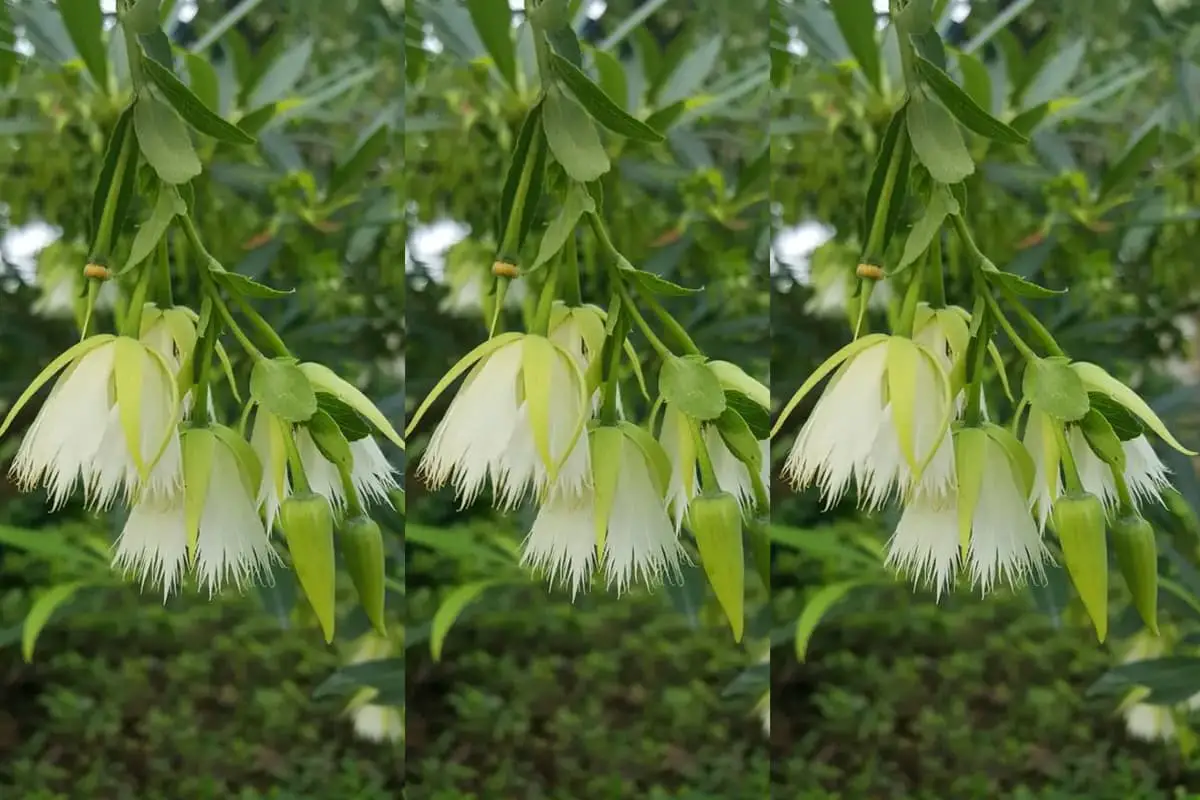
The Hainan Elaeocarpus is native to Vietnam and Thailand. It thrives in semi-shade, preferring hot and humid climates. With a deep root system, it is quite resistant to wind but not to cold or drought.
It enjoys moist conditions but does not tolerate waterlogging, requiring well-drained soil rich in organic matter for optimal growth. It is commonly propagated through seeding and cutting.
The tree is densely branched, forming a conical canopy. With its long blooming period and pristine, delicate white blossoms, it is a popular woody flower, suitable for planting on lawns, slopes, forest edges, in front of yards, or at crossroads.
It can also serve as a backdrop for other flowering plants, offering significant ornamental value.
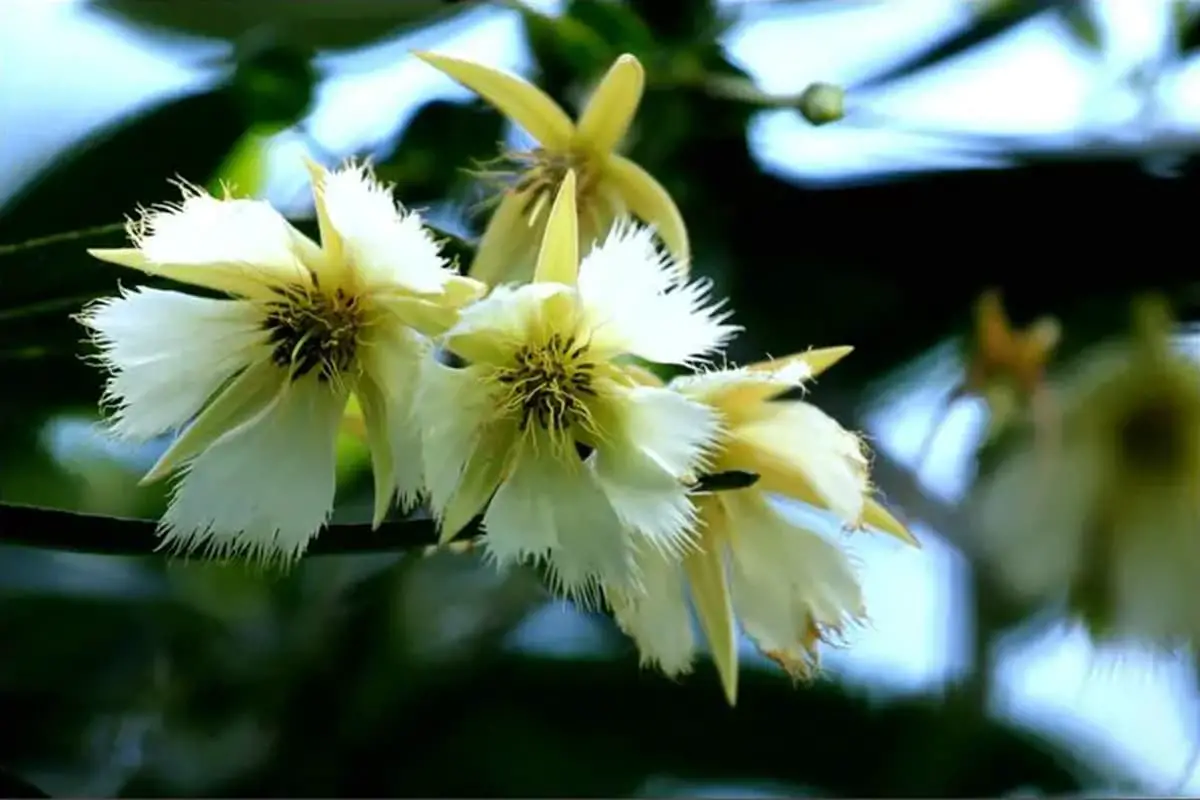
This small tree features pseudomonopodial branching and a wide canopy; its tender branches are hairless.
The leaves are leathery, narrowly inverted lanceolate, 7-15 cm in length and 1.5-3 cm in width, with a pointed tip and a wedge-shaped base.
Young leaves are bare on both sides, while mature leaves are dark green on the surface, shiny when dried, and light green underneath.
There are 14-16 pairs of prominent lateral veins on the surface and slightly raised net veins underneath, with edges densely lined with small blunt teeth; the petioles are 1-2 cm long.
The racemes grow in the leaf axils of current-year branches, are 5-7 cm long, and have 2-6 flowers each. The flowers are quite large, with a diameter of 3-4 cm.
The bracts resemble leaves, are stalkless, ovate, and about 1 cm long and 7-8 mm wide, with fine hairs on both sides and toothed edges. The base is rounded or ear-shaped, with reticulated and lateral veins, and remains on the plant.
The flower stalks are about 4 cm long with fine hairs; there are five sepals, lanceolate, approximately 2 cm long, covered in soft hair.
The petals are white, of the same length as the sepals, inverted ovate, softly haired on the outside with the tips torn into 30 strips, 4-6 mm long.
There are numerous stamens, roughly the same length as the petals, finely haired, with anthers protruding into awn-like shapes, 4 mm long.
The floral disc is deeply lobed and continuous, encircling the base of the ovary; the ovary has two chambers, hairless, with a 1 cm long, hairy style; there are two ovules per chamber.
The drupe is spindle-shaped, pointed at both ends, about 4 cm long, and 1-1.2 cm wide at the center; the inner fruit skin is hard and bony with shallow grooves, two ventral sutures, and 1.5 mm thick walls; one chamber; the seeds are 2 cm long. The flowering period is from June to July.
The Hainan Elaeocarpus is found in Thailand and Vietnam. It favors semi-shaded areas and thrives in high-temperature, high-humidity climates.
With a deep root system, it is resistant to wind but sensitive to cold and drought. It prefers moist conditions without standing water and grows best in fertile soil rich in organic matter.
Elaeocarpus hainanensis is commonly propagated through seeding and cutting.
For optimal germination rates, seeds should be sown immediately after harvesting. Seedlings should be transplanted either in early autumn or late spring, with small seedlings retaining their original soil and larger ones being moved with a clump of soil.
The species thrives when planted near water but does not tolerate prolonged waterlogging. Care should be taken to monitor water levels and soil permeability.
The seeds of Elaeocarpus hainanensis mature between September and October. Harvesting is done when the fruit skin transitions from green to dark yellow.
After harvesting, allow the seeds to ferment for 2-3 days to soften and decompose the flesh, then wash them in water to remove the pulp and dry them in the shade.
The dry weight of the seeds is approximately 2940 grams. It is recommended to sow the seeds as soon as they are collected. If storing in moist sand, do not exceed 40 days.
Select a nursery site with a gentle slope, ample sunlight, good drainage, and deep, fertile sandy loam soil. Raise the seedbed approximately 15cm high, using a mix of pure yellow heart soil and kiln-burnt earth in a 4:1 ratio as the substrate.
Flatten the substrate with a wooden board, then sow the seeds using a broadcasting method. Cover with a thin layer of fine topsoil or clean river sand, about 1.5-2.0cm thick, ensuring seeds are not exposed after watering.
Shade the seedbed with a net and keep it moist. Germination begins around 40 days after sowing and completes in about 30 days with a germination rate of 75%-90%.
Seedlings are ready for nutrient bags or cup transplantation once they reach 4-7cm in height and have 2-3 true leaves. Mix yellow heart soil (87%), kiln-burnt earth (10%), and calcium-magnesium phosphate (3%) evenly for the nutrient soil.
Cover with a shading net. Forty days after planting, apply a 1% concentration of compound fertilizer solution monthly during the growing season, and rinse the leaves with clean water.
After one year, seedlings reach a height of approximately 50-70cm and a ground diameter of about 0.7cm, meeting afforestation seedling standards.
Elaeocarpus hainanensis prefers fertile soil rich in organic matter but cannot withstand waterlogging. It grows best in areas with deep soil layers on mid to lower slopes.
Plant spacing should be 2m x 3m or 2.5m x 3m, with a planting density of 89-100 plants per acre. Prepare the land for afforestation by cutting mountainsides, leveling the ground, digging holes, applying base fertilizer, and backfilling with topsoil.
Planting holes should be 50cm long, 50cm wide, and 40cm deep. For base fertilizer, apply 1kg of calcium-magnesium phosphate or 1.5kg of decomposed manure.
For mixed forests, intersperse with other species at a ratio of 1:1 to 2:1 with species like Sophora japonica. Plant bare root seedlings in spring and bagged seedlings in late spring or summer.
In spring, plant when the temperature rises and the rain thoroughly soaks the forest land. For summer planting, do so 1-2 days before heavy rain or immediately after, or soak the nutrient bags before planting.
Water thoroughly to establish the roots. Spring plantings can achieve a survival rate of over 98%, slightly less in summer.
For the first three years after afforestation, cultivation should be carried out once each in April-May and September-October.
This includes clearing weeds, expanding and loosening the soil around the planting holes, applying decomposed manure or 0.1kg of compound fertilizer.
Fertilizer should be placed on either side of the drip line to avoid damaging the roots and affecting growth. The forest canopy will close and mature within 3-4 years.
The Ficus microcarpa primarily suffers from leaf-eating pests, including the green fruit beetle and subterranean pests such as grubs and mole crickets.
To control the green fruit beetle, one should target the adult beetle’s peak period. Methods include shaking them off and capturing them or using a solution of 50% Dichlorvos EC diluted to 800 times its volume for poisoning.
For grubs and mole crickets, Dichlorvos solution can be applied by pouring it into holes made with a bamboo stick at the soil surface.
The Ficus microcarpa is an evergreen with an attractive shape, long flowering period, and delicate white blossoms, making it an excellent choice for ornamental gardens and ecological public forests.
Its preference for semi-shady environments makes it suitable for planting as a secondary canopy in courtyards, grasslands, and roadside areas for garden landscaping.
With its dense branching and conical crown, the Ficus microcarpa boasts a long flowering season, and its crown is adorned with pure, subtly colored blossoms.
It is a common woody flower suitable for lawns, slopes, forest edges, front yards, and crossroads clusters. It can also serve as a backdrop for other flowering plants, offering significant aesthetic value.

Peggie was once a high school mathematics teacher, but she set aside her chalkboard and textbooks to follow her lifelong passion for flowers. After years of dedication and learning, she not only established a thriving flower shop but also founded this blog, “Flowers Library”. If you have any questions or wish to learn more about flowers, feel free to contact Peggie.
 English
  العربية
  Bahasa Indonesia
  Deutsch
  Français
  Italiano
  Nederlands
  Português
  Русский
  日本語
日本語