600+ Types of Flowers A To Z (With Names and Pictures)
Types Of Flowers By Names (A-Z) Types Of Flowers By Color Types Of Flowers By Season Types Of Flowers By Blooming Time 600+ Types of Flowers No. Flower Name No.…

Eichhornia crassipes is a floating aquatic herb. It has well-developed adventitious roots that are dark brown in color. The stems are very short and have creeping branches that are light green in color.
The leaves are arranged in a rosette at the base of the plant, with round-shaped leaf blades that are deep green in color. The leaf stalks vary in length and have numerous air chambers composed of polygonal columnar cells, with scattered vascular bundles in between.
The leaf stalks also have sheath-like bracts at the base, which are yellow-green in color. The flower stalks are angular and the inflorescence is usually a spike with 9-12 flowers.
The petals are purple-blue in color, with slightly symmetrical corollas that are pale purple-red on the sides and blue in the center. There is a yellow circular spot in the middle of the blue color.
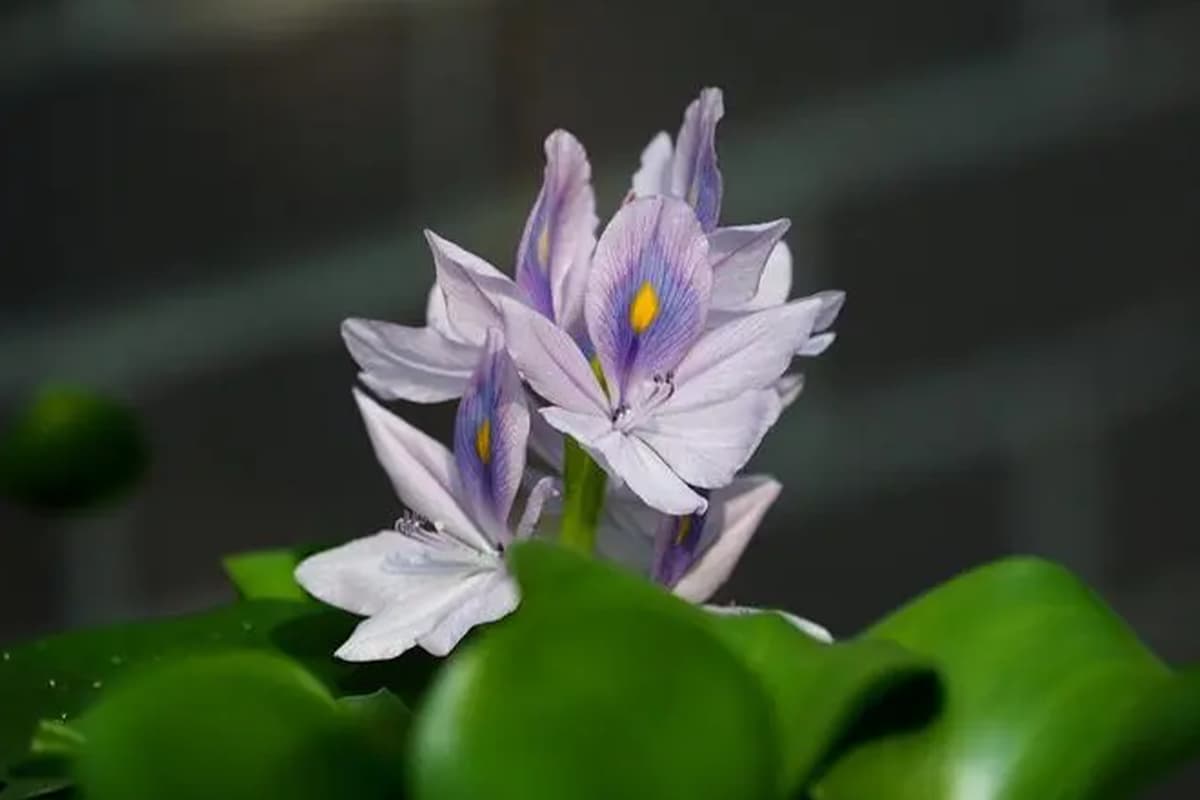
The petals are fused at the base to form a tube. The stamens are attached to the corolla tube, and there are glandular hairs on the filaments. The anthers are bluish-gray, and the pollen grains are yellow.
The ovary is pear-shaped and the style is about 2 centimeters long, with dense glandular hairs on the stigma. The fruit is ovoid in shape. It flowers from July to October and fruits from August to November.
Water hyacinth is a floating aquatic herb that grows to a height of 30-60 centimeters. It has well-developed adventitious roots that are dark brown and can grow up to 30 centimeters long.
The stems are very short and have long creeping branches, which are light green or purplish in color. They can grow into new plants when separated from the mother plant.
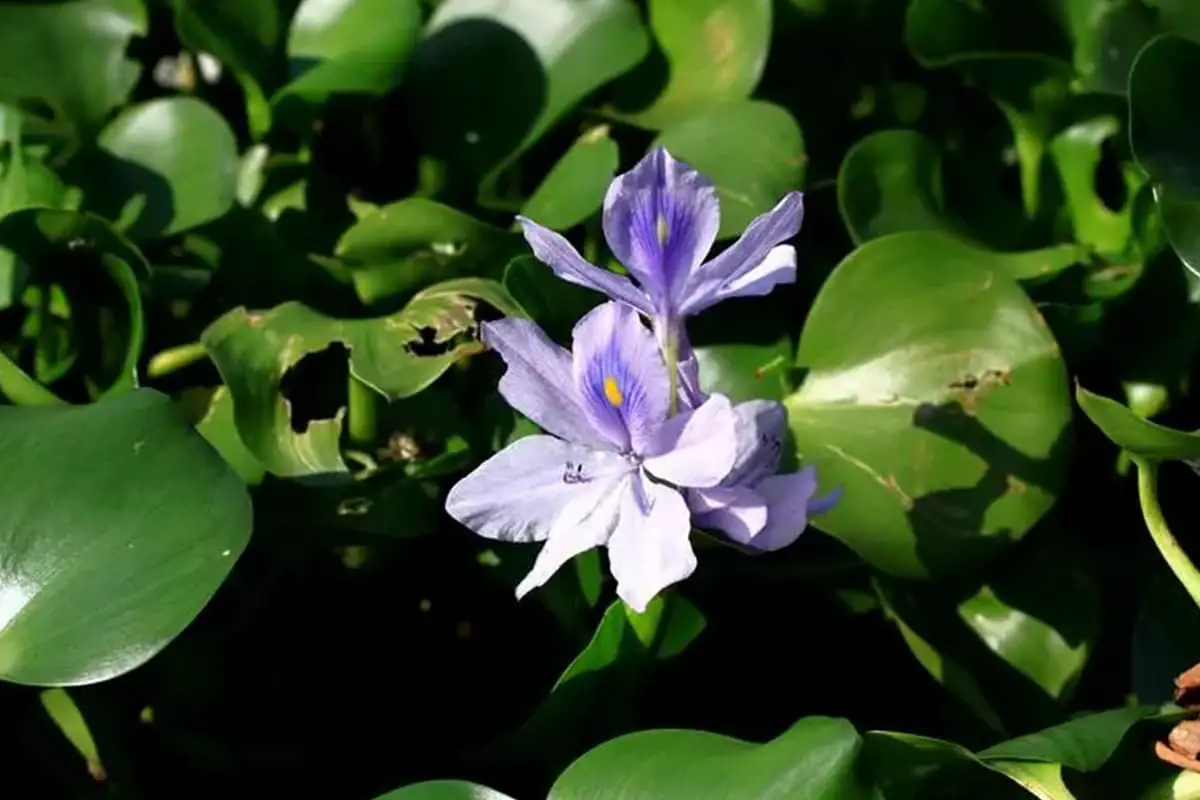
The leaves are arranged in a rosette at the base of the plant, usually 5-10 leaves. The leaf blades are round, broadly ovate, or broadly rhomboid in shape, measuring 4.5-14.5 centimeters in length and 5-14 centimeters in width.
The tips are bluntly rounded or slightly pointed, and the bases are wide wedge-shaped or shallowly cordate in young plants. The leaves have entire margins, curved veins, and a deep green, glossy surface.
They are thick and have a slightly upward curl on both sides, with the top slightly turned downward. The leaf stalks vary in length and have enlarged pouch-like or spindle-shaped midsections.
They have numerous air chambers composed of polygonal columnar cells, with scattered vascular bundles in between. The leaf stalks are yellow-green to green in color and smooth.
At the base of the leaf stalks, there are sheath-like bracts that are 8-11 centimeters long, yellow-green, thin, and translucent.
The flower stalks emerge from the axils of the sheath-like bracts at the base of the leaf stalks, measuring 34-46 centimeters in length and with many edges. The inflorescence is spike-like, measuring 17-20 centimeters in length, and usually has 9-12 flowers.
The six sepals are petal-like, ovate, oblong, or inverted ovate in shape, and are purple-blue in color. The corollas are slightly symmetrical, with a diameter of 4-6 centimeters.
One of the sepals is larger, measuring about 3.5 centimeters in length and 2.4 centimeters in width. It is pale purple-red on the sides and blue in the center, with a yellow circular spot in the blue center.
The other sepal petals are about 3 centimeters long and 1.5-1.8 centimeters wide. The lowermost sepal is narrower, measuring 1.2-1.5 centimeters in width. The sepals are fused at the base to form a tube, and there are glandular hairs near the base.
There are six stamens attached to the corolla tube, with three long and three short ones. The long stamens extend from the throat of the corolla tube, measuring 1.6-2 centimeters in length, while the short stamens are located near the throat, measuring 3-5 millimeters in length.
The filaments have glandular hairs that are about 0.5 millimeters long and consist of 3 (2-4) cells, with swollen tips. The arrow-shaped anthers are basifixed, bluish-gray in color, and have two longitudinal slits.
The pollen grains are elongated oval in shape and yellow. The ovary is superior, pear-shaped, measuring 6 millimeters in length, with 3 chambers and numerous ovules on the central axis.
There is one style that is about 2 centimeters long, and the part protruding from the corolla tube has glandular hairs. The stigma is covered with dense glandular hairs. The fruit is ovoid in shape. It flowers from July to October and fruits from August to November.
Water hyacinth is native to Brazil and can be found in ponds, ditches, and rice fields at elevations ranging from 200 to 1500 meters. It is also widely grown in tropical regions of Asia.
Select ponds with a large number of flowering plants. Do not harvest them. In September and October, when the small fruits turn pale yellow, remove the curved fruit stalks. Dry them in the shade and remove the fruit peel to extract the seeds.
If you rub the flowers that have exposed pollen on the stigma in the morning between 9-10 o’clock during peak flowering, the seeds will be more plump and full.
The seeds that are fully developed and have a yellow-brown color can be soaked in water at 25-30℃ for 10 days in late February to early March.
Then, they can be sown on the water surface and kept at a temperature and humidity of about 30℃. Germination will occur in 1 to 2 weeks. After the seedlings have grown 5-6 leaves and have enough buoyancy, they can be transplanted.
After the average temperature rises to around 20℃, which is around late spring, they can be moved to the water surface of an internal pond for cultivation.
Water hyacinth has many axillary buds on its rhizomes, which can develop into new plants. The creeping branches are longer and fragile, easily breaking off and becoming independent new plants. It has strong vegetative reproduction ability
Peggie was once a high school mathematics teacher, but she set aside her chalkboard and textbooks to follow her lifelong passion for flowers. After years of dedication and learning, she not only established a thriving flower shop but also founded this blog, “Flowers Library”. If you have any questions or wish to learn more about flowers, feel free to contact Peggie.
 English
  العربية
  Bahasa Indonesia
  Deutsch
  Français
  Italiano
  Nederlands
  Português
  Русский
  日本語
日本語