600+ Types of Flowers A To Z (With Names and Pictures)
Types Of Flowers By Names (A-Z) Types Of Flowers By Color Types Of Flowers By Season Types Of Flowers By Blooming Time 600+ Types of Flowers No. Flower Name No.…

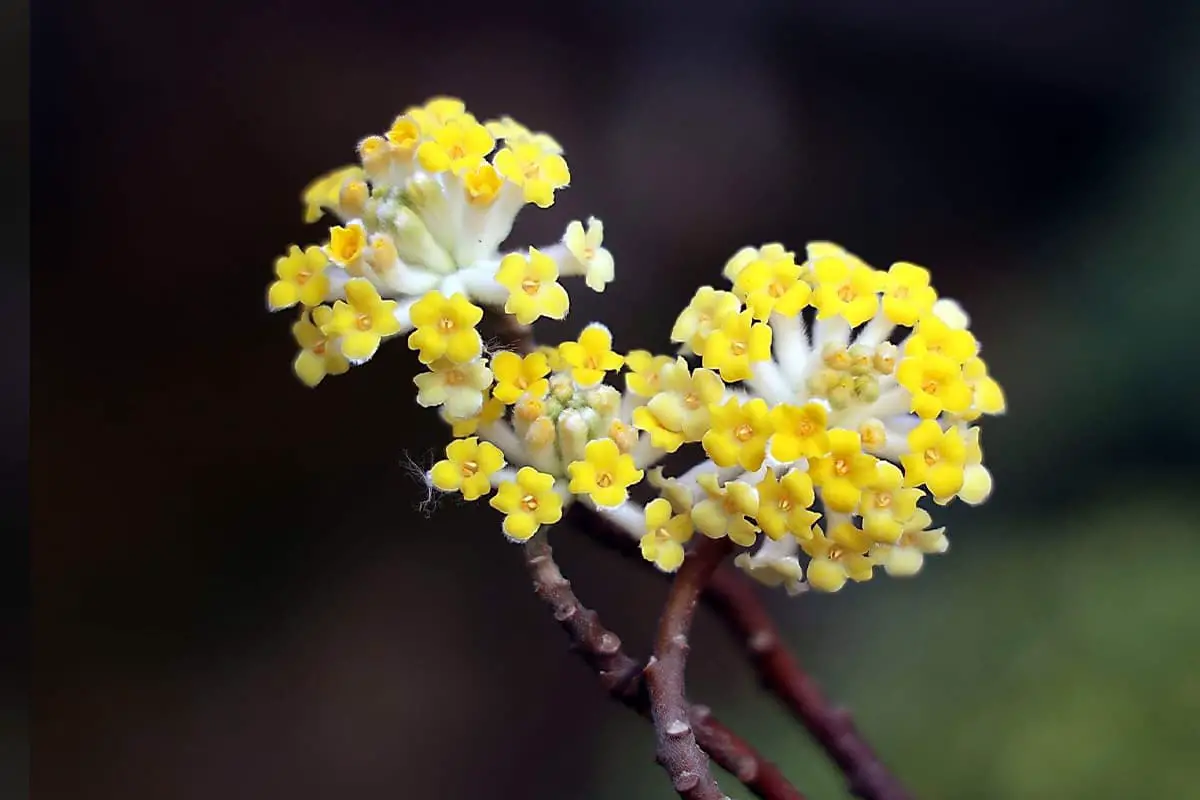
Edgeworthia chrysantha is a plant of the Thymelaeaceae family and Edgeworthia genus. It is a shrub that grows approximately 0.7-1.5 meters tall, with robust branches that are brown in color and often fork into three.
Young branches are often covered with short soft hair. The bark is extremely tough, and leaf scars are large, with a diameter of about 5 millimeters.
Leaves fall before the flowers bloom and are oblong, lanceolate to inversely lanceolate in shape, with a short pointed tip and a wedge-shaped or gradually narrowing base. It can be found growing wild or cultivated.
The bark fibers can be used to make high-quality paper and raw material for synthetic cotton. The whole plant has medicinal properties, helping to relax muscles and stimulate blood circulation, reduce inflammation and alleviate pain.
It can treat traumatic injuries and rheumatic pains, and can also be used as a veterinary medicine to treat livestock injuries. It can also be cultivated for ornamental purposes.
The Oriental Paperbush stands at about 0.7-1.5 meters tall with robust, brown branches that often fork into three. Young branches are often covered with short soft hair, and the bark is extremely tough.
Leaf scars are large, with a diameter of about 5 millimeters. Leaves, which fall before the flowers bloom, are oblong, lanceolate to inversely lanceolate in shape, with a short pointed tip and a wedge-shaped or gradually narrowing base.
They measure 8-20 centimeters long and 2.5-5.5 centimeters wide. Both surfaces are covered with silvery-grey, silk-like hair, with more on the underside. The slender, curved lateral veins are covered with soft hair.
The capitulum inflorescence is terminal or lateral, with 30-50 flowers forming a fluffy ball, surrounded by about 10 long-haired and early-falling bracts. The peduncle is 1-2 centimeters long, covered with grey-white long hard hair.
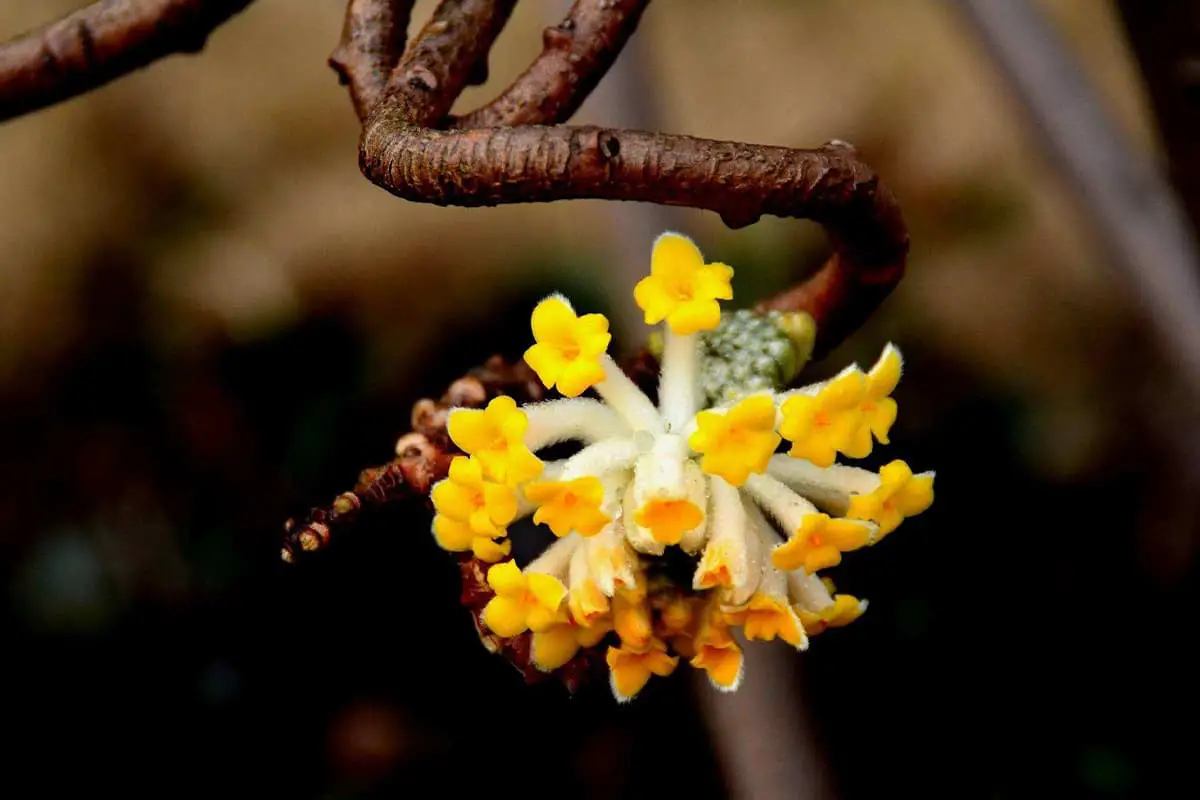
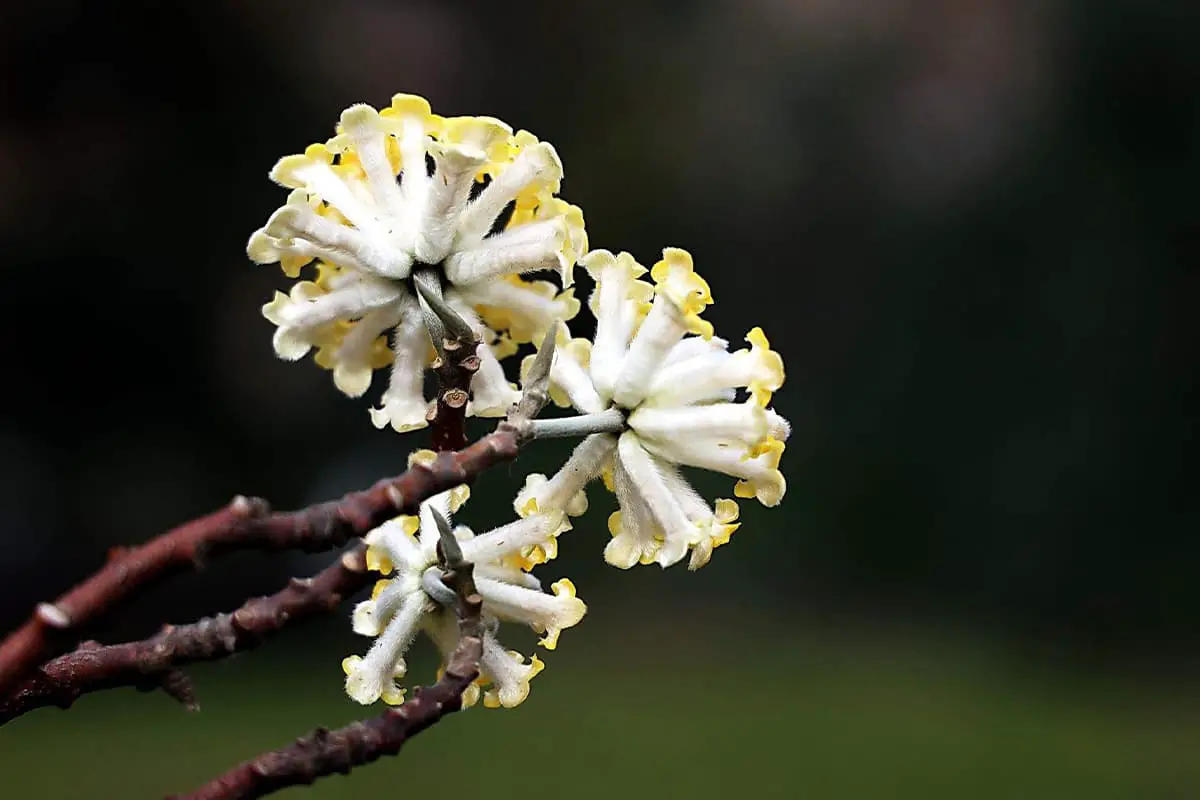
The flowers are fragrant, without a stem. The calyx is about 1.3-2 centimeters long and 4-5 millimeters wide, densely covered with white filamentous hair on the outside, hairless on the inside, and yellow.
The apex is 4-lobed, with each lobe being ovate, about 3.5 millimeters long and 3 millimeters wide. There are 8 stamens, arranged in two rows. The ovary is ovate, about 4 millimeters long and about 2 millimeters in diameter, with a filamentous hair tip.
The pistil is linear, about 2 millimeters long, hairless, with a rod-shaped stigma, about 3 millimeters long, with a papilla. The disc is shallowly cup-shaped, membranous, with an irregular edge.
The fruit is elliptical, green, about 8 millimeters long and about 3.5 millimeters in diameter, with a hairy tip. The flowers bloom in late winter to early spring, and the fruits mature between spring and summer.

This plant thrives in damp, fertile soil. It prefers semi-humid conditions and partial shade, making it ideal to plant or place facing south against a north wall.
This position provides protection from the harsh summer sun while allowing it to bask in the winter’s sunlight. For potted plants, it is advisable to keep them in a sunny spot from autumn to spring and move them to a semi-shaded area in summer.
Excessive exposure to sun can turn the leaves yellow and reduce flowering, while too much shade can weaken the fragrance of the flowers. This temperate plant loves warmth but can withstand temperatures as low as -20℃.
In areas south of Beijing, it can overwinter outdoors. However, in regions where winter temperatures drop between -10℃ and -20℃, flowering is delayed until March or April.
In areas where winter temperatures fall below -20℃, it is suitable for potting and should be kept indoors on a south-facing windowsill.
The fibrous bark can be used to produce high-quality paper and as raw material for synthetic cotton.
The entire plant has medicinal properties. It can relax muscles, reduce inflammation and alleviate pain, making it effective in treating injuries, rheumatic pain, and can also be used as a veterinary medicine for cattle injuries.
The roots are used to relax muscles, reduce swelling and relieve pain, and are effective in treating rheumatic joint pain and back pain.
They can also be applied externally to treat injuries and fractures. The flowers have the ability to dispel wind and improve vision, and can be used to treat red and painful eyes and night blindness.

The plant can be cultivated for ornamental purposes. With its spherical crown, beautiful branches, and leaves, it is suitable for planting in gardens or potting for decoration.
Its elegant posture and flexible branches, which can be tied into knots, make it a favorite among many. It is suitable for planting at the front of houses, along roadsides, by the water, between stones, and in corners.
In the north, it is often grown in pots for ornamental purposes. Its branches are flexible and can be bent and tied into knots without breaking, often shaped into various forms.
The symbolic meaning of this plant and its flowers is “Happy Union”. In China, it is known as the “Chinese Love Tree” as many people in love believe that if they tie two knots in the same direction on its branch, they will have lasting sweet love and happiness.

Peggie was once a high school mathematics teacher, but she set aside her chalkboard and textbooks to follow her lifelong passion for flowers. After years of dedication and learning, she not only established a thriving flower shop but also founded this blog, “Flowers Library”. If you have any questions or wish to learn more about flowers, feel free to contact Peggie.
 English
  العربية
  Bahasa Indonesia
  Deutsch
  Français
  Italiano
  Nederlands
  Português
  Русский
  日本語
日本語