600+ Types of Flowers A To Z (With Names and Pictures)
Types Of Flowers By Names (A-Z) Types Of Flowers By Color Types Of Flowers By Season Types Of Flowers By Blooming Time 600+ Types of Flowers No. Flower Name No.…

The term “Sakura” generally refers to the Mountain Cherry Blossom, while the Japanese Late Cherry Blossom is a specific type within the Japanese Cherry Blossom species.
These two types of cherry blossoms are different, with significant differences in their plants, leaves, and flowers. They can be easily distinguished just by their appearances.
Moreover, their blooming seasons do not overlap, allowing everyone to appreciate them at different times without worrying about missing out. Let’s take a look at the differences between the Japanese Late Cherry Blossom and the Sakura.
The Japanese Late Cherry Blossom is a deciduous tree, reaching up to 16 meters in height with silver-gray bark.
On the other hand, Sakura, a member of the Rosaceae family, is also a deciduous tree. However, its bark is purplish-brown, smooth, and glossy with horizontal stripes. The Sakura tends to be taller than the Japanese Late Cherry Blossom.
The leaves of the Japanese Late Cherry Blossom are ovate-elliptical, long elliptical to ovate, 5-12 cm long and 3-6 cm wide. They have sharp single or double serrated edges, somewhat prickly, hairless on the surface, and short soft hairs along the veins on the back.
Sakura leaves are alternately arranged, oval or ovate-elliptical, with awned teeth on the edges, pointed tips with glands, deep green and glossy on the surface, and slightly lighter on the back. Its stipules are lanceolate-linear, with finely serrated edges and glandular tips.
The Japanese Late Cherry Blossom flowers are grouped by 3-6 in a corymbose cyme, with short peduncles. The flowers bloom before the leaves, initially light pink, later turning white, with a diameter of 2-3 cm. The flower stalk is about 2 cm long, with short soft hairs.
The calyx is tubular, purplish-red with short soft hairs on the outside, and the calyx lobes have fine teeth. The petals have a concave tip, and the style has soft hairs near the base.
The drupe is near spherical, turning from red to purple-brown when ripe, with a diameter of about 1 cm. The flowering period is in April.
Sakura flowers, each stalk bearing three to five flowers, form an umbel-like inflorescence. The calyx lobes spread horizontally, the petal tips have notches, and the flowers are white or red.
They bloom in March, either simultaneously with the leaves or after the leaves have sprung. The drupe is spherical, initially red, later turning purple-brown, and ripens in July.
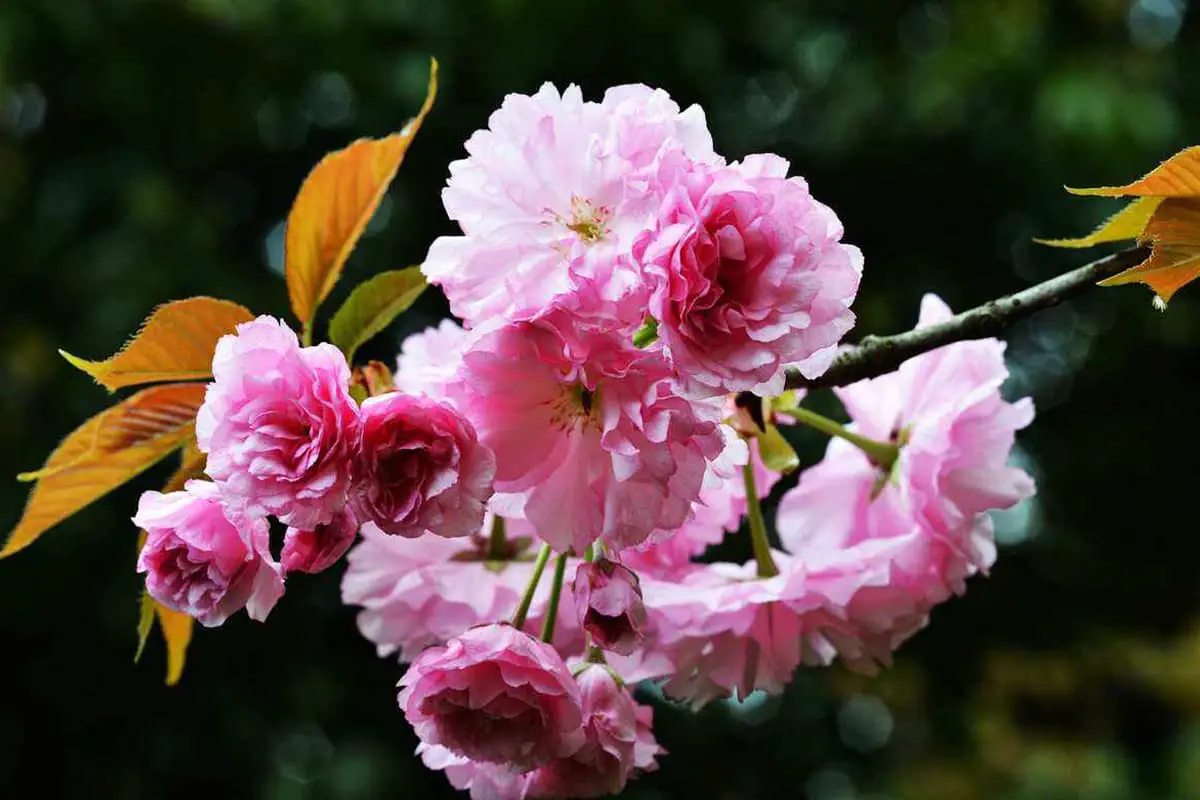
The Late Cherry Blossom is so named primarily because its flowering period is relatively late, blooming each year from April to May, significantly later than the early cherry blossoms.
During its bloom, the flowers look very tender in color, with larger and double-layered petals, which are also much lighter.
Due to its drooping flowers, it appears quite shy and attractive. When it blooms, it practically breaks the tree branches.
The blooming period of the Late Cherry Blossom is relatively brief, lasting only 7 days from full bloom to wilting, just like a fleeting life.
The flower language of Late Cherry also carries a sense of desolation, representing a love that is fleeting, symbolizing a short-lived love affair.
It also implies that love is not fulfilled and can only end in separation. The blooming period of Late Cherry is usually in April to May. Its life is short, so at the moment of blooming, it appears exceptionally beautiful.

Peggie was once a high school mathematics teacher, but she set aside her chalkboard and textbooks to follow her lifelong passion for flowers. After years of dedication and learning, she not only established a thriving flower shop but also founded this blog, “Flowers Library”. If you have any questions or wish to learn more about flowers, feel free to contact Peggie.
 English
  العربية
  Bahasa Indonesia
  Deutsch
  Français
  Italiano
  Nederlands
  Português
  Русский
  日本語
日本語