600+ Types of Flowers A To Z (With Names and Pictures)
Types Of Flowers By Names (A-Z) Types Of Flowers By Color Types Of Flowers By Season Types Of Flowers By Blooming Time 600+ Types of Flowers No. Flower Name No.…

Delonix regia, also known as the Flame Tree, Royal Poinciana, Fire Tree, and Foreign Ash, is a deciduous tree in the legume family. It is renowned as one of the world’s most colorful trees due to its vibrant red or orange flowers paired with bright green fern-like leaves.
This tropical ornamental tree is also the national tree of the Republic of Madagascar.
Delonix regia, a member of the legume family, is a deciduous tree that can grow up to 20 meters tall. It has a wide canopy. Its leaves are bi-pinnate, with small, oblong leaflets. It blooms in summer with large, glossy, red flowers in panicles.
The wooden seed pods can grow up to 50 centimeters long. Its striking combination of bright red or orange flowers and vivid green leaves make it one of the world’s most colorful trees.
The Flame Tree is the national tree of the Republic of Madagascar.
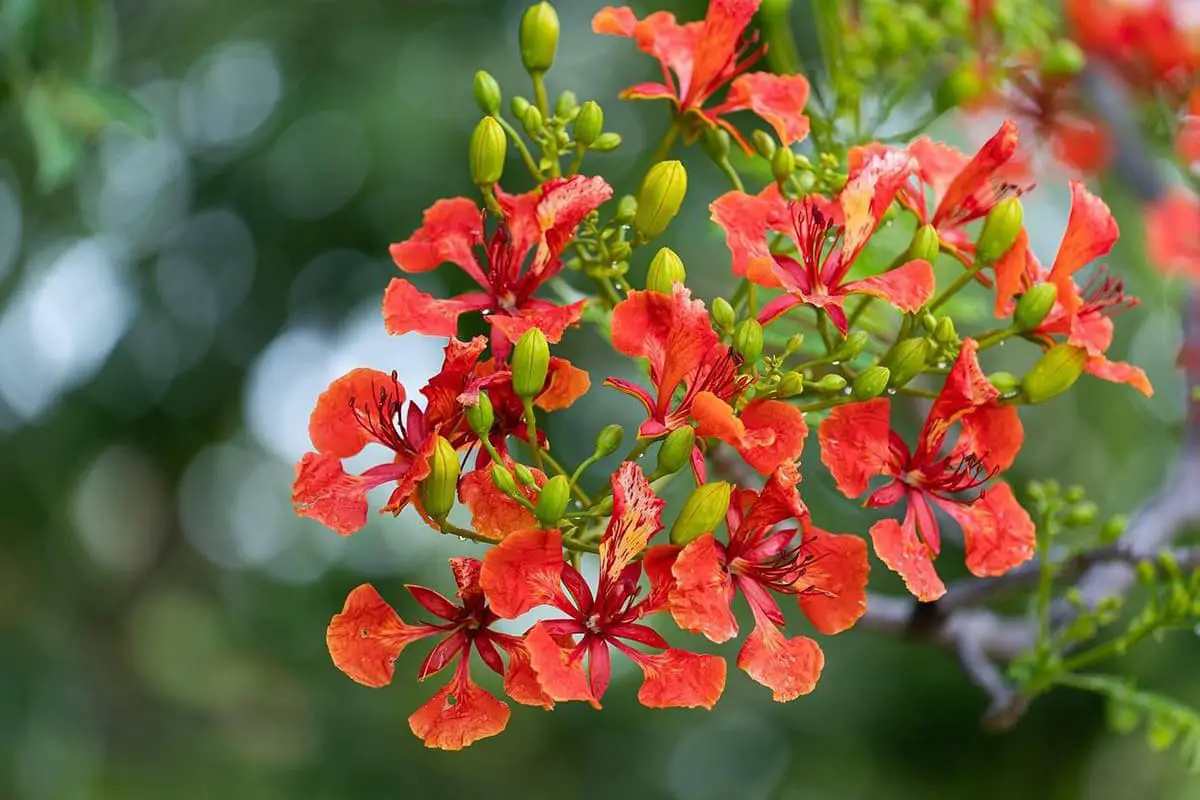
The Flame Tree is a large plant with a sprawling, drooping crown that provides shade in tropical regions. It thrives in high temperatures and sunny environments, flourishing in areas with ample sunlight.
It is found in the southern and southwestern parts of China, its native land Madagascar, and various tropical regions worldwide.
The Flame Tree is a tropical species that starts to bloom after 6 to 8 years. It prefers warm, humid conditions and plenty of sunlight. The optimal growing temperature is between 20 to 30°C.
It is not frost-tolerant, with the minimum winter temperature requirement being 10°C. It grows best in deep, fertile, organic-rich sandy loam; it does not tolerate waterlogging and requires good drainage.
Despite being drought-tolerant, it prefers thin, poor soil. Generally, 1-year-old trees can reach a height of 1.5 to 2 meters, while 2-year-old trees can grow up to 3 to 4 meters, with the trees starting to bloom after 6 to 8 years.
In southern China, the tree buds in early February, with the growth peak between April and July. Its growth slows down in late July due to high temperatures, but it picks up again from late August as the temperature drops.
Its growth slows down after October and the tree sheds its leaves between December and January.
The Flame Tree is native to Madagascar and has been widely introduced to tropical and subtropical regions around the world.
In the United States, the Flame Tree can be found in Florida, the Rio Grande Valley in southern Texas, desert areas in Arizona and California, Hawaii, Puerto Rico, the U.S. Virgin Islands, and Guam. It also thrives throughout the Caribbean region.

The Royal Poinciana is a large deciduous tree, without thorns, reaching over 20 meters in height, with a trunk diameter of up to 1 meter. The bark is coarse and grey-brown; the crown is flat and round, with many spreading branches; the twigs often have short soft hairs and noticeable lenticels.
It has a shallow root system, but it’s well-developed and strong against wind. It is resistant to air pollution, has strong sprout power, and grows rapidly.
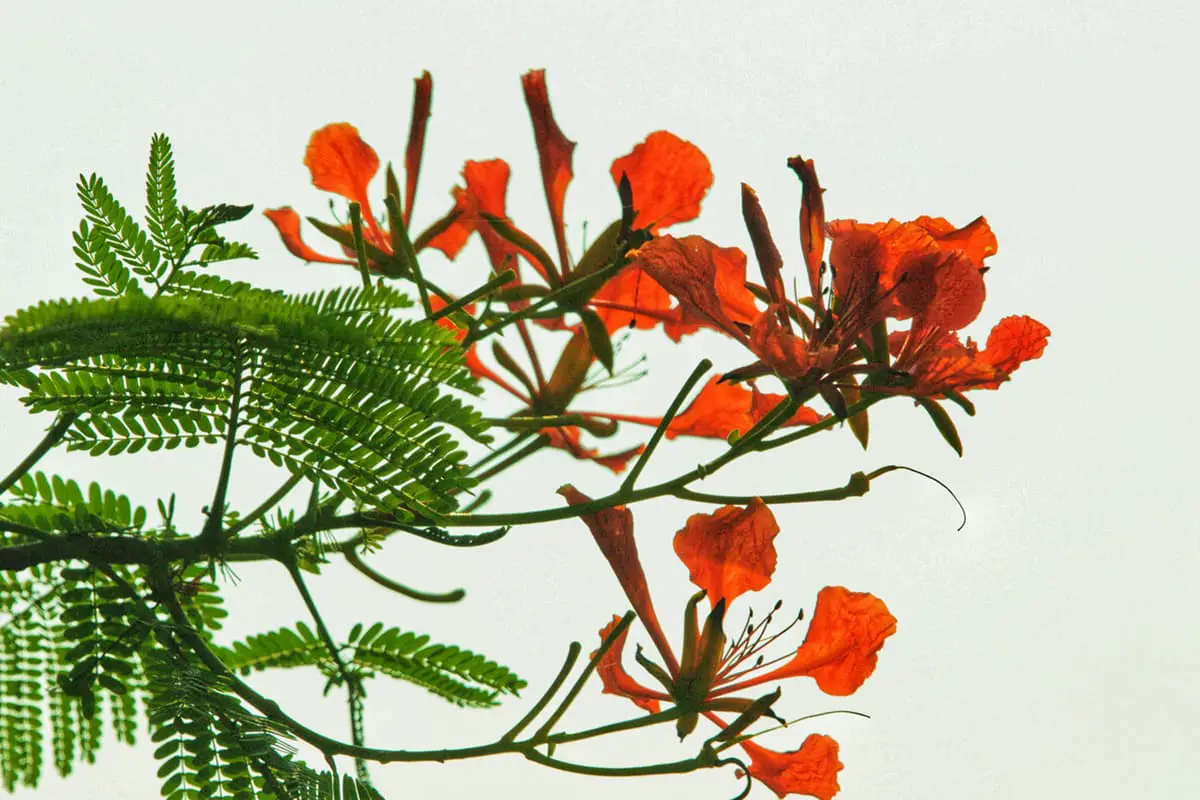
The Royal Poinciana’s leaves are twice pinnate, 20-60 centimeters long, with stipules; the lower stipules are noticeably feathery, and the upper ones are bristly; the petioles are 7-12 centimeters long, smooth to softly hairy, with a groove on the top, and the base is enlarged and cushion-shaped.
The leaflets are opposite, 15-20 pairs, up to 5-10 centimeters long; the leaflets are 25 pairs, densely opposite, oblong, 4-8 millimeters long, 3-4 millimeters wide, silky on both sides, blunt at the apex, and the base is oblique, the edge is entire; the midrib is prominent; the petiole is short.
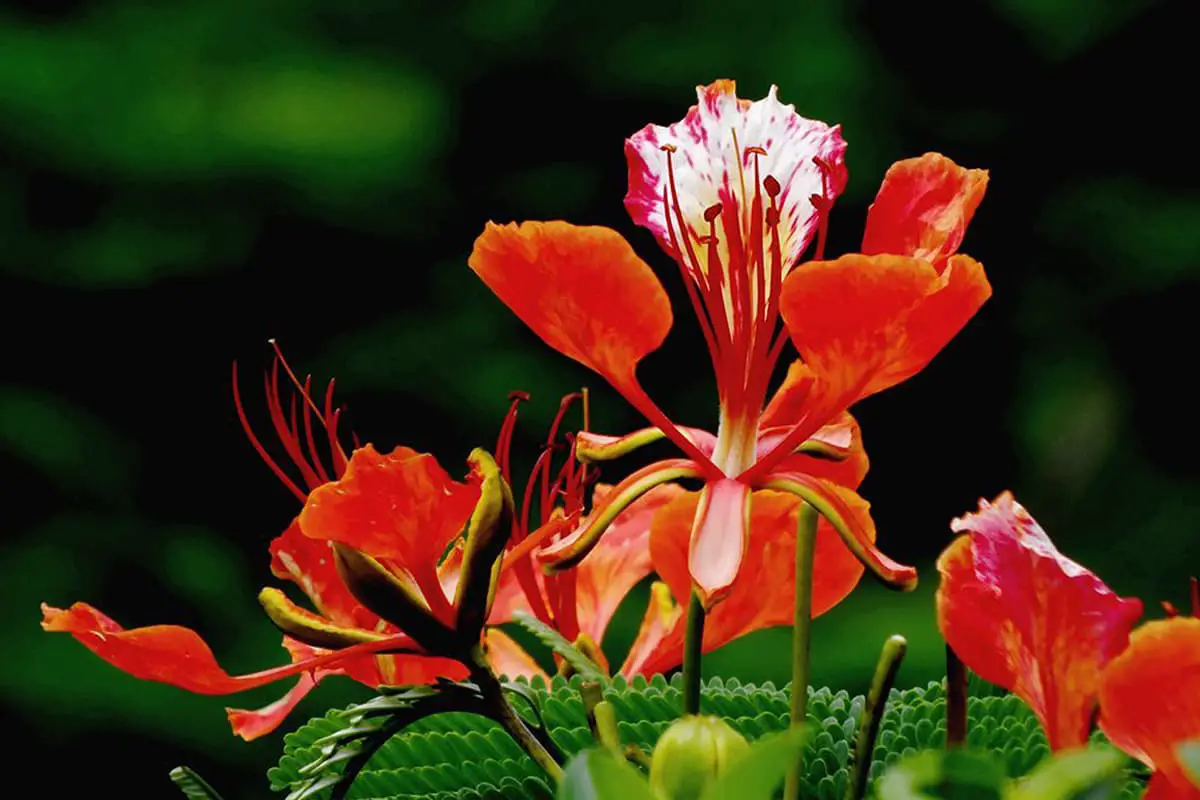
The inflorescences are umbellate cymes, terminal or axillary; the flowers are large and beautiful, 7-10 centimeters in diameter, bright red to orange-red, with 4-10 centimeters long pedicels; the calyx is disc-shaped or short spire-shaped; the sepals are 5, red inside, green-yellow on the edge.
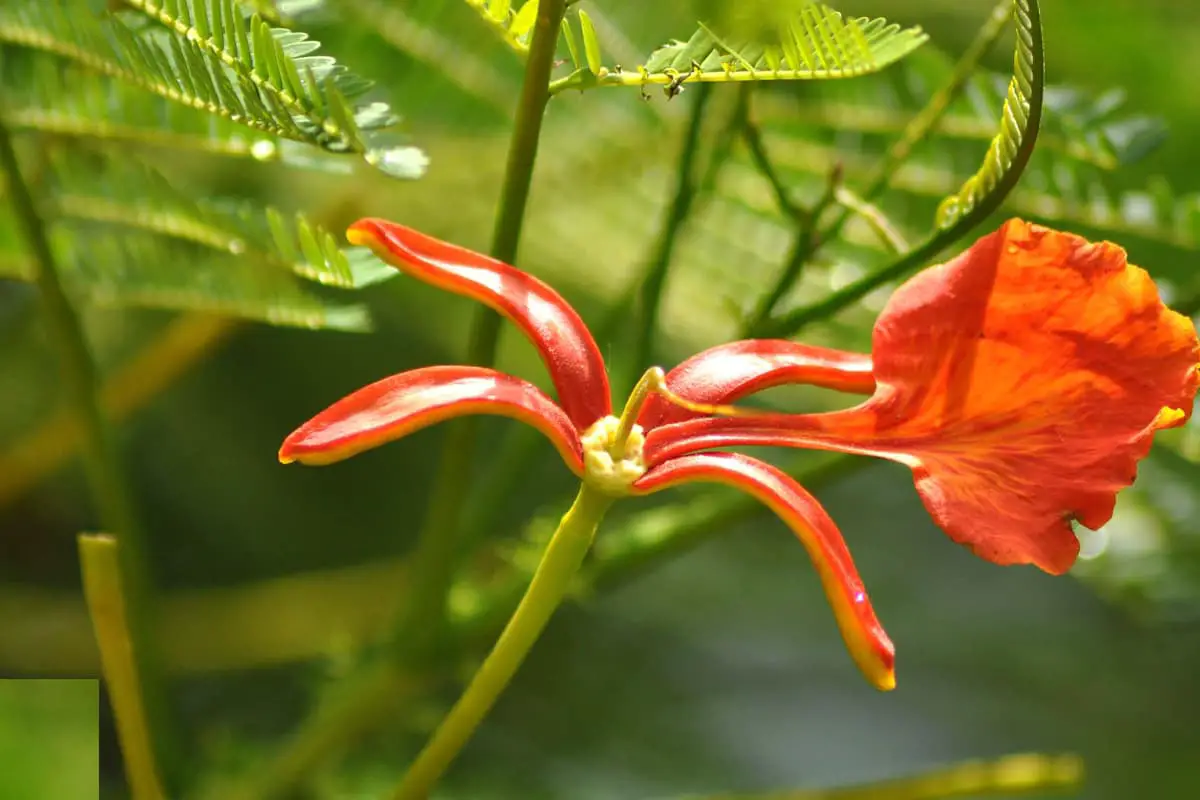
The petals are 5, spoon-shaped, red, with yellow and white spots, 5-7 centimeters long, 3.7-4 centimeters wide, curled back after blooming, the petiole is long and thin, about 2 centimeters long; the stamens are 10, red, of varying lengths, 3-6 centimeters long, bent upwards, the filaments are thick, the lower half is woolly, the anthers are red, about 5 millimeters long.
The ovary is about 1.3 centimeters long, yellow, hairy, without a stalk or with a short stalk, the style is 3-4 centimeters long, the stigma is small, truncate.
The fruit is a pod, flat, 30-60 centimeters long, 3.5-5 centimeters wide, slightly curved, dark red-brown, black-brown when mature, with a persistent style at the apex; there are 20-40 seeds, oblong, smooth, hard, yellow with brown spots, about 15 millimeters long, about 7 millimeters wide.
The flowering period of the Royal Poinciana is from June to July, and the fruiting period is from August to October.
The Royal Poinciana is a tropical tree species that loves heat and is intolerant to cold. It can survive the winter smoothly if the temperature in winter is not lower than 10 degrees Celsius.
The Royal Poinciana is not demanding about the soil, but it needs to be well-drained. Its roots have nitrogen-fixing nodules that can enhance soil fertility, but waterlogging will kill these nodules, affecting its growth. Therefore, it is important to control the amount of water and ensure no waterlogging.
The seedlings need to be transplanted once after 1-2 years of growth, preferably in early spring. The distance between the plants should be around 60 centimeters, and seedlings that are three years old can be used for planting. After planting, the soil needs to be loosened every year, weeds removed 2-3 times, and fertilizer applied once in spring and autumn.
New branches and leaves can grow from the trunk of the Royal Poinciana at any time. If left to grow naturally, the plant shape will change significantly and it will not maintain its vitality well, so regular pruning is necessary.
The pests found on the Phoenix tree are “night moths”. These insects feed on plant leaves in their larval stage, often eating all the leaves of the host plant, seriously affecting the growth and aesthetics of the tree.
The peak infestation months for these pests are July, August, and September. While the Phoenix tree night moth poses no harm to humans, some people may experience allergic reactions.
Control Methods
During the period when the larvae cluster and cause damage, dusting should be done in the early morning before the dew dries. You can use 2.5% of trichlorfon powder or 1.5% of parathion (1605) powder, 1.5% of malathion powder for dusting, 1.5-2 kg per acre.
Medicinal Value
Taste
Tree bark: Sweet, light, cold.
Benefits
Tree bark: Calms the liver and subdues yang, reduces fever. Treats dizziness and restlessness.
Root: Treats rheumatic pain.
Toxicity
The flowers and seeds are poisonous. If a child accidentally ingests the seeds, they may experience symptoms such as dizziness, salivation, bloating, abdominal pain, and diarrhea.
The water extract from the stem bark has emetic effects on cats and monkeys and inhibits the central nervous system. The alcohol and water extracts from the flowers have anthelmintic effects. The toxic components are unknown. The flowers contain carotenoids.
The seeds contain lysolecithin and other phospholipids. The stem bark contains erythritol and leucocyanidin. Ingestion can cause symptoms such as abdominal pain, bloating, diarrhea, dizziness, and salivation.
The Phoenix tree has a large crown, and during the flowering period, the flowers are red and the leaves are green. The tree looks like a flame, hence the name Phoenix tree. It is a famous tropical ornamental tree species.
In the southern cities of our country, it is planted in botanical gardens and parks as an ornamental tree or a roadside tree.
Roadside tree: Roadside trees have a microclimate effect of cooling and humidifying in the summer. They are landscape trees for greening, beautifying, and fragrancing the environment.
Shade tree: In the midsummer, a Phoenix tree with a trunk diameter of 7-8 cm can have a maximum crown width of 8-10 meters. Its shading rate is between 50% and 70%.
The Phoenix tree has many branches, and there is not much difference between the middle and the edge of the crown, so the shading effect is relatively even and the ventilation condition is good.
The temperature inside the crown is 3°C lower than that of the exposed place outside, and the maximum is 6°C lower. The relative humidity inside the crown is 10%-20% higher than that of the exposed land outside.
Fertilizing and soil improvement: The root system has nitrogen-fixing rhizobium, which can save the use of fertilizer. The Phoenix tree has a large amount of leaf fall every year. For example, a tree with a trunk diameter of 7-8 cm falls about 3.1 kg of leaves a year.
A large amount of fallen leaves provides good cover for ground plants, which helps to retain moisture, improve soil organic matter content and structure, and increase soil fertility.
The resin can be dissolved in water for craftsmanship; the wood is light, elastic, and has special wood grain, which can be used for small furniture and raw materials for craftsmanship.
The pods of the Phoenix tree are used as percussion instruments in the Caribbean, called shak-shak or maracas.
Phoenix Flower Language
The Phoenix flower carries the meanings of parting, missing, and passionate youth. Because it blooms in June, the graduation season, it signifies a sense of parting and the feeling of missing friends after parting.
Also, because it blooms in September, the start of school season, its fiery red color represents the passion of youth. It can be given to friends to express emotions.

Peggie was once a high school mathematics teacher, but she set aside her chalkboard and textbooks to follow her lifelong passion for flowers. After years of dedication and learning, she not only established a thriving flower shop but also founded this blog, “Flowers Library”. If you have any questions or wish to learn more about flowers, feel free to contact Peggie.
 English
  العربية
  Bahasa Indonesia
  Deutsch
  Français
  Italiano
  Nederlands
  Português
  Русский
  日本語
日本語