600+ Types of Flowers A To Z (With Names and Pictures)
Types Of Flowers By Names (A-Z) Types Of Flowers By Color Types Of Flowers By Season Types Of Flowers By Blooming Time 600+ Types of Flowers No. Flower Name No.…

The Cymbidium ensifolium is a terrestrial plant with an ovoid pseudobulb, encased at the base of the leaves. It has 2-6 strap-like, glossy leaves, each 30-60 cm long and 1-2.5 cm wide.
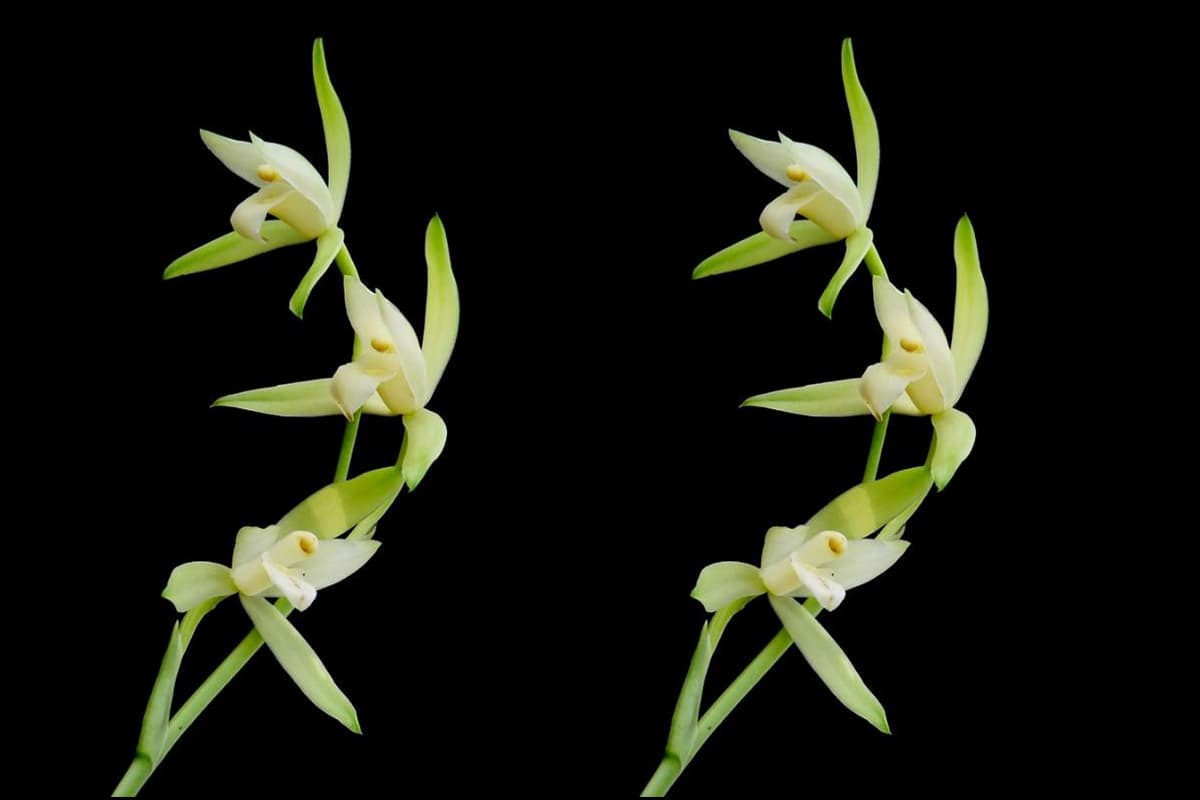
The flower spike emerges from the base of the pseudobulb, usually shorter than the leaves, with 3-9 flowers in a raceme. These flowers often have a pleasant fragrance, and their color varies widely, usually light yellow-green with purple spots.
The sepals are nearly narrowly oblong or narrowly elliptical, while the petals are narrowly elliptical or narrowly ovate-elliptical, 1.5-2.4 cm long and 5-8 mm wide, and nearly spreading.
The lip is almost ovate, 1.5-2.3 cm long and slightly 3-lobed. The capsule is narrowly elliptical, 5-6 cm long and about 2 cm wide. The flowering period is usually from June to October.

It grows under sparse forests, in shrubs, beside valleys, or in grasses, at an altitude of 600-1800 meters. It is native to many parts of China and is widely distributed in Southeast Asia and South Asia, north to Japan. This flower is cultivated and has high horticultural and herbal value.
The Cymbidium ensifolium is a terrestrial plant with an ovoid pseudobulb, 1.5-2.5 cm long and 1-1.5 cm wide, encased at the base of the leaves.
It has 2-4 (up to 6) strap-like, glossy leaves, each 30-60 cm long and 1-1.5 (up to 2.5) cm wide, sometimes with fine teeth on the front edge. The joint is located 2-4 cm from the base.
The flower spike emerges from the base of the pseudobulb, standing erect, 20-35 cm long or longer, but generally shorter than the leaves. The raceme has 3-9 (up to 13) flowers.
The floral bracts, except for the bottom one which can reach 1.5-2 cm long, are 5-8 mm long, generally no more than one-third to half the length of the pedicel and ovary.
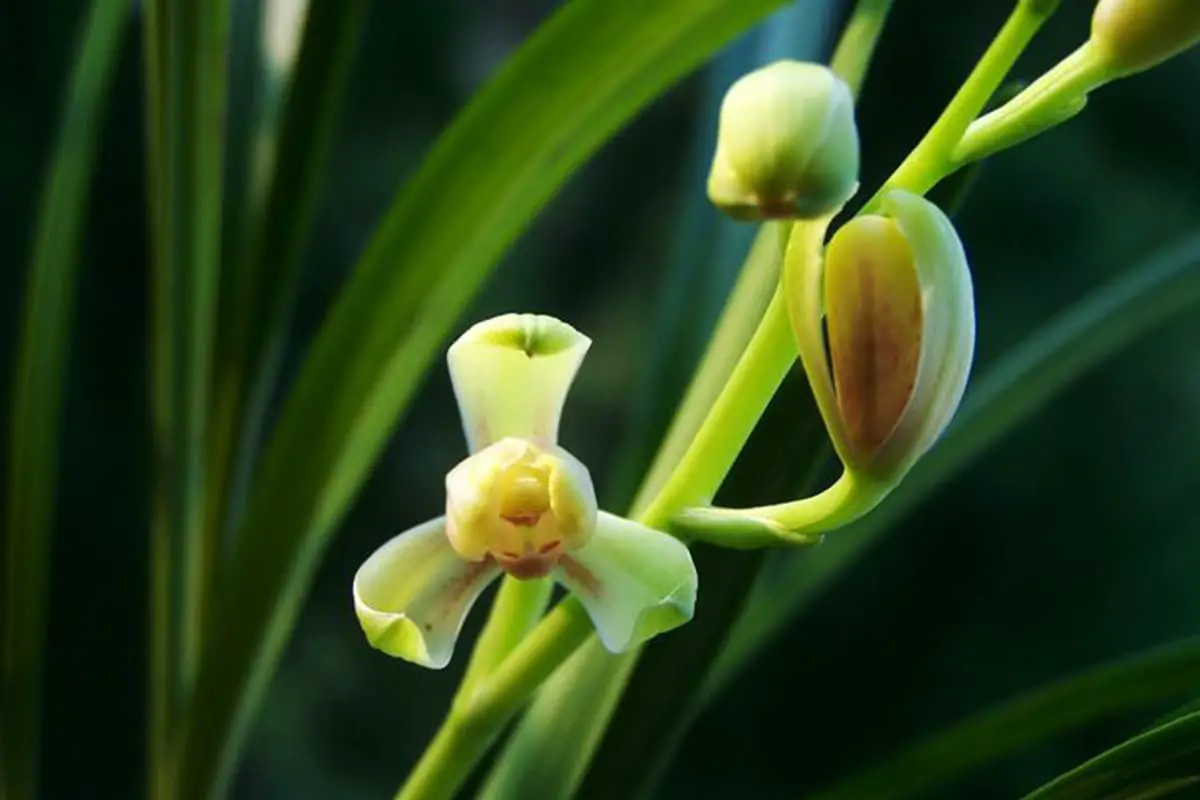
The pedicel and ovary are 2-2.5 (up to 3) cm long. The sepals are nearly narrowly oblong or narrowly elliptical, 2.3-2.8 cm long and 5-8 mm wide. The lateral sepals often spread downwards.
The petals are narrowly elliptical or narrowly ovate-elliptical, 1.5-2.4 cm long and 5-8 mm wide, nearly spreading. The lip is almost ovate, 1.5-2.3 cm long, slightly 3-lobed. The lateral lobes are erect and somewhat embrace the column, with small papillae on the upper surface.
The middle lobe is larger, ovate, outward-curving, wavy at the edges, also with small papillae. Two longitudinal pleats on the lip disc extend from the base to the base of the middle lobe, inclining inward and converging in the upper half, forming a short tube.
The column is 1-1.4 cm long, slightly bent forward, and has narrow wings on both sides. There are four pollen masses, forming two pairs, and they are broadly ovate.
The capsule is narrowly elliptical, 5-6 cm long and about 2 cm wide. The flowering period is usually from June to October.
It grows under sparse forests, in shrubs, beside valleys, or in grasses, at an altitude of 600-1800 meters. It is widely distributed in Southeast Asia and South Asia, north to Japan.
Orchids typically grow on the mountainside valley walls of deep mountain valleys, on well-draining and water-retaining sloping hillsides or in rock crevices, next to sparse mountain grasses, under the shade of secondary mixed forests.
They can also be found in places with shade, short sunlight exposure or only scattered light. They thrive in places with high air humidity and good air circulation, sometimes even on the cliffs beside mountain streams.
Orchids are best grown in an environment with good air circulation. They prefer shade, avoid direct sunlight, love moisture, and dislike dryness. The optimal growing temperature is between 15°C and 30°C. Growth is poor above 35°C.

Severe cold below 5°C can affect its vitality, at which time, the orchids often go dormant. If the temperature is too high and the sun is too strong, the leaves can get scorched or wilted within a day or two.
If the temperature is too low and they are not moved indoors in time, frostbite may occur.
Orchids have fleshy roots and are suitable for sandy loam rich in humus. It must have good drainage, so leaf mold or mountain soil rich in humus should be chosen. Slightly acidic loose soil or iron-rich soil, with a pH value of 5.5-6.5 is suitable.
Jianlan orchids are generally propagated by division, which can be done in both spring and autumn, usually every three years. Plants that are growing robustly, with dense pseudobulbs, can be divided, but each division should contain at least five pseudobulbs joined together.
Watering should be reduced before division, so the potting mix is slightly drier. When potting after division, cover the drain hole with broken tile pieces, then put coarse stones, which should occupy 1/5 to 1/4 of the pot depth, then add coarse-grained soil and a small amount of fine soil, and plant with sandy loam rich in humus.
The planting depth should just cover the pseudobulbs. Leave a 2cm edge at the rim of the pot, cover with moss or fine stones, then water thoroughly, place in the shade for 10-15 days, keep the soil moist, gradually reduce watering, and provide normal care.
White Silk Disease often occurs in the plum rain season. Pay attention to ventilation and lighting, and good drainage of the potting mix to prevent it. After the disease occurs, remove the infected soil from the pot, and sprinkle with pentachloronitrobenzene or lime.
Anthracnose can occur all year round, but is more rampant in hot and rainy seasons. In addition to improving environmental conditions, during the disease period, first spray with a 800-1500 times solution of 50% methyl tobujin wettable powder, once every 7-10 days, then complement with 1% Bordeaux mixture, once every half a month.
The whole plant (Orchid Grass): Pungent, sweet, slightly bitter, neutral. It moisturizes the lungs, stops coughs, transforms phlegm, invigorates blood, and relieves pain.
It is used for blood stasis, menstrual pain, postpartum blood stasis abdominal pain, sudden cough, tuberculosis cough, hemoptysis, kidney deficiency, rheumatic pain, dizziness, lower back pain, painful urination, and leukorrhea.
The root (Orchid Grass Root): Nourishes the yin, clears the lungs, transforms phlegm and stops cough. The flower (Orchid Grass Flower): Pungent, neutral.
It regulates qi, relaxes the middle, and brightens the eyes. It is used for chronic cough, chest tightness, diarrhea, color blindness, and cataracts.
The Orchid plant is robust, with thick and long roots. It is suitable for planting in pots of five tubes or more. Each pot has a slightly larger number of seedlings. Placed in the forest, garden, or hall, the flowers are dense and the leaves are lush, showing great vigor.
It can also be planted in larger waist-signed tube pots for a few seedlings. Over time, it becomes green and erect, very spirited. The flowers bloom in the midsummer, and the cool wind blows the orchid fragrance, making people feel serene.
The cultivation history of the Orchid is long, with many varieties. It is very common in the southern part of our country. It is an excellent furnishing for balconies, living rooms, flower racks, and small courtyard steps, showing freshness and elegance.

Peggie was once a high school mathematics teacher, but she set aside her chalkboard and textbooks to follow her lifelong passion for flowers. After years of dedication and learning, she not only established a thriving flower shop but also founded this blog, “Flowers Library”. If you have any questions or wish to learn more about flowers, feel free to contact Peggie.
 English
  العربية
  Bahasa Indonesia
  Deutsch
  Français
  Italiano
  Nederlands
  Português
  Русский
  日本語
日本語