600+ Types of Flowers A To Z (With Names and Pictures)
Types Of Flowers By Names (A-Z) Types Of Flowers By Color Types Of Flowers By Season Types Of Flowers By Blooming Time 600+ Types of Flowers No. Flower Name No.…

The Crocosmia crocosmiflora, also known as the Montbretia, is a hybrid of the genus, resulting from a cross between the Parker’s Montbretia and the Yellow Montbretia. Native to southern Africa, this plant thrives in abundant sunlight and is frost resistant.
The Montbretia comes in three colors: red, orange, and yellow, with the orange variant undoubtedly being the most visually striking.
The blossoms are arranged in slightly curved, spike-like clusters that emerge from the verdant foliage in a pleasingly scattered fashion, their orange-red hue undulating in the wind like waves of wheat – a sight that is truly captivating.
This plant is highly heat-tolerant and continues to bloom even throughout the quiet floral period of midsummer. With its high ornamental value, the Montbretia is an excellent choice for decorating flower beds and gardens, and it also makes a great cut-flower material.
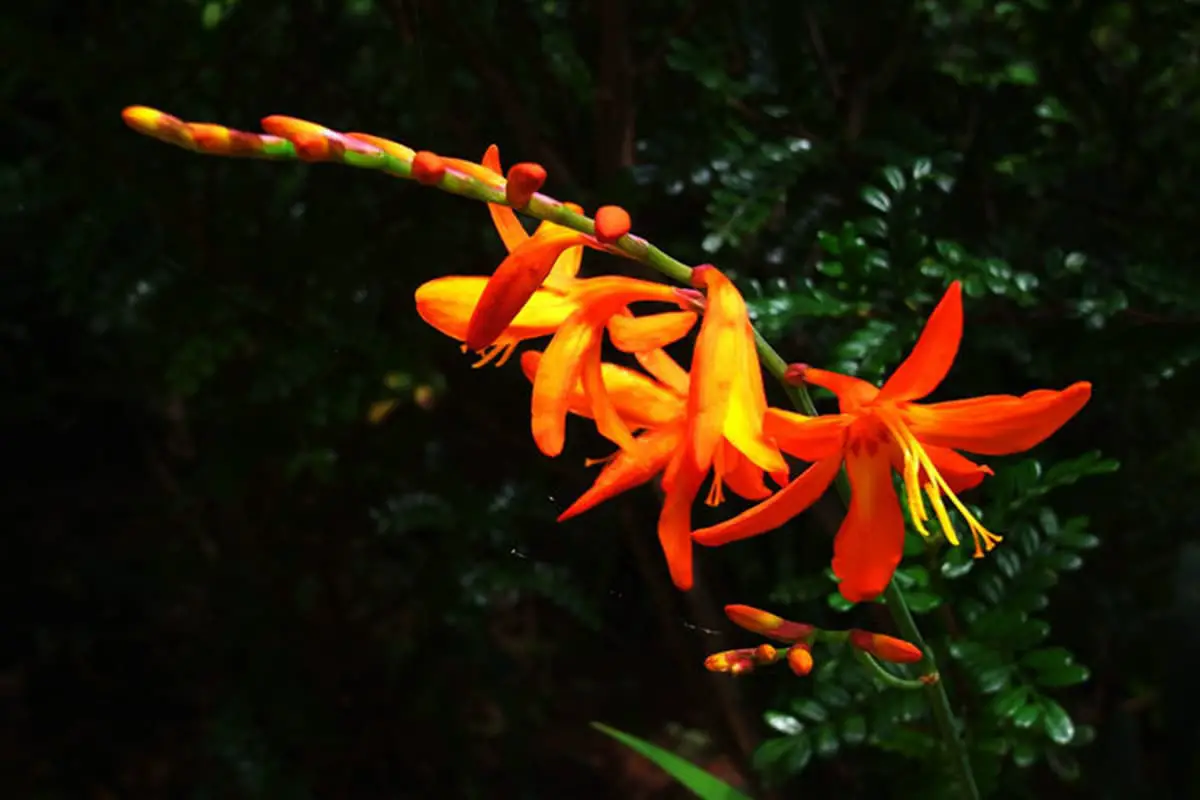
The Montbretia is a member of the Iris family. Its flowers are arranged in slightly curved, cone-shaped clusters that extend out from the green foliage in an irregular yet orderly fashion.
Resistant to extreme heat, it blooms incessantly during midsummer and is suitable for decorating flower beds, gardens, and as cut-flower material. It is a plant of high ornamental value.
Habit: Prefers abundant sunlight and is frost resistant. In the middle and lower reaches of the Yangtze River, the bulbs can overwinter outdoors. It grows best in well-drained, loose, fertile sandy loam soil and requires sufficient soil moisture during the growing period.
Region: Native to South Africa.

The Montbretia is a perennial herb with bulbs and creeping stems. The bulbs are flat-round, similar to water chestnuts, and covered with brown fibrous membranes. The aerial stem is about 50 cm high and often branches.
The leaves are linear-lanceolate and grow from the base of the stem with leaf sheaths. The flowers are numerous, arranged in compound conical clusters that protrude from the green foliage in a scattered and orderly fashion.
The funnel-shaped flowers are orange-red, with horticultural varieties in red, orange, and yellow. The perianth is thin and slightly curved, with expanding lobes. The fruit is a capsule containing several seeds.
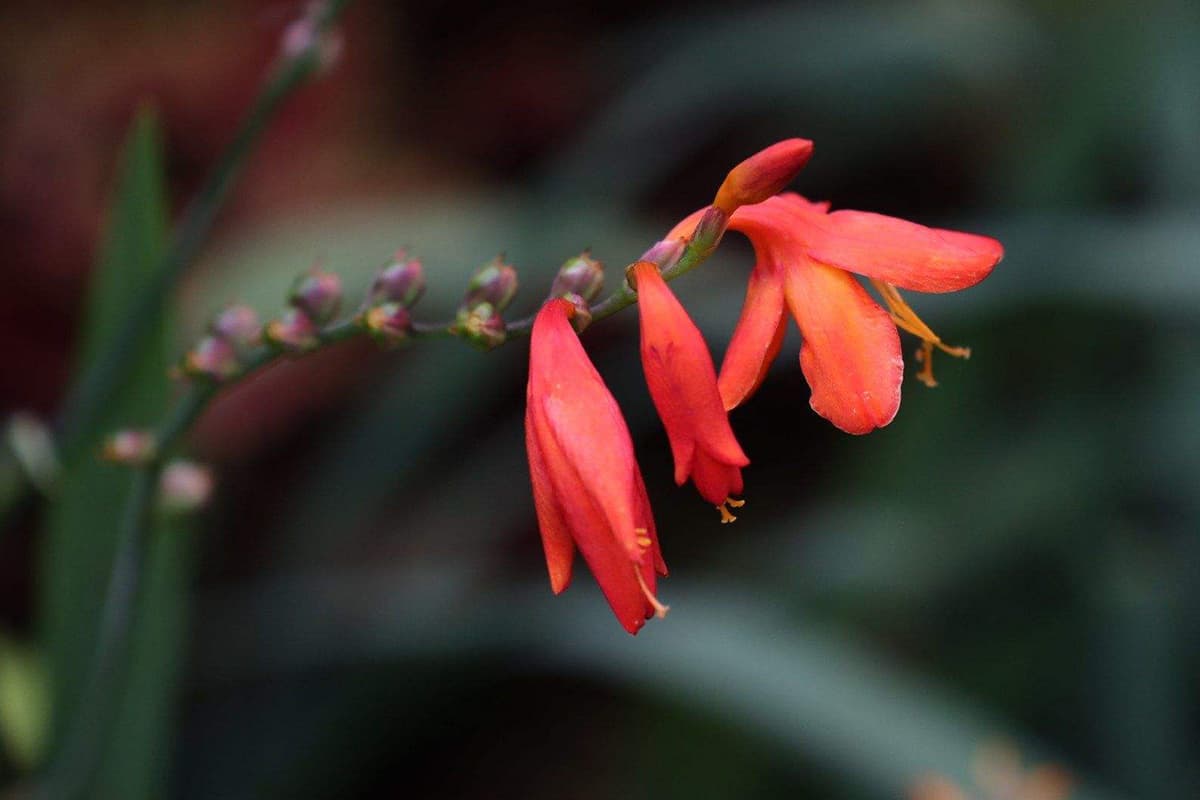
Due to the extension of the creeping stems, the plant has strong vining ability. Before planting, the soil should be thoroughly plowed, sufficient base fertilizer applied, and elevated beds formed. The depth of planting should be 3-5 centimeters.
Generally, the bulbs bloom from June to August of the same year, while the smaller bulbs bloom in the following year.
The main diseases are spot disease and spider mite damage. Spot disease can be sprayed with a solution of 75% Bacillus subtilis wettable powder diluted 700 times. Spider mites can be sprayed with a solution of 40% trichlorfon emulsion oil diluted 1000 times.
Mars flowers come in three colors: red, orange, and yellow. They are heat-resistant and bloom continuously during the midsummer season, making them excellent choices for floral arrangements, flower beds, and cut flowers.
They are also suitable for large-scale planting on street green islands, in front of buildings, on lawns, by lakes, etc., and can also be used as cut flowers.

The natural propagation ability of Mars flower bulbs is strong, and they are often propagated by bulb division. Generally, bulbs are divided once every three years, and the bulbs are dug up before the new buds sprout in the spring, and then the divided bulbs are planted.
Due to the elongation of the creeping stems, the plant has strong vining ability. Before planting, the soil should be thoroughly plowed, sufficient base fertilizer applied, and elevated beds formed. The depth of planting should be 3-5 centimeters. Bulbs.
Generally, the bulbs bloom from June to August of the same year, while the smaller bulbs bloom in the following year.

Mars flowers arrange themselves into slightly curved spike inflorescences, with varying heights and densities of orange-red flowers emerging from the green onion leaves. The waving of the bright red flower spikes in the wind is very appealing.
Mars flowers are heat-resistant and continuously bloom during the midsummer when other flowers are silent. They are very natural and appropriate for decorating flower beds, flower landscapes, and rock gardens.
If planted in large areas under forests, in gaps, and on sunny slopes, the scenery is very spectacular. Mars flowers can also be potted or used as cut flowers. Mars flowers bloom from bottom to top.
When cutting flowers, choose branches with several blooming flowers at the base. With proper care, Mars flowers can be water-inserted for 1-2 weeks, and the leaves can last even longer.


Peggie was once a high school mathematics teacher, but she set aside her chalkboard and textbooks to follow her lifelong passion for flowers. After years of dedication and learning, she not only established a thriving flower shop but also founded this blog, “Flowers Library”. If you have any questions or wish to learn more about flowers, feel free to contact Peggie.
 English
  العربية
  Bahasa Indonesia
  Deutsch
  Français
  Italiano
  Nederlands
  Português
  Русский
  日本語
日本語