600+ Types of Flowers A To Z (With Names and Pictures)
Types Of Flowers By Names (A-Z) Types Of Flowers By Color Types Of Flowers By Season Types Of Flowers By Blooming Time 600+ Types of Flowers No. Flower Name No.…

The Corpse Flower, scientifically known as Rafflesia, encompasses 20 species of parasitic flowering plants within the family Rafflesiaceae. Contrary to the common misconception, it is not a saprophytic plant but rather a holoparasite, completely dependent on its host for nutrients.
Rafflesia is renowned for producing the largest individual flower in the world, with Rafflesia arnoldii holding the record for a bloom measuring up to 1 meter (3.3 feet) in diameter and weighing up to 11 kilograms (24 pounds).
Distinctive characteristics of Rafflesia include its enormous flower, absence of true leaves, stems, and roots, and its notorious carrion-like odor. The plant’s vegetative body is reduced to thread-like structures that grow within the tissues of its host, typically vines of the genus Tetrastigma.
When not in bloom, Rafflesia is virtually undetectable, emerging only to flower. The flower’s putrid scent, reminiscent of decaying flesh, serves to attract carrion flies and beetles for pollination. Rafflesia species are endemic to the tropical rainforests of Southeast Asia, particularly in Indonesia, Malaysia, Thailand, and the Philippines.
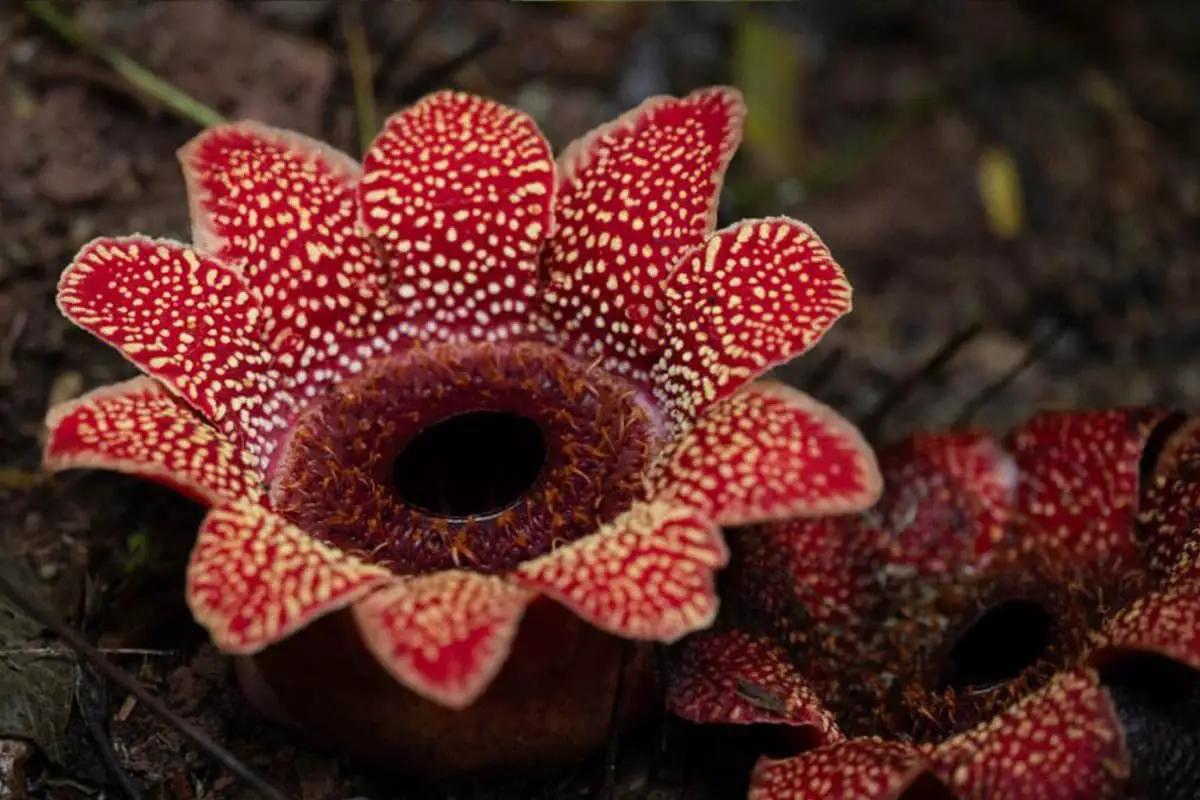
Rafflesia can initiate flower bud development at any time of the year, given the relatively constant climate of its tropical habitat. However, the main flowering period typically occurs from May to October. The flower bud emerges from the host plant as a small, cabbage-like structure, initially about the size of a golf ball.
Over several months, the bud slowly enlarges, eventually reaching the size of a large cabbage. The five fleshy petals (technically perigone lobes) then gradually unfurl over a period of about 24 to 48 hours to reveal the fully open flower.
The bloom’s lifespan is remarkably brief, lasting only 5 to 7 days. During this period, the flower emits its characteristic foul odor, which is most intense during the first two days of blooming. This scent, often compared to rotting meat, effectively attracts carrion flies and beetles while repelling most other animals and insects.
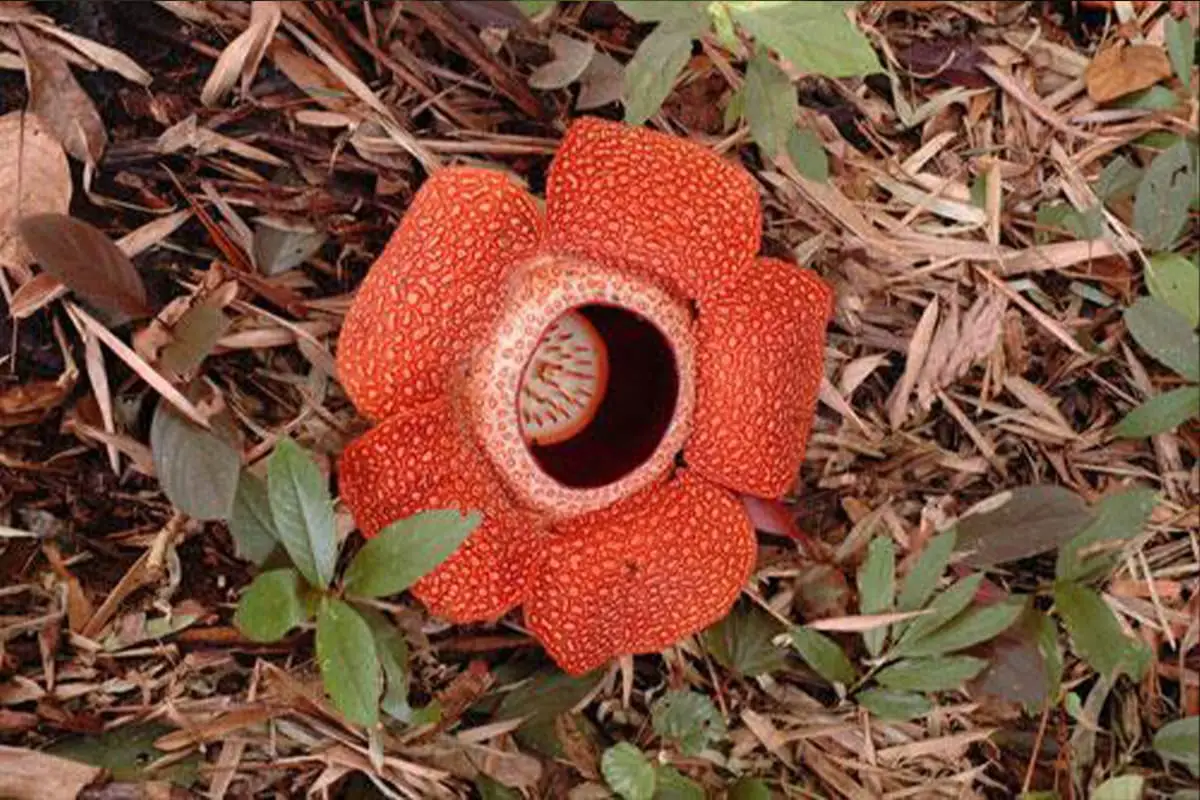
As the flower withers, the petals darken and decompose into a blackened mass. If successfully pollinated, the ovary develops into a large, berry-like fruit over the following 6 to 8 months. This fruit contains numerous tiny seeds, which are dispersed by small mammals and possibly rainwater.
Rafflesia plants are dioecious, meaning individual flowers are either male or female. Each plant typically produces only one flower in its lifetime, although rare instances of multiple blooms have been observed. The flowers’ gender cannot be determined until they open.
The pollination process is complex and not fully understood. While flies and beetles are attracted by the scent, squirrels and tree shrews have also been observed visiting Rafflesia flowers, potentially aiding in pollination as they move between blooms seeking nectar from the central disk.
After pollination, the female flowers develop into large, spherical fruits approximately 15 centimeters in diameter. These fruits have a woody, brown exterior and contain a fleshy interior filled with thousands of minute seeds. The fruit’s flesh is rich in lipids, which may aid in seed dispersal by attracting animals.
The extraordinary life cycle of Rafflesia, from its parasitic growth to its brief but spectacular flowering, represents one of the most unique and specialized adaptations in the plant kingdom.

The Corpse Flower, or Rafflesia, is native to the tropical rainforests of Southeast Asia, specifically thriving in Indonesia, Malaysia, Thailand, and the Philippines. It is predominantly found on the Malay Peninsula, Sumatra, Borneo, and the Philippines, typically growing at altitudes between 500 to 700 meters above sea level.
The Corpse Flower (Rafflesia) is a remarkable parasitic plant, not a carnivorous “man-eating plant” as sometimes misperceived. It lacks typical plant structures such as leaves, stems, or roots. Instead, its vegetative body is reduced to thread-like structures (haustoria) that penetrate the host plant’s tissues, usually vines of the genus Tetrastigma.
The most distinctive feature of Rafflesia is its enormous flower, which can reach up to 1 meter in diameter. The largest known species, Rafflesia arnoldii, found in Sumatra, can produce flowers up to 1.5 meters across and weighing up to 11 kg, making it the largest individual flower in the world.
The flower structure resembles a large, fleshy, wide-mouthed jar. It typically has five thick, leathery petals that are reddish-brown with white or yellowish spots or warts. The center of the flower contains a deep bowl-like structure called the diaphragm, which can hold up to 6 liters of liquid.
Rafflesia is dioecious, meaning individual plants are either male or female. The flowers are unisexual, with male and female flowers on separate plants. The male flowers have a central column (column of stamens) that produces pollen, while female flowers have a stigma to receive pollen.
The development of a Rafflesia flower is a slow process. It begins as a small bud that emerges from the host plant’s tissue. This bud grows over several months, eventually reaching the size of a cabbage before blooming. The flowering process itself takes about a week, with the flower remaining fully open for only a few days.
Rafflesia reproduction is complex and not fully understood. The tiny seeds are sticky and are thought to be dispersed by small mammals or insects that visit the flowers. Some researchers suggest that larger animals like elephants or wild pigs might play a role in seed dispersal by stepping on ripe fruits and carrying seeds on their feet.
Pollination is another challenge for Rafflesia. The flowers emit a strong odor resembling rotting flesh, which attracts carrion flies. These flies are believed to be the primary pollinators, transferring pollen from male to female flowers.
Rafflesia species are facing significant threats due to habitat loss and fragmentation. The conversion of tropical rainforests for agriculture, logging, and urban development has drastically reduced suitable habitats for both Rafflesia and its host plants.
The plant’s complex life cycle and specific habitat requirements make it particularly vulnerable to environmental changes. Moreover, its rarity and uniqueness have made it a target for illegal collection, further threatening wild populations.
Many Rafflesia species are critically endangered. For example, Rafflesia magnifica is listed as Critically Endangered (CR) on the IUCN Red List. Conservation efforts are underway in several countries:
Despite these efforts, the future of Rafflesia remains precarious. Continued habitat protection, research, and conservation initiatives are crucial for ensuring the survival of these extraordinary flowers.

Peggie was once a high school mathematics teacher, but she set aside her chalkboard and textbooks to follow her lifelong passion for flowers. After years of dedication and learning, she not only established a thriving flower shop but also founded this blog, “Flowers Library”. If you have any questions or wish to learn more about flowers, feel free to contact Peggie.
 English
  العربية
  Bahasa Indonesia
  Deutsch
  Français
  Italiano
  Nederlands
  Português
  Русский
  日本語
日本語