Chlorophytum comosum, also known as Spider Plant, Hanging Basket Plant, or Reverse Hanging Orchid, is a perennial evergreen herbaceous plant in the monocot class, lily family, and chlorophytum genus.
The spider plant’s leaves are tufted, linear, and slender, similar to an orchid, making it a common ornamental plant. However, with proper care, it will also bloom. The flower stems sprout from the leaf tufts and grow into stolons, from which clusters of leaves emerge.
The flowers are small and white, typically blooming in clusters of two to four in spring, around May. The spider plant comes in a variety of types, such as spider plants, purple spider plants, flower spider plants, gold-edged spider plants, and silver-edged spider plants.
Basic Information
The Spider Plant is also known as Hanging Basket Plant, Hanging Orchid, Fishing Orchid, Orchid Grass, Crane Orchid, Air Guardian. It’s referred to as Spider Grass or Airplane Plant in Western Europe and is native to South Africa.
It’s a perennial evergreen herbaceous plant in the monocot class, Asparagaceae family, and chlorophytum genus, with horizontal or oblique rhizomes and numerous thick roots.
The leaves are tufted, linear, slender, and similar to orchids, sometimes with green or yellow stripes. The flower stems sprout from the leaf tufts, forming clusters of leaves at the ends of the stolons. The flowers are white, typically in clusters of two to four, arranged in sparse panicles or racemes, and occasionally, purple petals may appear internally.
The capsule fruit is trigonous and flat, about 5mm long and 8mm wide, each compartment contains 3-5 seeds. The flowering period is in May, with fruiting in August. The plant is known for its air-purifying capabilities, and the entire plant can be used for medicinal purposes.
Introduction to Spider Plant Varieties
There are numerous types of Spider Plants, each with a unique appearance and characteristics. The most common varieties are the Spider Plant, Purple Spider Plant, Flower Spider Plant, Gold Leaf Spider Plant, and Silver Edge Spider Plant.
Spider Plant: The stems and leaves are inseparable, with the leaves hanging down. The leaves are deep green, and it blooms in June and July each year, with flowers in pale yellow and white.
Purple Spider Plant: The stems form nodes, each node produces leaves, and the leaf stalks are all purple-red. The leaves are thick and glossy, all hanging downwards. It blooms from June to October each year, with pink flowers.
Flower Spider Plant: The stems become creeping, with hanging branches and leaves. The leaves are peach-shaped, with golden patterns along the edges, which pass through the center of the leaf veins. The back of the leaves is purple and shiny.
Gold Leaf Spider Plant: There are yellow stripes surrounding the green leaves.
Silver Edge Spider Plant: The green leaves are edged with white, making them even more vibrant.
Morphology and Features
The rootstock is short and the roots are slightly thick. The leaves are sword-shaped, 10-30 cm long, 1-2 cm wide, and slightly narrower towards the ends.
The Spider Plant is a perennial herbaceous plant, with its leaves growing from the base. The leaves are linear to lanceolate, slender, flexible and orchid-like. The plant’s most distinguishing feature is the periodic growth of stolons from mature plants.
The stolons are 30-60 cm long, with small plants and flower stems sprouting from their ends, which are often longer than the leaves, sometimes reaching up to 50 cm. They often turn into creeping branches with leaf clusters or small plants near the ends.
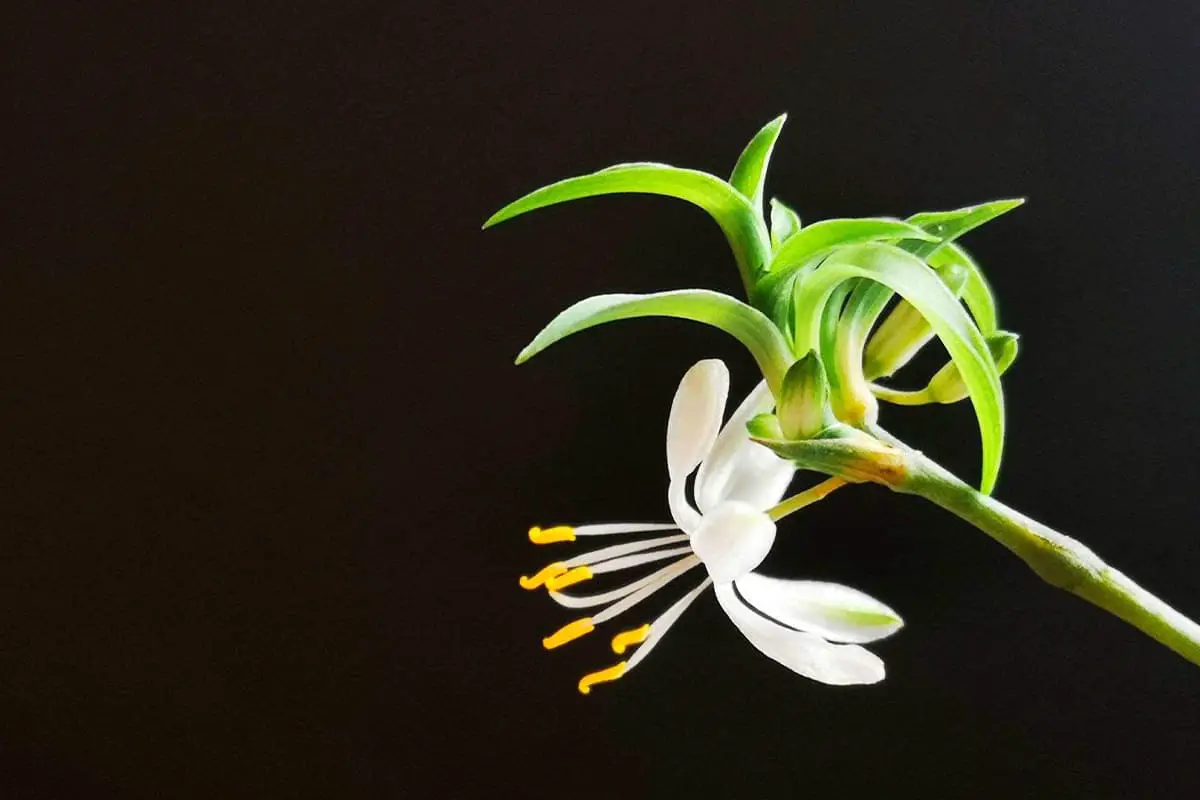
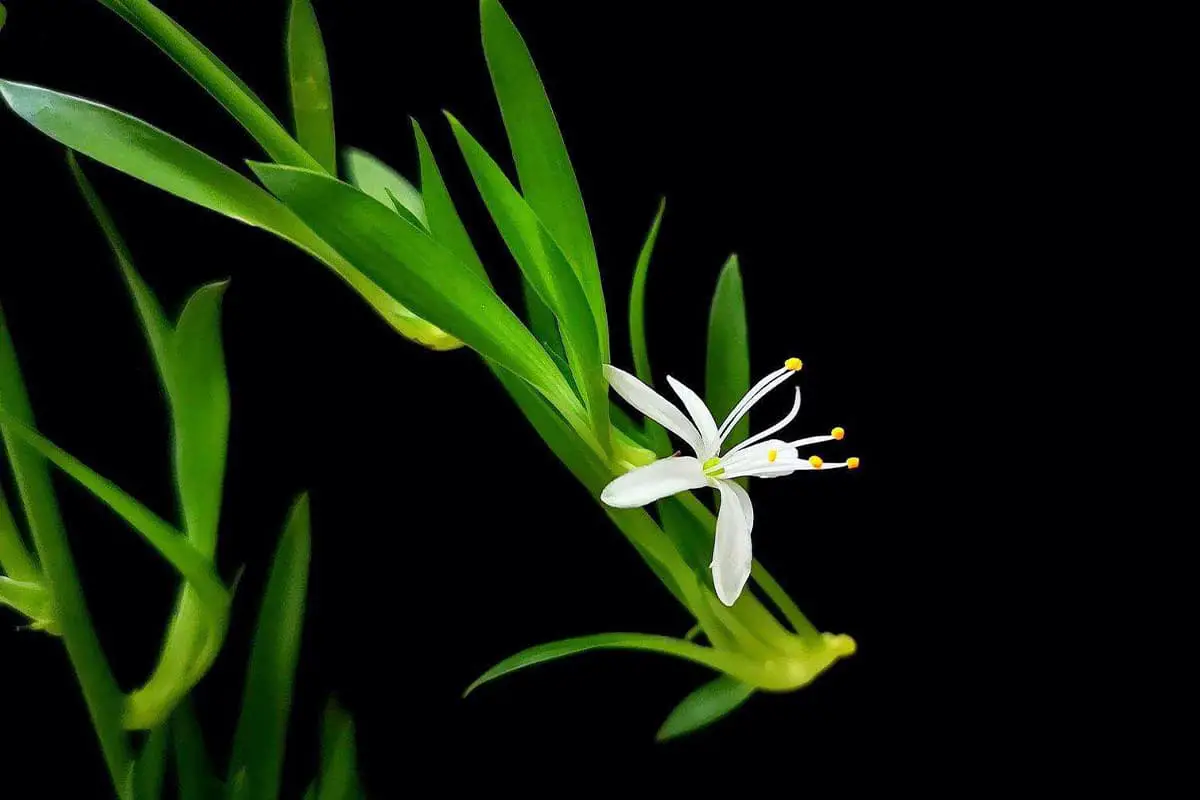
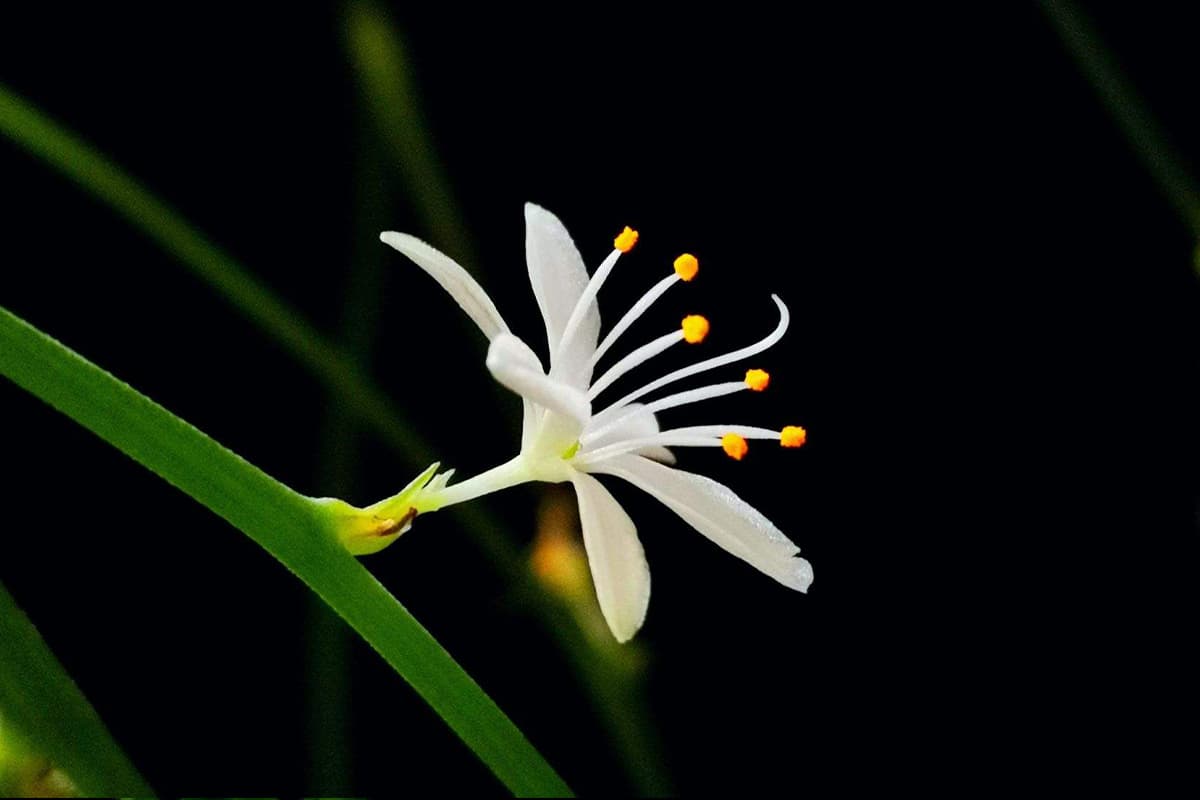
The flowers are white, typically in clusters of two to four, arranged in sparse panicles or racemes. The pedicels are 7-12 mm long, with a joint in the middle to upper part.
The tepals are 7-10 mm long with three veins, and the stamens are slightly shorter than the tepals. The anthers are rectangular, 1-1.5 mm long, noticeably shorter than the filaments, and often curled after splitting.
The capsule fruit is trigonous and flat, about 5 mm long and 8 mm wide, each compartment contains 3-5 seeds. The flowering period is in May, with fruiting in August.
Habits
Spider Plants prefer warm, moist, semi-shaded environments. They are highly adaptable, drought-resistant, but not frost-tolerant. They can grow in a variety of soils, but they thrive in well-drained, loose, and fertile sandy soil. They do not require strict light conditions and generally grow well under medium light conditions, but they can also tolerate low light.
The ideal growing temperature is 15-25°C, with a wintering temperature of 5°C. They grow fastest at temperatures between 20-24°C, and easily produce stolons. They stop growing above 30°C, and the leaves often turn yellow and dry at the tips.
In winter, if the room temperature is maintained above 12°C, the plants can grow normally and bloom; if the temperature is too low, growth slows or becomes dormant; if it falls below 5°C, they can suffer from frost damage.
How to Care for Spider Plants
Substrate Requirements
Spider Plants have a strong ability to adapt to various soils and are easy to cultivate. They can be potted in fertile sandy loam, peat, peat soil, or fine sandy soil with a small amount of base fertilizer.
Containers
Any container that can hold water can be used to grow Spider Plants hydroponically. It’s best to use transparent vessels for hydroponics so you can admire the dazzling white root system. Glass wine glasses, tea cups, and mineral water bottles that you have around can serve as economical and attractive containers for growing Spider Plants hydroponically.
The container for hydroponically grown Spider Plants can be single-layered or double-layered. Single-layer containers directly plant the Spider Plant in glass or plastic bottles without bottom holes.
Double-layer containers use a plastic sieve as the top layer and a bottle with no holes as the bottom layer. The Spider Plant is planted in the plastic sieve in the top layer, allowing the roots of the Spider Plant to extend into the bottom layer.
Placement
Usually, the plant is placed in rooms facing north where there are fewer windows to eliminate the sense of cold with some potted plants. As there is less sunlight, shade-loving plants should be chosen. The kitchen is a room with frequent activities and scattered items, with more smoke and high temperatures, so it is not suitable for large potted plants, but hanging pots are more appropriate.
Among them, the Spider Plant is ideal. Placing a Spider Plant in the room can absorb harmful gases such as carbon monoxide, carbon dioxide, sulfur dioxide, nitrogen oxides, etc., within 24 hours, acting as an air filter.
Maintenance and Management
Lighting
Spider Plants prefer semi-shady environments. In spring and autumn, they should avoid direct exposure to strong sunlight. In summer when the sunlight is particularly strong, they can only get some oblique light in the early morning and evening, and during the day they need to shade 50%-70% of the sunlight, otherwise, the leaf tips will dry up.
Especially for variegated varieties, they are more afraid of strong sunlight. The golden-edged Spider Plant will grow more beautifully in places with weak light, the yellow golden edge is more obvious, and the leaves are more shiny. However, in winter, they should get more sunlight to keep the leaves tender and fresh.
If you are growing a Spider Plant at home, it should be placed in front of a south-facing window, otherwise, the leaves will lose their luster and even wilt. If conditions permit, it’s best to turn the flower pot about 15° in a fixed direction every week to ensure the same degree of drooping of the Spider Plant.
Watering
Spider Plants like a humid environment, and the pot soil can often be kept moist. In summer, watering should be sufficient, and water should also be sprayed on the branches and leaves around noon and in the evening to clean the dust on the leaves in time to prevent the leaves from drying out.
However, the fleshy roots of Spider Plants can store a large amount of water, so they have strong drought resistance and won’t die if they are not watered for several days. In winter, when the temperature is below 5°C, water less and do not over-wet the pot soil, otherwise the leaves will easily turn yellow.
Fertilization
Spider Plants are leaf-viewing plants that are quite tolerant of fertilizer. If they lack fertilizer, they can easily become scorched, the leaves turn yellow, and lose their ornamental value.
From late spring to early autumn, you can apply organic liquid fertilizer every 7-10 days. However, for variegated varieties like the golden-edged or golden-centered, nitrogen fertilizer should be applied less to avoid fading or even disappearance of the variegated color, affecting the appearance.
You can appropriately use organic fertilizers made from bone meal, eggshells, etc. After full fermentation, take an appropriate amount of diluted liquid and apply it every 10-15 days, which can make the leaves bright and beautiful.
During the growing season, apply liquid fertilizer every two weeks. Variegated varieties should have less nitrogen fertilizer, otherwise, the white or yellow markings on the leaves will become less obvious. Stop fertilizing when the ambient temperature is below 4°C.
Pruning
Yellow leaves should be cut off at any time. In March of each year, you can repot the plant once, cutting off old roots, rotten roots, and excess aerial roots. In early to mid-May, some old leaves of the Spider Plant can be cut off to stimulate the growth of more new leaves and smaller Spider Plants. The root system of the Spider Plant is quite developed.
After a period of cultivation, the flower pot should be replaced in time to prevent root accumulation, which can cause the Spider Plant to yellow and wilt.
Propagation Methods
Spider Plants can be propagated by methods such as cutting, dividing, and seeding.
Cutting Method
Cutting propagation of Spider Plants can be carried out anytime from spring to autumn. Cut the cluster stems and leaves on the stolon of the Spider Plant (which is actually a new plant seedling, with leaves on the top and aerial roots on the bottom), and plant it directly into the flower pot for cultivation, watering it thoroughly and placing it in a cool place for maintenance.
When cutting, be careful not to bury it too deep, otherwise, it can rot. When potting Spider Plants, the number of cuttings depends on the size of the pot. Generally, 2-3 plants can be cut for a small pot, about 3 for a medium pot, and up to 5-6 for a large pot.
Division Method
When dividing Spider Plants, you can lift the plant out of the pot, remove the old soil and rotten roots, cut the old roots, and leave three stems on each divided plant, then transplant them separately for cultivation. You can also cut the cluster stems and leaves on the stolon of the Spider Plant and plant them directly into the flower pot for cultivation.
Seeding Method
Seed propagation of Spider Plants can be done in March each year. Because the seeds are not large, the soil covering the seeds should not be thick, generally 0.5 cm is enough.
At a temperature of 15°C, the seeds can germinate in about 2 weeks, and they can be transplanted for cultivation after the seedlings take shape. When the variegated varieties are propagated by seeds, the offspring will degenerate into all-green varieties.
Pest and Disease Control
Spider Plants have few pests and diseases, mainly physiological diseases. The front end of the leaves turns yellow. Water accumulation in the pot soil and poor ventilation can cause root rot, and root rot may also occur, so fertilization and water management should be strengthened.
Scale Insects
Regularly check and timely wipe off the scale insects on the leaves.
Control method: According to the various occurrences of scale insects, spray pesticides during the peak period of nymphs. At this time, most of the nymphs have just hatched, their body surfaces have not yet secreted wax, and the scale has not formed, so it is easy to kill with medication.
Spray once every 7-10 days, continuously 2-3 times. You can use 40% Oxidized Regent 1000 times liquid, or 50% Malathion 1500 times liquid, or 255 Amiton 1000 times liquid, or 50% Dimethoate 1000 times liquid, or 2.5% Cypermethrin 3000 times liquid, spray.
Mealybugs
Control method: Use Polyram Wettable Powder 500-800 times solution to irrigate the roots, once a week, continuous use for 2-3 times can be effective.
Aphids
Aphids in the spring are a common pest, and should be removed promptly.
Control method: Spray with a 1500 times solution of Oxidized Regent to kill them.
Mites
Mites in summer and autumn are next, and they need to be killed with a 1000 times solution of Trichloromethiazide. Pay attention to ventilation and increase leaf humidity to reduce mite infections.
Root Rot
Control method: For prevention, use wettable powder at a rate of 2-4 grams per square meter to irrigate the roots, or use a 1500-3000 times solution to irrigate the roots before or at the onset of the disease, with 200 milliliters of solution per plant. If the disease is severe, remove the diseased plants and use root solidification to irrigate the roots at the same time.
Leaf Browning
More than 20 days after the Spider Plant is brought indoors, abnormal symptoms such as yellowing and browning of the leaves may appear, possibly due to late entry into the room and the characteristics of cold damage to its leaves caused by low temperatures.
Spider Plants like warm, humid and semi-shaded environments, are not cold-resistant, are less cold-resistant than general green leaf Spider Plants, are afraid of high temperatures and strong sunlight, and also cannot tolerate drought, salinity and waterlogging. Its suitable growth temperature is 13-28°C, and the winter environment temperature should not be lower than 7°C.
After the frost falls, the morning temperature may already be close to 4°C. Such temperature conditions will bring obvious cold damage to the Spider Plant.
Although it did not show up immediately at the time, after moving indoors, due to insufficient light, dry air, high room temperature, poor ventilation, etc., the Spider Plant that has been cold-damaged will inevitably show yellowing green stripes on the leaves and browning edges.
However, as long as its fleshy root system has not rotted and died due to cold damage, etc., moving it to a bright place, controlling pot soil watering, increasing leaf surface spraying, changing the pot before going out next spring; at the same time, pruning dead leaves, strengthening water and fertilizer management, the plant can quickly recover its vigorous growth.
Leaf Tip Drying
For Spider Plants grown in pots at home, under normal circumstances, it is easy to see the drying of leaf tips and the gradual loss of leaf gloss. To properly care for and manage the Spider Plant, the following measures need to be taken.
Changing Soil and Pots
In the management of potted Spider Plants, in order to promote vigorous growth of stems and leaves, the soil and pots should be changed once in March each year. If the pot is deep and the base fertilizer is sufficient, the pot can be changed once every two years.
When changing pots, knock the plants out of the pot, cut off the decayed roots and excess root system, replace them with new culture soil rich in humus, and then apply livestock hoof and horn pieces or rotten cake fertilizer as base fertilizer.
After planting, place it in a semi-shaded warm place for seedling recovery. The suitable growth temperature for Spider Plants is about 25°C. After the plant recovers to robust growth, hang the flower pot under the porch eaves or an appropriate indoor location. The general height should be such that it does not touch the head, and ventilation should be noted.
Dead leaves and yellow leaves at the bottom should be removed at any time, and when the leaf tips turn yellow, use scissors to diagonally cut off the yellow head. Normally, maintain normal humidity, not too dry, and not too wet.
Value and Others
Functions of Spider Plant
Medicinal
Herbal source: Whole plant or root of the Asparagaceae plant, Spider Plant.
Harvest and storage: It can be harvested throughout the year, and should be washed for fresh use.
Taste: Sweet; slightly bitter; cool nature.
Indications: Transform phlegm, stop coughing; disperse stasis, reduce swelling. It is used for phlegm-heat cough, trauma, fractures, abscesses, hemorrhoids, and burns. It can also be used for high fever in children, lung-heat cough, hemoptysis, trauma and swelling.
Ornamental
Spider Plant is a perennial herbaceous plant with slender, drooping branches. It produces small white flowers in summer or other high-temperature seasons. The flowers are concentrated at the ends of the drooping branches. The stamens are yellow, and the inner tender leaves are sometimes purple, suitable for potted ornamental purposes.
Purifying Environment
Spider Plants are easy to breed, highly adaptable, and are one of the traditional hanging plants in living rooms. Its leaves are long and soft, and small plants sprout from the axils of the leaves. They droop down from the edge of the pot, spreading out like a flower, and are evergreen throughout the year.
Spider plants can perform photosynthesis in weak light and can absorb more than 80% of harmful gases indoors. They are very good at absorbing formaldehyde. A general room with 1-2 potted Spider plants can absorb an amount of formaldehyde equivalent to the adsorption of 10g of coconut shell activated carbon, which can absorb almost all the toxic gases in the air.
A pot of Spider plant in a room of 8-10 square meters is equivalent to an air purifier. Because newly decorated houses continue to release harmful gases such as formaldehyde, environmental protection experts suggest that ventilation should be maintained after decoration, and a few pots of Spider plants and other green plants should be grown. This way, the new house can basically meet the occupancy standard after being vacant for three to six months.
Spider plants can also absorb almost all the carbon monoxide and nitrogen dioxide emitted by stoves, electrical appliances, and plastic products, decompose benzene, absorb stable harmful substances such as nicotine in cigarette smoke, hence Spider plants also have the beautiful name of “air guardians”.
Nanoadsorption: The pore diameter of the pore is between 0.27-0.98 nanometers and is arranged in a crystal form. At the same time, it has weak electrical properties.
The molecular diameters of formaldehyde, ammonia, benzene, toluene, and xylene are all between 0.4-0.62 nanometers, and they are all polar molecules. They have the characteristics of preferentially adsorbing harmful gases such as formaldehyde, benzene, and TVOC, achieving the effect of purifying indoor air.
The flower language of the Spider plant is “helplessness and yet giving people hope.
This comes from a legend that there was a jealous chief examiner who, in order to make his godson top the list, was determined to suppress a talented man surnamed Lin. When correcting Lin Dexiang’s papers, he happened to meet the emperor visiting incognito.
The chief examiner hurriedly hid the papers in the lush orchid pot on his desk. The emperor, who was fond of this beautiful pot, inadvertently saw and learned the truth. The ending everyone can guess, not only did he lose his official position, but the emperor also “gifted” him that pot of flowers.
The chief examiner was both embarrassed and annoyed, depressed, and soon died. Since then, the stems and leaves of this kind of orchid have never straightened up again, and gradually evolved into today’s Spider plants, and its flower language also derives from its meaning.
Share
Facebook
Twitter
LinkedIn
Email
Share is Caring.
Peggie
Founder of FlowersLib
Peggie was once a high school mathematics teacher, but she set aside her chalkboard and textbooks to follow her lifelong passion for flowers. After years of dedication and learning, she not only established a thriving flower shop but also founded this blog, “Flowers Library”. If you have any questions or wish to learn more about flowers, feel free to contact Peggie.
Before you go
You May Also Like
We picked them just for you. Keep reading and learn more!
The Crinum asiaticum, commonly known as Giant Crinum Lily, Spider Lily, or Grand Crinum Lily, is a magnificent member of the Amaryllidaceae family. This robust perennial herb, despite its misleading…
Jasmine, a beloved ornamental flower, has captivated gardeners and enthusiasts for centuries. Originally native to tropical and subtropical regions of Asia, particularly Persia (modern-day Iran), jasmine was introduced to many…
Prunus persica, commonly known as the White Peach Blossom, is a cultivar of the peach tree that belongs to the Rosaceae family. It typically comes in two varieties: the Large-Flowered…
The Cerasus subhirtella, commonly known as the Winter-flowering Cherry or Higan Cherry, is a magnificent sight when in bloom. This deciduous tree, belonging to the Rosaceae family, creates a breathtaking…
1. Tabebuia Chrysantha Tabebuia chrysantha, commonly known as the Golden Trumpet Tree or Yellow Poui, is a striking deciduous tree belonging to the Bignoniaceae family. This ornamental species is characterized…
Carnations, with over 2,000 years of cultivation history in Europe, are among the most widely used flowers in the world. Their popularity stems from their long-lasting blooms, diverse color range,…
The rose, a deciduous shrub belonging to the Rosales order, Rosaceae family, and Rosa genus, is one of the most beloved flowers worldwide. Thriving in sunlight, roses are characterized by…
Consolida ajacis, commonly known as rocket larkspur, is an annual herbaceous plant belonging to the Ranunculaceae family and Consolida genus. It is renowned for its striking flower spikes that resemble…
Cymbidium tortisepalum Fukuyama is a distinguished member of the Orchidaceae family and Cymbidium genus. This elegant orchid species is characterized by its slender, linear form with soft, slightly leathery leaves…


 English
  العربية
  Bahasa Indonesia
  Deutsch
  Français
  Italiano
  Nederlands
  Português
  Русский
  日本語
日本語