600+ Types of Flowers A To Z (With Names and Pictures)
Types Of Flowers By Names (A-Z) Types Of Flowers By Color Types Of Flowers By Season Types Of Flowers By Blooming Time 600+ Types of Flowers No. Flower Name No.…

Caragana sinica, also known as yellow bird flower, soil yellow bean, sticky socks, soybean petals, sunbird flower, and yellow thorn, grows on mountain slopes and in shrubs. It prefers sunlight and is often found on sunny slopes.
It has a well-developed root system with nodules, making it drought-resistant and able to grow in rocky crevices. It dislikes excessive moisture. It has strong sprouting and suckering abilities, and can reproduce naturally through self-seeding.
It thrives in deep, fertile, and moist sandy loam soil. It is a shrub that grows 1-2 meters tall. The bark is dark brown, and the small branches are angular and hairless.
The pods are cylindrical, about 3-3.5 centimeters long and approximately 5 millimeters wide. It blooms from April to May and bears fruit in July.
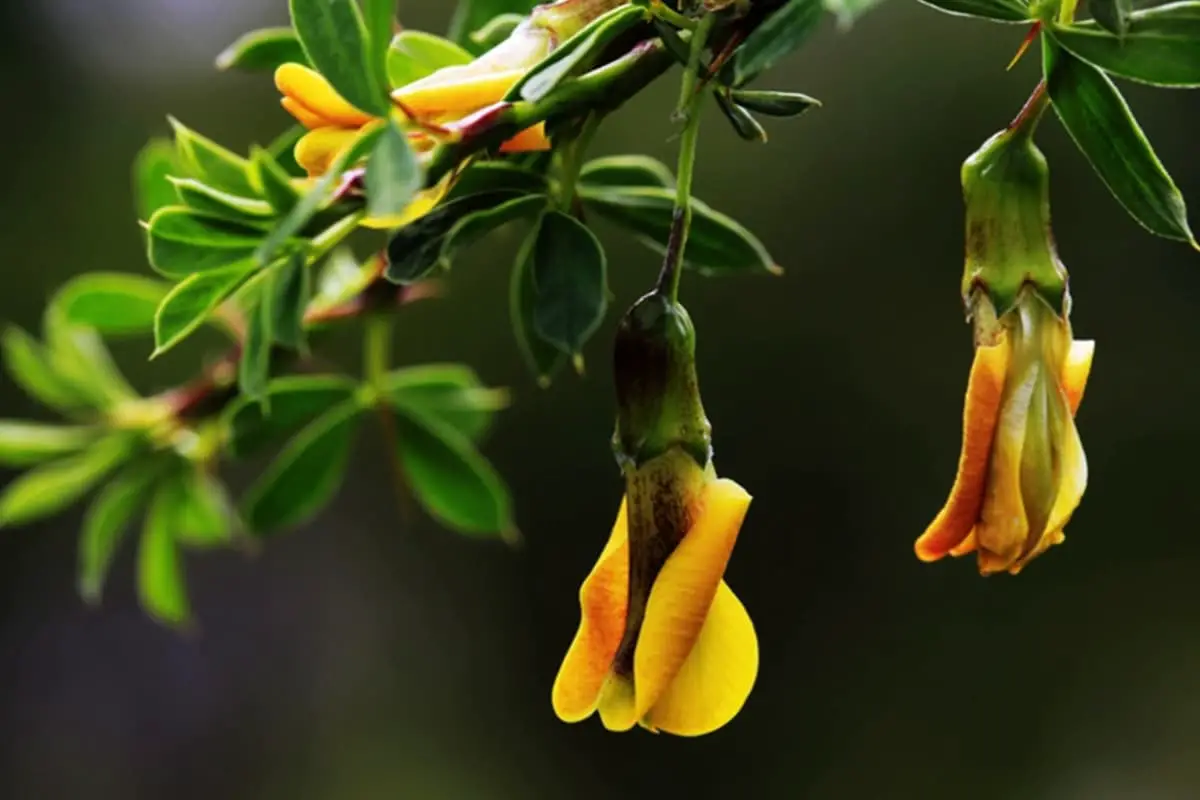
The stipules are triangular and hardened into spines, measuring 5-7 millimeters in length. The leaf stalks either fall off or harden into spines, which can be 7-15 (25) millimeters long.
There are 2 pairs of leaflets, pinnate or sometimes palmate, with the upper pair usually larger and thicker, leathery or papery, inversely egg-shaped or elongated-ovate, measuring 1-3.5 centimeters in length and 5-15 millimeters in width.
The apex is rounded or slightly notched, with or without spines, and the base is wedge-shaped or broadly wedge-shaped. The upper surface is dark green, while the lower surface is light green.
The flowers are solitary, with flower stalks about 1 centimeter long, and a joint in the middle. The calyx is bell-shaped, 12-14 millimeters long and 6-9 millimeters wide, with a slightly inclined base.
The corolla is yellow, often with red markings, 2.8-3 centimeters long. The standard petal is narrowly inversely egg-shaped, with a short stalk. The wing petals are slightly longer than the standard petal, and the stalks are nearly equal in length to the petals.
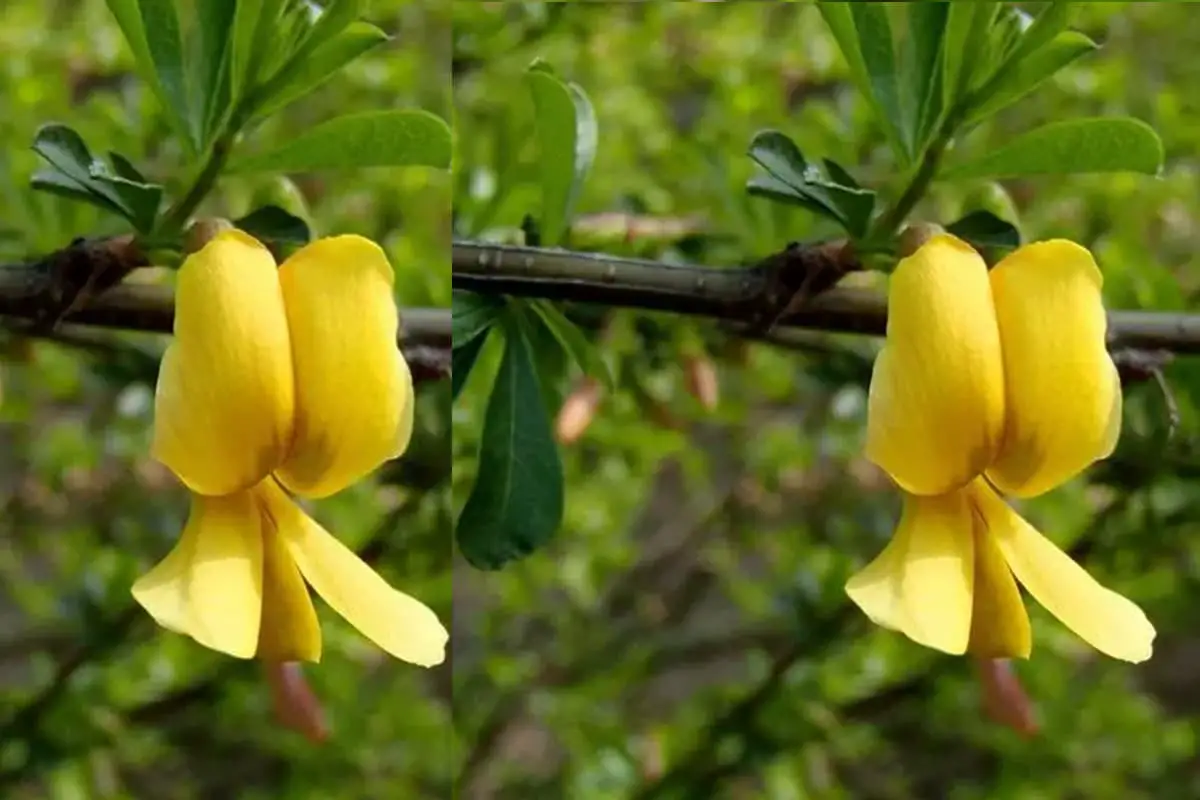
The keel petal is wide and blunt. The ovary is hairless. The pods are cylindrical, about 3-3.5 centimeters long and approximately 5 millimeters wide. It blooms from April to May and bears fruit in July.
Caragana sinica prefers sunlight but can tolerate partial shade. It is highly cold-resistant and can safely overwinter in temperatures as low as -50℃. It is also drought-resistant and can tolerate poor and thin soil.
It can grow normally in mildly saline-alkaline soil but dislikes waterlogging, as prolonged waterlogging can lead to the death of seedlings.
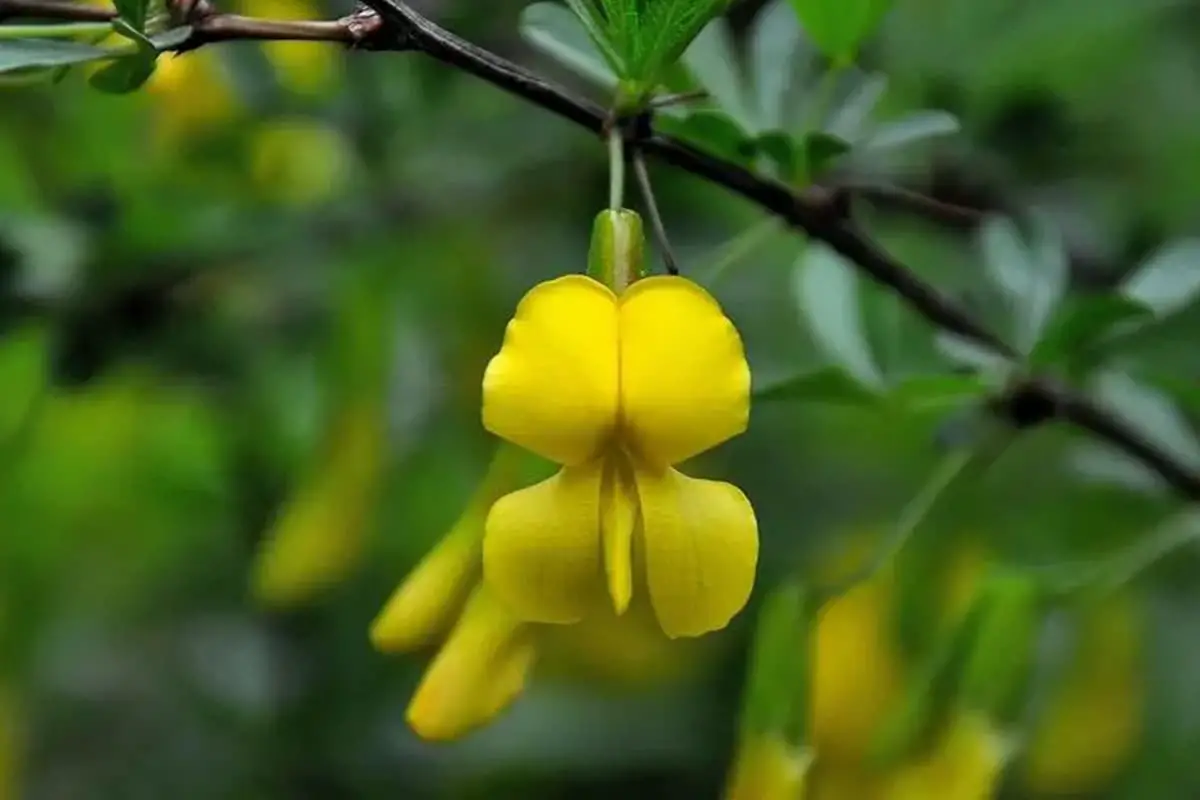
Caragana sinica is distributed in the Yangtze River Basin and the northern region of China, mainly in hilly and mountainous areas on sunny slopes. It is widely cultivated as a garden flower.
Caragana sinica contains proteins, fats, carbohydrates, various vitamins, and minerals. It has a slightly warm and sweet taste, with the effects of nourishing Yin, harmonizing blood, and invigorating the spleen.
It is used to treat hot cough, dizziness and lumbago, asthma and leukorrhea in women, malnutrition in children, mastitis, and bruises.
Roots: Sweet, slightly pungent, neutral.
Flowers: Sweet, warm.
Functions and Indications:
Roots: Nourish and strengthen the body, activate blood circulation, regulate menstruation, dispel wind, and eliminate dampness. It is used for hypertension, dizziness, tinnitus, weak and tired body, irregular menstruation, leukorrhea, insufficient milk supply, rheumatic joint pain, and bruises.
Flowers: Dispel wind, activate blood circulation, stop cough, and transform phlegm. It is used for dizziness, tinnitus, pulmonary weakness, and cough in children.
This species is listed as a toxic plant in the Chinese Plant Database. The LD50 of the ethanol extract injected into the abdominal cavity of mice is 10g/kg for stems and leaves.
Caragana sinica has beautiful branches and leaves, and vibrant flowers. It can be planted individually or in groups along roadsides, slopes, or next to rockeries in garden landscaping. It can also be used for bonsai.
Caragana sinica can be propagated by seed sowing, cuttings, division, and layering. It is best to sow the seeds immediately after harvesting. If stored, they should be soaked for germination before sowing in the following spring.
Hardwood cuttings can be done in March, and softwood cuttings can be done during the rainy season. Cuttings should be 8-12 centimeters long, inserted halfway into the soil, covered with shade, and watered appropriately.
After rooting, remove the shade cover to receive sufficient sunlight for robust growth and high survival rate. Division propagation can be done in spring, from March to April.
Caragana sinica is generally propagated by seed sowing. The seeds mature in early August, and they should be harvested when the fruits turn deep yellow.
If harvested too late, the seeds may scatter due to pod bursting, making it difficult to collect them. Place the harvested pods in the sun to dry, allowing the seeds to naturally separate from the pods.
After cleaning the seeds, store them in a clean cloth bag in a shaded and well-ventilated place. In mid-March of the second year, soak the seeds in 45°C warm water for 48 hours before sowing.
Choose fertile and well-drained sandy loam soil for the nursery, and apply well-rotted and fermented cow or horse manure as base fertilizer at a rate of 3500 kilograms per acre. Mix the base fertilizer thoroughly with the soil, then level and fine it after sun exposure.
Disinfect the seedbed with pentachloronitrobenzene. Broadcasting can be used for sowing, with a seeding rate of 20-25 grams per square meter. After sowing, lightly stamp with the feet and water once.
During the germination period, keep the soil moist. After the seedlings emerge, water them every 5-7 days, ensuring thorough watering.
Watering should be done in the morning or evening. When the seedlings reach about 20 centimeters in height, thin them out. Thinning should be done on cloudy and rainy days, taking care not to damage other seedlings.
To promote the accelerated growth of seedlings, apply urea in mid-June and phosphorus-potassium fertilizer in early August, followed by timely watering. Transplantation can be done after two years.

Peggie was once a high school mathematics teacher, but she set aside her chalkboard and textbooks to follow her lifelong passion for flowers. After years of dedication and learning, she not only established a thriving flower shop but also founded this blog, “Flowers Library”. If you have any questions or wish to learn more about flowers, feel free to contact Peggie.
 English
  العربية
  Bahasa Indonesia
  Deutsch
  Français
  Italiano
  Nederlands
  Português
  Русский
  日本語
日本語