600+ Types of Flowers A To Z (With Names and Pictures)
Types Of Flowers By Names (A-Z) Types Of Flowers By Color Types Of Flowers By Season Types Of Flowers By Blooming Time 600+ Types of Flowers No. Flower Name No.…

The Trumpet Creeper, Campsis radicans, belongs to the Bignoniaceae family and is a vine with aerial roots that can grow up to 10 meters long. Its leaves consist of 9-11 leaflets, which are oval to ovate-elliptical in shape.
The tips of the leaves taper to a point, and the base is wedge-shaped with serrated edges. Along the midrib, there are short, soft hairs. The calyx is bell-shaped, around 2 cm long, slightly curled outwards without any prominent ridges.
The corolla is a slender tube with a funnel shape, colored from orange-red to bright red. Its fruit is a cylindrical capsule, 8-12 cm long and roughly 2 mm thick, with a hard, woody texture.
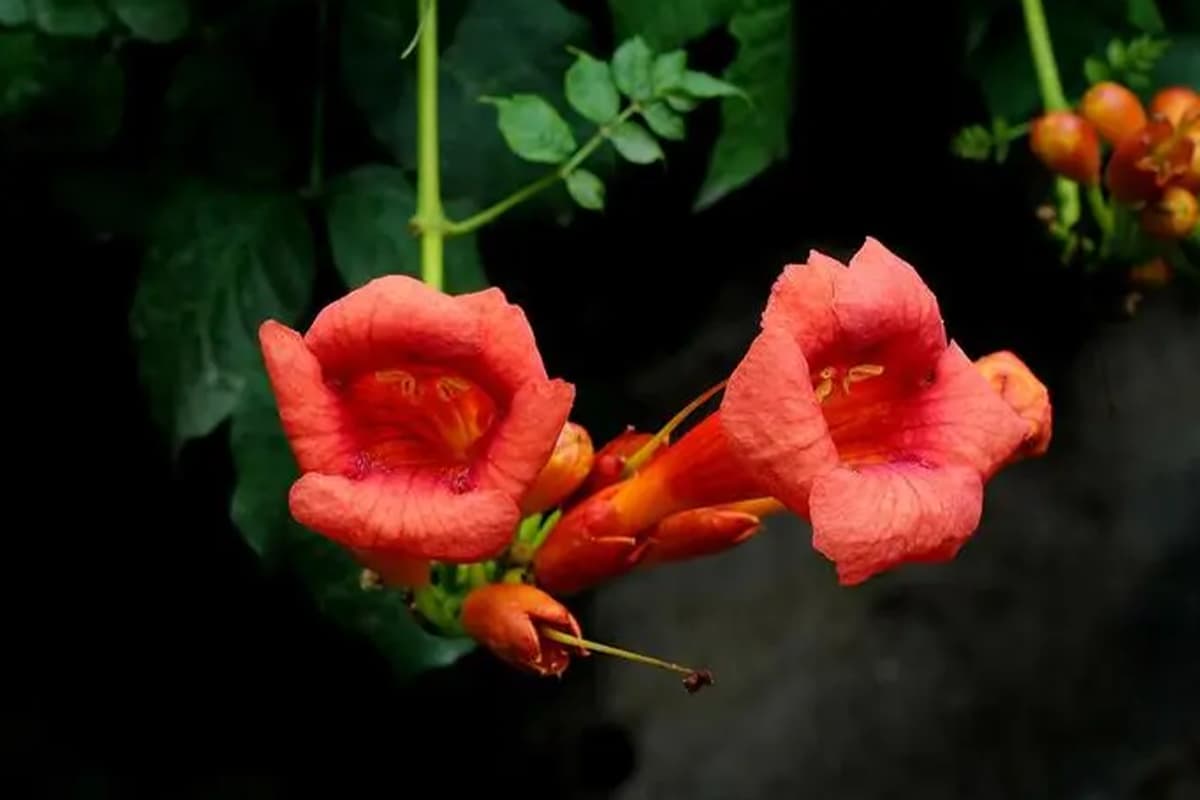
This vine, with its aerial roots, can extend up to 10 meters. It has 9-11 leaflets which are oval to ovate-elliptical, measuring 3.5-6.5 cm in length and 2-4 cm in width. The leaf apex tapers to a point, the base is wedge-shaped, and the edges are serrated.
The upper side of the leaf is a deep green, while the underside is a lighter shade of green and hairy, especially along the midrib. The bell-shaped calyx measures about 2 cm with a diameter of approximately 1 cm at the opening.
The corolla’s tube is slender and funnel-shaped, ranging in color from orange-red to bright red, measuring three times the length of the calyx, approximately 6-9 cm with a diameter of about 4 cm.
The fruit is a long cylindrical capsule, 8-12 cm in length with a beak-like tip, and a thickness of around 2 mm.
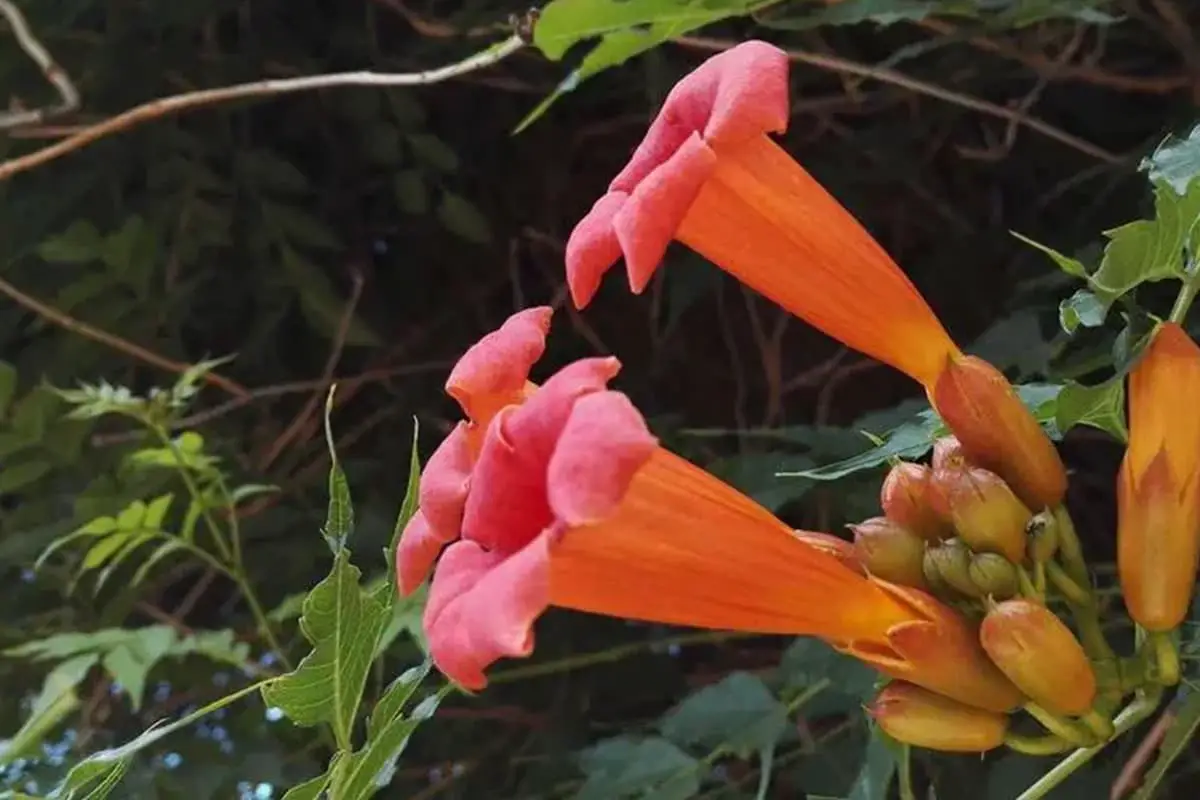
The Trumpet Creeper loves sunlight but can tolerate a bit of shade. It’s cold-resistant, and in Beijing, it can survive outdoors during winter. It can withstand drought and excessive moisture.
The plant isn’t particular about soil and can thrive in alkaline conditions, even in soil with a salt content of 0.31%. It’s a deep-rooted plant with strong sprouting and budding capabilities.
While it’s native to the Americas, it’s also cultivated in countries like Vietnam, India, and Pakistan.
The Trumpet Creeper can be propagated through various methods including seeding, root burial, layering, and cutting.
Cuttings are the most popular method due to their ease and the potential to produce a large number of seedlings at once. Hardwood cuttings are typically taken from mid-March to mid-April.
The Trumpet Creeper thrives with ample fertilization. When planting, it’s beneficial to use well-fermented manure as a base fertilizer. Urea can be added at the start of summer to boost its growth. Avoid fertilizing in the fall to prevent new growth during that season.
Before planting the Trumpet Creeper, it’s advisable to prune the plant. Lightly trim the main vine and remove all side branches. Once the main vine sprouts new branches, choose the strongest and nearest branch to the top to extend as the main vine.
The flowers can be used medicinally as a substitute for traditional Chinese Trumpet Creeper flowers, boasting benefits such as blood circulation improvement and cooling properties. The leaves contain caffeic acid, coumaric acid, and ferulic acid.

Peggie was once a high school mathematics teacher, but she set aside her chalkboard and textbooks to follow her lifelong passion for flowers. After years of dedication and learning, she not only established a thriving flower shop but also founded this blog, “Flowers Library”. If you have any questions or wish to learn more about flowers, feel free to contact Peggie.
 English
  العربية
  Bahasa Indonesia
  Deutsch
  Français
  Italiano
  Nederlands
  Português
  Русский
  日本語
日本語