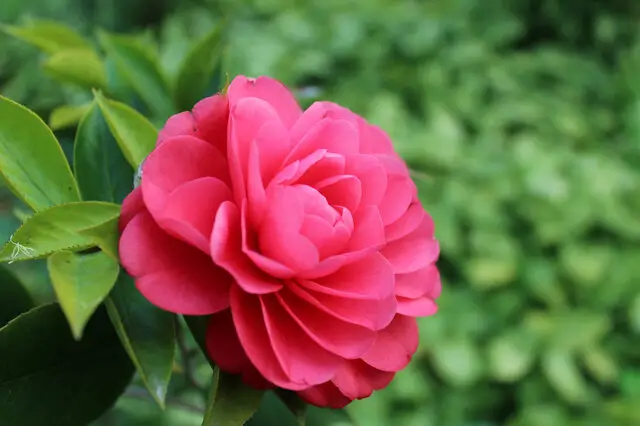
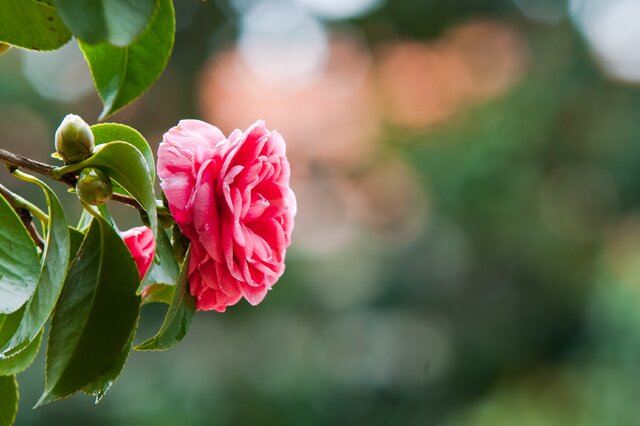
As one of China’s top ten renowned flowers, the camellia is a delicate gem that blooms in winter and spring. Its full and dignified elegance has been cherished since ancient times.
In this article, I will highlight the top ten attractive camellia varieties: Eighteen Scholars, Mandarin Duck Phoenix Crown, Five Color Red Cinnabar, Big Five Colors, Fierce Fragrance, Competing Peonies, Hexagonal Big Red, Golden Camellia, Purple Splendor, and White Swan.
These are all incredibly popular camellia varieties; let’s get to know them in more detail.
1. Eighteen Scholars
Among the numerous camellia varieties, the first that comes to mind as the most beautiful is Eighteen Scholars, known for its fame and immense aesthetic value.
It’s a prized camellia species, characterized by an elegant tree shape and unusual flower structure, made up of 70-130 petals that form a hexagonal corolla.
With its tower-like, well-defined layers and orderly arrangement, the number of petal rounds is often eighteen, thus the name. The Eighteen Scholars camellia grows at a moderate pace, flowering from January to February.
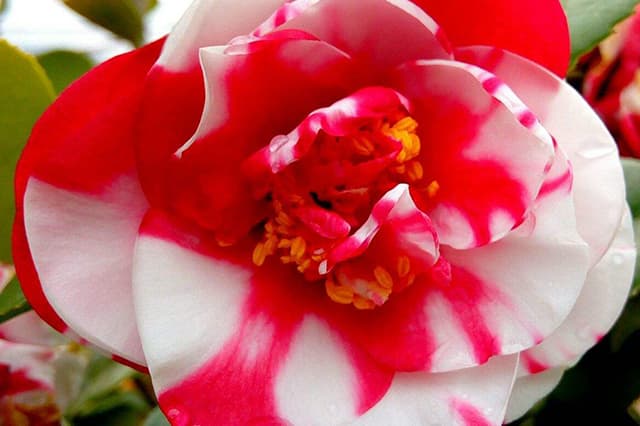
The flowers, either terminal or axillary and single or clustered in groups of 2-3, are refined and colorful. They bloom profusely, and sometimes, a single plant can simultaneously produce pink, red, white, white with red stripes, and red with white stripes blooms.
From a distance, their gentle and elegant posture is an overwhelming sight of beauty. The variety prefers wind-sheltered, sunny conditions, thriving in airy, warm, humid locations with well-drained, fertile sandy loam, loess, or humus-rich soil.
2. Mandarin Duck Phoenix Crown
Looking for a great camellia variety? The Mandarin Duck Phoenix Crown is a superior choice. It’s a distinguished camellia breed, cultivated from the Red Cinnabar bud mutation, native to East China and arguably surpassing its predecessor.
Its leaves resemble the Red Cinnabar, but are wider, with shorter tips. The leaf veins are finer and clearer, and the flower colors are more varied and seductive.
The Mandarin Duck Phoenix Crown exhibits diverse flower colors, including solid red, solid pink, half-red-half-pink, red radial pink stripes, pink radial red stripes, all on one tree.
With 8-10 petal rounds or more, its stiff petals form a fully double bloom that is as charming as a peony and as delicate as a rose, making it one of the most beautiful camellia varieties.
While easy to cultivate, it grows slowly, and its flowering period is mid to late season, offering high ornamental value.
3. Five Color Red Cinnabar
Five Color Red Cinnabar, also known as Pink Cinnabar, is a bud variant of the camellia “Red Cinnabar”, even more beautiful than its predecessor, and highly valuable as an ornamental plant, making it a worthy camellia species to acquire.
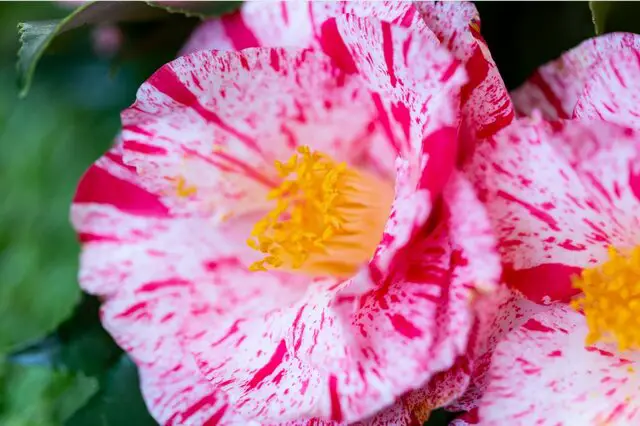
The Five Color Red Cinnabar shares similar traits with the Red Cinnabar and is an easy camellia variety to cultivate, especially suitable for beginners. Its medium-sized plant is easy to branch, leaves are bright green with a glossy surface, and flowers are pink with red stripes and blotches, occasionally appearing half pink, half red, or entirely pink or red.
With vibrant colors and a large size—sometimes reaching a diameter of about 15 centimeters—it blooms from mid-February to late March, making it an exceedingly popular camellia variety.
4. Large Multicolor
For beautiful camellia varieties, I’d recommend the Large Multicolor, a traditional and valuable variety of East China camellia. Also known as Five Color Camellia, it is called “Chang’e Color” in Songyang, Zhejiang, and “Large Five Treasures” in Fujian.
As it often blooms with fused-stem polyembryonic flowers, it’s also known as “Fused Stem Chang’e.” The leaves of the Five Color Camellia are rounder, light green, with distinct veins. The flowers are about 6 cm in diameter, peony-shaped or fully double-flowered.
For younger plants, usually, 99% of the flowers on the tree are of one color, mostly light pink with irregular red stripes and blotches, occasionally featuring other colors.
Its flower color is graceful and elegant, reminiscent of the descent of the moon goddess Chang’e, and it ranks among the top five most popular camellia varieties.
5. Intense Fragrance
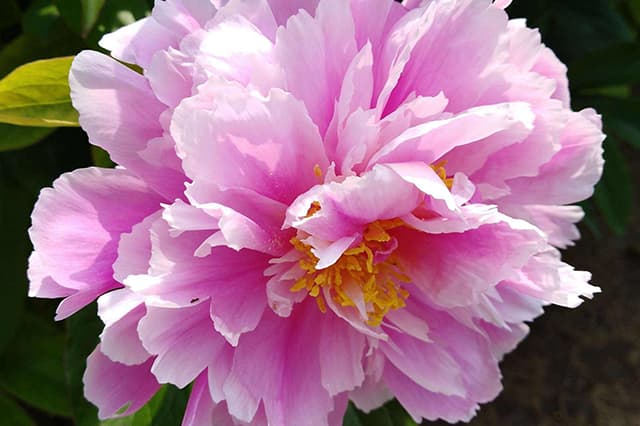
The Intense Fragrance camellia, also known as Thousand Mile Fragrance or Drunken Fragrance, is revered as the Fragrant Beauty, a member of the tea plant family. It’s the most classic variety among potted camellias and currently boasts the most intense fragrance worldwide.
Its blooms are pale ivory pink, with deep pink edgings on the petals. Most of the flowers are pink or pinkish-white, with a diameter of about 8-10 cm and a moderate number of petals with a particularly rich fragrance.
The Intense Fragrance camellia offers high value for its price, is inexpensive, easy to care for, and beginners find it easy to cultivate. It’s well-loved by flower enthusiasts.
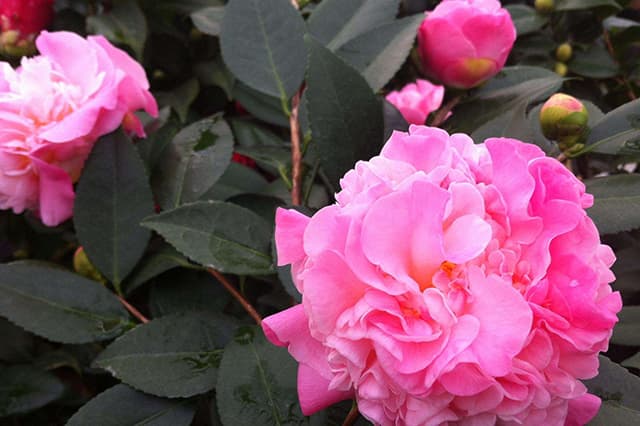
6. Peony Rival
The Peony Rival originates from Europe and belongs to the red camellia species. It is now widely grown in southern China. Mention the Peony Rival to any camellia enthusiast, and they’ll be enthralled by its large and dazzlingly colorful flowers.
Even though it has been known in China for over a decade, its popularity among camellia lovers has not waned. The Peony Rival family boasts more than a dozen members, with Peony Rival being the fourth generation direct descendant.
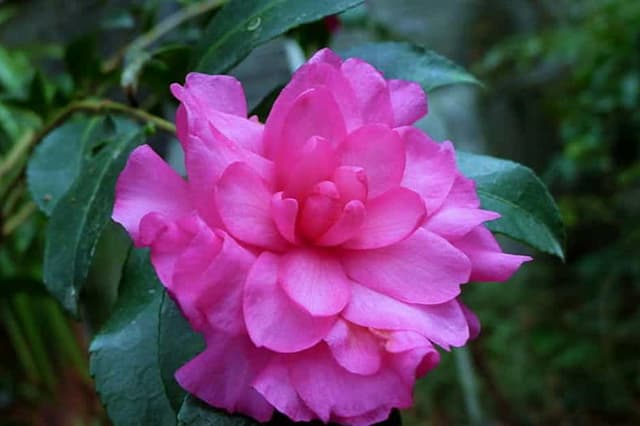
Its blooms are large, light flesh pink, with darker coloration at the base of the petals, fading to near white at the edges.
Upon closer inspection, you can see faint pink veins on the petals. Petal edges have fine hairs, leaves are deep green with deep teeth, and the nutrient buds usually appear red. Peony Rival can be used as a potted plant or cut flower and is truly beautiful.
7. Hexagonal Bright Red
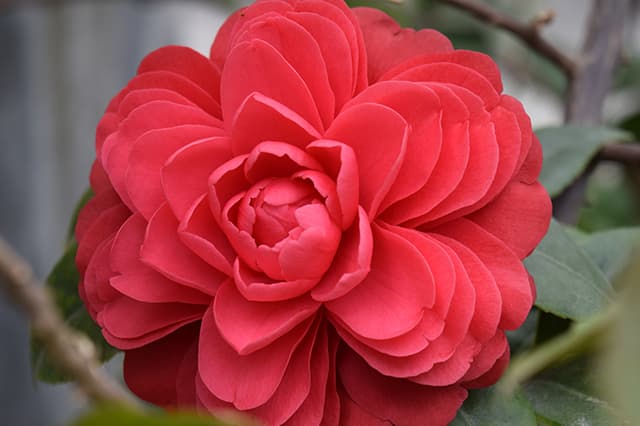
The Hexagonal Bright Red Camellia, also known as Songyang Red, boasts a strikingly beautiful “Chinese Red” color, ranking among the top ten camellia varieties. This variety features an elegant tree shape, full and upright branches, deep green ovate leaves with serrations, and slow growth.
During blooming, the petals take a hexagonal shape, hence its name. The Hexagonal Bright Red Camellia has concave and firm petals, with no white streaks appearing in the center, while the whole flower is a brilliant “Chinese Red.”
The diameter of the flowers can even exceed 12 cm, which is quite a pleasing sight. After withering, the flowers fall off by themselves, with no dead flowers hanging on the branches, greatly enhancing its ornamental value.
8. Golden Camellia
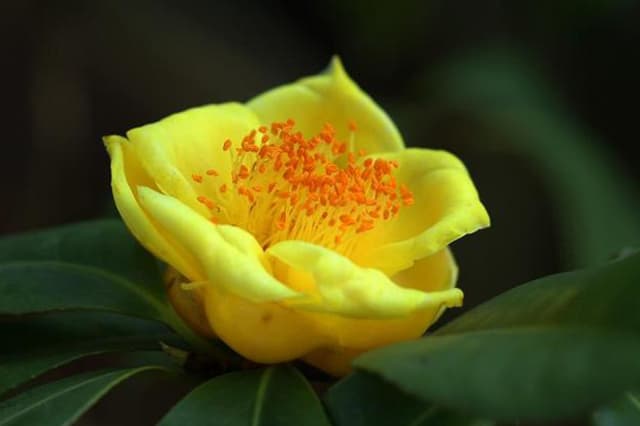
What are some of the most beautiful camellia varieties? In my opinion, the Golden Camellia exudes a sense of nobility with its color, making it a beautiful variety of camellia. The Golden Camellia belongs to the tea family and is one of the national first-class protected plants in China.
Its flowers are gold, dazzling, and appear as if they’ve been coated with a layer of wax—crystal clear and glossy, almost semi-transparent. The Golden Camellia flowers are single, growing in the leaf axils, and come in cup-shaped, jug-shaped, or bowl-shaped forms when they bloom.
They are charming and elegant, known abroad as the magical oriental magic tea and hailed as the “panda of the plant world” or the “queen of tea.”
9. Purple Beauty
For purple camellia varieties, I’d recommend the Purple Beauty. The camellia “Purple Beauty” was bred in Texas, USA, from the seedlings of the winter camellia variety “Lion’s Head” and was announced in 1958.
The color of the Purple Beauty is light purple-red, fully double-flowered, and considered a medium-sized flower with a diameter of 7-8 cm. Its leaves are densely grown, dark green, and it grows relatively quickly. It’s known as “Blue Field Jade” in Taiwan.
The Purple Beauty likes warm climates, slightly cold-resistant, heat-resistant, prefers high humidity, and dislikes dryness.
Purple camellia varieties like the Purple Beauty, or those with a hint of purple, are arguably the most elegant and intellectual among the many camellias. It is also one of the most popular camellia varieties.
10. White Swan
Which variety of camellia is the most beautiful? One cannot avoid mentioning the White Swan, which ranks among the top ten most beautiful camellia varieties.
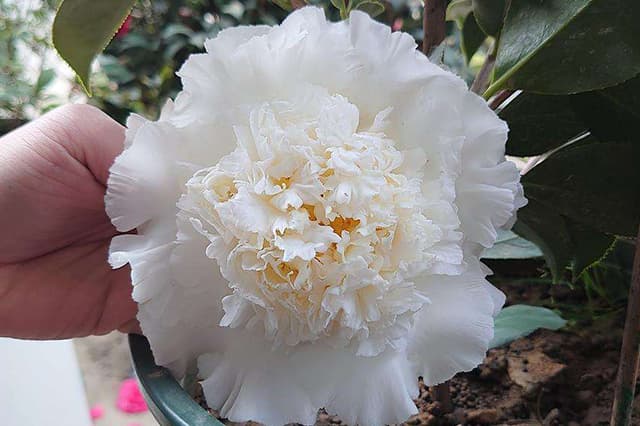
The White Swan is a mutation of the Peony Rival variety and is the fifth-generation direct descendant in the Peony Rival family. The White Swan flowers are large to very large, pure white, with a slightly yellow center.
The outer petals are slightly twisted, with the edges occasionally appearing fringed, while the central petals vary in shape, often presenting a martial-petal appearance.
The leaves and growth habits are similar to those of the Peony Rival, and the nutrient buds are usually white, giving it high ornamental value.


 English
  العربية
  Bahasa Indonesia
  Deutsch
  Français
  Italiano
  Nederlands
  Português
  Русский
  日本語
日本語