600+ Types of Flowers A To Z (With Names and Pictures)
Types Of Flowers By Names (A-Z) Types Of Flowers By Color Types Of Flowers By Season Types Of Flowers By Blooming Time 600+ Types of Flowers No. Flower Name No.…

The Aristolochia gigantea, known as the Giant Dutchman’s Pipe, is a large, evergreen, woody vine from the Aristolochiaceae family. It’s named for its giant flowers and the mature fruit resembling a bell hanging beneath a horse’s neck.
Unlike insectivorous plants such as pitcher plants and Venus flytraps, the Giant Dutchman’s Pipe not only captures but also nurtures insects, aiding in pollination without harming them. The uniqueness of the Giant Dutchman’s Pipe lies not only in its beautiful and peculiar flowers, which lack the symmetry of ordinary petals, but also in its distinctive structural morphology.
The base of the flower houses a swollen pouch containing both the pistil and stamen. However, the pistil matures a day before the stamen, preventing self-pollination and necessitating cross-pollination through insects.
The Giant Dutchman’s Pipe is a large, evergreen, woody vine of the Aristolochiaceae family. Its name is derived from its enormous flowers and the mature fruit that looks like a bell hanging from a horse’s neck. Unlike insectivorous plants like the pitcher plant and Venus flytrap, the Giant Dutchman’s Pipe not only captures insects but also provides them a nurturing environment to aid in pollination without causing any harm.
The distinctive feature of this plant lies not only in its beautiful and bizarre flowers, which lack the symmetrical petals of ordinary flowers, but also in its exceptionally unique morphological structure. The base of the flower comprises a swollen sac containing both the pistil and stamen.
As the pistil matures a day earlier than the stamen, self-pollination is inhibited, and cross-pollination via insects is required. The strange scent and speckled petals of the Giant Dutchman’s Pipe’s flowers lure insects into this pouch. Once inside, they lose their freedom due to the inward-facing hairs lining the pouch walls.
When the stamen matures and the anther ruptures, releasing pollen, the inward-facing hairs on the inner wall of the flower become soft and wilt, allowing the pollen-coated insect to escape and fly to another just-opening flower, delivering pollen to the stigma.
The Giant Dutchman’s Pipe is indigenous to Brazil and thrives primarily in tropical and subtropical regions. There is a species in the Xishuangbanna Tropical Botanical Garden in China that blooms splendidly from April to June each year.
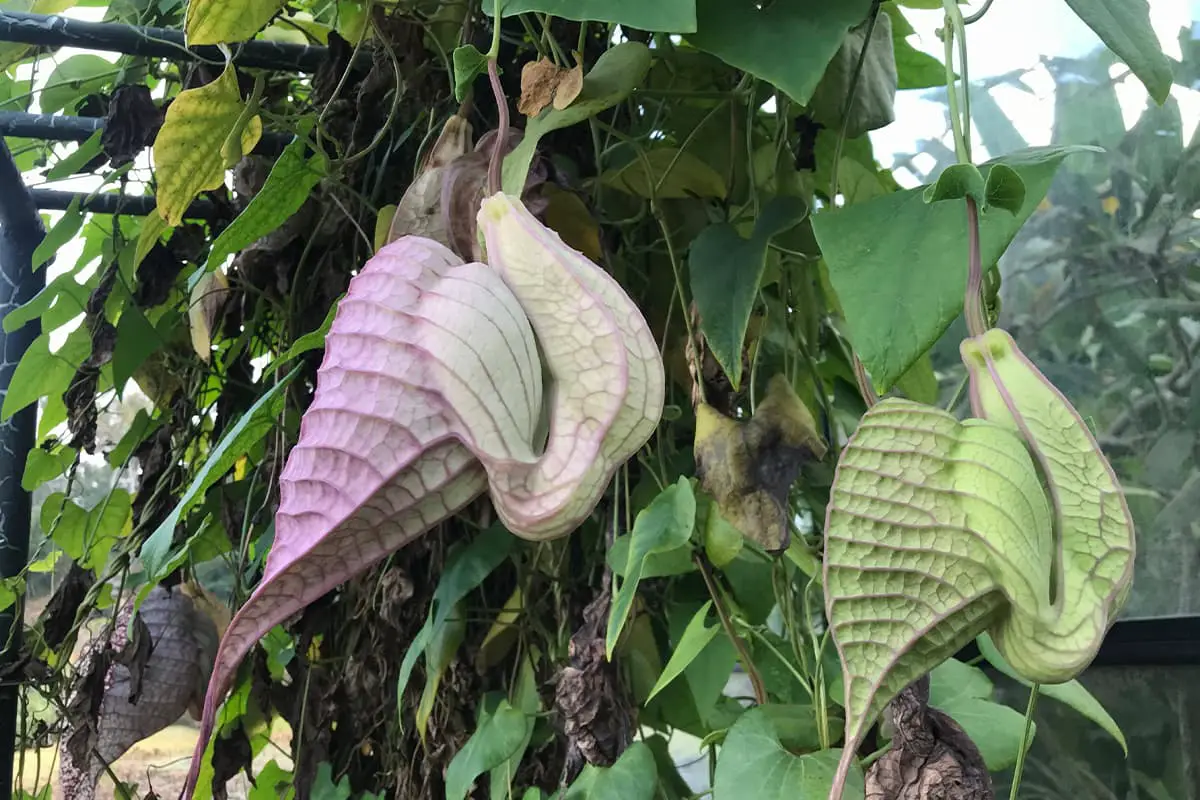
The Giant Dutchman’s Pipe is a large, woody vine with a rough, ridged stem. The vine can grow up to 10 meters in length. The leaves are alternate, ovate-heart-shaped, entire, pointed at the tip, heart-shaped at the base, and have petioles attached to the old stem. The large flowers are purple-brown with white spots.
There is only one species of the Giant Dutchman’s Pipe in the Xishuangbanna Tropical Botanical Garden, and its flowering period lasts from the end of February to mid-November each year, with peak blooming occurring between April and June.
The seeds of this plant are small and often difficult to spot. The survival rate of cuttings for propagation is not high, making the seedlings extremely rare and not yet utilized in urban greening.
While some plants rely on their fragrance to attract pollinators for the transfer of pollen, others, like the Giant Dutchman’s Pipe, do the exact opposite. They rely on their stench to draw in pollinators.

Peggie was once a high school mathematics teacher, but she set aside her chalkboard and textbooks to follow her lifelong passion for flowers. After years of dedication and learning, she not only established a thriving flower shop but also founded this blog, “Flowers Library”. If you have any questions or wish to learn more about flowers, feel free to contact Peggie.
 English
  العربية
  Bahasa Indonesia
  Deutsch
  Français
  Italiano
  Nederlands
  Português
  Русский
  日本語
日本語