600+ Types of Flowers A To Z (With Names and Pictures)
Types Of Flowers By Names (A-Z) Types Of Flowers By Color Types Of Flowers By Season Types Of Flowers By Blooming Time 600+ Types of Flowers No. Flower Name No.…

The Allemanda neriifolia is an evergreen shrub that grows upright to about 6.6 feet, though when potted it is typically kept at around 3.3 feet.
The leaves, which come in whorls of three to five, are oval or inversely lanceolate and range from 2 to 4.7 inches in length and 0.6 to 1.6 inches in width, covered with short, soft hairs.
Its inflorescences are umbel-like, boasting golden yellow flowers with orange-red stripes in the throat. The corolla is a broad funnel shape with five lobes that overlap either to the left or right, and the base of the corolla is swollen, encasing five stamens.
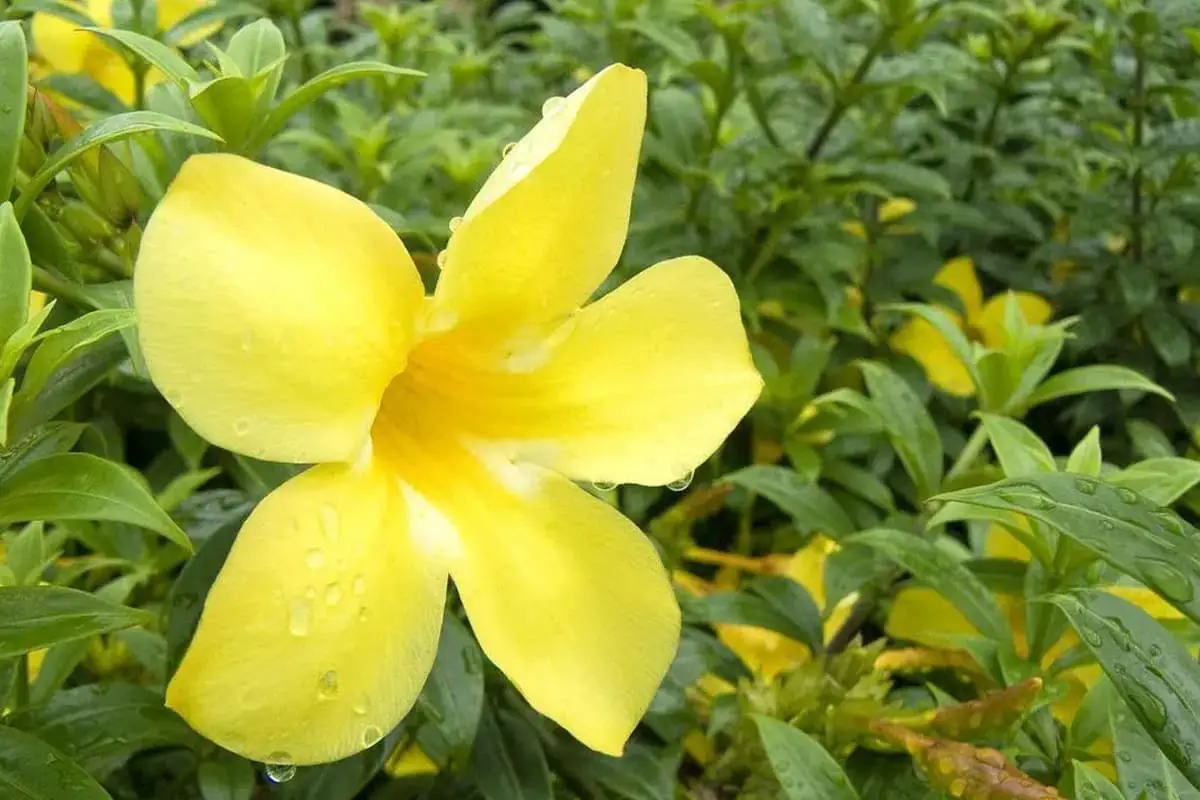
The fruit is a spiny capsule. Blooming occurs in May and June. Native to the southern United States and Brazil, it is cultivated in tropical America and introduced in China.
It serves as a lush, decorative plant for gardens, with its dense foliage, vibrant green leaves, and brilliantly bright flowers making a striking display.
It’s well-suited for large and medium-sized potted arrangements, enhancing living rooms, balconies, parks, malls, and large indoor spaces with its gorgeous effect.
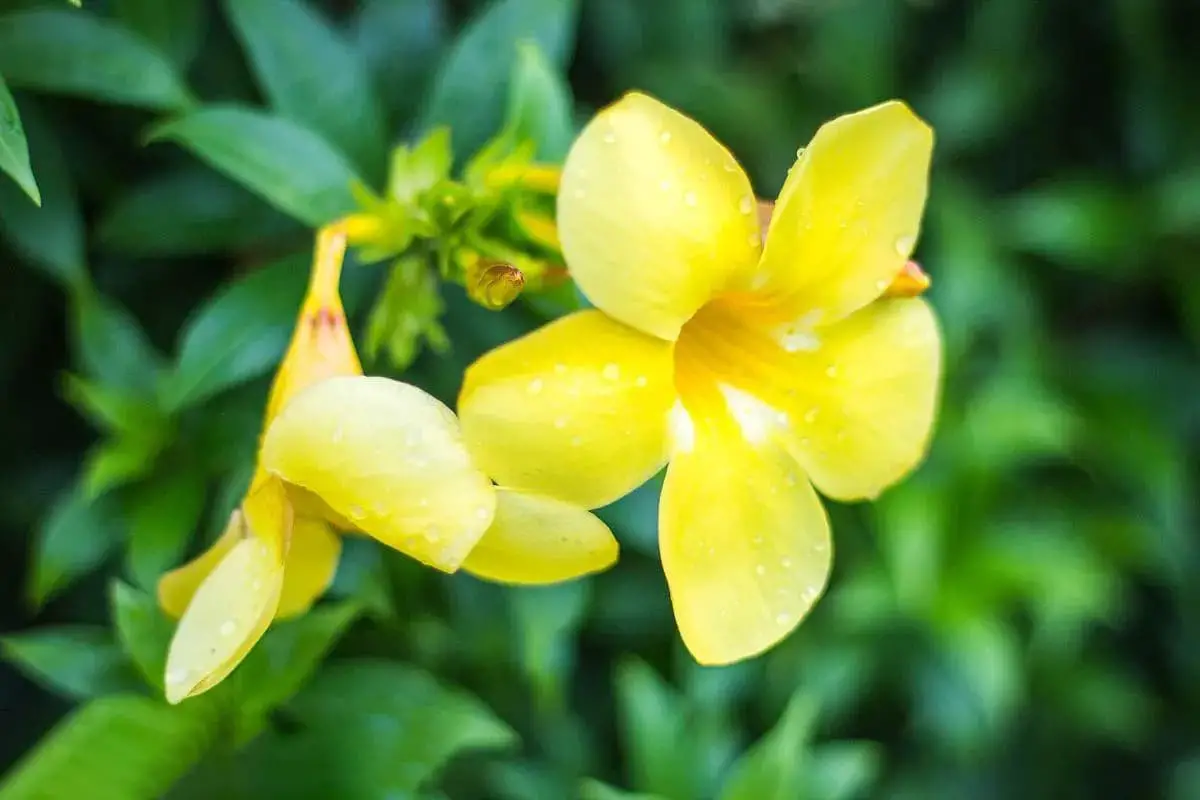
The Yellow Alamanda is an erect shrub that can reach heights of 3.3 to 6.6 feet, with latex-bearing branches that are a greyish-white.
The leaves are whorled in groups of three to five, with a smooth margin, elliptical or inversely oblong shape, measuring 2.4 to 4.7 inches long and 0.8 to 1.6 inches wide. The tips are tapered or acute, and the base is cuneate.
The leaf surface is a deep green, while the underside is a lighter green. Apart from the short soft hairs on the midrib and lateral veins on the underside, the leaves are otherwise hairless.
The venation is flat on the surface and raised on the underside, with seven to twelve lateral veins on each side that do not reach the margin but form a network. The petioles are extremely short, with glands at the base and in the axils.
The inflorescences are terminal umbels; the peduncles and pedicels are covered with scurfy-like soft hairs.
The flowers are orange-yellow, 1.6 to 2.4 inches long, with a corolla opening approximately 1.6 inches in diameter; the bracts are lanceolate and attached at the base of the pedicels.
The calyx is deeply five-lobed, with lanceolate segments and a few glands at the base of the inner side. The corolla is funnel-shaped with reddish-brown stripes inside.
The lower part of the corolla forms a cylindrical tube no longer than 0.8 inches and with a diameter of 0.08 to 0.16 inches, which swells at the base.
The corolla throat expands upward into a limb about 1.2 inches long and 0.6 inches in diameter, with the limb’s top five-lobed and the corolla lobes overlapping to the left.
The lobes are ovate or circular, blunt at the tips, about 0.6 to 0.8 inches long and 0.7 inches wide. There are five stamens attached at the throat of the corolla tube, with short filaments covered in soft hairs at the base, and ovate anthers with blunt tops and rounded bases.
The disk is fleshy and entire, encircling the base of the ovary; the ovary is entire, one-chambered, with a thread-like style and a blunt stigma at the top, and a ring-like base.
The fruit is a spiny capsule, about 1.2 inches in diameter; the seeds are flat with a membranous edge, about 0.8 inches long and 0.6 inches wide. The flowering period is from May to August, with fruiting from October to December.
Native to Brazil, this species is now widely cultivated in tropical regions.
It thrives in high temperatures and humidity, with plenty of sunlight and a slight tolerance for partial shade.
It prefers fertile and well-drained soil. Intolerant to cold and frost, it suffers damage to branches and leaves when exposed to prolonged temperatures of 41 to 42.8°F.
It favors fertile, moist loamy sand but performs poorly in heavy, compact soil and cannot tolerate waterlogged or saline conditions. While it is relatively tolerant to wet conditions, it does not withstand drought; the soil should be kept moist consistently.
Optimal growing temperatures range from 64.4 to 86°F, and it can still grow normally above 95°F. During the dormant winter period, the ideal temperature is between 53.6 and 59°F, not dropping below 50°F, as temperatures below 41°F can cause frost damage to the plant.
After flowering, the Golden Trumpet produces fruit with soft spines, and its winged seeds should not be stored for long. They are best sown immediately after collection. One-year-old seedlings can be transplanted from the nursery.
Layering is best done in the rainy season. Bend a branch close to the ground, slightly wound the bark, and bury it in the soil. Roots will develop in about two months, after which the new plant can be separated from the parent.
Water propagation is particularly effective. Cuttings can be taken any time during the growing season, ideally 30-40 centimeters long. Split the lower end of the cutting 4-6 centimeters with a knife and place it in a glass of water.
Spring and autumn temperatures are most favorable, with roots typically sprouting within 2-3 weeks. In summer, due to higher temperatures and water spoilage, it is advisable to change the water every two days.
Commercially, cuttings are the most commonly used method of propagation. From late March to mid-April, when temperatures stabilize, cuttings from six-month to two-year-old branches are planted closely in moist sand or a gravel bed and kept humid with misting.
Once temperatures exceed 20°C, roots will usually form within 20 days, and the plants can be moved to a nursery bed or potted in about 40 days.
Symptoms include a black appearance on the crown of the affected plants and darkened branches, with a surface covered in black mold that feels sticky to the touch.
Over time, the black mold may partially peel off, leaving the leaves mottled with black and white spots. Severely affected plants suffer from blocked photosynthesis, poor growth, premature leaf drop, and reduced ornamental value.
The disease is caused by ascomycete fungi, including Capnodium spp. and Neocapnodium spp., with their asexual stages often spreading sooty molds.
Patterns of Occurrence: In Guangdong, the asexual stage of the fungus is common. The fungus overwinters as mycelium on affected parts or debris and reproduces on honeydew secreted by scale insects, spreading through wind, rain, and the activity of scale insects.
Environments that favor the reproduction of scale insects also favor the outbreak of sooty mold.
Control measures include improving aeration in gardens and applying insecticides to control pests and diseases.
Solutions such as 40% fast-acting emulsifiable concentrate at 1000-3000 times dilution, or 40% chlorpyrifos emulsifiable concentrate at 1000 times dilution, or 25% imidacloprid emulsifiable concentrate at 2000 times dilution (for scale insects during the nymph stage with a diluted solution), or 50% pirimicarb emulsifiable concentrate at 2000-3000 times dilution (for aphids).
The Golden Trumpet’s Red Wax Scale (Ceroplastes rubens Maskell) is a widespread pest belonging to the Hemiptera and Coccidae families.
It damages the Golden Trumpet by sucking sap from branches and leaves, causing nutritional deficiencies, weakened vigor, and obstruction of flowering and fruiting, which can lead to branch dieback.
Morphological Characteristics: The adult males and females of the Red Wax Scale differ in appearance. The wingless female is oval-shaped, dark red, about 4 millimeters long and 2.5 millimeters high, with a thick wax covering on the back, giving it a bun-like appearance.
The male has one pair of white, semi-translucent wings with a wingspan of 2.5 millimeters. The nymphs are oval-shaped and dark red, with the last instar’s wax thickening and resembling the adult female’s shell, but smaller.
There is one generation per year, with overwintering fertilized females. The peak egg-laying period for overwintering females is in May and June, with egg-laying lasting over a month.
Newly hatched nymphs migrate to new shoots and leaves to feed, with various wasps as natural predators.
Patterns of Occurrence: There is one generation per year, with overwintering fertilized females on branches.
The newly hatched nymphs crawl for a while before settling on the host to feed, starting to secrete wax after about 6 hours and forming a starburst wax coat after 15 days.
Once the wax coat is formed, it’s less ideal to treat them because the effectiveness of control measures decreases.
Control Methods:
Manual control: At the onset, remove pests manually or prune heavily infested branches and leaves, and dispose of them properly.
Horticultural control: Pruning timely and properly to improve air and light conditions can help reduce infestations.

Peggie was once a high school mathematics teacher, but she set aside her chalkboard and textbooks to follow her lifelong passion for flowers. After years of dedication and learning, she not only established a thriving flower shop but also founded this blog, “Flowers Library”. If you have any questions or wish to learn more about flowers, feel free to contact Peggie.
 English
  العربية
  Bahasa Indonesia
  Deutsch
  Français
  Italiano
  Nederlands
  Português
  Русский
  日本語
日本語