600+ Types of Flowers A To Z (With Names and Pictures)
Types Of Flowers By Names (A-Z) Types Of Flowers By Color Types Of Flowers By Season Types Of Flowers By Blooming Time 600+ Types of Flowers No. Flower Name No.…

Agastache rugosa, also known as Korean mint, wrinkled giant hyssop, and others, is a perennial herbaceous plant of the mint family. It features a straight stem, measuring 0.5 to 1.5m in height, quadrate in shape, and up to 7-8mm in thickness.
The leaves range from heart-shaped to oblong-lanceolate, while the corolla is a pale lavender-blue, approximately 8mm long. Its mature nutlets are ovate oblong, about 1.8mm long and 1.1mm wide.
The flowering period spans from June to September, and the fruiting period is from September to November. This plant is distributed in Russia, North Korea, Japan, and North America.
The young stems and leaves of Agastache rugosa are edible and considered a delicacy in the wild. The plant has antibacterial properties; a single leaf can freshen the breath and prevent infectious diseases, and it can also serve as a preservative.
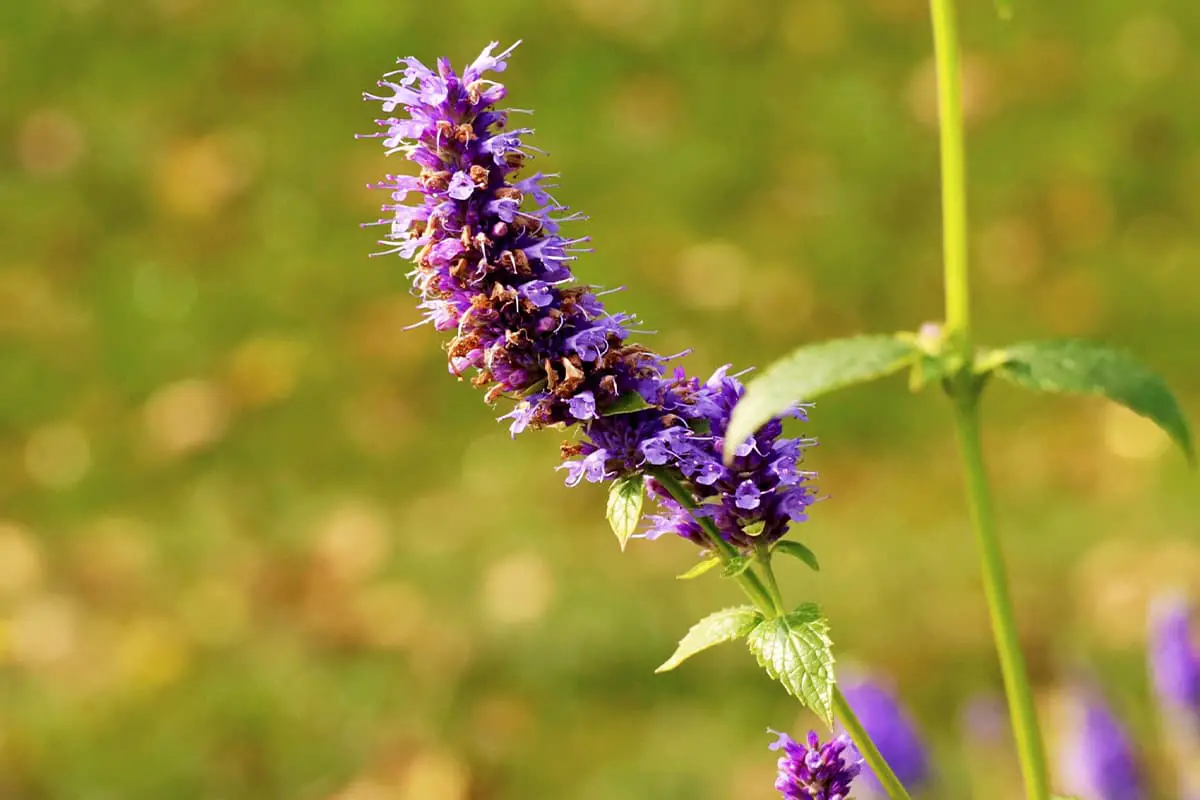
Consuming a porridge or tea made from Korean mint in the summer can effectively alleviate symptoms such as damp-heat syndrome, spleen-stomach dampness obstruction, abdominal distension, limb heaviness, and nausea and vomiting.
Agastache rugosa is a perennial herb. The stem is straight, 0.5 to 1.5m high, quadrangular, up to 7-8mm thick, with the upper part covered with very short fine hair and the lower part hairless.
It grows fertile branches in the upper part. The leaves are heart-shaped to oblong-lanceolate, 4.5 to 11cm long, 3 to 6.5cm wide, tapering to a tail-like point at the apex, heart-shaped at the base, rarely truncate, with coarse teeth along the margin.
The leaves are papery, olive-green on the upper surface, nearly hairless, slightly lighter and soft hairy underneath with dotted glands. The leaf stalk is 1.5 to 3.5cm long.
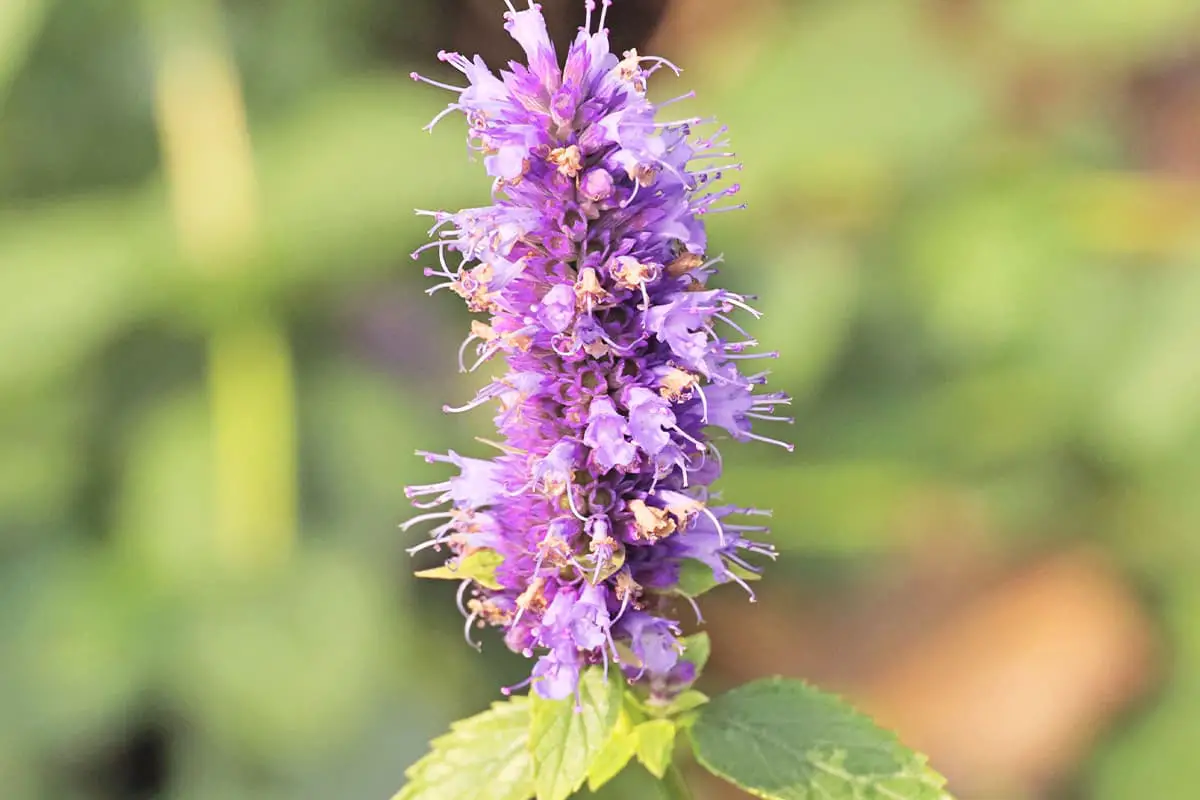
The inflorescence is a dense, cylindrical, terminal spike on the main stem or side branches, 2.5 to 12cm long, 1.8 to 2.5cm in diameter. The bracts at the base of the inflorescence are not more than 5mm long and about 1 to 2mm wide, linear-lanceolate, tapering to a point.
The calyx is tubular-inverted conical, about 6mm long, 2mm wide, glandular-soft hairy, and dotted with yellow glands, somewhat tinged with light purple or purplish-red.
The corolla is a light lavender-blue, about 8mm long, softly hairy outside, with a base about 1.2mm wide, slightly exceeding the calyx, gradually widening upwards to about 3mm at the throat.
The nutlets are ovate oblong when mature, about 1.8mm long, 1.1mm wide, keeled on the ventral surface, with short stiff hair at the apex, and are brown in color. The plant blooms from June to September and bears fruit from September to November.
This plant thrives in warm and sunny environments, with less optimal growth in shaded areas. It is best suited to regions with an average annual temperature of 66.2~78.8℉, and growth slows or stops when temperatures rise above 95℉ or fall below 60.8℉.
It prefers humid, rainy environments, is drought-sensitive, and requires annual rainfall of 63 inches or more. While seedlings enjoy rain, the plant thrives in high humidity during its growth phase, although excessive soil moisture can lead to root rot.
Areas with less rainfall should employ regular irrigation. Seedlings prefer shade and need a canopy or straw cover, but mature plants can grow in full sunlight.
Its roots are frost-tolerant and can survive winters in the north, regrowing in the following spring, while the above-ground parts are frost-sensitive, shedding leaves en masse after the first frost, gradually withering and dying.
The plant is not picky about soil and can grow in most types, although it prefers deep, fertile, and loose sandy loam or loam. It does not tolerate waterlogging; if planted in low-lying areas prone to water accumulation, it may suffer from root rot.
The seeds have a lifespan of 2~4 years, so they can be sown every other year. Seed germination requires light and a temperature of 64.4~71.6℉, with germination occurring within 7~10 days.
The plant is found in Russia, North Korea, Japan, and North America.
Propagation is primarily through seeds. Seeds sown in the same year yield new plants with abundant, high-quality leaves.
It can also propagate through overwintering roots (old plants), which involves leaving the roots in place after seed harvest, allowing them to overwinter and sprout new shoots in the spring that can be transplanted to the field.
In the north, seedlings are sown in mid to late April. Prior to sowing, 5.5~6.6 lbs of composted manure per square meter is applied to the seedbed as base fertilizer.
The bed is then leveled and finely raked before sowing. For broadcast sowing, seeds are mixed with fine sand or wood ash and evenly spread on the seedbed.
The bed is then lightly patted with a thin board to ensure good contact between the seeds and the bed, and covered with soil to a depth of 1cm. For row sowing, shallow furrows are made along the bed at a row spacing of 9.8~11.8 inches, and a depth of 0.4~0.6 inches.
After watering thoroughly, seeds mixed with fine sand are evenly spread in the furrows, covered with 1cm of soil, and lightly pressed down.
The amount of seed needed for nursery sowing is 0.0044~0.0088 lbs per square meter, or 1.1~1.76 lbs for a 0.165-acre field. Finally, the seedbed is covered with a thin film to maintain temperature and moisture.
Transplanting: When the seedlings are 4.7~5.9 inches tall with 4~6 true leaves, they are transplanted on a cloudy day at a plant spacing of 9.8 inches and a row spacing of 131.2 feet, with 6~7 thousand plants per 0.165-acre field.
After transplanting, water is thoroughly applied to help the plants establish.
Transplanting overwintered roots (old plants) is very successful. In the second year (May), after new shoots emerge, the withered stems from the previous winter are cut off at ground level and a thin application of manure is applied to promote new growth.
When the new shoots are 3.5~5.9 inches tall, they can be dug up with soil attached and transplanted to the field. This should be done on a rainy or cloudy day, and the plants should be planted as soon as they are dug up to ensure high survival rates.
The plants are spaced 11.8 inches apart in rows 13.8 inches apart, with 6 thousand plants per 0.165-acre field. After planting, a thin application of manure is applied to promote survival.
When the overwintered roots produce shoots that are 27.6~35.4 inches tall, the same year’s spring-sown plants will be 5.9~14.2 inches tall.
Overwintered root transplants begin to flower from late June to early July, while spring-sown plants start flowering in mid-July.
This disease commonly occurs during the rainy season in summer, with the plants rotting from the roots and rhizomes, gradually extending to the above-ground parts, causing the cortex to turn brown, and eventually wilting and dying.
Prevention and control methods: Remove the diseased plants and incinerate them in a centralized manner.
Disinfect the disease holes by sprinkling lime on them, or use a solution of 800 times 50% methyl tobujin, or water the disease holes with a solution of 500 times 50% carbendazim.
This disease occurs from mid-June to early July. Initially, the leaves and leaf tips of the diseased plants droop, with a green wilt appearance, and finally the roots rot and the whole plant dies.
After harvesting Agastache rugosa, clear out the remaining diseased plants, incinerate them in a centralized manner, and eliminate the overwintering pathogens. Drain the ditches in time after the rain to reduce the humidity in the field;
Combine with the application of potassium dihydrogen phosphate by leaf surface spraying to enhance the disease resistance of the plants;
At the onset of the disease, remove the diseased plants and water the disease holes and the roots of the adjacent plants with a solution of 500 times 50% carbendazim, or 800 times 50% methyl tobujin, or 500 times 40% carbendazim gel suspension to prevent spread.
Because Agastache rugosa itself is a plant with a fragrant aroma, the whole plant has a fragrance, so it is often paired with other fragrant plants, used in some green spaces for the blind, to enhance the blind’s understanding of the plant world.
Agastache rugosa green belts are often used for mass planting along flower paths, pond sides, and courtyards.
Agastache rugosa is a high-calcium, high-carotene food. Every 100g of tender leaves contains 72g of water, 8.6g of protein, 1.7g of fat, 10g of carbohydrates, 6.38mg of carotene, 0.1mg of vitamin B1, 0.38mg of vitamin B2, 1.2mg of niacin, 23mg of vitamin C, 580mg of calcium, 104mg of phosphorus, 28.5mg of iron, and 0.5% of aromatic volatile oils in the whole plant.
The oil mainly contains methyl eugenol (about 80%), limonene, α-pinene and β-pinene, para-cymene, linalool, I-clove, etc., which have a certain inhibitory effect on various pathogenic fungi.
Aromatic volatile oil is the raw material for manufacturing various Chinese patent medicines.
The edible part of Agastache rugosa is generally the tender stems and leaves, which are the best wild dishes. It can be mixed cold, stir-fried, fried, or made into porridge. Agastache rugosa can also be used as a cooking condiment or ingredient.
Because of its spleen-strengthening and qi-enhancing effect, it is a cooking ingredient that is both a food and a medicine. Therefore, some relatively rare dishes and folk snacks use its rich taste to increase nutritional value.
Processing: Remove residual roots and impurities, first shake off the leaves, sieve clean and set aside; wash the stems, moisten thoroughly, cut into sections, dry in the sun, then mix with the leaves.
Taste and Meridian: Pungent, slightly warm. Enters the spleen, stomach, and lung meridians.
Functions and indications: Aromatic transformation of turbidity, harmonizing the middle to stop vomiting, and promoting the exterior to relieve summer-heat.
Used for damp turbidity obstructing the middle, fullness and vomiting, summer-heat exterior syndrome, initial onset of damp-heat, fatigue and fever, chest discomfort, cold-dampness closing summer-heat, abdominal pain, vomiting and diarrhea, nasal congestion, headache.
Agastache rugosa has antibacterial functions, holding a leaf in the mouth can remove bad breath, prevent infectious diseases, and can be used as a preservative.
In summer, boiling porridge or making tea with Agastache rugosa is effective for heavy symptoms of summer-heat dampness, spleen and stomach dampness obstruction, distention and fullness in the chest and abdomen, heavy limbs, nausea, and vomiting.

Peggie was once a high school mathematics teacher, but she set aside her chalkboard and textbooks to follow her lifelong passion for flowers. After years of dedication and learning, she not only established a thriving flower shop but also founded this blog, “Flowers Library”. If you have any questions or wish to learn more about flowers, feel free to contact Peggie.
 English
  العربية
  Bahasa Indonesia
  Deutsch
  Français
  Italiano
  Nederlands
  Português
  Русский
  日本語
日本語