600+ Types of Flowers A To Z (With Names and Pictures)
Types Of Flowers By Names (A-Z) Types Of Flowers By Color Types Of Flowers By Season Types Of Flowers By Blooming Time 600+ Types of Flowers No. Flower Name No.…

The Desert Rose, scientifically known as Adenium obesum and also known as the Impala Lily, belongs to the dogbane family. This succulent plant, also known as a juicy plant, is a small shrub or tree that can grow up to 4.5 meters tall.
The trunk of the plant is swollen; its leaves are single, alternately arranged, and clustered at the branch ends. The leaves are ovate to elliptical, reaching up to 15 cm in length, with entire margins, blunt tips with short tips, and are fleshy with nearly no petiole.
The inflorescence is corymbose, terminal, bearing more than 10 bell-shaped flowers, 6-8 cm in length. The flowers are 5-lobed, with colors ranging from crimson, pink, white, and multicolored.
The flowering period of the Desert Rose is from May to December, with flowers in red, crimson, pink, and white.
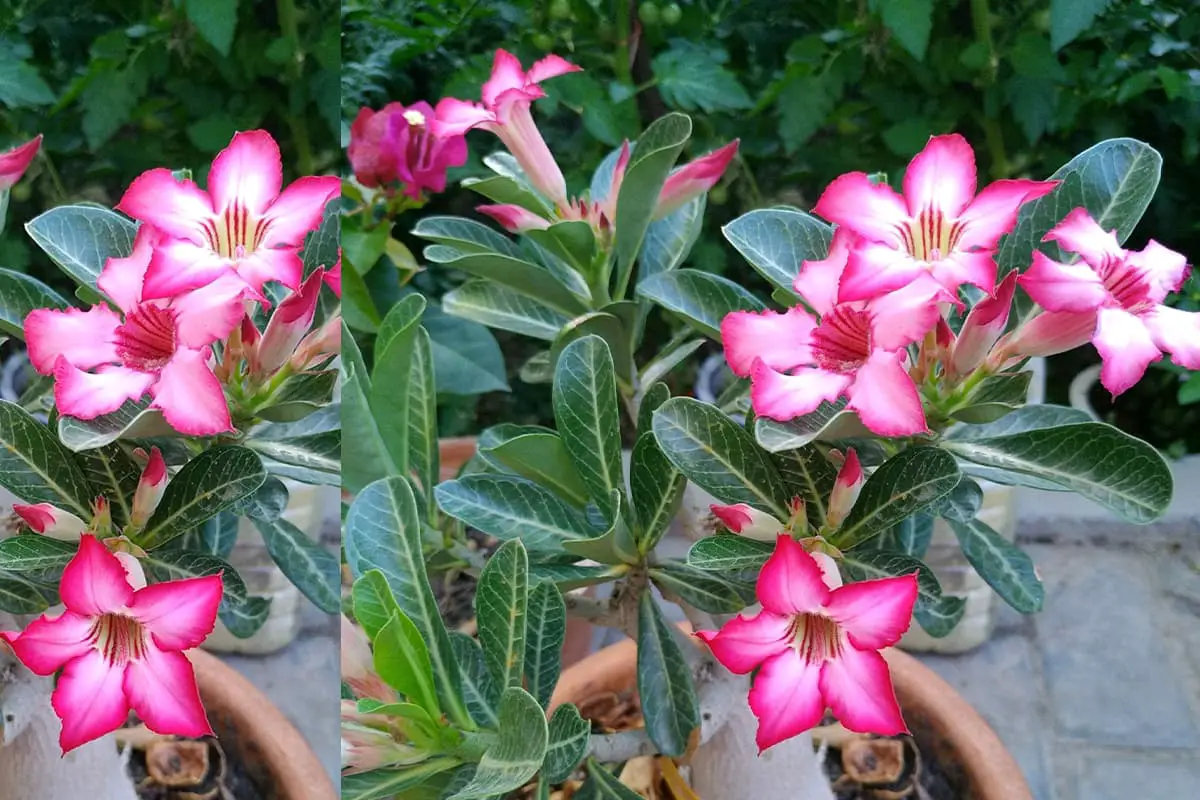
It is easily cultivated in greenhouses in the south, prefers high temperature, arid, and sunlit environments, withstands intense heat, but does not tolerate cold.
It is named the Desert Rose because it originates near deserts and is as red as a rose. It is native to Kenya and Tanzania in Africa, and is often cultivated for its beauty when in full bloom.
This succulent shrub or small tree can reach up to 4.5 meters in height, with a swollen trunk. Its single leaves are alternately arranged and clustered at the branch ends.
The leaves are ovate to elliptical, reaching up to 15 cm in length, with entire margins, blunt tips with short tips, and are fleshy with nearly no petiole.
The corolla is funnel-shaped, with short soft hair on the outside, 5-lobed, about 5 cm in diameter, with the outer edge in red to pink, lighter in the middle, and wavy at the lobes’ edge; the flowers are terminal umbel inflorescences.
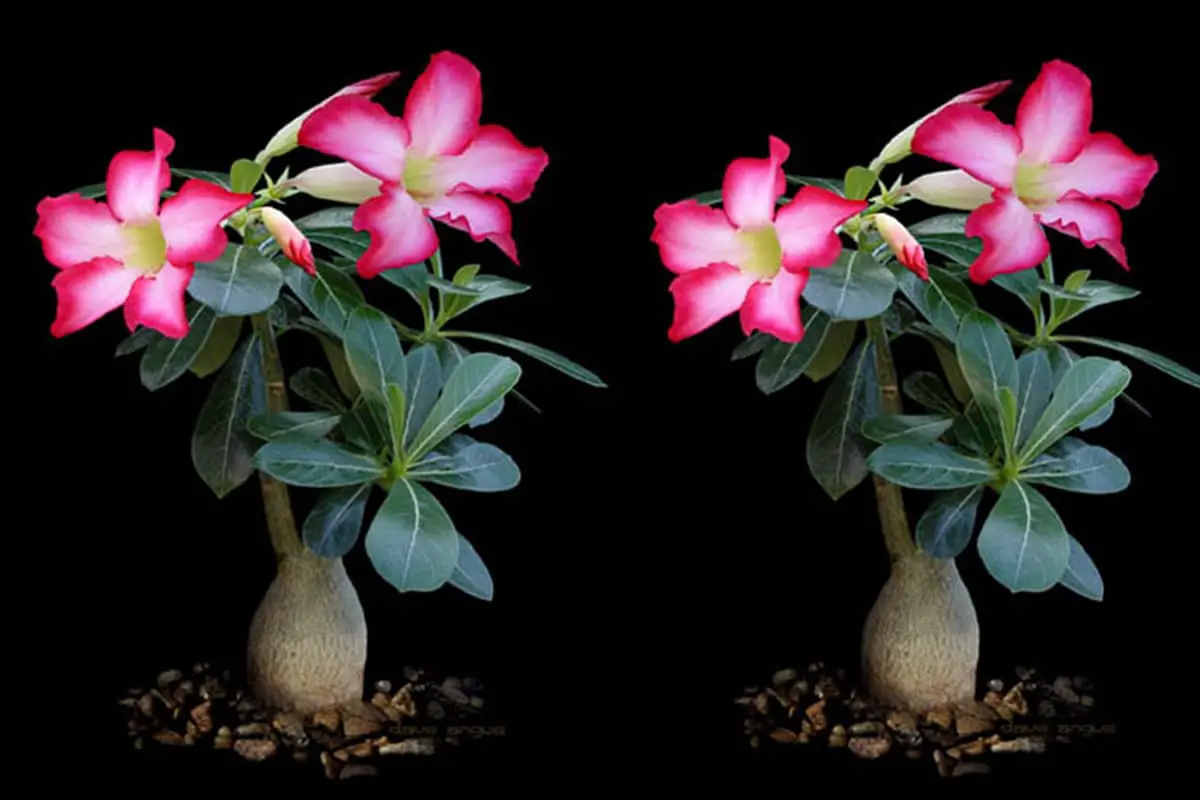
The Desert Rose flower resembles a small trumpet, with a vibrant rose-red color. The umbel inflorescences, in clusters of three to five, are bright and beautiful, blooming continuously throughout the year.
The plant is named the Desert Rose because it originates near deserts and is as red as a rose. The Desert Rose’s single leaves are alternately arranged, ovate, with an acute apex, 8-10 cm in length, 2-4 cm in width, leathery, glossy, with a deep green underside and a grayish-green upper side, with entire margins.
The inflorescence is corymbose, terminal, bearing more than 10 bell-shaped flowers, 6-8 cm in length. The flowers are 5-lobed, with colors ranging from crimson, pink, white, and multicolored.
The flowering period of the Desert Rose is from May to December, with flowers in red, crimson, pink, and white. It is easily cultivated in greenhouses in the south. The seeds have white soft hair, which aids their flight and dispersion.
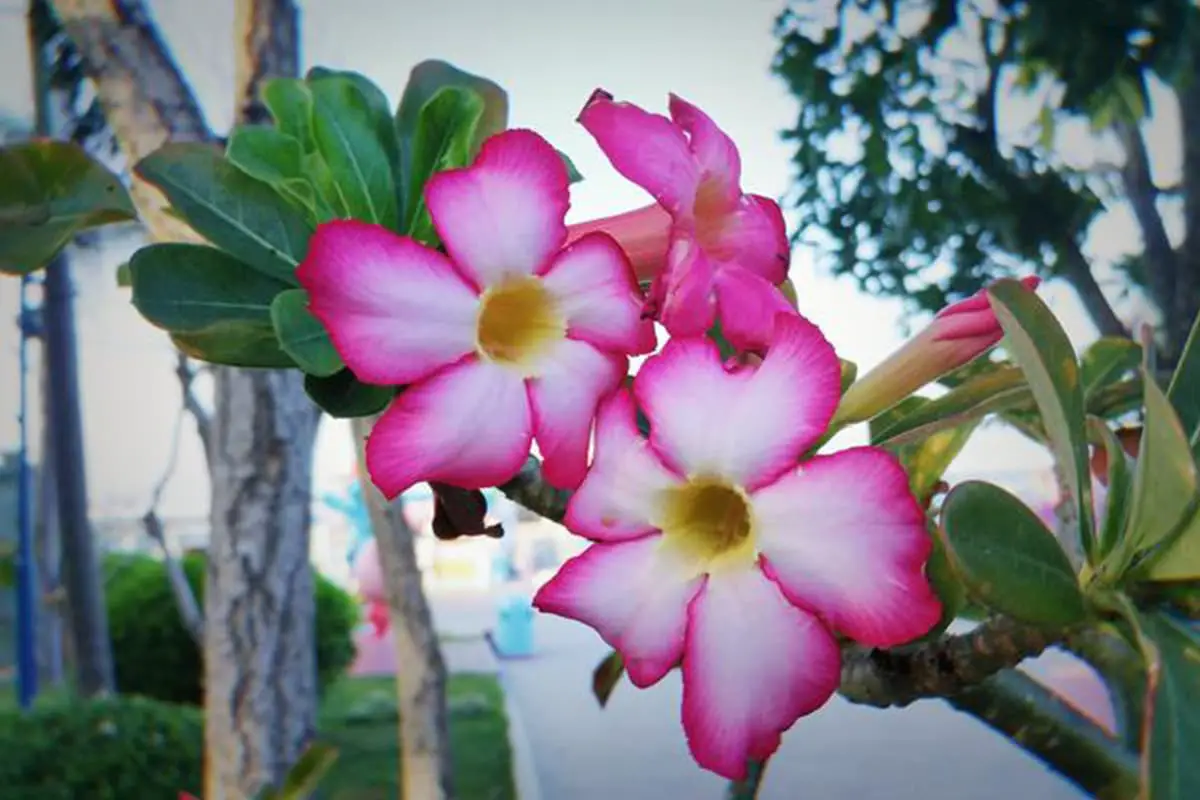
The Desert Rose thrives in high-temperature, arid, sunlit environments, and prefers calcium-rich, loose, well-drained sandy soil. It does not tolerate shade, waterlogging, strong and raw fertilizers, and fears the cold. The optimal growing temperature is 25-30℃.
In summer, it can be placed outdoors in a sunlit spot, without the need for shade. Water it fully to keep the soil moist, but do not let water accumulate.
In winter, control watering and maintain a winter temperature above 10℃, so it loses its leaves and goes dormant. During cultivation, apply organic fertilizer 2 to 3 times a year.
For propagation, in summer, choose 1-year to 2-year-old branches about 10 cm long, let the cut end dry a bit, and then insert it into a sand bed.
Roots should develop in 3 to 4 weeks. You can also propagate it in summer using aerial layering. If you can collect seeds, you can also propagate it by sowing.
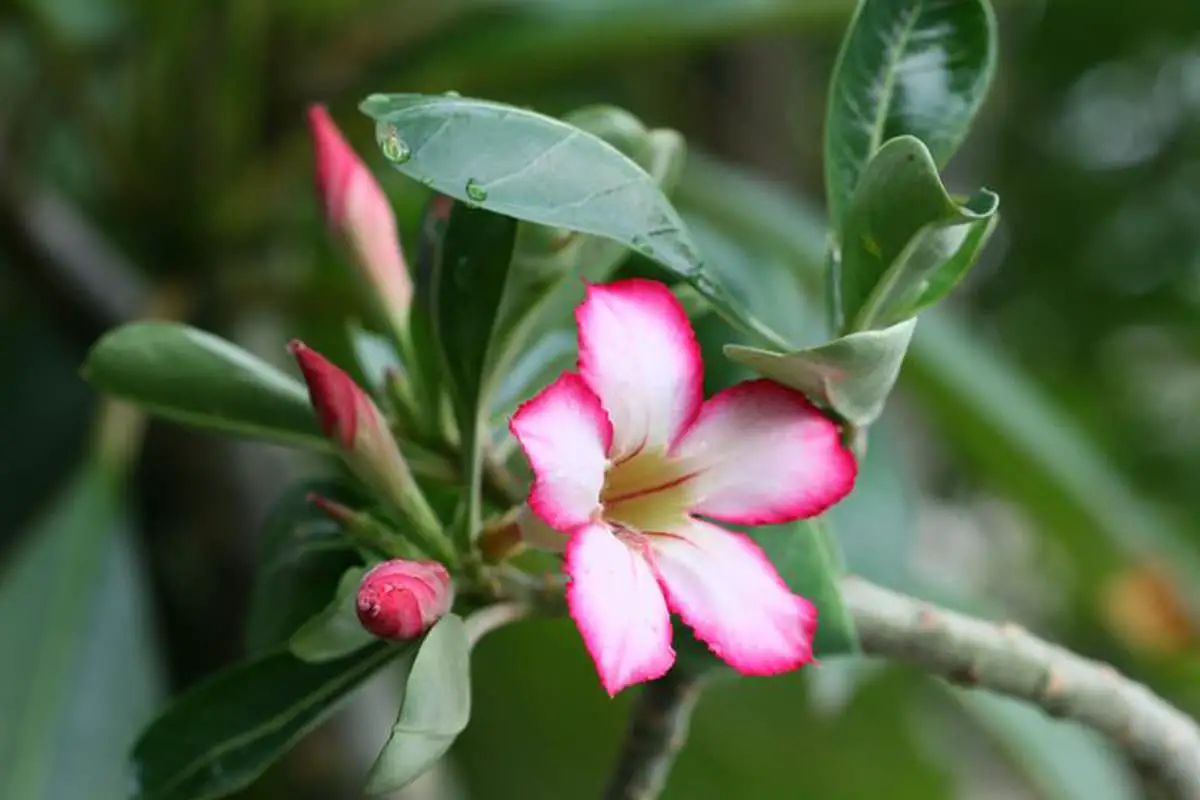
Originally from East Africa to the southern Arabian Peninsula, specifically native to Kenya and Tanzania in Africa, it is also found in North African countries such as Tunisia, Algeria, and Morocco.
Since its introduction to South China in the 1980s, it has become widespread in most parts of China, including Guangdong, Fujian, Guangxi, and Inner Mongolia.
Commonly propagated by cutting, grafting, and layering, it can also be grown from seed. Cuttings are best taken in the summer from 1-2 year old branches, preferably those at the tip.
Cut them into 10 cm lengths, let the cut ends dry, then plant them in a sand bed. They should root within 3-4 weeks. Adenium can also be grafted onto oleander rootstock in summer using the cleft grafting method.
Once established, the plants grow robustly and bloom readily. Layering is typically done in summer using the air layering method.
On healthy branches, remove 2/3 of the bark, fill with sphagnum moss, wrap in plastic, and roots should form in about 25 days. Cut and pot after 45 days. Seeds can be sown in summer and germinate best at 21°C.
Leaf spot disease can be controlled by spraying with a 500-fold dilution of 50% propineb wettable powder. Pests include scale insects and cabbage worms, which can be controlled by spraying with a 1000-fold dilution of 50% phoxim emulsion.
Scale insects are the primary pest. In severe infestations, they can cause all leaves to drop, growth points to die, and even kill the plant. Home growers should closely observe their plants and immediately wipe off any scale insects discovered with a cotton swab dipped in water.
During the egg-laying and hatching periods, spray 1-2 times with a 1000-2000-fold dilution of 40% dimethoate emulsion or a 1000-fold dilution of 50% phoxim emulsion. Always use pesticides safely.
Soft rot is a major disease of desert roses. Symptoms include a watery softening near the surface of the ground, initially white or pale yellow, turning dark brown, and rotting and smelling foul in damp conditions.
The internal tissues turn black and feel sticky and soft. This is mainly caused by high temperatures, poor ventilation, or waterlogging in the pot in summer.
To combat this, choose a well-drained, medium-fertility sandy loam for planting, avoid overwatering, and about once a month, apply a spray of 1000-fold diluted agricultural streptomycin or 150-200-fold diluted Bordeaux mixture.
The desert rose is a small plant with an ancient and vigorous form, and a rootstock that swells like a bottle.
It flowers twice a year in April-May and September-October, with bright, beautiful, trumpet-like blossoms that are very distinctive and loved by people.
It is a great choice for small courtyards in the south, giving a simple, dignified, and natural look. As a potted plant, it adds a unique touch to indoor balconies.
The desert rose is used in traditional medicine to treat nausea, dysentery, prolapse, hematemesis, bloody stools, mumps, and excessive vaginal discharge. It can also be applied topically to treat boils and swellings.
The desert rose belongs to the family Apocynaceae and is of the Adenium genus. It is somewhat toxic, and its milky sap is particularly so. Ingesting it can cause accelerated heart rate and arrhythmia.
Flower language: Unchanging love.

Peggie was once a high school mathematics teacher, but she set aside her chalkboard and textbooks to follow her lifelong passion for flowers. After years of dedication and learning, she not only established a thriving flower shop but also founded this blog, “Flowers Library”. If you have any questions or wish to learn more about flowers, feel free to contact Peggie.
 English
  العربية
  Bahasa Indonesia
  Deutsch
  Français
  Italiano
  Nederlands
  Português
  Русский
  日本語
日本語